Black Friday: 30% off your first Premium payment until 30 November with code BLACKFRIDAY See the offer
 Mandarin Mosaic
Free on iPhone, iPad and Android.
Download on theApp Store Get it onGoogle PlayYour first month of Premium is free.
Simplified to Traditional Chinese Converter (and Traditional to Simplified)
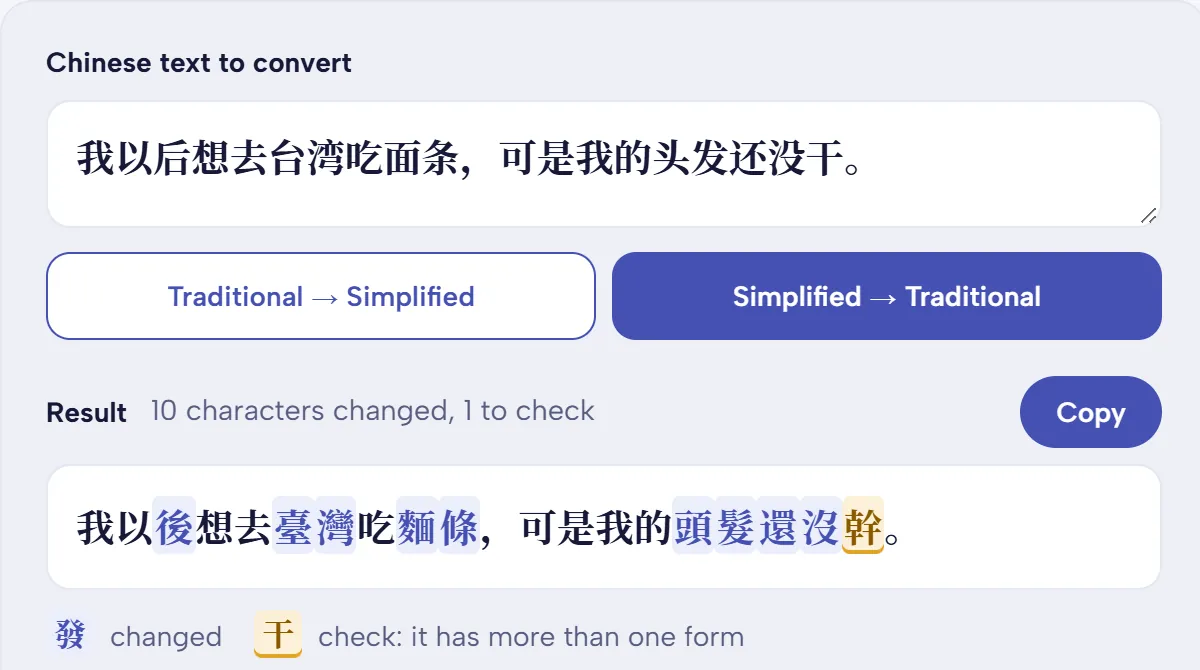
Paste Chinese text, pick a direction and copy the result. The converter works word by word, so 头发 (tóufa, hair) becomes 頭髮 while 发展 (fāzhǎn, to develop) becomes 發展. Every character it changed is highlighted: tap one to see its other form. Characters it couldn’t decide are marked in amber for you to check. It runs in your browser, so your text isn’t sent anywhere.
How the Converter Works
It uses CC-CEDICT, a free Chinese–English dictionary that lists every word in both scripts. First it looks for the longest dictionary word at each point in your text, because the word settles which form a character takes: 头发 is 頭髮 and 发展 is 發展. Where no word matches, it falls back on a table of single characters and picks the form used most often across the dictionary’s common words. If that character has more than one Traditional form, the result is marked for you to check, and tapping it lets you pick the other form.
Conversion is dictionary-based and changes characters only. Taiwan, Hong Kong and the mainland also use different words for some things, and those aren’t converted: 软件 (ruǎnjiàn, software) becomes 軟件, not Taiwan’s 軟體 (ruǎntǐ). The same goes for 出租车 (chūzūchē, taxi), which Taiwan calls 計程車 (jìchéngchē), and 网络 (wǎngluò, internet), which is 網路 (wǎnglù) in Taiwan. Our guide to Taiwanese and mainland Mandarin lists the common vocabulary differences.
What Can’t Be Converted Automatically
Going from Traditional to Simplified is almost always safe, because several Traditional characters were merged into one Simplified character. Going the other way is where the trouble is: one Simplified character can stand for two or three Traditional ones, and only the meaning tells you which. These are the ones you’ll meet most:
| Simplified | Traditional forms | Examples |
|---|---|---|
| 发 | 發 fā, to send out, to develop 髮 fà, hair | 发展 → 發展 头发 → 頭髮 |
| 干 | 乾 gān, dry 幹 gàn, to do; trunk 干 gān, to interfere | 干净 → 乾淨 干部 → 幹部 干扰 → 干擾 |
| 后 | 後 hòu, after, behind 后 hòu, empress, queen | 以后 → 以後 皇后 → 皇后 |
| 面 | 面 miàn, face, side 麵 miàn, noodles, flour | 方面 → 方面 面条 → 麵條 |
| 只 | 只 zhǐ, only 隻 zhī, measure word for animals | 只有 → 只有 一只猫 → 一隻貓 |
| 里 | 裡 lǐ, inside 里 lǐ, li (a unit of distance) | 里面 → 裡面 公里 → 公里 |
| 台 | 臺 tái, platform, stage 颱 tái, typhoon 檯 tái, table, counter | 舞台 → 舞臺 台风 → 颱風 台灯 → 檯燈 |
| 钟 | 鐘 zhōng, clock, bell 鍾 zhōng, to concentrate (affection); a surname | 分钟 → 分鐘 一见钟情 → 一見鍾情 |
| 复 | 復 fù, to return, again 複 fù, double, complex 覆 fù, to cover, to repeat | 恢复 → 恢復 复杂 → 複雜 反复 → 反覆 |
| 系 | 係 xì, to relate to 繫 xì, to tie, to connect 系 xì, system, department | 关系 → 關係 联系 → 聯繫 系统 → 系統 |
| 历 | 歷 lì, to go through 曆 lì, calendar | 历史 → 歷史 日历 → 日曆 |
| 表 | 表 biǎo, surface; to show 錶 biǎo, watch | 表示 → 表示 手表 → 手錶 |
| 松 | 鬆 sōng, loose 松 sōng, pine | 放松 → 放鬆 松树 → 松樹 |
| 范 | 範 fàn, model, pattern 范 fàn, the surname Fan | 范围 → 範圍 范仲淹 → 范仲淹 |
The converter gets all the examples above right, because each is a dictionary word. It can’t know your meaning when a character stands alone: in 我的头发还没干 (“my hair isn’t dry yet”), 干 isn’t part of a word, so it gets the most common form, 幹, marked to check, and you’d pick 乾. Names are the other weak spot. The surnames 范 and 钟 are 范 and 鍾 in Traditional, but on their own they come out as 範 and 鐘, marked to check, unless the whole name is in the dictionary, as 范仲淹 (fàn zhòngyān, a Song dynasty statesman) is. In the Traditional to Simplified direction, the common characters to watch are 乾, which stays 乾 in names such as 乾隆 (qiánlóng, the Qianlong Emperor); 著, which stays 著 in 著名 (zhùmíng, famous); and 覆, which becomes 复 in 反覆 but stays 覆 in 覆蓋 (fùgài, to cover). The converter knows these words too.
Where the dictionary allows two forms, the converter uses the Taiwan standard: 裡 rather than Hong Kong’s 裏, and 臺灣 for Taiwan. You’ll also see 台灣 written in Taiwan every day, and both are correct.
Simplified vs Traditional Chinese
Simplified characters were introduced in mainland China from the 1950s to make reading and writing quicker to learn. Many characters lost strokes (體 → 体, 學 → 学), and many others were left alone: 人, 大 and 中 are the same in both. Of the 3,000 most common characters in the word-frequency list this converter uses, about a third (1,050) are written differently in Traditional, and 78 of those have more than one Traditional form. Many changes follow patterns, such as 言 becoming 讠 on the left of a character (說 → 说). If you’re deciding which to learn, our guide to Simplified vs Traditional Chinese covers the differences and who should start with which.
Where Simplified and Traditional Are Used
- Simplified: mainland China and Singapore, and Chinese-language schools in Malaysia. Most courses, apps and the HSK exam use it.
- Traditional: Taiwan, Hong Kong and Macau, and many older Chinese communities overseas.
Typing Simplified or Traditional Chinese
If you can’t type Chinese on this device, our free online Chinese keyboard turns pinyin into characters in either script, so you can type straight into Traditional rather than converting. To check how a character in either script is written, the stroke order tool draws it stroke by stroke, and the pinyin chart plays every syllable in all four tones.
Frequently Asked Questions
Is my text sent anywhere?
No. The converter runs in your browser: the dictionary loads with the page, and your text never leaves your device. There’s nothing to sign up for, and long texts work too.
Why are some characters marked to check?
Those are Simplified characters with more than one Traditional form, such as 发 (發 or 髮) or 干 (乾, 幹 or 干), where no dictionary word settled which one you mean. The converter puts the most common form and marks it in amber. Tap it to see the other forms and pick the right one before you copy.
Does it convert Taiwanese words to mainland words?
No, only characters. A Simplified text with mainland words such as 软件 (software) or 出租车 (taxi) comes out in Traditional characters with the same words, 軟件 and 出租車, not Taiwan’s 軟體 and 計程車. Someone in Taiwan will understand it but will notice the mainland words.
Does it use Taiwan or Hong Kong character forms?
Taiwan’s, where they differ, because that’s what CC-CEDICT mostly uses: 裡 (inside) rather than Hong Kong’s 裏, for example. The differences between the two are small, and readers in either place will understand both.
Does Mandarin Mosaic support Traditional characters?
Yes. Mandarin Mosaic, our app for learning Chinese through sentences, lets you choose Simplified or Traditional when you first open it, and you can switch later in Settings, under Display and then Character set. The lessons are the same sentences in either script, so they use mainland vocabulary.
Dictionary data from CC-CEDICT, used under the Creative Commons Attribution-ShareAlike 4.0 licence. The converter’s data file is derived from it and shared under the same licence.