Black Friday: 30% off your first Premium payment until 30 November, applied at checkout. See the offer
 Mandarin Mosaic
Free on iPhone, iPad and Android.
Download on theApp Store Get it onGoogle PlayYour first month of Premium is free.
Chinese Writing Practice Sheets: Printable Tianzige PDF
Type the characters you want to practise, or pick an HSK level, and this tool makes a printable sheet on 田字格 (tiánzìgé) paper: squares split into four by a dashed cross, so you can see where each part of a character goes. Every character gets its own row, with the model and its pinyin, its strokes built up one at a time, grey copies to trace and empty boxes to write in. Print it, or choose “Save as PDF” in your browser’s print window to keep it as a PDF. It’s free, needs no sign-up and covers about 4,000 characters, Simplified and Traditional.
How to Use the Sheets
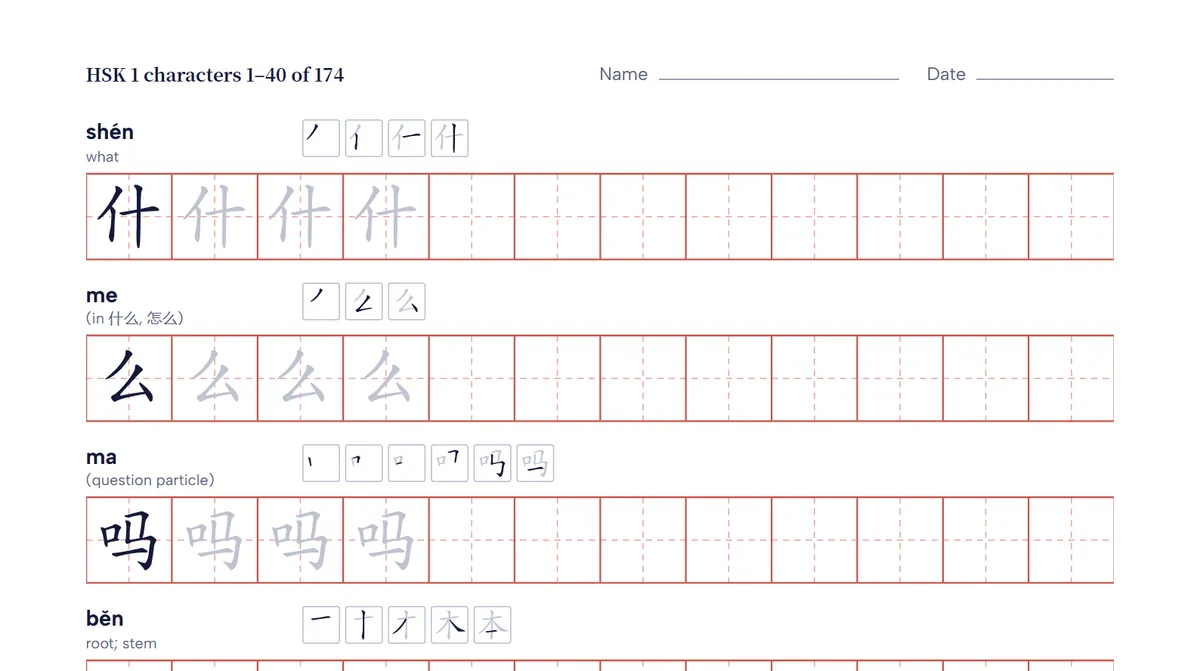
A row works best from left to right, a little at a time:
- Read the stroke order first. The small boxes next to the pinyin add one stroke at a time, with the new stroke in black. If a stroke’s direction isn’t clear, watch the character drawn in our stroke order tool.
- Trace the grey copies slowly, saying the sound out loud as you write. Tracing teaches your hand the route: where each stroke starts, turns and stops.
- Copy it in the empty boxes while you can still see the model. Use the grid lines to check the height, the width and where each part sits.
- Write it from memory. Fold the sheet so the model is hidden and write it once more, then check it. Recall is what makes it stick.
- Use it in a word. On the back of the sheet, write a word or a short sentence that uses the character, such as 你好 (nǐ hǎo, hello) for 好.
- Come back to it a few days later and write it from memory again. Characters you can still write after a gap are the ones you’ve learned.
A few clean copies are worth more than a page of rushed ones: once your copies start to drift, stop and move on to the next character. Teachers can print a sheet per student with the “Name” and “Date” line at the top of each page.
Why Stroke Order Matters
Characters are written in a standard order, mostly top to bottom, left to right and outside before inside, and following it is what makes a character come out balanced and the same each time. It also makes other people’s fast handwriting readable, because joined-up strokes only make sense once you know the path the pen took. Our guide to handwriting in Chinese explains the rules and the basic strokes, and the stroke order tool animates any character on this sheet, so use it when a strip in the margin isn’t enough.
Writing by hand helps you remember characters, too. In a 2011 study of people learning Chinese as a second language (Guan and colleagues, Journal of Educational Psychology), those who practised writing characters by hand remembered their shapes and meanings better than those who only read them. If you mostly want to read, you don’t have to write every character you learn: our guide on how to learn Chinese characters suggests recognising them first and writing the most common ones, and the Chinese radicals chart shows the parts that most characters are built from.
Tianzige, Mizige or Plain Squares?
| Grid | What it looks like | Best for |
|---|---|---|
| 田字格 (tiánzìgé) | A square split into four by a cross, like the character 田 (tián, field) | Beginners: the cross shows the centre and the four quarters, so you can see whether a character is balanced |
| 米字格 (mǐzìgé) | The same cross plus two diagonals, like 米 (mǐ, rice) | Characters with slanting strokes, such as 人, 文 and 我, and judging symmetry |
| Plain squares | Empty squares with no guide lines | Once your proportions are steady: writing at an even size without help |
Many learners start on 田字格 paper, the grid Chinese primary school pupils write in, and move to plain squares as their characters settle. The box sizes go from 12 mm, for characters you already know, to 20 mm, which gives room to see each stroke clearly when a character is new.
Sheets for HSK 1, 2 and 3
Pick “An HSK level” to get the characters for HSK 1, 2 or 3 without typing them. They come from the HSK 2.0 word lists, the same lists as our HSK 1 vocabulary list, and each level has only the characters that are new at that level, in the order of the list: 174 for HSK 1, 171 more for HSK 2 and 270 more for HSK 3. Each sheet takes 40, so HSK 1 fills five sheets.
Writing a character teaches you its shape; you still need to learn the words it makes. The HSK 1 list has all 150 words with example sentences, and Mandarin Mosaic, our app for iOS and Android, teaches them in sentences with spaced repetition. It has no handwriting practice, so sheets like these are the writing half: the app for reading and remembering words, paper for learning to write them.
Frequently Asked Questions
What Is Tianzige Paper?
Tianzige (田字格, tiánzìgé) paper is Chinese writing paper made of squares, each split into four smaller squares by a dashed cross, so the grid looks like the character 田 (tián, field). One character goes in each square, and the cross helps you place its parts and keep it centred.
Can I Make a PDF?
Yes. Press “Print or save as PDF”, then pick “Save as PDF” as the printer in Chrome or Edge, “Save to PDF” in Firefox or “Microsoft Print to PDF” on Windows; in Safari on a Mac, use the PDF menu at the bottom of the print window. Set the paper size to match the sheet (A4 or US Letter) and the scale to 100% or “Actual size”, so the boxes come out the size you chose. The sheet is made in your browser, so nothing is uploaded.
Does It Do Traditional Characters?
Yes: type or paste Traditional characters, such as 學 or 書, and the sheet uses them. The stroke order follows the mainland Chinese standard, which is what its data from the Make Me a Hanzi project uses; Taiwan’s standard differs for some characters. The HSK lists are in Simplified characters, so for a Traditional HSK sheet, convert the list with our Simplified and Traditional converter and paste it in.
How Many Times Should I Write Each Character?
There’s no magic number. A few slow traces and a few careful copies are usually enough in one sitting; what matters more is writing the character from memory and doing it again a few days later. That’s why the default row has three copies to trace and the rest empty, and you can change both.
Why Is a Character Missing From My Sheet?
The sheets cover about 4,000 characters: every character on the HSK 1–6 lists, the most common ones beyond them and their Traditional forms. Rarer characters aren’t in the stroke data, so the tool leaves them out and lists them under the button. Punctuation, letters and numbers are skipped too.
Stroke shapes from Make Me a Hanzi via hanzi-writer-data, derived from fonts by Arphic Technology and used under the Arphic Public License. Pinyin from the Unicode Unihan database; meanings from CC-CEDICT (CC BY-SA 4.0). QR codes by qrcode-generator (MIT licence).