Black Friday: 30% off your first Premium payment until 30 November, applied at checkout. See the offer
 Mandarin Mosaic
Free on iPhone, iPad and Android.
Download on theApp Store Get it onGoogle PlayYour first month of Premium is free.
Chinese to Pinyin Converter (with Tone Marks)
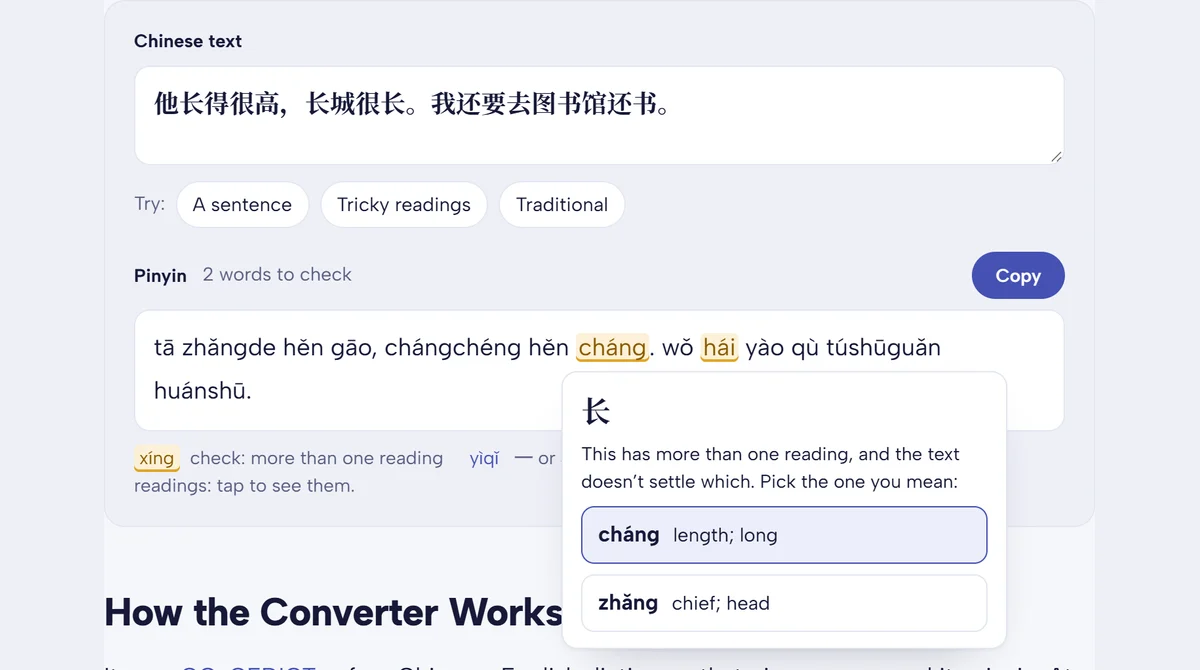
Paste Chinese characters and get the pinyin, with tone marks or tone numbers. The converter reads word by word, so 银行 (bank) comes out yínháng and 行动 (action) xíngdòng, and it writes 一 and 不 the way they’re said: 不是 is búshì, 一起 is yìqǐ. A word with more than one possible reading is marked in amber: tap it to pick the right one. It works for Simplified and Traditional characters, and it runs in your browser, so your text isn’t sent anywhere.
How the Converter Works
It uses CC-CEDICT, a free Chinese–English dictionary that gives every word its pinyin. At each point in your text it looks for the longest dictionary word first, because the word settles how a character is read: 行 is háng in 银行 (yínháng, bank) and xíng in 行动 (xíngdòng, action). Where no word matches, a character standing on its own gets the reading learners meet most often. For the common characters with more than one reading, that choice comes from the same hand-made list our app, Mandarin Mosaic, uses: a lone 了 is le, a lone 的 is de. If a lone character could still mean something else, the converter marks it in amber, and tapping it shows every reading with a short meaning so you can pick.
The pinyin follows the usual spelling rules. Syllables in one word are written together, with an apostrophe where a syllable starting with a, o or e would otherwise run into the one before (西安 xī’ān, 女儿 nǚ’ér). Everything is in lower case, names included (北京 běijīng, 中文 zhōngwén), ü keeps its dots (女 nǚ, 绿 lǜ), and an 儿 ending joins the syllable before it (一点儿 yìdiǎnr). Our guide to pinyin pronunciation rules explains what the spelling hides, such as why ui sounds like uei.
Characters With More Than One Reading
About one common character in seven has more than one pronunciation, and a few of them turn up in almost every text. A dictionary word decides which one you need; on their own they’re the ones the converter may mark to check. These are the ones you’ll meet most:
| Character | Readings | Examples |
|---|---|---|
| 行 | xíng to walk; OK háng row; trade, firm | 行动 xíngdòng, action 银行 yínháng, bank |
| 长 | cháng long zhǎng to grow | 长城 chángchéng, the Great Wall 长大 zhǎngdà, to grow up |
| 得 | de (after a verb) dé to get děi must | 跑得快 pǎo de kuài, run fast 得到 dédào, to obtain 我得走了 wǒ děi zǒu le, I have to go |
| 还 | hái still; also huán to give back | 还有 háiyǒu, there’s also 还书 huán shū, to return a book |
| 为 | wèi for wéi as; to become | 为什么 wèishénme, why 成为 chéngwéi, to become |
| 重 | zhòng heavy; important chóng again | 重要 zhòngyào, important 重新 chóngxīn, again, anew |
| 乐 | lè happy yuè music | 快乐 kuàilè, happy 音乐 yīnyuè, music |
| 了 | le (a grammar particle) liǎo to finish; to know | 吃了 chī le, ate 了解 liǎojiě, to understand |
| 地 | de (before a verb) dì ground; place | 慢慢地 mànmàn de, slowly 地方 dìfang, place |
| 只 | zhǐ only zhī (measure word for animals) | 只有 zhǐyǒu, only 一只猫 yì zhī māo, a cat |
| 干 | gàn to do gān dry | 干活 gànhuó, to work 干净 gānjìng, clean |
| 便 | biàn convenient pián (in 便宜, cheap) | 方便 fāngbiàn, convenient 便宜 piányi, cheap |
| 觉 | jué to feel jiào sleep | 觉得 juéde, to think, to feel 睡觉 shuìjiào, to sleep |
The converter gets all of these examples right except one: in 我得走了 (“I have to go”), 得 stands alone, so it gets the usual reading, de, marked in amber, and you’d pick děi. It also knows two rules our app uses: 长 before 得, 大 or 高 is zhǎng (他长得很高, tā zhǎng de hěn gāo, he’s tall), and 了 after 不 is liǎo (我来不了, wǒ lái bùliǎo, I can’t come). Names are the other weak spot. A well-known name is in the dictionary, but most people’s names aren’t, so a surname such as 曾 (zēng) or 单 (shàn) comes out with its everyday reading. Check names by hand.
Tone Changes: 一, 不 and the Third Tone
Two characters change tone with the syllable after them, and the converter writes them as they’re said (switch to “As in a dictionary” to see the original tones):
- 不 (bù) becomes bú before a fourth tone: 不是 búshì, 不对 búduì. Before any other tone it stays bù: 不好 bù hǎo.
- 一 (yī) becomes yí before a fourth tone (一样 yíyàng, 一个 yí gè) and yì before the other tones (一天 yì tiān, 一起 yìqǐ). It stays yī at the end of a number, when counting digits and in ordinals: 十一 shí yī, 一九八四 yī jiǔ bā sì, 第一 dì yī. Before 百 and 千 it changes as usual: 一百 yì bǎi.
- Between a repeated word, both go neutral: 好不好 hǎo bu hǎo, 看一看 kàn yi kàn.
The third-tone change isn’t written, here or anywhere else: 你好 is spelt nǐ hǎo but said ní hǎo, because a third tone before another third tone rises. Our guide to Mandarin tone sandhi covers all three rules with audio.
Hearing and Typing Pinyin
Pinyin tells you the sounds, but it’s easier to trust once you’ve heard them. The pinyin chart plays every syllable in all four tones, and the tone trainer drills your ear on the tones themselves. To go the other way, from pinyin to characters, use our online Chinese keyboard. Two other tools work on the same pasted text: the HSK level checker shows which words in it are beyond your level, and the Simplified and Traditional converter switches its characters.
Frequently Asked Questions
Is my text sent anywhere?
No. The converter runs in your browser: the dictionary loads when you start typing, and your text never leaves your device. There’s nothing to sign up for, and long texts work too.
Why are some words marked in amber?
Those are characters with more than one reading that stand on their own in your text, so no dictionary word settled which one you mean, such as 行 (xíng or háng) or 得 (de, dé or děi). The converter puts the usual reading and marks it. Tap it to see the others, each with a short meaning, and pick the right one before you copy. Words with a dotted underline have other readings too, but the dictionary word already chose the usual one.
Can I get tone numbers instead of tone marks?
Yes. Choose “Numbers” under Tones to get ni3 hao3, with 5 for the neutral tone (ma5), a format many Anki decks and dictionaries use. “None” drops the tones altogether.
Does it work with Traditional characters?
Yes. CC-CEDICT lists every word in both scripts, so 銀行 comes out yínháng just as 银行 does.
Why does it write yí and bú rather than yī and bù?
Because that’s how 一 and 不 are pronounced before a fourth tone, and most textbooks for learners write the changed tone. Dictionaries list the original tone instead. Switch “一 and 不” to “As in a dictionary” if you need that.
Can I see the pinyin above the characters?
Yes. Choose “Over characters” under Show, and each character gets its syllable above it. Copying in that view gives you the characters on one line and the pinyin on the next.
Does Mandarin Mosaic show pinyin?
Yes. Mandarin Mosaic, our app for learning Chinese through sentences, can show the pinyin above each sentence or hide it while you practise reading, and tapping a word gives its pinyin, meaning and audio.
Dictionary data from CC-CEDICT, used under the Creative Commons Attribution-ShareAlike 4.0 licence. The converter’s data file is derived from it and shared under the same licence.