 Mandarin Mosaic
Free on iPhone, iPad and Android.
Download on theApp Store Get it onGoogle PlayYour first month of Premium is free.
Chinese Stroke Order: Animated Lookup and Writing Practice
Type a character to watch its strokes in order, then trace it yourself. Each character is drawn on a 米字格 (mǐzìgé) practice grid with its stroke count. Play the whole character, step through it one stroke at a time, or switch to Practise and write it with your finger or mouse; after two misses on a stroke, the tool shows you where it goes. It covers about 4,000 characters, Simplified and Traditional: every character on the HSK 1–6 lists and the most common ones beyond them.
Can’t type Chinese? Write it with our free Chinese keyboard, then copy it here.
Pick a character to see its strokes
The Stroke Order Rules in Brief
A handful of rules cover most characters. Tap an example to watch it in the tool above.
| Rule | Example | What to watch |
|---|---|---|
| Top to bottom | sān, three | The top line first, the bottom line last |
| Left to right | chuān, river | The left stroke first |
| Horizontal before vertical | shí, ten | The horizontal, then the vertical that crosses it |
| Left-falling before right-falling | rén, person | The stroke sweeping down to the left (撇, piě), then the one to the right (捺, nà) |
| Middle before the sides | xiǎo, small | The hooked vertical, then the left and right strokes |
| Outside before inside | yuè, moon | The frame, then the two short strokes inside |
| Fill the inside, then close the frame | rì, sun | The bottom stroke comes last |
| 辶 goes last | zhè, this | 文 first, then the 辶 that runs under it |
| The top-right dot last | wǒ, I | The small dot at the top right is the last stroke |
The rules sometimes pull against each other, and a few common characters have an order of their own, so check a new character here rather than guessing. Our guide to handwriting in Chinese explains the rules in full, with the names of the basic strokes and the mistakes learners make. Most characters are built from a few recurring parts, and the Chinese radicals chart lists the ones dictionaries sort them by.
Does Stroke Order Matter?
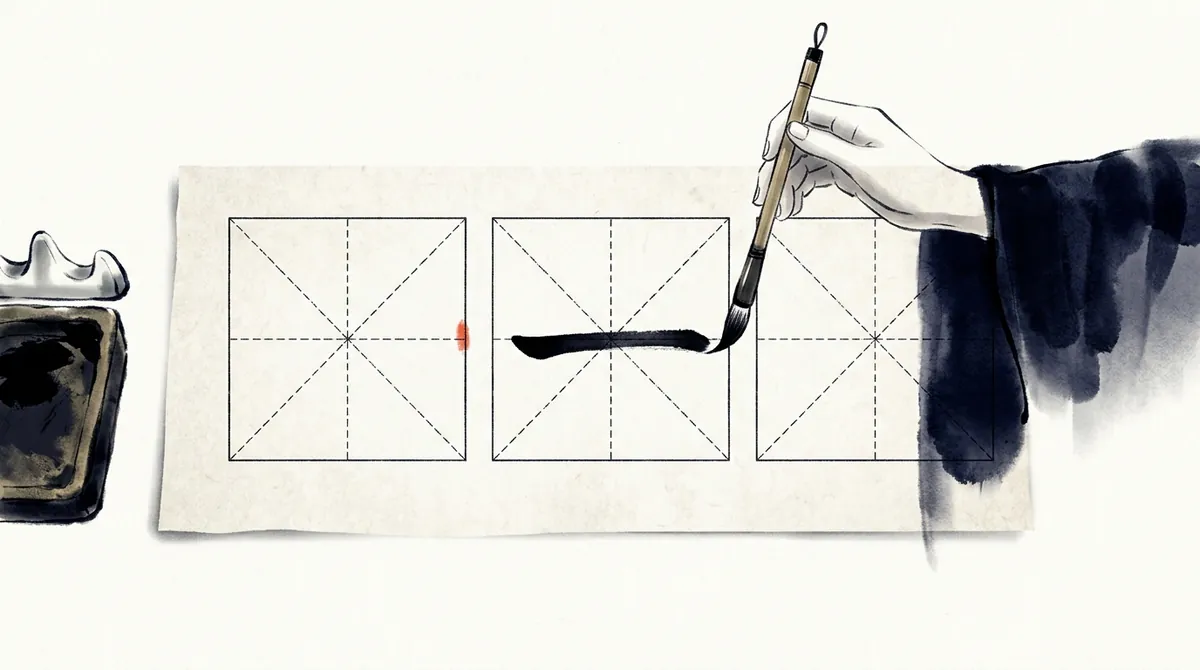
If you write by hand, yes. The standard order is what makes a character come out balanced and the same each time, and it’s why fast, joined-up handwriting is readable at all: other people’s scrawl only makes sense once you know the path the pen took. And writing helps memory: in a 2011 study of people learning Chinese, those who wrote characters by hand remembered their shapes and meanings better than those who only read them.
If you mostly want to read, it matters much less. Recognising a character doesn’t depend on knowing how to write it, and most learners read on screens and type in pinyin. Our guide on how to learn Chinese characters suggests recognising first and writing some later, starting with the characters you use most. Mandarin Mosaic, our app, works on that reading side: it teaches characters inside sentences with one new word each, and it has no handwriting practice, so this tool is the place for writing.
Frequently Asked Questions
Is stroke order the same in Traditional and Simplified Chinese?
Mostly, and this tool shows both in the mainland Chinese order, which its data from the Make Me a Hanzi project follows. Taiwan and Hong Kong have their own standards, which differ from the mainland order for some characters, so a Taiwanese textbook may occasionally show a different order.
How many strokes does a Chinese character have?
Anything from one, as in 一 (yī, one), to more than 30 for a few rare characters; half the characters on the HSK 1–6 lists have 9 strokes or fewer. Traditional forms often have more: 鬱 (yù, gloomy) has 29 strokes, and its Simplified form 郁 has 8.
What is a 米字格?
A 米字格 (mǐzìgé) is the practice grid in this tool: a square divided by a cross and two diagonals, so its guide lines look like the character 米 (mǐ, rice). The lines help you place each stroke and keep the character centred and in proportion.
Why does Practise say my stroke is wrong?
It compares each stroke you draw with the next stroke in the standard order, including its direction, so a stroke drawn out of order or backwards doesn’t count. After two misses on a stroke it flashes that stroke to show you where it goes.
Stroke animations by Hanzi Writer (MIT licence). Character data from Make Me a Hanzi, derived from fonts by Arphic Technology and used under the Arphic Public License.