Black Friday: 30% off your first Premium payment until 30 November with code BLACKFRIDAY See the offer
 Mandarin Mosaic
Free on iPhone, iPad and Android.
Download on theApp Store Get it onGoogle PlayYour first month of Premium is free.
Chinese Character Counter: Count Characters and Words
Paste or type Chinese text to count its characters and words as you type. You get the Chinese characters with and without punctuation, an estimate of the words, and the characters used most. It works with Simplified and Traditional, and your text stays in your browser.
- Chinese words (estimate)
- 0
- Different characters
- 0
- Punctuation marks
- 0
- English words and numbers
- 0
- All characters, with spaces
- 0
- All characters, no spaces
- 0
- Paragraphs
- 0
- Reading aloud (native speed)
- –
Most used characters
What level is it? Paste the same text into the HSK level checker to check this text’s HSK level, word by word.
Can’t type Chinese on this device? Write your text with our online Chinese keyboard, which turns pinyin into characters, then paste it here.
How the Counter Counts
- Chinese characters: every character from Unicode’s blocks of Chinese characters (CJK ideographs), including the rare ones in the extension blocks, and 〇 (líng, zero). Simplified and Traditional count alike. Punctuation, letters, digits and spaces aren’t included.
- Punctuation marks: each mark counts once, Chinese ones such as ,。、!?:;“”《》() and Western ones such as . and ?. The dash —— and the ellipsis …… count as two each, because they’re typed as two characters and take two squares on essay paper.
- Characters + punctuation: the two added together, which is what you’d fill in on squared essay paper.
- Chinese words: Chinese is written without spaces between words, so the text has to be split before words can be counted. The counter splits each run of characters into the longest words it finds on the HSK 2.0 and HSK 3.0 word lists (about 11,400 words), trying from both ends and keeping the split with fewer words, so 我今天很忙 (wǒ jīntiān hěn máng, I’m busy today) becomes 我 / 今天 / 很 / 忙, four words. It’s the same split the HSK level checker uses. Words that aren’t on the lists, such as names and newer words, are counted one character at a time, so a text full of them comes out a little high. People, and programs, don’t always agree on where a Chinese word ends, so the figure is an estimate.
- Different characters: how many distinct Chinese characters the text uses. The most used ones are listed under the counts.
- All characters: everything except line breaks, with and without spaces, including letters, digits and symbols.
- English words and numbers: runs of Latin letters or digits, such as “AI” or “2026”.
- Reading aloud: the Chinese characters at 295 a minute, the average reading-aloud speed of 103 young native speakers in a 2018 study using the IReST reading texts. Learners read more slowly, so treat it as the time a native speaker would need, for a speech or a presentation.
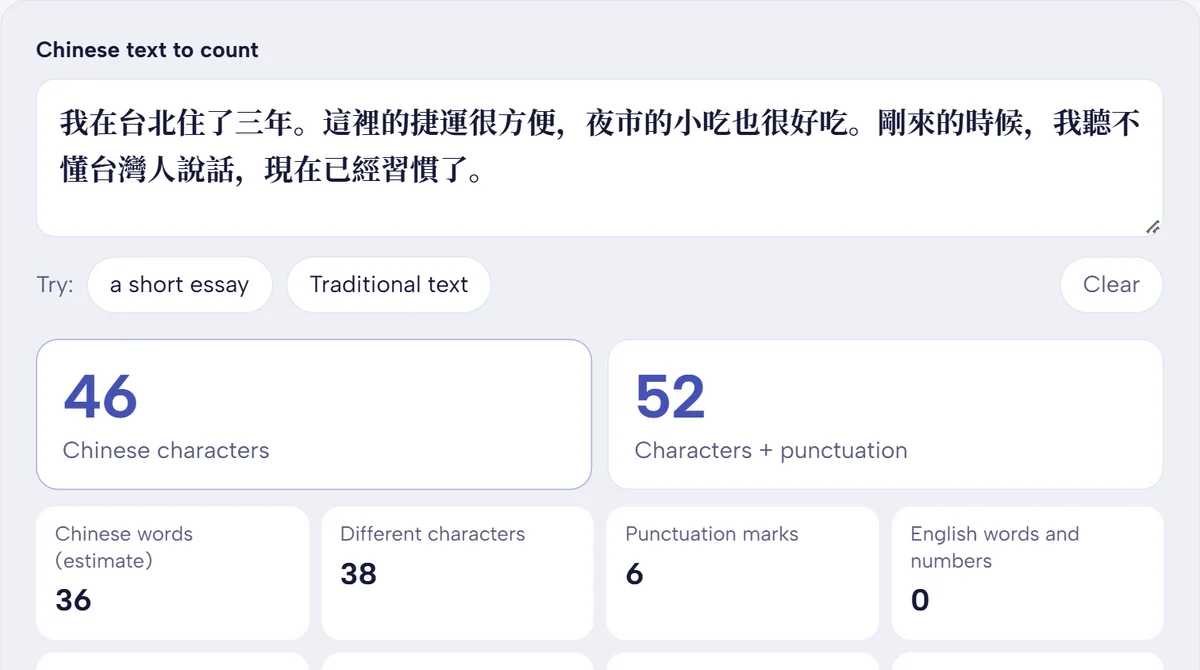
For a Traditional text, the word estimate first matches each Traditional character to its Simplified form, because the word lists are in Simplified; the character counts don’t change. If you need the whole text in the other script, our Simplified and Traditional converter switches it word by word. The counting happens in your browser, so nothing you paste is sent to us.
Characters vs Words in Chinese
A Chinese word (词, cí) can be one character, such as 我 (wǒ, I), or several: 时间 (shíjiān, time), 图书馆 (túshūguǎn, library). Most dictionary words have two. Of the 10,929 words on the HSK 3.0 word lists that Mandarin Mosaic uses, 76% have two characters, 14% have one and 10% have three or four, an average of 2.0 characters a word.
Running text has fewer characters per word, because the commonest words are short. 的 (de), 了 (le), 在 (zài), 是 (shì) and 我 (wǒ) are the five most frequent words in the 25,000-word frequency list our online keyboard uses, and each is a single character. Weighting every word on that list by how often it’s used gives an average of about 1.5 characters a word. That’s our own calculation, and it fits the rule of thumb of 1.4 to 1.6 in our post on how many words 3,000 characters is. So a 300-character essay is roughly 200 words, and the counter’s word estimate for ordinary text usually lands near the character count divided by 1.5.
The same gap matters for learners: knowing 3,000 characters isn’t the same as knowing 3,000 words. Our guide to how many words you need to become fluent counts in words for that reason.
Character Limits in Essays and Translation
Chinese essays and homework are set in characters (字, zì), not words: 写一篇300字的作文 (xiě yì piān sānbǎi zì de zuòwén) means “write a 300-character essay”.
Whether punctuation counts depends on who set the task. Handwritten essays are written on squared essay paper (稿纸, gǎozhǐ), where every character and every punctuation mark takes a square of its own, and many teachers count squares, so punctuation counts. Typed work may be counted either way. Check your brief, or ask. The counter shows both figures, and the limit box under the counts can track either.
HSK writing tasks give a length too. In the HSK 2.0 exams, the last two questions of HSK 5 each ask for a short piece of about 80 characters (80字左右), and HSK 6 has you read a passage for 10 minutes and then retell it in about 400 characters (字数为400左右), with 35 minutes to write. Those figures come from the official sample papers. A new HSK syllabus starts with its first exam on 13 December 2026, and its writing tasks may differ, so check Chinese Testing International for the exam you’re sitting.
Translators usually price Chinese source text by the character, often per thousand characters (千字, qiān zì), where English is priced by the word. Agencies differ on whether punctuation, numbers and English words count, so agree the rule before you quote or order. The counter’s figures with and without punctuation, and without spaces, cover the usual choices.
Frequently Asked Questions
Does punctuation count as characters in Chinese?
Often, but not always. On squared essay paper every punctuation mark takes a square, so a teacher who counts squares counts punctuation; others count only the characters. The counter shows both: Chinese characters, and characters plus punctuation.
How many words is 1,000 Chinese characters?
About 650 words of ordinary Chinese, at an average of about 1.5 characters a word. Text with many long compound words comes out at fewer words. Paste your own text into the counter for its estimate.
Does it work with Traditional Chinese?
Yes. Characters and punctuation are counted the same way in either script. For the word estimate, Traditional characters are first matched to their Simplified forms, because the word lists are in Simplified.
What HSK level is my text?
The counter only counts. Paste the same text into the HSK level checker to see each word’s HSK level and how much of the text a learner at each level would know.
Is my text sent anywhere?
No. The counting happens in your browser: the word lists load with the page, and your text never leaves your device.
The word estimate uses Mandarin Mosaic’s HSK 2.0 and HSK 3.0 word lists. Traditional characters are matched to Simplified with data from CC-CEDICT, used under the Creative Commons Attribution-ShareAlike 4.0 licence.