How to Import Anki Decks into Mandarin Mosaic

If you've been collecting Chinese sentences in Anki or a spreadsheet, you don't need to type them in again. Mandarin Mosaic can import three kinds of file and turn them into a sentence pack you study like any other:
- Anki decks: an .apkg file exported from Anki (or the same file renamed to .zip).
- Spreadsheets: a .csv file with a Chinese column, and an English one if you have it.
- Text files: a .txt file with one sentence per line.
Step 1: open the importer and choose a file
- From Home, tap Lessons, then Your Packs.
- To make a new pack, tap Add Pack, then Import Pack. To add sentences to a pack you already have, tap the three dots on that pack and choose Import sentences.
- The Import Sentences screen lists the supported files. Tap Choose File and pick your file from your phone or cloud storage.
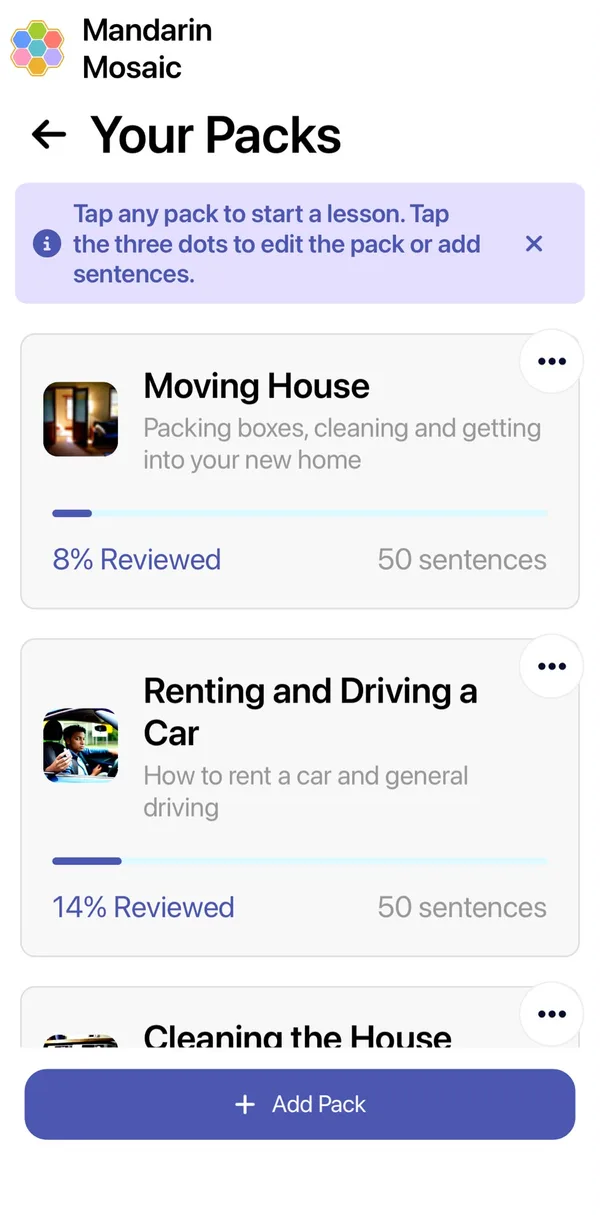
Your Packs, with Add Pack at the bottom. 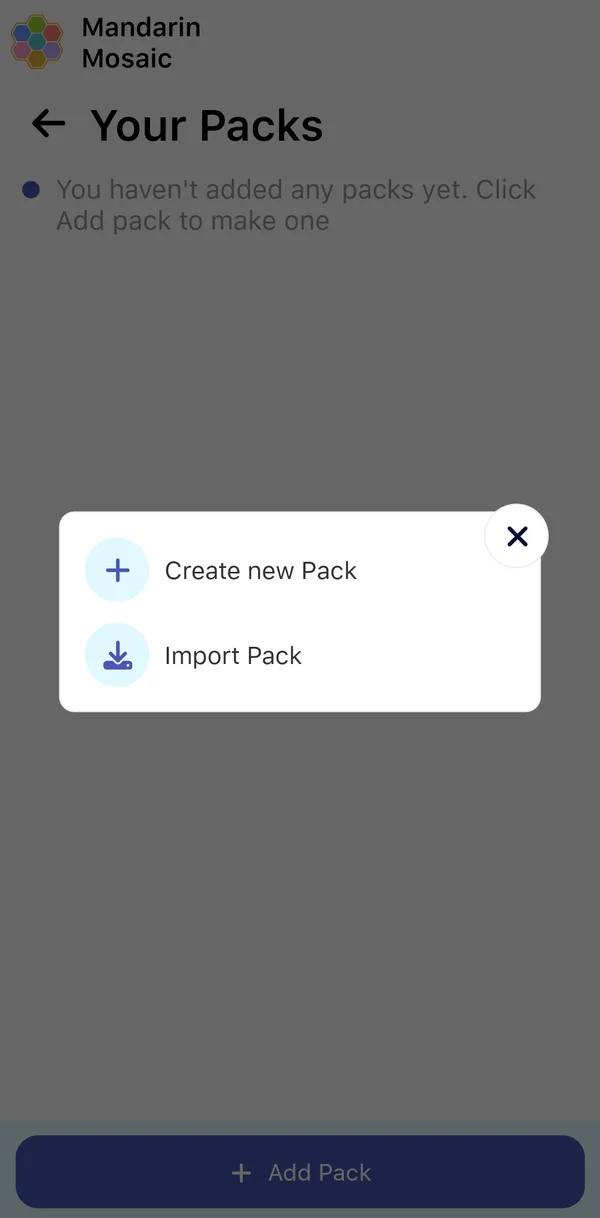
Choose Import Pack to bring in a file.
Step 2: check the columns
Mandarin Mosaic reads the file and tries to work out which column holds the Chinese and which holds the English. In an Anki deck, each field of the note (Front, Back, Pinyin and so on) becomes a column, in the same order. A pinyin column written with tone marks is usually recognised and skipped.
Under Which columns, check the choices:
- Chinese: the column with the Chinese sentences.
- English: the translation. Leave it as None for a Chinese-only deck.
- Separated by (CSV and text files only): Comma, Tab or Pipe. The app guesses this for you; if the preview looks jumbled or everything is in one column, try another option.
A text file with just one sentence per line has nothing to choose, so the column options don't appear. Any HTML formatting in an Anki deck, such as bold text or line breaks, is removed, leaving plain text.
Step 3: check the preview and import
Under Check these look right you'll see the first 25 sentences exactly as they'll be imported. If the Chinese and English are the wrong way round or show pinyin, go back up and change the columns.
- Sentences that appear more than once in the file are added only once.
- When adding to an existing pack, sentences it already holds are skipped, so you can safely re-import an updated export.
- Rows with no Chinese in them are ignored.
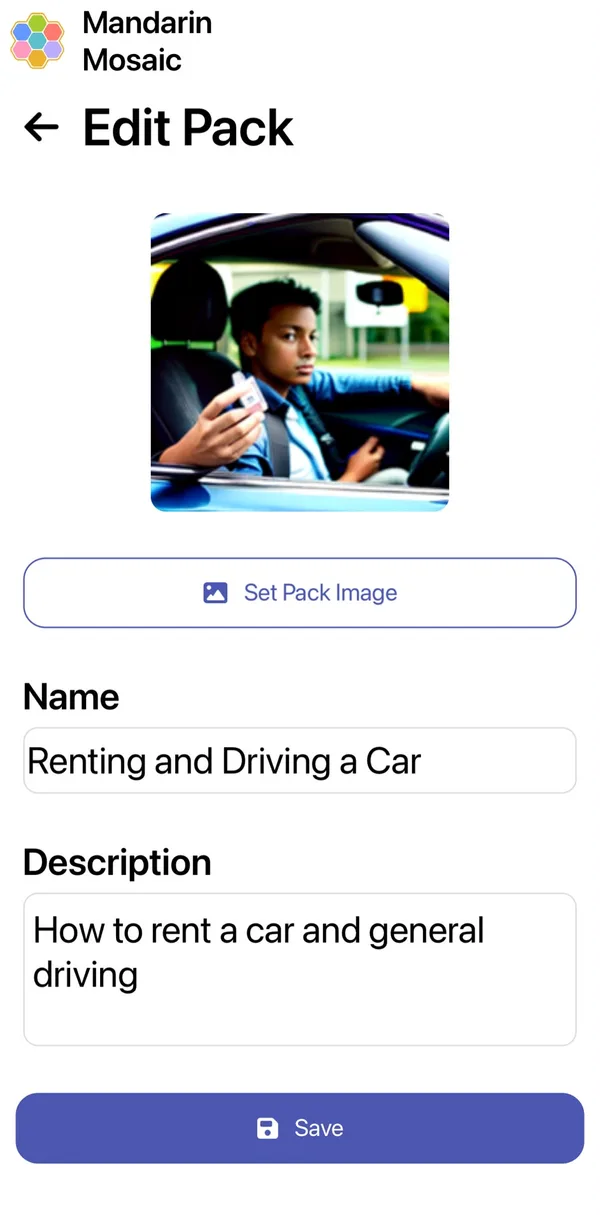
When you're happy, tap the button at the bottom. It tells you exactly what will happen, for example Create pack with 354 sentences or Add 12 sentences. A new pack is named after the file and opens on the Edit Pack screen, where you can change the name, add a description, Set Pack Image and tap Save. When you add to an existing pack, you'll see a summary of what was added and skipped, and Back to pack takes you to it.
Exporting a deck from Anki
If you downloaded a shared deck from AnkiWeb, you already have an .apkg file and can import it directly. To export one of your own decks, use Anki on your computer:
- Choose File, then Export.
- Set the format to Anki Deck Package (*.apkg) and choose the deck.
- Tick Support older Anki versions. This is important: without it, newer versions of Anki save the deck in a format Mandarin Mosaic can't read yet, and you'll see a message asking you to export it again with this option.
- You can untick Include media to keep the file small, because images and audio aren't imported.
- Save the file somewhere your phone can reach, such as iCloud Drive, Google Drive or your phone's own storage, then choose it in the importer.
Export a deck package (.apkg) rather than a whole-collection package (.colpkg). Mandarin Mosaic imports sentences, not your Anki review history, so your progress starts afresh in the app.
Importing CSV and text files
Any spreadsheet app can save a sheet as CSV. Put the Chinese in one column and, if you have it, the English in another. A pinyin column with tone marks is fine too; the app normally spots it and leaves it out. For example:
我们现在没有钱。,wǒmen xiànzài méiyǒu qián.,We don't have money now.
For a text file, put one Chinese sentence on each line. Tab-separated and pipe-separated (|) files work too: set Separated by to match.
What happens to your sentences after import
- They're split into words automatically, and each word is checked against the words you know, so lessons pick the sentences with the fewest new words for you. If a sentence is split wrongly, fix it with Edit Segmentation.
- Every sentence gets audio from the app's lifelike text-to-speech voices. Sentences show the pack's image, and you can add a picture to any sentence with Generate Image.
- The blank is chosen automatically in lessons. To choose it yourself, open the pack's three dots, Show Sentences, tap a sentence and use Edit Cloze. See how cloze tests work.
- They aren't checked by our native speakers, unlike the built-in packs, so it's worth choosing decks from a reliable source.
Importing words you already know
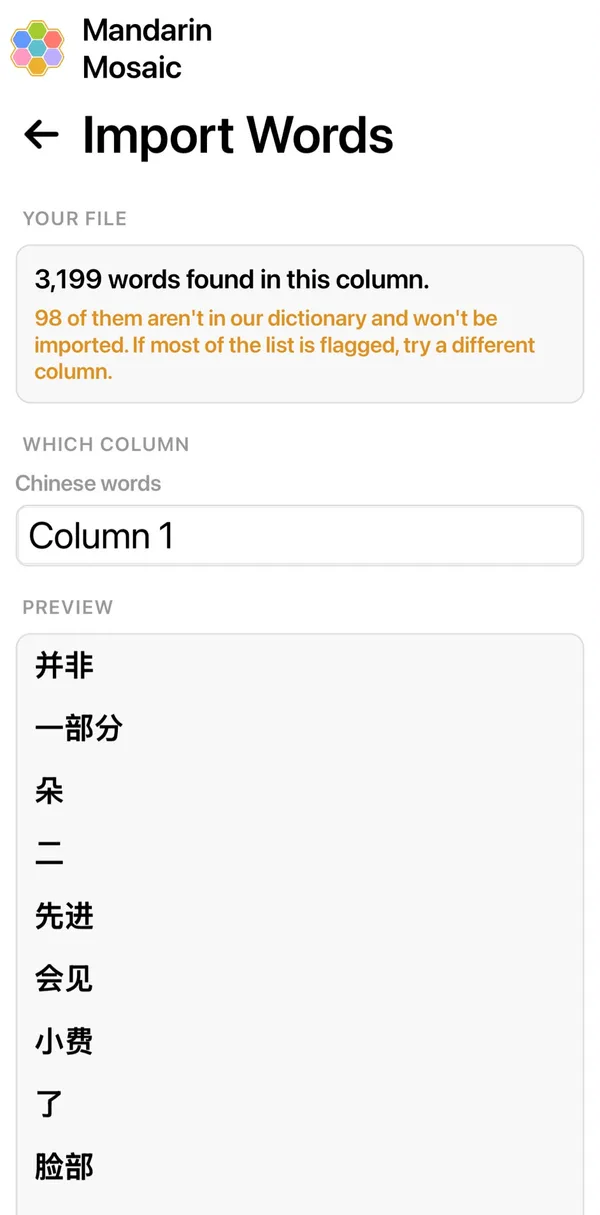
Importing sentences doesn't change your vocabulary. If you already know lots of words from Anki or another app, add them to your known words so lessons don't teach them as new:
- Open Settings and, under Data & Storage, tap Import known words.
- Tap Choose File and pick a CSV or text file with one word per line.
- Check the column and the preview. Words that aren't in the app's dictionary, such as names, are marked "Not in dictionary" and skipped.
- Tap the Add button to finish.
Lists of single characters (like some Dong Chinese exports) aren't supported yet: the file needs whole words. Imported words are spread over the coming days for review, rather than all falling due at once.
Free plan and Premium
At the time of writing, the free plan allows one custom pack and 10 custom sentences. Import Pack creates a new custom pack, so on the free plan you can use it only if you don't already have one. Premium removes both limits, which makes it the practical choice for importing full decks. See pricing for current details.
Troubleshooting
"We couldn't read that file"
Check the file is an .apkg, .csv or .txt, and for Anki decks, that you ticked Support older Anki versions when exporting. If it still won't import, email it to [email protected] as the app suggests, and we'll import it for you.
The Chinese and English are mixed up
Change the Chinese and English choices under Which columns until the preview looks right. For CSV and text files, also try a different Separated by option.
The button says "Nothing new to add"
Every sentence in the file is already in that pack, so there's nothing to import.
Where to find Chinese decks
Our list of the best Chinese Anki decks only includes decks we've checked import correctly into Mandarin Mosaic. You can also browse Anki Chinese shared decks; most sentence decks import well, but check the preview before you import. If you're weighing up whether to keep using Anki alongside the app, read Mandarin Mosaic vs Anki, and for what to do with your new pack, see sentence mining with Mandarin Mosaic.