Your Guide to the Radical Chinese Character System
A Chinese radical is the part of a character that gives you a massive clue about its meaning or category. Think of radicals as the foundational building blocks of the written language. They're like categorical 'tags' for thousands of characters, making the entire system feel logical rather than just a random collection of lines.
What Is the Chinese Radical System?
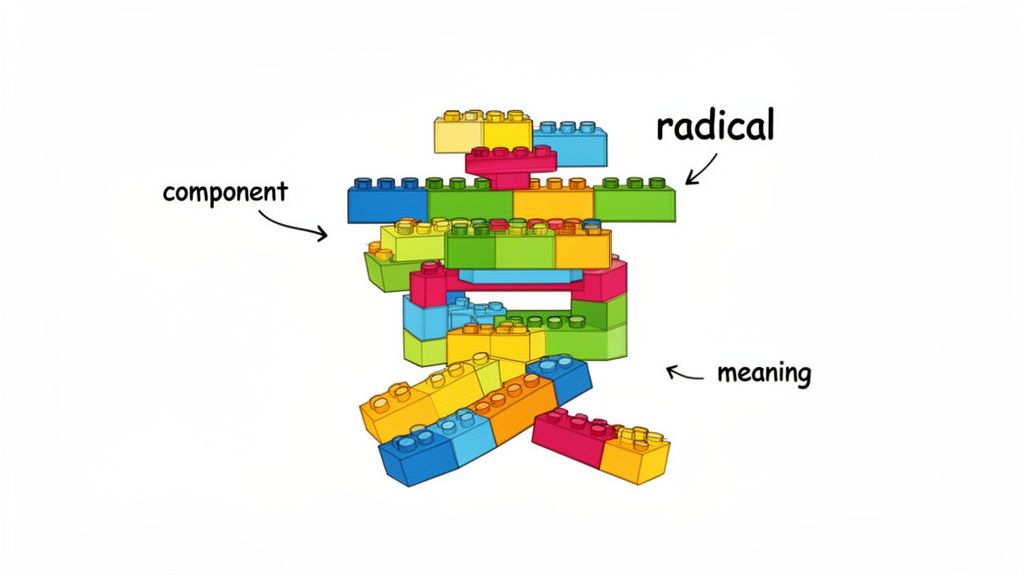
Imagine trying to build a complex model without knowing how the basic pieces connect. Learning Chinese characters, or Hanzi, without understanding radicals is a similar challenge. A character isn't just a jumble of strokes; it’s a thoughtfully constructed symbol, and the radical is often its most important piece.
A radical (部首, bùshǒu) is essentially a graphical component used to classify characters, which is how they're traditionally organised in dictionaries. Historically, there are 214 classic radicals, though modern lists often simplify this a bit. But their real power for learners is in the semantic clues they provide. Radicals frequently hint at the general meaning of the character they're a part of.
Shifting from Memorisation to Logic
Most beginners dive into learning Hanzi with pure rote memorisation. It's a slow, often frustrating, process. Grasping the radical system changes your entire strategy from brute force to something more like detective work. When you see a new character, spotting its radical gives you an immediate starting point for figuring out its meaning.
For instance, loads of characters that include the "water" radical (氵) are related to liquids or bodies of water:
- 河 (hé) – river
- 湖 (hú) – lake
- 洗 (xǐ) – to wash
Recognising this pattern is a total game-changer. It transforms what seems like an endless list of symbols into an interconnected web of meaning. This is why getting your head around radicals in Chinese characters is one of the most effective shortcuts to literacy.
By learning to see the radical within each character, you're essentially learning the 'DNA' of the Chinese writing system. It allows you to decode words instead of just memorising them.
This foundational knowledge doesn't just make learning easier; it makes it more intuitive and rewarding. It’s the first and most critical step towards truly understanding the elegant structure and logic behind Hanzi.
Why Radicals Are a Superpower for Learning Mandarin
Trying to learn Chinese characters without understanding radicals is like trying to navigate a huge city without a map. You might get where you’re going eventually, but you're ignoring a system specifically designed to make your journey faster and far more logical. Learning radicals isn't some dry academic task; it's a practical superpower that will genuinely speed up your path to fluency.
The most immediate payoff is that you'll finally be able to use a Chinese dictionary properly. Traditional dictionaries aren't organised by sound but by the radical Chinese character system. Once you can spot the radical in a character like 想 (xiǎng), you can look it up under its radical, 心 (xīn). This simple skill turns a frustrating search into an efficient one.
From Chaos to Connection
Beyond finding words in a dictionary, radicals turn the overwhelming task of memorising vocabulary into a satisfying game of pattern recognition. Suddenly, the writing system stops feeling like a random collection of squiggles and starts revealing itself as a beautifully interconnected web of meaning.
Once you learn the 'water' radical (氵), you'll start seeing it everywhere. Each new character containing it becomes a mini-puzzle you already have a piece for, giving you a massive clue about its core concept.
Take these characters, for example. When you see them for the first time:
- 河 (hé) – You spot the water radical and can guess it’s related to water. You're right, it means river.
- 湖 (hú) – Again, the 氵 signals a connection to liquid. This one means lake.
- 海 (hǎi) – Following the same pattern, you have the context to learn that this means sea.
This way of making associations is so much more effective than rote memorisation. Your brain is built to find patterns, and radicals feed it exactly what it needs to make new information stick.
By mastering radicals, you're not just memorising individual characters; you're learning the underlying logic of the entire writing system. This shift in perspective turns learning from a slow grind into an engaging process of discovery.
Building Vocabulary Faster
This pattern-based approach creates a snowball effect. Every radical Chinese character you learn becomes a key that unlocks the potential meaning of dozens, sometimes hundreds, of other characters. Think about the 'hand' radical (扌). It often shows up in verbs involving an action you do with your hands, like 打 (dǎ - to hit) or 找 (zhǎo - to find).
Instead of facing thousands of unique symbols, you begin to see familiar bits and pieces popping up again and again. This familiarity eases the mental strain of learning new words, letting you build a solid vocabulary much more quickly. If you're curious about how characters get their shapes, you can learn more about the meaning of Chinese symbols in our other guide. It's this deeper understanding that truly cements your knowledge.
The 20 Most Common Radicals You Need to Know First
Trying to memorise all 214 traditional radicals right out of the gate is a recipe for burnout. It's overwhelming and, frankly, not a smart use of your time. A much better way to go about it is to focus on the radicals that show up most often. It’s the most efficient way to start.
This list isn't just a random collection of symbols; it's your launchpad. Once you get these 20 radicals down, you'll be able to instantly recognise the general meaning behind hundreds of the most common Chinese characters. It’s the first big step in turning those mysterious squiggles into logical puzzles you can actually solve.
People, Nature, and the World Around Us
Many of the most vital radicals are basically simple drawings of things we see every day: people, body parts, and elements from the natural world. Once you know them, you'll start seeing them everywhere.
Here are some of the most essential ones, organised by their themes.
Table: Top 20 Essential Chinese Radicals for Beginners
To give you a clear, actionable starting point, here are the top 20 radicals that will give you the biggest bang for your buck. Learning these will immediately help you deconstruct a huge number of common characters.
| Radical | Pinyin | Meaning | Example Characters |
|---|---|---|---|
| 人 (亻) | rén | Person | 你 (nǐ - you), 他 (tā - he), 休 (xiū - rest) |
| 口 | kǒu | Mouth | 吃 (chī - eat), 叫 (jiào - call), 吗 (ma - question particle) |
| 心 (忄) | xīn | Heart | 想 (xiǎng - think), 快 (kuài - happy), 忙 (máng - busy) |
| 手 (扌) | shǒu | Hand | 打 (dǎ - hit), 找 (zhǎo - find), 拿 (ná - take) |
| 水 (氵) | shuǐ | Water | 河 (hé - river), 洗 (xǐ - wash), 没 (méi - not have) |
| 火 (灬) | huǒ | Fire | 灯 (dēng - lamp), 热 (rè - hot), 炒 (chǎo - to stir-fry) |
| 木 | mù | Wood/Tree | 椅 (yǐ - chair), 林 (lín - forest), 机 (jī - machine) |
| 艹 | cǎo | Grass | 花 (huā - flower), 茶 (chá - tea), 菜 (cài - vegetable) |
| 日 | rì | Sun | 明 (míng - bright), 时 (shí - time), 早 (zǎo - early) |
| 月 | yuè | Moon/Month | 朋友 (péngyǒu - friend), 有 (yǒu - to have) |
| 讠 | yán | Speech | 说 (shuō - speak), 话 (huà - word), 语 (yǔ - language) |
| 土 | tǔ | Earth/Soil | 地 (dì - ground), 在 (zài - at), 坐 (zuò - sit) |
| 刀 (刂) | dāo | Knife | 到 (dào - to arrive), 分 (fēn - minute/divide) |
| 力 | lì | Power/Strength | 男 (nán - male), 办 (bàn - to do) |
| 门 | mén | Door | 们 (men - plural for people), 问 (wèn - to ask) |
| 女 | nǚ | Woman/Female | 好 (hǎo - good), 她 (tā - she), 妈 (mā - mum) |
| 子 | zǐ | Child/Son | 字 (zì - character), 学 (xué - to study) |
| 宀 | mián | Roof | 家 (jiā - family/home), 安 (ān - peace) |
| 走 | zǒu | To walk | 起 (qǐ - to rise), 超 (chāo - super) |
| 目 | mù | Eye | 看 (kàn - to see), 眼 (yǎn - eye) |
Getting a handle on these radicals first is a game-changer. You'll quickly see how characters are built, and each new word you encounter will feel a little less foreign and a lot more familiar.
Spotting the Patterns in Action
Learning to spot these provides immediate context. For instance, when you see the heart radical (心 or the variant 忄), you can bet the character probably has something to do with an emotion, a thought, or a mental state. See the hand radical (手 or 扌)? Look for an action, something done with the hands.
The real beauty of the Chinese radical system is its incredible logic. When you learn the 'water' radical (氵), you're not just learning one symbol. You're gaining a key that helps unlock the meaning of words for river (河), lake (湖), sea (海), and even washing (洗).
It’s this interconnectedness that makes radicals so powerful.
By starting with this focused list of the most common building blocks, you're setting yourself up for much faster progress. Instead of drowning in a sea of 214 symbols, you’re building a solid foundation that makes every new character you meet feel more manageable and far less intimidating.
How to Find the Radical in Any Chinese Character
Spotting the radical in a complex Chinese character can feel like a bit of a puzzle, especially when you’re just starting out. You've got several different parts all vying for your attention, so which one is the actual radical?
Don't worry, it gets much easier with a little practice. Most radicals don't just show up randomly; they occupy predictable spots within a character. Learning where to look first is the key to identifying them quickly and confidently, which is a vital skill for looking up words or just breaking down something new you’ve encountered.
Decoding the Character's Geography
Think of every Chinese character as fitting inside a small square box. The radical will almost always be tucked into one of several key areas. Once you know these common layouts, your recognition speed will shoot up.
Here are the most common positions for radicals:
- Left side: This is by far the most frequent spot for meaning-based radicals. Just think of the hand radical (扌) in 打 (dǎ - to hit) or the water radical (氵) in 河 (hé - river).
- Top: Radicals often sit right on top of the other components, like the grass radical (艹) in 花 (huā - flower) or the roof radical (宀) in 家 (jiā - home).
- Bottom: You'll find radicals at the base of a character, too. Good examples are the heart radical (心) in 想 (xiǎng - to think) and the fire radical variant (灬) you see in 热 (rè - hot).
- Enclosing: Some radicals actually wrap around the other parts of the character. The mouth radical (口) in 国 (guó - country) is a classic example of this.
While radicals can sometimes pop up on the right side or even in the middle, these are less common. The trick is to always check these high-frequency spots first.
A Simple Rule of Thumb
Here’s a fantastic guideline that will help you out time and time again: the "meaning-left, sound-right" structure. In a huge number of compound characters, the component on the left (the radical) gives a clue about the meaning, while the part on the right gives a hint about the pronunciation.
It's not a 100% universal rule, but it holds true so often that it’s an excellent starting point for your analysis. This simple decision tree below maps out the mental process.
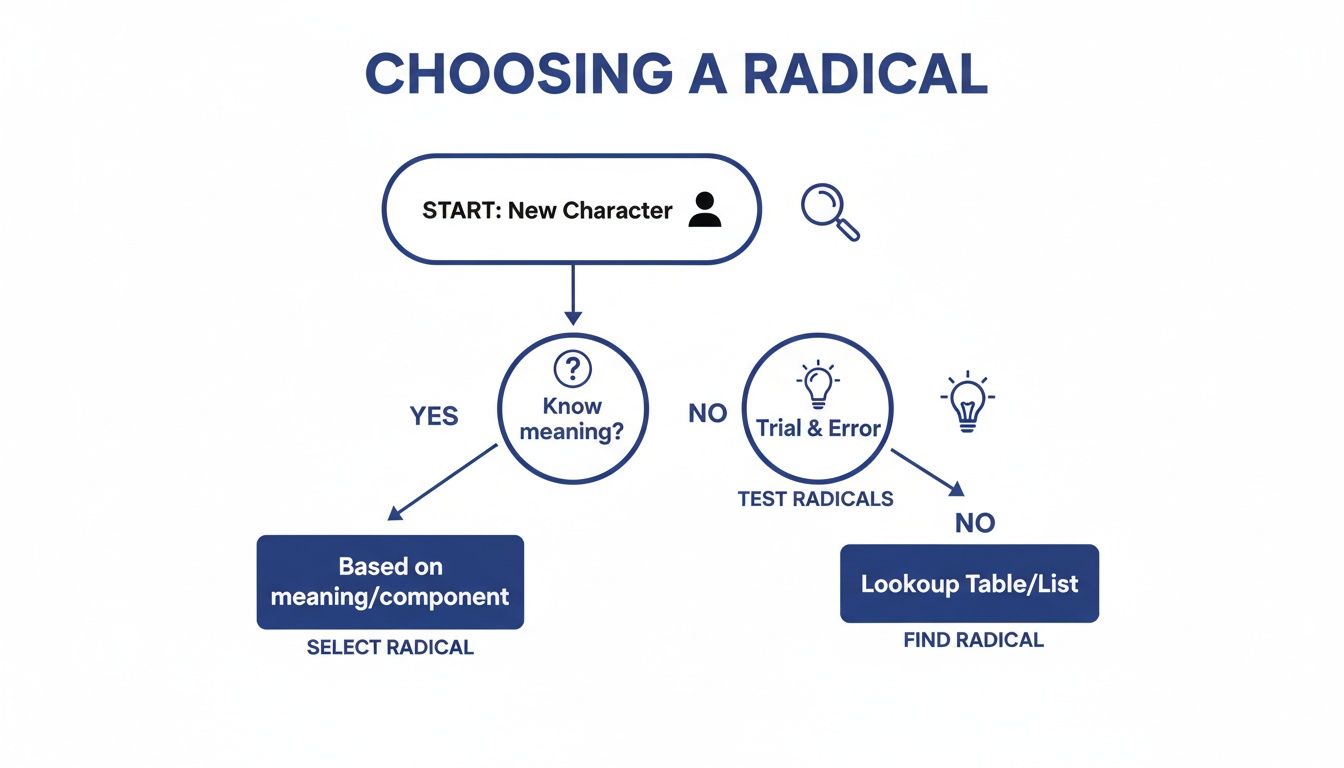
As you can see, your first move should be to look for a component that gives a clear hint about the character's general category or meaning.
When in doubt, search for the most common or visually distinct component in one of the primary positions (left, top, bottom). Experience will quickly build your intuition, making the process almost automatic.
This active way of looking at characters turns reading from a passive task into an engaging analytical skill. By learning to confidently find the radical chinese character component, you empower yourself to tackle unfamiliar words and really get to grips with the logic behind the written language—something that's essential for getting to a more advanced level.
A Smarter Strategy for Learning Radicals in Context
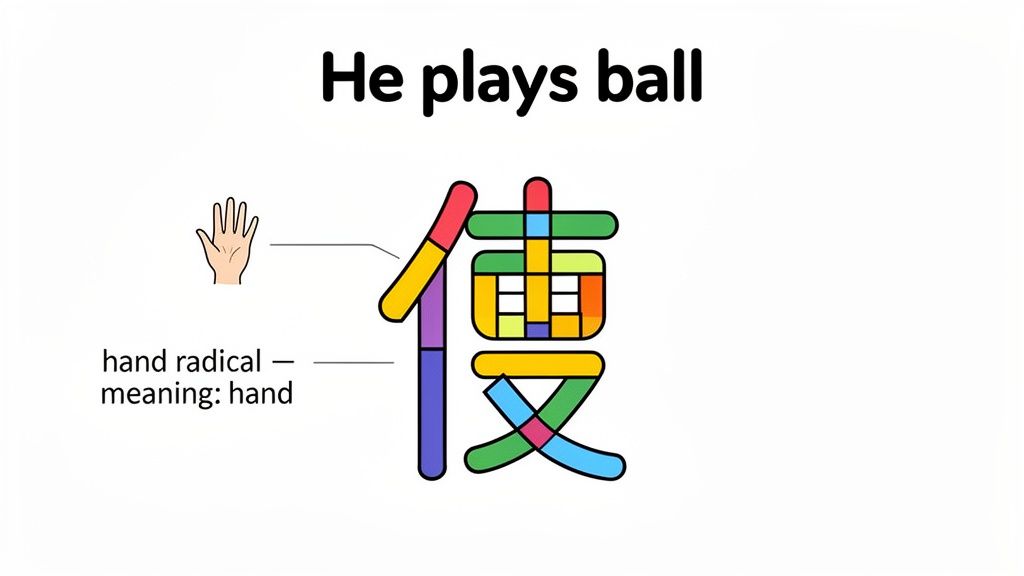
Trying to memorise radicals from a static list is probably one of the least effective ways to learn them. Real, lasting understanding doesn't come from brute force memorisation; it comes from seeing them in action, inside real sentences. This is called contextual learning, and it’s the key to connecting the abstract idea of a radical to its actual job in the language.
Think about learning the 'hand' radical, 扌. On its own, it’s just a squiggle on a flashcard. But what happens when you encounter it in the sentence 他打球 (Tā dǎ qiú – He plays ball)? Suddenly, it all clicks. You see the radical 扌 inside the verb 打 (dǎ – to hit), and you instantly make a connection to a hand-based action.
This is worlds away from just drilling a list. It cements the radical's meaning in your mind because you’ve seen it doing what it’s supposed to do. This simple shift turns learning from a chore into a genuinely interesting process of discovery.
From Flashcards to Fluid Understanding
The goal here is to move beyond simply knowing a radical's definition and start understanding its application. Static lists treat radicals like isolated vocabulary words, but their real power is in the relationships and patterns they reveal across the language.
Learning radicals in context is like learning the rules of a game by actually playing it, not just memorising a diagram of how each piece moves. The theory only becomes meaningful when you see it applied in a real situation.
This approach also has a natural reinforcing effect. Every time you read a sentence and spot a familiar radical, you're strengthening the neural pathways tied to it. You’re not just recalling a fact; you’re actively decoding meaning, which is a much deeper and more powerful way to learn.
Leveraging Technology for Contextual Learning
Now, finding the right sentences at the right time used to be a massive headache. Thankfully, modern tools are designed to do the heavy lifting for you. An app like Mandarin Mosaic, for example, is built entirely around this principle. It introduces new words and grammar within sentences that are perfectly matched to your current level.
The app shows you a sentence and highlights the new word, letting you see its radical in a natural setting. This visual approach makes it effortless to connect the character, its radical, and its meaning without breaking your study flow. By also building in spaced repetition, the app makes sure you review these contextual examples at just the right moments for long-term retention.
This process is a core part of a highly effective learning strategy called sentence mining. To get the full picture, you can check out our complete guide on sentence mining for a step-by-step breakdown. A truly smarter strategy might also weave in elements of social learning concepts, where talking with others can deepen your understanding even further.
By treating each radical not as an isolated piece of data but as part of a living, breathing language, you'll find your learning becomes more intuitive, more effective, and a whole lot more rewarding.
Common Questions About Chinese Radicals
As you start getting to grips with radicals, a few questions always seem to pop up. Getting clear on these early can make a huge difference, clearing up confusion and giving you the confidence to push forward. Let’s tackle some of the most common queries learners have.
Getting straight answers turns those lingering doubts into solid knowledge, making your study time that much more effective.
How Many Radicals Do I Actually Need to Learn?
This is probably the most common question of all, and the answer is reassuring. While the classic Kangxi dictionary system lists 214 radicals, you absolutely do not need to memorise all of them. A more modern, simplified list often used today has around 189.
But for practical, day-to-day fluency, your target is much smaller. Mastering the 50 to 100 most frequent radicals is the real key. This core group covers the vast majority of characters you’ll run into in daily reading and conversation. The strategy here is to focus on what’s common, not the total count.
Focus on the high-impact radicals that give you the biggest return on your study time.
Is the Radical Always on the Left Side?
Nope, and this is a classic beginner’s misconception. While the left-hand side is a very common spot—especially for meaning-based radicals—they can actually show up in any part of a character.
You’ll find them all over the place:
- Top: You can see this with the grass radical (艹) in 花 (huā – flower).
- Bottom: The heart radical (心) sits at the base of 想 (xiǎng – to think).
- Right: The knife radical variant (刂) is on the right in 到 (dào – to arrive).
- Enclosing: The mouth radical (口) wraps around the character 国 (guó – country).
Learning to scan all parts of a character, not just the left, is a crucial skill to develop.
Do All Chinese Characters Have a Radical?
Yes, for dictionary purposes, every single Chinese character is officially assigned one primary radical. It’s essential for indexing and looking up words.
Some simple characters, like 木 (mù – tree) or 人 (rén – person), are actually radicals themselves. In more complex characters that have multiple components, only one gets designated as the official radical for classification. For instance, in 好 (hǎo – good), which is made of 'woman' (女) and 'child' (子), the 女 component is considered the radical.
Can a Radical Look Different in Characters?
Absolutely. Many radicals change their shape to fit more neatly into a character’s structure. These are often called radical variants, and being able to spot them is essential for breaking down characters.
For example, the radical for water, 水, gets squashed into its three-dot form 氵 when placed on the left. Likewise, the heart radical 心 becomes 忄, and the person radical 人 turns into 亻 when used on the left side. Learning these common transformations is a fundamental part of mastering the radical system.
Ready to stop memorising and start understanding? The Mandarin Mosaic app is built around learning radicals in context, showing you how they work in real sentences. Start learning smarter today at mandarinmosaic.com.