 Mandarin Mosaic
Free on iPhone, iPad and Android.
Download on theApp Store Get it onGoogle PlayYour first month of Premium is free.
Pokémon in Chinese: A Learner's Guide to Names and Regions

Search for Pokémon names in Chinese and you'll quickly find disagreement. One site says Pikachu is 皮卡丘, an old clip calls it 比卡超, and a fan forum talks about 口袋妖怪 rather than 宝可梦. None of these is a mistake. They come from different regions and different eras, and sorting them out is a neat lesson in how Chinese adapts foreign names.
The short answer: Pokémon is officially 宝可梦 (bǎokěmèng), and Pikachu is 皮卡丘 (píkǎqiū). Read on for where the other names came from and the names worth learning first.
Why 'Pokémon in Chinese' Is a Perfect Language Lesson
A learner often meets Pokémon in Chinese in fragments: 皮卡丘 in a learning app, 比卡超 in an old Hong Kong cartoon, 神奇宝贝 on a Taiwanese DVD. The contrast between them is the lesson.
Pokémon names touch several things Chinese learners need: character recognition, names built from sound, names built from meaning, and regional variation. You aren't just memorising creature names; you're seeing how Chinese-speaking markets adapt foreign brands.
The history explains the mess. For its first twenty years, Pokémon had no single Chinese name. The games weren't translated into Chinese until Pokémon Sun and Moon in 2016, so fans played Japanese or English versions, or unofficial translations, while the anime was dubbed separately in each region. Taiwan, Hong Kong and mainland China each ended up with their own names.
Why learners get stuck
- One franchise, several histories: each Chinese-speaking region built habits around different names.
- Sound versus meaning: some names imitate the original pronunciation, while others describe the creature.
- Old media stays online: learners often find old subtitles, fan lists and clips before they find current official names.
Practical rule: when a Chinese Pokémon name looks unfamiliar, don't assume it's wrong. Ask which region, which era and which kind of media it comes from.
If you enjoy learning through shows and familiar characters, our guide to learning Chinese from TV shows goes well with Pokémon vocabulary.
宝可梦: The Official Chinese Name for Pokémon
The first name to learn is 宝可梦 (bǎokěmèng; 寶可夢 in Traditional characters). It's the official name everywhere Chinese is used, so it gives you a fixed point when older names turn up.
What the characters suggest
Look at both the sound and the meaning of each character:
| Characters | Pinyin | Basic sense |
|---|---|---|
| 宝 | bǎo | treasure, precious |
| 可 | kě | can, able, acceptable |
| 梦 | mèng | dream |
Read literally, 宝可梦 doesn't mean anything as a phrase. It's a brand name that imitates the sound of "Pokémon" using positive, familiar characters ("treasure" and "dream"). Don't force a literal translation; use the character meanings as memory hooks.
How it became the official name
On 26 February 2016, alongside the announcement of Pokémon Sun and Moon, The Pokémon Company gave the series a single official Chinese name for all regions: 精灵宝可梦 (jīnglíng bǎokěmèng). According to Pokémon Company president Tsunekazu Ishihara, it borrowed from the two best-known older names: 精灵 ("spirit") from Hong Kong's 寵物小精靈 and 宝 ("treasure") from Taiwan's 神奇寶貝. In 2019 the name was shortened to just 宝可梦.
Once you know 宝可梦 as the official name, the older terms are easier to place. They stop looking random.
How to remember it
- Sound: say bǎokěmèng aloud a few times. It sounds like "Pokémon" with Chinese tones.
- Characters: 宝 (treasure) and 梦 (dream) are common characters you'll meet in plenty of other words.
- Context: put it in a sentence, such as 我喜欢宝可梦 (wǒ xǐhuan bǎokěmèng, I like Pokémon) or 宝可梦的名字很有意思 (bǎokěmèng de míngzi hěn yǒu yìsi, Pokémon names are really interesting).
If you're curious how foreign names are adapted more generally, our article on turning an English name into a Chinese name shows how sound and meaning work together.
Mainland, Taiwan and Hong Kong: A Regional Guide
To make sense of Pokémon in Chinese, think in regions, not one big category called "Chinese". Most of the confusion comes from mixing them up.
Mainland China
Before 2016 the mainland had no single name. Gamers mostly said 口袋妖怪 (kǒudai yāoguài), a direct translation of the Japanese title "Pocket Monsters". 口袋 means "pocket", and 妖怪 means a monster or demon from folk tales, which gives the name a spookier feel than the official one. Mainland fans also used the Hong Kong and Taiwanese names, 宠物小精灵 and 神奇宝贝, so there was no single standard.
Taiwan
Taiwan used 神奇寶貝 (shénqí bǎobèi; 神奇宝贝 in Simplified characters). 神奇 means magical or wondrous, and 宝贝 means "treasure" or "darling", the word you'd use for a baby or a loved one. It's a much softer name than "monster".
Hong Kong
Hong Kong used 寵物小精靈 ("little pet spirits"), and many of its names were chosen to sound right in Cantonese, not Mandarin. The famous example is Pikachu: 比卡超, pronounced bei2 kaa1 ciu1 in Cantonese, close to the Japanese. Its official replacement, 皮卡丘, sounds right in Mandarin but quite different in Cantonese. When the unified names were announced in 2016, the change upset many Hong Kong fans, who saw it as part of a wider push for Mandarin over Cantonese, and a small group protested outside the Japanese consulate. Language Log covered the row at the time.
So if you read a Hong Kong name and the characters seem unrelated to the Mandarin sound, try Cantonese. Our guide to Chinese dialects explains how Cantonese and Mandarin differ.
A quick comparison
| Region | Older name for Pokémon | What learners should notice |
|---|---|---|
| Mainland China | 口袋妖怪 (kǒudai yāoguài), among others | Old fan lists and forums often use pre-2016 names |
| Taiwan | 神奇寶貝 (shénqí bǎobèi) | Traditional characters; names often feel gentler |
| Hong Kong | 寵物小精靈 | Traditional characters; many names make sense only in Cantonese |
Today all three regions use the same official names, written in Simplified characters on the mainland and Traditional characters in Taiwan and Hong Kong. If you're reading Traditional characters, our guide to learning Traditional Chinese will help.
When you see different Pokémon names in Chinese, ask "Which region, and which year?" That's more useful than "Which one is correct?"
From Pikachu to Ash: Essential Names to Know
Don't try to learn the whole Pokédex. A handful of names will teach you how the translations work.
Names built from sound
These imitate the original Japanese name. The characters are chosen to be easy to read, not to describe the creature.
- Pikachu, 皮卡丘, píkǎqiū: the characters mean roughly "skin, card, hill", which tells you nothing about an electric mouse. It's pure sound.
- Eevee, 伊布, yībù: imitates the Japanese name, Ībui.
- Meowth, 喵喵, miāomiāo: "miaow miaow", the sound a cat makes in Chinese.
Names that mix sound and meaning
Many names take a sound from the Japanese name and add a character that says what the creature is. These are the most satisfying to learn.
- Squirtle, 杰尼龟, jiéní guī: 杰尼 imitates "Zeni" from its Japanese name Zenigame, and 龟 means turtle.
- Psyduck, 可达鸭, kědá yā: 可达 imitates "Koda" from Koduck, and 鸭 means duck.
- Snorlax, 卡比兽, kǎbǐ shòu: 卡比 imitates "Kabi" from Kabigon, and 兽 means beast.
- Jigglypuff, 胖丁, pàngdīng: 胖 means chubby, and 丁 echoes 布丁 (bùdīng, pudding), which is what its Japanese name Purin means.
Names built from meaning
Others describe the creature directly, so every character is useful vocabulary.
- Charmander, 小火龙, xiǎohuǒlóng: "little fire dragon".
- Charizard, 喷火龙, pēnhuǒlóng: "fire-breathing dragon" (喷 means to spurt or spray).
- Bulbasaur, 妙蛙种子, miàowā zhǒngzi: "wondrous frog seed", a nod to the bulb on its back and its Japanese name Fushigidane ("strange seed").
- Mewtwo, 超梦, chāomèng: "super dream", using the same 梦 as 宝可梦.
- Team Rocket, 火箭队, huǒjiànduì: 火箭 (rocket) + 队 (team).
Human characters
- Ash Ketchum, 小智, xiǎozhì: Ash's Japanese name is Satoshi, written with the character 智 (wisdom). 小 ("little") is common in Chinese nicknames, as in 小王 (xiǎo wáng) for a younger person surnamed 王 (wáng).
Useful Pokémon words
- 训练家 (xùnliànjiā): trainer
- 精灵球 (jīnglíng qiú): Poké Ball
- 进化 (jìnhuà): to evolve
- 道馆 (dàoguǎn): gym
- 图鉴 (tújiàn): Pokédex (an illustrated guide)
Why older lists may not match newer media
Official names can also change. In 2020 several mainland names were quietly revised to drop words such as "hooligan", "thief" and "death", as The China Project reported. Pangoro, for example, went from 流氓熊猫 (liúmáng xióngmāo, "hooligan panda") to 霸道熊猫 (bàdào xióngmāo, "domineering panda"). Older fan spreadsheets still circulate with the previous names.
So treat old fan lists with caution, check whether a source uses current official names, and learn the version that matches what you're actually watching or playing.
Memorising Pokémon Vocabulary in Context
Lists feel efficient, but they rarely stick. You might recognise 皮卡丘 on a quiz and still stumble when it turns up in a sentence.
The fix is context: learn the names inside short sentences where they do a job.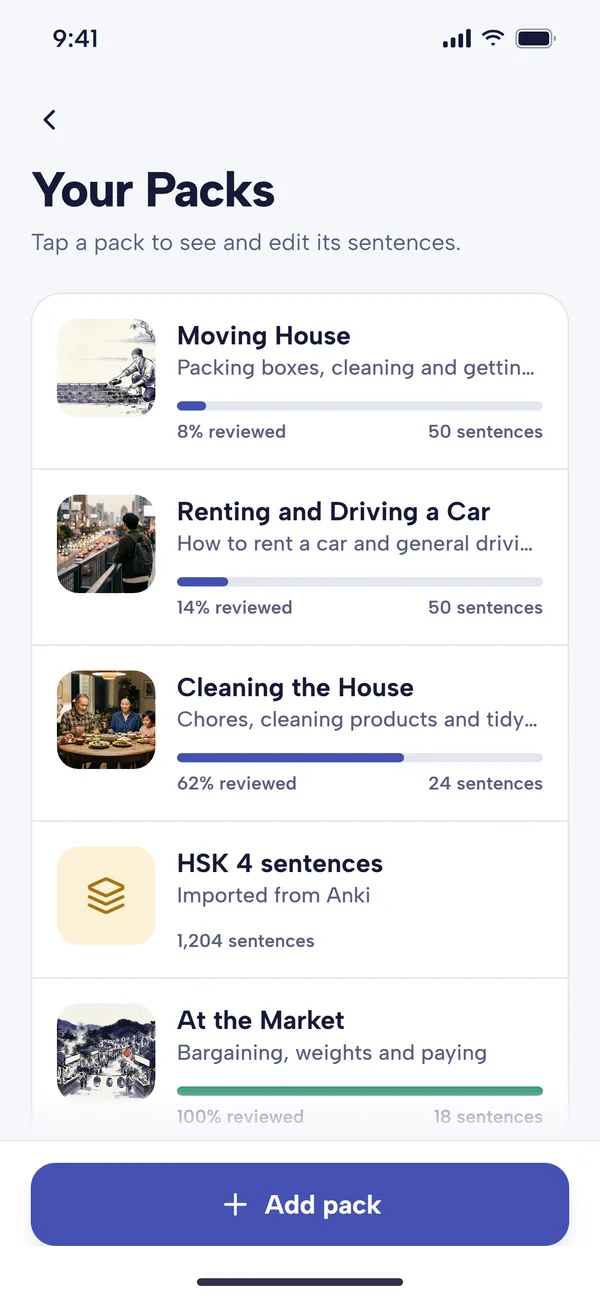
What contextual study looks like
Instead of reviewing bare pairs like 皮卡丘 = Pikachu or 火箭队 = Team Rocket, use sentences like these:
- 我最喜欢的宝可梦是皮卡丘。 (wǒ zuì xǐhuan de bǎokěmèng shì píkǎqiū.) My favourite Pokémon is Pikachu.
- 小智的皮卡丘很厉害。 (xiǎozhì de píkǎqiū hěn lìhai.) Ash's Pikachu is really strong.
- 小火龙进化成了火恐龙。 (xiǎohuǒlóng jìnhuà chéng le huǒkǒnglóng.) Charmander evolved into Charmeleon.
- 火箭队又来了! (huǒjiànduì yòu lái le!) Team Rocket are back again!
- 你有几个精灵球? (nǐ yǒu jǐ ge jīnglíng qiú?) How many Poké Balls have you got?
Now you're learning more than names: 的 for possession, 又 (yòu, again), 进化成 (evolve into), and how questions with 几 (jǐ, how many) work.
Why sentence mining works well here
Collecting sentences like these is called sentence mining, and it suits fan vocabulary well: if you already care about the characters, the sentences are easier to remember.
Mandarin Mosaic is built around this. It's a sentence-mining app for iOS and Android that shows you sentences with one new word where possible, lets you tap any word for its meaning and audio, and schedules reviews with spaced repetition. Its built-in sentences cover everyday and HSK vocabulary rather than Pokémon, but you can add your own sentences, or import them from a text file, CSV or Anki deck, into a custom pack and review them the same way.
A simple study routine
- Start small: pick five names you already know in English.
- Collect sentences: take short lines from subtitles or game text, or write simple ones yourself.
- Keep one new word per sentence: if a sentence has too many unknown words, find a simpler one.
- Say them aloud: names need pronunciation practice too, tones included.
Where to Go Next
Pokémon in Chinese looks confusing at first because it reflects real language, not textbook neatness. Remember 宝可梦 as the official name, recognise 口袋妖怪, 神奇宝贝 and 比卡超 as older regional names, and notice whether each creature's name follows sound, meaning or both. Then watch an episode or play a game in Chinese, and save the lines you enjoy.
If you want a practical way to turn interests like Pokémon into daily Mandarin study, Mandarin Mosaic teaches you through sentences instead of word lists, so new vocabulary arrives in context and is easier to remember.