The Top 10 Essential Phrases in Mandarin for Learners in 2026
Learning Mandarin Chinese can feel like an immense journey. The key to making real progress isn't memorising thousands of individual words at once, but mastering the foundational phrases that unlock real-world communication and build a solid conversational base. This guide moves beyond simple translations. We will deconstruct essential phrases in Mandarin, providing not just the characters and pinyin, but the cultural context, pronunciation nuances, and practical, modern examples you need to start speaking with confidence.
We have structured this listicle for serious learners at every stage, from beginners building their initial vocabulary to intermediate students seeking to break through a learning plateau. We will explore how each phrase functions in daily conversation, from polite greetings and essential travel requests to ordering food and navigating small talk. You’ll find actionable study tips for integrating these phrases into a powerful sentence-mining workflow, turning rote learning into intuitive understanding.
This organised approach is designed to provide a clear path forward, helping you build a practical and resilient foundation for your language skills. To further support your foundational learning, consider exploring dedicated Mandarin Chinese translation resources to verify meanings and explore new sentence structures. By focusing on these core building blocks and understanding their application, you can accelerate your journey towards fluency and start having meaningful conversations much sooner.
1. 你好 (Nǐ hǎo) - Hello/Hi
The quintessential Mandarin greeting, 你好 (nǐ hǎo), is often the very first phrase learners encounter, and for good reason. Literally translating to "you good," it's the bedrock of social interaction in Chinese. This universally understood phrase is your reliable entry point into any conversation, appropriate for nearly every situation, from greeting a shopkeeper to meeting a new colleague. Mastering its pronunciation is a crucial first step for building confidence.
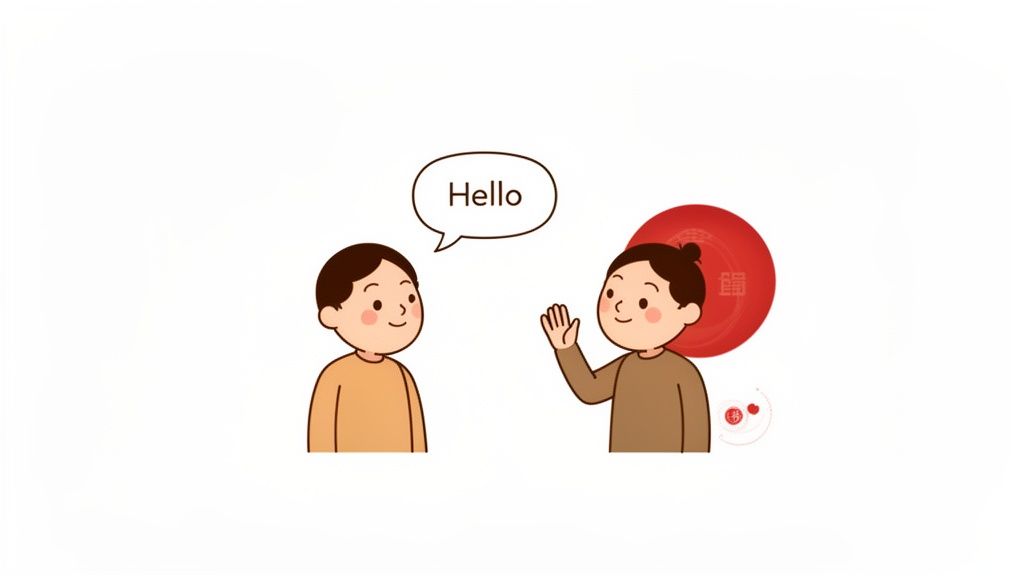
While 你好 is a fantastic all-purpose greeting, it's just the beginning. As you progress, you'll want to add more context-specific greetings to your vocabulary. To expand your conversational toolkit for different times of the day, you can explore other Mandarin greetings on our blog.
Tonal Nuances and Pronunciation
The key to a natural-sounding 你好 lies in the tones. Individually, 你 (nǐ) is a third tone and 好 (hǎo) is also a third tone. However, due to a phonological rule known as "tone sandhi," when two third tones appear together, the first one changes to a second (rising) tone. Therefore, the phrase is pronounced "ní hǎo," not "nǐ hǎo."
- Practice: Say "ní" with a rising intonation, like asking a question, then "hǎo" with a dipping-then-rising tone. It feels like a small scoop in your voice.
- Combine with Gestures: Pair the phrase with a slight nod and direct eye contact to convey sincerity and respect, making your greeting feel more authentic.
Practical Application and Study Tips
To move beyond rote memorisation, integrate 你好 into full sentences immediately. This contextualises the phrase, making it a functional tool rather than an isolated vocabulary item. This approach is fundamental for anyone serious about learning phrases in Mandarin effectively.
- At a restaurant: 你好, 我想看一下菜单。(Nǐ hǎo, wǒ xiǎng kàn yīxià càidān.) - "Hello, I'd like to see the menu."
- Answering the phone: 你好, 请问您是哪位? (Nǐ hǎo, qǐngwèn nín shì nǎ wèi?) - "Hello, may I ask who is calling?"
For your SRS workflow, create flashcards with these full sentences rather than just the isolated phrase. This sentence-mining technique helps you absorb grammar and usage patterns naturally, accelerating you past the beginner plateau.
2. 谢谢 (Xièxie) - Thank You
Alongside greetings, expressing gratitude is one of the most fundamental aspects of polite communication. The phrase 谢谢 (xièxie) is the standard way to say "thank you" and is indispensable in daily interactions. It is composed of two identical characters, reflecting the Chinese cultural value of showing appreciation and maintaining harmonious relationships. Using it correctly is crucial for respectful communication in any Mandarin-speaking environment.
Mastering 谢谢 is a non-negotiable step for any learner. While it may seem simple, understanding its tonal delivery and the various ways to expand upon it will add significant depth to your conversational skills. You can deepen your understanding of these critical pronunciation rules by reviewing the four main tones in Mandarin.
Tonal Nuances and Pronunciation
The pronunciation of 谢谢 is a perfect example of how tones can change meaning and flow. The first character 谢 (xiè) is a fourth tone, which is a sharp, falling tone. The second character, however, is pronounced with a neutral tone, making it lighter and shorter than the first. This creates a distinct "XIÈ-xie" rhythm.
- Practice: Say the first "xiè" with a firm, downward inflection, as if giving a command. Then, attach the second "xie" lightly and quickly, with almost no tonal emphasis.
- Avoid Common Mistakes: A common error is pronouncing both syllables with a fourth tone. This sounds unnatural and robotic to native speakers. Focus on the "heavy-light" stress pattern.
Practical Application and Study Tips
To truly internalise 谢谢, you must use it in complete, natural-sounding sentences. This practice is vital for learning phrases in Mandarin in a way that sticks. Start with the basic phrase and gradually build more complex expressions of gratitude.
- Receiving a gift: 谢谢! 这很好看。(Xièxie! Zhè hěn hǎokàn.) - "Thank you! This looks great."
- After getting help: 谢谢你的帮助。(Xièxie nǐ de bāngzhù.) - "Thank you for your help."
- In a shop: 谢谢, 再见。(Xièxie, zàijiàn.) - "Thank you, goodbye."
For your SRS workflow, create a set of flashcards that show this progression: start with just 谢谢, then add cards for 谢谢你 (thanking a specific person), and finally full sentences like 谢谢你的帮助. This sentence-mining approach builds a solid foundation for expressing nuanced gratitude.
3. 对不起 (Duìbùqǐ) / 抱歉 (Bàoqiàn) - I'm Sorry/Excuse Me
Navigating social interactions requires knowing how to apologise or get someone's attention politely. In Mandarin, 对不起 (duìbùqǐ) and 抱歉 (bàoqiàn) are your go-to phrases, though they carry different weights. 对不起 is a more formal and sincere apology, literally meaning "I cannot face you," implying a sense of wrongdoing. In contrast, 抱歉 is slightly more casual and often used for minor inconveniences, translating to "to hold regret."
Understanding the distinction between these two is key to sounding natural and showing the right level of deference. While a beginner can use 对不起 universally, differentiating between them demonstrates a higher level of social and linguistic awareness. Mastering these essential phrases in Mandarin ensures you can handle everything from bumping into someone to making a more significant mistake with grace.
Tonal Nuances and Pronunciation
The pronunciation of 对不起 (duìbùqǐ) requires attention to its tones: a fourth (falling) tone, a neutral (or light) tone, and a third (dipping) tone. The middle character, 不 (bù), is unstressed, making the phrase flow smoothly. For 抱歉 (bàoqiàn), you have two consecutive fourth tones, which requires a sharp, definitive drop in pitch for both syllables.
- Practice: For 对不起, focus on a quick, unstressed "bu" sound between the emphatic "duì" and the dipping "qǐ." For 抱歉, practice two distinct falling tones back-to-back: "bào-qiàn."
- Combine with Gestures: A slight bow of the head when saying 对不起 enhances its sincerity, especially in more formal contexts. A simple hand gesture or concerned expression can accompany 抱歉 for minor issues.
Practical Application and Study Tips
The best way to learn the difference is through context. Integrate these phrases into full sentences that clearly illustrate their appropriate usage. This sentence-mining approach is far more effective than just memorising the words in isolation.
- Formal apology: 对不起, 我不应该那样做。(Duìbùqǐ, wǒ bù yìnggāi nàyàng zuò.) - "I'm sorry, I shouldn't have done that."
- Getting attention: 对不起, 请问洗手间在哪里? (Duìbùqǐ, qǐngwèn xǐshǒujiān zài nǎlǐ?) - "Excuse me, may I ask where the restroom is?"
- Casual apology: 抱歉, 让你久等了。(Bàoqiàn, ràng nǐ jiǔ děng le.) - "Sorry for keeping you waiting."
For your SRS workflow, create separate flashcards for each phrase, each with a distinct contextual sentence. For instance, one card for 对不起 in a "serious apology" context and another for 抱歉 in a "minor inconvenience" context. This will help you internalise the subtle but important differences in their application.
4. 请问 (Qǐngwèn) - May I Ask/Excuse Me (Information Request)
When navigating any Chinese-speaking environment, knowing how to politely ask for information is indispensable. The phrase 请问 (qǐngwèn), which literally translates to "please ask," is your master key for this purpose. It acts as a courteous preface to any question, instantly softening your approach and showing respect. Using 请问 signals that you value the other person's time and are not making a demand, a crucial element of social etiquette.
This simple phrase is incredibly versatile, fitting into nearly any scenario where you need to ask a stranger for help, from finding the nearest underground station to asking for the price of an item. It's one of the most functional phrases in Mandarin for daily life, transforming a direct question into a polite and culturally appropriate inquiry.
Tonal Nuances and Pronunciation
The pronunciation of 请问 is straightforward, but achieving the correct tones is vital for clarity. The character 请 (qǐng) is a third tone, and 问 (wèn) is a fourth tone. This combination is common and great for practice.
- Practice: Say "qǐng" with a dipping-then-rising tone, like a small scoop in your voice. Immediately follow with "wèn," a sharp, falling tone, like giving a command. The contrast between the dipping third tone and the falling fourth tone is key.
- Combine with a Pause: Native speakers often have a slight, natural pause after saying 请问 and before asking the main question. This gives the listener a moment to register that you are about to ask for something.
Practical Application and Study Tips
The best way to master 请问 is by combining it directly with the question words you are learning. This sentence-framing technique makes your questions sound natural and respectful from the very beginning.
- Asking for directions: 请问, 洗手间在哪里? (Qǐngwèn, xǐshǒujiān zài nǎlǐ?) - "Excuse me, where is the bathroom?"
- In a shop: 请问, 这个多少钱? (Qǐngwèn, zhège duōshǎo qián?) - "May I ask, how much is this?"
For your SRS workflow, build a deck of flashcards that pair 请问 with various questions you anticipate asking. This method is far more effective than just memorising the phrase in isolation. For instance, when dining out, you can combine this with ordering vocabulary, a skill you can refine by learning how to order food in Chinese. This approach embeds practical grammar and usage patterns, accelerating your journey towards fluency.
5. 再见 (Zàijiàn) - Goodbye/See You Again
Just as 你好 (nǐ hǎo) opens conversations, 再见 (zàijiàn) provides the standard, polite way to close them. Literally translating to "again see," this phrase encapsulates a hopeful sentiment that the parting is only temporary. It is the quintessential Mandarin farewell, appropriate for almost any situation, whether you are leaving a shop, ending a meeting, or saying goodbye to friends.
While 再见 is a reliable and universally understood way to end an interaction, its usage marks a clear conclusion. Mastering this phrase and its variations is crucial for navigating the full arc of a conversation, allowing you to end discussions as smoothly and confidently as you begin them. This is a foundational skill for learners aiming to use phrases in Mandarin in complete, natural-sounding dialogues.
Tonal Nuances and Pronunciation
A crisp and accurate pronunciation of 再见 is key to sounding natural. The phrase consists of a fourth tone followed by another fourth tone, but in common speech, the second character often softens to a neutral tone.
- Practice: Pronounce 再 (zài) with a sharp, falling tone, like a decisive command. Follow it with a light, unstressed 见 (jian). The rhythm should feel like "ZAI-jian," with the emphasis clearly on the first syllable.
- Combine with Gestures: A friendly wave or a slight nod often accompanies 再见, reinforcing the polite and positive intention behind the words.
Practical Application and Study Tips
To truly master farewells, you should learn to place 再见 within the context of a conversation's closing sequence. It often follows expressions of gratitude or plans for the future, making it a final, conclusive statement.
- Leaving a friend's house: 谢谢你的招待, 再见! (Xièxiè nǐ de zhāodài, zàijiàn!) - "Thank you for your hospitality, goodbye!"
- Ending a casual chat: 好的, 那明天见, 再见! (Hǎo de, nà míngtiān jiàn, zàijiàn!) - "Okay, see you tomorrow then, goodbye!"
- On a phone call: 那我先挂了, 再见。(Nà wǒ xiān guà le, zàijiàn.) - "I'll hang up now, goodbye."
When creating flashcards for your SRS, include these closing sequences. Instead of just memorising "再见 = goodbye," create cards like "明天见 (míngtiān jiàn) - See you tomorrow" or "待会儿见 (dāihuǐr jiàn) - See you later." This sentence-mining approach helps you internalise the subtle rhythms and rituals of ending conversations in Mandarin, which is a vital step towards fluency.
6. 好的 (Hǎo de) - Okay/Understood/Agreed
One of the most frequent and functional phrases in Mandarin you'll hear and use is 好的 (hǎo de). While it translates simply to "okay," "sure," or "got it," its role as a conversational lubricant is immense. It signals agreement, acknowledges an instruction, and confirms understanding all in one neat package. Mastering 好的 is a significant step towards sounding more natural and responsive in everyday interactions.
This phrase moves beyond basic greetings into the realm of practical communication. It's the go-to response for countless daily scenarios, from accepting a dinner invitation to confirming a work task. Recognising its versatility is key for anyone learning essential phrases in Mandarin who wants to engage in authentic, fluid conversations.
Tonal Nuances and Pronunciation
The pronunciation of 好的 is relatively straightforward, but the intonation can subtly change its meaning. 好 (hǎo) is a third tone (dipping), and 的 (de) is a neutral tone, meaning it's light, short, and unstressed. The combination creates a distinct, conclusive sound.
- Practice: Say "hǎo" with its characteristic dip-and-rise, then immediately follow it with a quick, soft "de." It should feel like the second syllable is an afterthought to the first.
- Varying Enthusiasm: A flat, quick "hǎo de" can sound perfunctory or neutral. Adding a slightly higher pitch and a more drawn-out "hǎo" can convey more enthusiasm or eagerness, signalling a more positive agreement. Pair it with a slight nod for non-verbal reinforcement.
Practical Application and Study Tips
The true power of 好的 lies in its contextual flexibility. It can be a standalone response or part of a longer sentence, making it an excellent addition to your active vocabulary. Integrating it into your study routine will quickly improve your conversational flow.
- Confirming understanding: A: 明天三点见面。(Míngtiān sān diǎn jiànmiàn.) - "Let's meet at 3 pm tomorrow." B: 好的。(Hǎo de.) - "Okay."
- Accepting a request: A: 请帮我拿一下那个。(Qǐng bāng wǒ ná yīxià nàgè.) - "Could you grab that for me, please?" B: 好的。(Hǎo de.) - "Sure."
- Acknowledging an instruction: A: 请明天带护照来。(Qǐng míngtiān dài hùzhào lái.) - "Please bring your passport tomorrow." B: 好的。(Hǎo de.) - "Got it."
When adding this to your SRS workflow, create flashcards that present a request or question on one side and "好的" as the appropriate response on the other. This helps you internalise its function as a natural conversational reply, rather than just a vocabulary item.
7. 不好意思 (Búhǎo yìsi) - Sorry/Excuse Me/I'm Embarrassed
Beyond a formal apology, 不好意思 (búhǎo yìsi) is a nuanced and versatile phrase that captures a sense of social grace in Mandarin. Literally translating to "not good meaning" or "not good feeling," it conveys a lighter apology, polite interruption, or genuine embarrassment. It's the phrase you use when bumping into someone, asking for a small favour, or admitting a minor mistake, making it one of the most frequently used phrases in mandarin for daily life. Its emotional weight is lighter than the more serious 对不起 (duìbuqǐ), making it feel more personal and relatable in casual settings.

Understanding when to use 不好意思 versus a more formal apology is key to sounding natural. It reflects a grasp of cultural etiquette, showing consideration for others in everyday situations. This phrase is indispensable for navigating social interactions smoothly and is a must-have in your conversational toolkit. For a deeper dive into expressing apologies, you can explore our guide to saying sorry in Mandarin on our blog.
Tonal Nuances and Pronunciation
The pronunciation requires careful attention to tones: 不 (bú) is a second tone (it changes from fourth to second before another fourth tone), 好 (hǎo) is a third tone, 意 (yì) is a fourth tone, and 思 (si) is a neutral tone. The rhythm is therefore: rising, dipping, falling, then short and neutral. Mastering this sequence is crucial for the phrase to land with the intended politeness.
- Practice: Say "bú" with a rising sound, follow with the low dip of "hǎo," then a sharp drop for "yì," and end with a light, unstressed "si."
- Combine with Gestures: A slight bow of the head, a hand gesture, or even a mildly sheepish expression can enhance the sincerity of your 不好意思, making it clear you are being considerate.
Practical Application and Study Tips
Integrating 不好意思 into full sentences is the best way to grasp its contextual usage. Notice how it often appears at the beginning of a sentence to soften a request or statement. Adding such phrases to your repertoire is a significant step in learning phrases in Mandarin that go beyond basic vocabulary.
- Polite interruption: 不好意思, 我能问一个问题吗? (Búhǎo yìsi, wǒ néng wèn yīgè wèntí ma?) - "Excuse me, may I ask a question?"
- Personal apology: 不好意思, 我迟到了。(Búhǎo yìsi, wǒ chídàole.) - "I'm sorry, I'm late" (expressing genuine embarrassment).
When adding this to your SRS workflow, create flashcards for each specific use case. For example, one card for "Excuse me" and another for "I'm embarrassed." This sentence-mining approach will help you internalise the different shades of meaning and deploy the phrase with confidence in real-world conversations.
8. 能... 吗? (Néng... ma?) - Can You...?
This isn't just a single phrase; it's a fundamental sentence pattern that unlocks countless practical questions in Mandarin. By learning the structure 能 (néng) + Verb + 吗 (ma)?, you gain the ability to make polite requests and ask about someone's capabilities. Mastering this pattern is a significant leap forward, transforming you from a passive listener into an active participant in conversations. It's one of the most versatile tools for navigating daily life in a Mandarin-speaking environment.
The structure is beautifully simple: "Can... yes/no?". This formula allows you to insert almost any verb you know to create a functional, grammatically correct question. This grammatical key is essential for anyone learning phrases in Mandarin, as it provides a framework for independent sentence creation, moving beyond simple memorisation.
Tonal Nuances and Pronunciation
The core components are 能 (néng), a second (rising) tone, and 吗 (ma), a neutral tone. The neutral tone for 吗 is crucial; it should be light and quick, attached to the end of the sentence without its own distinct pitch contour. The verb you place in the middle will have its own tone, which you should pronounce clearly.
- Practice: Say "néng" with a rising inflection, as if asking "what?". Then, add your verb, for instance, a first-tone "kàn" (看). Finish with a short, unstressed "ma". The whole phrase, 能看吗? (Néng kàn ma?), should have a natural, inquisitive rhythm.
- Combine with Gestures: When making a request, like asking to see something (能看一下吗?), you can combine the phrase with a polite, open-hand gesture towards the object. This adds clarity and courtesy to your interaction.
Practical Application and Study Tips
The true power of this pattern emerges when you start plugging in different verbs. This approach is far more effective than memorising each question individually and is a cornerstone of efficient language acquisition. It allows you to adapt to new situations instantly.
- Requesting service: 能给我一杯水吗? (Néng gěi wǒ yī bēi shuǐ ma?) - "Can you give me a glass of water?"
- Asking for help: 你能帮我一下吗? (Nǐ néng bāng wǒ yīxià ma?) - "Can you help me for a moment?"
- Checking ability: 你能说中文吗? (Nǐ néng shuō Zhōngwén ma?) - "Can you speak Chinese?"
For your SRS workflow, focus on creating "cloze deletion" flashcards. Write a full sentence like "你能 [__] 一下吗?" and test yourself on inserting different verbs (e.g., 帮, 等, 看). This technique reinforces the pattern and expands your active vocabulary simultaneously, making it one of the most effective ways to study phrases in Mandarin.
9. 多少钱? (Duōshǎo qián?) - How Much (Does It Cost)?
Asking for the price is a fundamental part of daily life. In Mandarin, 多少钱? (Duōshǎo qián?) is your go-to phrase for this essential task. Literally translating to "how much money?", it combines the question word 多少 (duōshǎo - how much/how many) with 钱 (qián - money). This simple yet powerful question is indispensable for everything from shopping at a local market to paying for a taxi ride.
Mastering this phrase opens up countless practical interactions, making it one of the most useful phrases in Mandarin for any traveller or new learner. It moves your language skills from the classroom into the real world, allowing you to navigate transactions with confidence. For a deeper dive into numbers, which are crucial for understanding the answers you'll receive, you can practise Mandarin numbers on our blog.
Tonal Nuances and Pronunciation
The pronunciation of 多少钱? is relatively straightforward, but paying attention to the tones will make you sound much more natural. The tones are first, third, and second: duō (first), shǎo (third), and qián (second).
- Practice: Start with duō (多), a high, flat tone. Then, a dipping-and-rising third tone for shǎo (少). Finally, a rising second tone for qián (钱), like you're asking a question. The rhythm is "high -> dip -> rise."
- Combine with Gestures: Pointing politely to the item you are interested in while asking the question helps to eliminate any ambiguity and ensures the vendor knows exactly what you're asking about.
Practical Application and Study Tips
To make this phrase truly your own, you must practise using it in complete, context-rich sentences. This approach helps you learn associated vocabulary and grammar, such as measure words and pronouns, making your communication more precise and effective.
- At a market: 这个苹果多少钱? (Zhège píngguǒ duōshǎo qián?) - "How much are these apples?"
- Negotiating a taxi fare: 去火车站多少钱? (Qù huǒchēzhàn duōshǎo qián?) - "How much to go to the train station?"
- In a restaurant: 这个菜多少钱? (Zhège cài duōshǎo qián?) - "How much is this dish?"
When adding this to your SRS workflow, create flashcards for each full sentence. Also, create separate cards for related vocabulary like 贵 (guì - expensive), 便宜 (piányi - cheap), and 打折 (dǎzhé - discount). This will prepare you not just to ask the question, but to understand and respond to the answer.
10. 我不会 (Wǒ búhuì) / 我不知道 (Wǒ búzhīdào) - I Can't/I Don't Know
Knowing how to express inability or a lack of knowledge is just as crucial as expressing what you can do. These two phrases, 我不会 (wǒ búhuì) and 我不知道 (wǒ bù zhīdào), are fundamental for honest and clear communication. They empower you to manage expectations, ask for help, and avoid misunderstandings, making them indispensable phrases in Mandarin for any learner.
While they both convey a negative, their usage is distinct. 我不会 (wǒ búhuì) means "I can't" or "I am not able to," typically referring to a learned skill or ability. In contrast, 我不知道 (wǒ bù zhīdào) translates to "I don't know," used when you lack a piece of information or a fact. Mastering this distinction will make your communication far more precise and natural.
Tonal Nuances and Pronunciation
The key pronunciation detail for both phrases lies in the tone sandhi of 不 (bù). Normally a fourth (falling) tone, it changes to a second (rising) tone when followed by another fourth tone, as in 会 (huì). Therefore, you pronounce it "bú huì." In 我不知道, the tones remain as written: "bù zhīdào."
- Practice 我不会 (wǒ búhuì): Say "bú" with a rising tone, then "huì" with a sharp falling tone. It should sound decisive.
- Practice 我不知道 (wǒ bù zhīdào): Say "bù" (falling), "zhī" (high and flat), and "dào" (falling). Keep the rhythm steady.
- Distinguish from 我不能 (wǒ bù néng): This means "I am not allowed to" due to rules or circumstances, not a lack of ability. For example, 我不能在这里停车 (Wǒ bù néng zài zhèlǐ tíngchē) - "I can't/am not allowed to park here."
Practical Application and Study Tips
Using these phrases effectively involves understanding their context. They aren't just dead ends in a conversation; they are invitations for clarification or assistance. This makes them powerful tools for active learning.
- Expressing a skill gap: A: 你会用筷子吗?(Nǐ huì yòng kuàizi ma?) - "Can you use chopsticks?" B: 我不会,你能教我吗?(Wǒ búhuì, nǐ néng jiāo wǒ ma?) - "I can't, can you teach me?"
- Admitting a knowledge gap: A: 这个字怎么写?(Zhège zì zěnmē xiě?) - "How do you write this character?" B: 我不知道。(Wǒ bù zhīdào.) - "I don't know."
When adding these to your SRS workflow, focus on situational flashcards. Create cards that pose a question (e.g., "Can you drive?") and require you to respond with the appropriate phrase and a follow-up, like 我不会,你能帮我吗?(Wǒ búhuì, nǐ néng bāng wǒ ma?) - "I can't, can you help me?". This sentence-mining approach builds conversational fluency, not just vocabulary recall.
Comparison of 10 Common Mandarin Phrases
| Phrase | Implementation complexity | Resource requirements | Expected outcomes | Ideal use cases | Key advantages |
|---|---|---|---|---|---|
| 你好 (Nǐ hǎo) - Hello/Hi | Very low — 2 characters; basic tone practice | Minimal — audio and example sentences | Immediate conversation entry; basic politeness | All social and formal contexts; beginners | Universal, foundation for greetings, tone practice |
| 谢谢 (Xièxie) - Thank You | Very low — reduplication with tone nuance | Minimal — contextual examples to avoid overuse | Politeness reinforcement; frequent practice opportunities | Daily interactions, service, gifts | High frequency, culturally essential, extendable |
| 对不起 (Duìbù qǐ) / 抱歉 (Bào qiàn) - I'm Sorry | Low–moderate — register differences to master | Moderate — roleplay and situational examples | Ability to apologize appropriately; manage conflicts | Business, interpersonal, service situations | Versatile apology forms; signals cultural sensitivity |
| 请问 (Qǐngwèn) - May I Ask | Low — politeness marker for questions | Minimal — question templates and audio | Polite information requests; softened questions | Travelers, formal inquiries, customer service | Softens directness; widely appropriate in formal contexts |
| 再见 (Zàijiàn) - Goodbye/See You Again | Very low — simple closing phrase | Minimal — practice in conversation closings | Smooth conversation endings; natural closures | All interactions, phone calls, meetings | Universally appropriate; optimistic nuance; extendable |
| 好的 (Hǎo de) - Okay/Understood/Agreed | Low — contextual nuance vs. 好 | Minimal — varied sentence examples | Natural confirmations and flow control | Business confirmations, daily acknowledgments | Extremely versatile and high-frequency confirmation |
| 不好意思 (Búhǎo yìsi) - Sorry/Excuse Me | Moderate — 4 characters; tone and emotional nuance | Moderate — audio, cultural context, example responses | Expresses embarrassment or gentle apology | Casual apologies, polite interruptions, service corrections | More personal/softer than 对不起; builds rapport |
| 能... 吗? (Néng...ma?) - Can You...? | Moderate — grammatical pattern requiring verbs | Moderate — verb practice, contrasts with 可以 | Form polite requests and capability questions | Requests, capability checks, service interactions | Highly extensible; teaches core question formation |
| 多少钱? (Duōshǎo qián?) - How Much? | Low–moderate — simple phrase but needs numbers | Moderate — numbers, measure words, currency practice | Handle transactions and shopping exchanges | Markets, shops, travel commerce | Immediate practical utility; links to numbers/currency |
| 我不会 / 我不知道 (Wǒ búhuì / Wǒ búzhīdào) - I Can't/I Don't Know | Low — basic negation patterns; context-specific | Minimal — examples and follow-up question practice | Honest limitation expression; prompts clarification | Classroom, real-life confusion, asking for help | Crucial for clarity; teaches negation and self-advocacy |
Transforming Phrases into Fluent Conversation
You've now explored a curated collection of foundational phrases in Mandarin, from essential greetings like 你好 (Nǐ hǎo) to practical questions like 多少钱? (Duōshǎo qián?). This journey, however, represents the first step, not the final destination. The true goal is to move beyond simply knowing these phrases and to start using them with the confidence and nuance of a natural speaker. This transition from passive knowledge to active skill is the most critical stage in your language-learning adventure.
The core takeaway from this guide is that phrases are not isolated units of vocabulary; they are dynamic tools for communication. Mastering them involves understanding their function, cultural context, and grammatical flexibility. For example, recognising the subtle differences between 对不起 (Duìbù qǐ) and 不好意思 (Búhǎo yìsi) is what elevates a beginner's apology to a socially aware expression of regret. Similarly, understanding that 请问 (Qǐngwèn) is a key that unlocks polite interactions is fundamental to navigating daily life in a Mandarin-speaking environment.
From Memorisation to Integration
The path forward lies in integrating these core phrases in Mandarin into a consistent, context-rich study routine. Isolated flashcards have their place, but true fluency is built by seeing and hearing these expressions used in authentic sentences. This is where a modern approach like sentence mining becomes indispensable.
Instead of just memorising "谢谢 (Xièxie)," you should be collecting and studying sentences like:
- 太谢谢你了,这个礼物我非常喜欢。(Tài xièxie nǐ le, zhège lǐwù wǒ fēicháng xǐhuān.) - Thank you so much, I really love this gift.
- 不用谢,这只是举手之劳。(Búyòng xiè, zhè zhǐshì jǔshǒuzhīláo.) - You're welcome, it was just a small effort.
This method does more than teach you the phrase; it teaches you how the phrase lives and breathes in real conversation. It reveals sentence patterns, introduces new vocabulary, and solidifies your grammatical intuition.
Your Actionable Next Steps
To transform these phrases into the bedrock of your conversational ability, focus on these concrete actions:
- Become a Sentence Collector: Actively look for these ten foundational phrases whenever you read or listen to Mandarin content. When you find one, capture the entire sentence. Your goal is to build a personal library of real-world examples.
- Prioritise Audio: For every sentence you collect, ensure you have high-quality native audio. Mimic the pronunciation, paying close attention to the tones, rhythm, and intonation. This trains your mouth and your ear simultaneously.
- Leverage Spaced Repetition (SRS): Input your collected sentences into a spaced repetition system. This is the most efficient way to commit them to long-term memory, ensuring you don't forget what you've learned.
- Experiment and Create: Don't be afraid to use these phrases, even if you make mistakes. Try forming your own simple sentences. For instance, take the "能... 吗? (Néng...ma?)" pattern and combine it with verbs you already know. Can you ask, "Can you help me?" (你能帮我吗? - Nǐ néng bāng wǒ ma?) or "Can I see?" (我能看看吗? - Wǒ néng kànkan ma?).
To truly transform phrases into fluent conversations, consider how you can leverage AI translation tools to understand complex sentences and cultural nuances you encounter during your sentence-mining process. These tools can provide an initial layer of understanding as you dissect more advanced content.
Ultimately, mastering these foundational phrases in Mandarin is about building a framework. Each phrase is a cornerstone upon which you can construct more complex thoughts and engage in more meaningful interactions. Your journey is not a sprint but a steady process of building, connecting, and communicating, one sentence at a time.
Ready to stop memorising lists and start building real conversational skills? Mandarin Mosaic is designed to streamline this entire process, turning your device into a powerful sentence-mining and SRS learning tool. Move beyond basic phrases and start mastering the language in context by visiting Mandarin Mosaic to begin your journey to fluency today.