 Mandarin Mosaic
Free on iPhone, iPad and Android.
Download on theApp Store Get it onGoogle PlayYour first month of Premium is free.
What Native Speakers Fix in Chinese Example Sentences
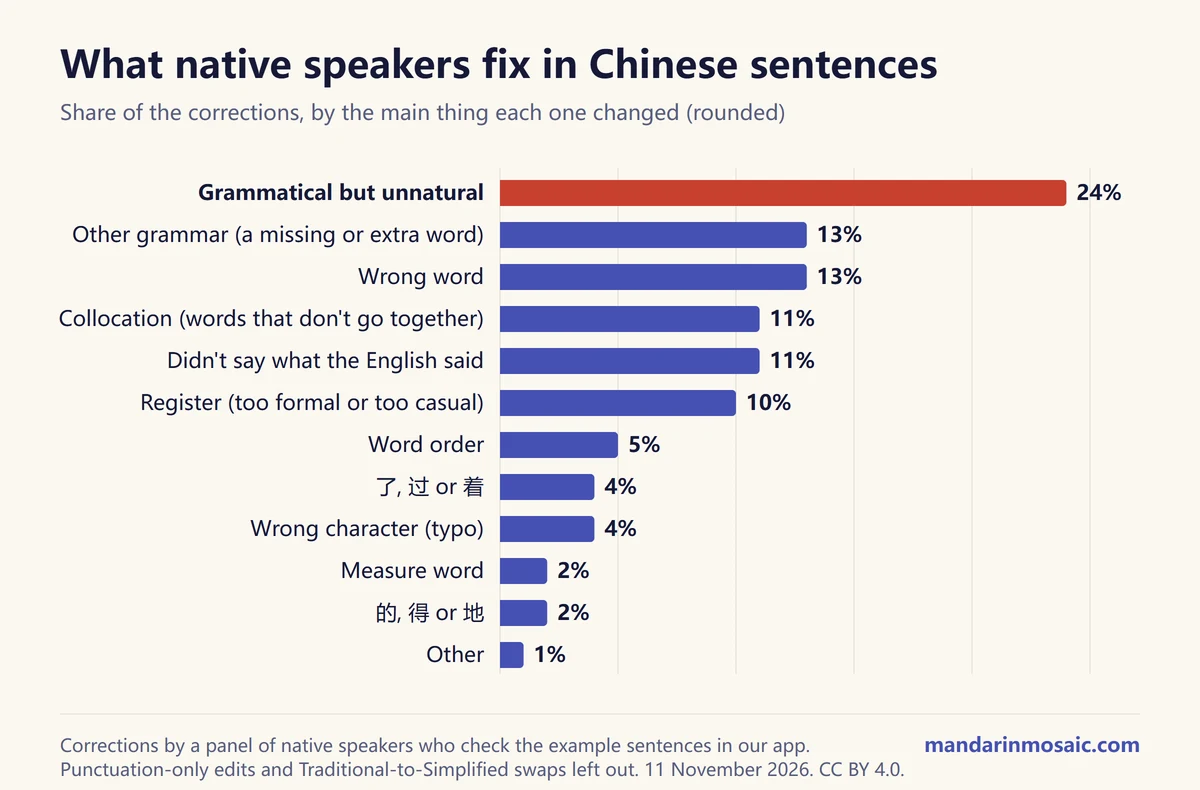
Mandarin Mosaic teaches Chinese through example sentences, and a panel of native speakers checks them. When one of them changes a sentence's Chinese, the original and the corrected version are both kept. We went through every one of those corrections and sorted them by what the native speaker fixed. The result is a picture of what actually goes wrong in written Chinese, and it isn't the list most textbooks would predict.
Below are the ranked types, then a section for each of the big ones, with before-and-after examples taken from the native speakers' own corrections and a short note on how to avoid each mistake. The method and its limits are at the end.
The Mistakes Native Speakers Fixed, Ranked
Each correction is counted once, under the main thing it changed. Shares are of all corrections except punctuation-only edits and swaps of a Traditional character for its Simplified form, which we set aside (about 1 correction in 20).
| Rank | Type of fix | Share of fixes | The rule in one line |
|---|---|---|---|
| 1 | Grammatical but unnatural | 24% | Say it the way Chinese says it, not the way English does: 请坐, not 请你坐下. |
| 2 | Other grammar (a missing or extra word) | 13% | Put in the small words Chinese needs: 会 for a prediction, 都 after 每, 把 to move an object. |
| 3 | Wrong word | 13% | Check what the Chinese word means, not just its dictionary gloss: a date you go on is 约会, not 日期. |
| 4 | Collocation (words that don't go together) | 11% | Learn verbs with their usual objects: 打羽毛球, not 玩羽毛球. |
| 5 | Didn't say what the English said | 11% | Check the Chinese says everything the English does, and nothing more. |
| 6 | Register (too formal or too casual) | 10% | Use everyday words in everyday sentences: 要, not 将. |
| 7 | Word order | 5% | Time goes before the verb, and descriptions before the noun. |
| 8 | 了, 过 or 着 | 4% | Use 了 for a completed action and 过 for an experience. |
| 9 | Wrong character (typo) | 4% | Check characters that sound or look alike: 花 and 发, 像 and 象. |
| 10 | Measure word | 2% | Each noun takes its own measure word: 一只狗, not 一个狗. |
| 11 | 的, 得 or 地 | 2% | 的 before a noun, 得 after a verb, 地 before a verb. |
| 12 | Other | 1% |
The table is free to reuse: download it as a CSV (CC BY 4.0, please link this page).
Two of the types don't get a section of their own. "Didn't say what the English said" covers fixes that changed the content rather than the Chinese: a missing "my", the wrong person, a detail left out. Typos are characters that sound or look like the right one, such as 发 (fā) for 花 (huā) in 花时间 (huā shíjiān, to spend time).
1. Grammatical but Unnatural: The Commonest Fix
A quarter of the corrections fixed a sentence that had nothing wrong with its grammar. A learner could parse it, a dictionary would back every word, and a Chinese speaker would understand it. It just isn't how anyone would say it, and the native speaker rewrote it the way Chinese puts the idea.
| Before | Native speaker's version | English |
|---|---|---|
| 请你坐下。 | 请坐。qǐng zuò. | Please sit down. |
| 请问,你的名字是什么? | 请问,你叫什么名字?qǐngwèn, nǐ jiào shénme míngzi? | Excuse me, what's your name? |
| 我仍在从时差中恢复过来 | 我还在倒时差。wǒ hái zài dǎo shíchā. | I'm still getting over jet lag. |
| 你是不是喜欢吃苹果? | 你喜欢吃苹果吗?nǐ xǐhuan chī píngguǒ ma? | Do you like apples? |
Every "before" sentence follows English. "Sit down" becomes 坐下, "what is your name" becomes 你的名字是什么, and "recovering from jet lag" becomes a word-for-word chain of 从……中恢复过来, where Chinese has a set phrase: 倒时差 (dǎo shíchā), "to adjust to the time difference". The last one is subtler: 你是不是喜欢吃苹果 isn't wrong, but it asks "you like apples, don't you?", checking a hunch. A plain question takes 吗.
The fixes also tend to be shorter. Chinese drops what context makes obvious: the 你 in "please (you) sit", the 我的 in "I'm washing (my) car". English needs those words; Chinese usually doesn't.
How to avoid it: don't build sentences from English. Learn how Chinese says common things, as whole sentences, and copy the shape. When you write, ask "have I seen a Chinese sentence like this?" rather than "is each word right?".
2. Other Grammar: The Small Words Chinese Needs
About 1 fix in 8 added or removed a small grammar word: a modal verb, a preposition, 把, 都, a complement after the verb. These are the words an English sentence has no slot for, so they're easy to leave out.
| Before | Native speaker's version | English |
|---|---|---|
| 天有点阴,可能下雨。 | 天有点阴,可能会下雨。tiān yǒudiǎn yīn, kěnéng huì xià yǔ. | It's a bit cloudy; it might rain. |
| 他停车在路边等待朋友的到来。 | 他把车停在路边等待朋友的到来。tā bǎ chē tíng zài lùbiān děngdài péngyou de dàolái. | He parked at the side of the road and waited for his friend to arrive. |
| 我每晚洗澡。 | 我每晚都洗澡。wǒ měi wǎn dōu xǐzǎo. | I have a bath every night. |
A prediction usually takes 会, even after 可能 ("might"); our guide to 会 vs 能 vs 可以 covers this use of 会. A verb plus a place where the object ends up (停在路边, park at the roadside) needs 把 to bring the object forward. And 每 ("every") is nearly always followed by 都 before the verb. Another fix in this group is a classic: 帮忙我 became 帮助我, because 帮忙 can't take an object (see commonly confused Chinese words).
How to avoid it: notice the small words in the sentences you study, and learn patterns rather than words: 每……都, 可能会, 把 + object + 在 + place.
3. Wrong Word: When the Dictionary Gloss Misleads
About 1 fix in 8 swapped a word for one with a different meaning. Most came from an English word with two senses, where the Chinese picked the wrong one.
| Before | Native speaker's version | English |
|---|---|---|
| 我好像有点失落了。 | 我好像有点迷路了。wǒ hǎoxiàng yǒudiǎn mílù le. | I seem to be a bit lost. |
| 我明天有一个重要的日期。 | 我明天有一个重要的约会。wǒ míngtiān yǒu yí ge zhòngyào de yuēhuì. | I have an important date tomorrow. |
| 我忘记了他的名称。 | 我忘记了他的名字。wǒ wàngjì le tā de míngzi. | I forgot his name. |
"Lost" can mean lost your way (迷路) or feeling lost and let down (失落, shīluò). "Date" can be a day in the calendar (日期, rìqī) or an appointment (约会). "Name" is 名字 for a person and 名称 (míngchēng) for an organisation or a product.
How to avoid it: when a dictionary gives one Chinese word for an English one, look at its example sentences before you use it. If none of them matches what you mean, it's probably the other sense.
4. Collocation: Words That Don't Go Together
About 1 fix in 9 kept the meaning but changed a partner word: the right idea, the wrong verb for that object, or the wrong adjective for that noun.
| Before | Native speaker's version | English |
|---|---|---|
| 我喜欢玩羽毛球。 | 我喜欢打羽毛球。wǒ xǐhuan dǎ yǔmáoqiú. | I love playing badminton. |
| 昨天下了一场大量的雨。 | 昨天下了一场大雨。zuótiān xià le yì chǎng dà yǔ. | There was heavy rain yesterday. |
| 我今天晚上会在家里看电视机。 | 我今天晚上会在家里看电视。wǒ jīntiān wǎnshang huì zài jiā li kàn diànshì. | I'll be watching TV at home tonight. |
"Play" is 打 (dǎ, literally "hit") for most ball games played with the hands or a racket: 打篮球, 打网球; football is 踢足球 (tī zúqiú, "kick"). Heavy rain is simply 大雨; 大量 (dàliàng, "a large quantity") is for amounts, not for a shower. And you watch 电视, television, not 电视机, the set.
How to avoid it: learn verbs together with their objects (打羽毛球, 看电视, 借书) and adjectives with their nouns, as one chunk.
5. Register: Too Formal for an Everyday Sentence
About 1 fix in 10 kept the meaning but swapped a formal or literary word for the one people use in conversation. Almost all went in that direction: a stiff word replaced by a plain one.
| Before | Native speaker's version | English |
|---|---|---|
| 我将送你一份生日礼物。 | 我要送你一份生日礼物。wǒ yào sòng nǐ yí fèn shēngrì lǐwù. | I'm going to give you a birthday present. |
| 我昨天乘坐飞机去旅行了。 | 我昨天坐飞机去旅行了。wǒ zuótiān zuò fēijī qù lǚxíng le. | Yesterday I flew off on a trip. |
| 你喜欢不喜欢烹调? | 你喜欢不喜欢做饭?nǐ xǐhuan bu xǐhuan zuò fàn? | Do you like cooking? |
将 (jiāng) is the future marker of news reports and announcements; in conversation, "going to" is 要 or 会. 乘坐 (chéngzuò) is what a flight announcement says; you just 坐 a plane. 烹调 (pēngtiáo) is cookery as a craft, and at home you 做饭.
How to avoid it: be wary of the first word a dictionary gives for an English verb; it's often the formal one. Check its examples, and prefer the word you've heard in conversation.
6. Word Order
About 1 fix in 20 moved words without changing them. Most moved a time word, or a description, to the place Chinese puts it.
| Before | Native speaker's version | English |
|---|---|---|
| 我想请假明天不上班。 | 我想明天请假不上班。wǒ xiǎng míngtiān qǐngjià bú shàngbān. | I'd like to take tomorrow off work. |
| 我需要买一张机票去旧金山。 | 我需要买一张去旧金山的机票wǒ xūyào mǎi yì zhāng qù jiùjīnshān de jīpiào | I need to buy a plane ticket to San Francisco. |
| 你吓死了我 | 你吓死我了nǐ xià sǐ wǒ le | You scared me to death |
Time comes before the verb, and descriptions come before the noun, however long they are: "a ticket to San Francisco" is "a to-San-Francisco ticket". The third is a set phrase: 吓死我了, with 了 at the end. Our guide to Chinese sentence structure sets out where each part goes.
How to avoid it: before you write, sort the parts into Chinese order: who, when, where, how, then the verb and its object.
7. 了, 过 and 着
About 1 fix in 25 added, removed or swapped an aspect particle. More often than not, a 了 or a 过 was missing.
| Before | Native speaker's version | English |
|---|---|---|
| 他昨天打扫房间吗? | 他昨天打扫房间了吗?tā zuótiān dǎsǎo fángjiān le ma? | Did he clean the room yesterday? |
| 即使多年没有看见我的同学,我也马上认出了他。 | 即使多年没有见过我的同学,我也马上认出了他。jíshǐ duō nián méiyǒu jiànguo wǒ de tóngxué, wǒ yě mǎshàng rènchū le tā. | Even though I hadn't seen my classmate for years, I recognised him at once. |
A question about whether something happened takes 了: 昨天 on its own doesn't mark it. "Haven't seen for years" is an experience, so it takes 过. Our guide to Chinese particles covers all three.
How to avoid it: when an English sentence is in the past, ask whether it's a completed action (了), an experience (过) or a habit (no particle).
Measure Words and 的, 得, 地: Rarer Than You'd Think
Measure words and the three "de" particles fill whole chapters of grammar books, but each was the main fix in only about 1 correction in 50. When they did go wrong, it was the familiar slip: 个 where the noun has its own measure word, or 的 where 地 or 得 belongs.
| Before | Native speaker's version | English |
|---|---|---|
| 我有一个很可爱的老狗。 | 我有一只很可爱的老狗。wǒ yǒu yì zhī hěn kě'ài de lǎo gǒu. | I have a very sweet old dog. |
| 他为她准备了一个浪漫的晚餐。 | 他为她准备了一顿浪漫的晚餐。tā wèi tā zhǔnbèi le yí dùn làngmàn de wǎncān. | He made her a romantic dinner. |
| 她真心真意的帮助我。 | 她真心真意地帮助我。tā zhēnxīn zhēnyì de bāngzhù wǒ. | She helps me with all her heart. |
| 他总是用这样得方式说话,所以每个人都讨厌他。 | 他总是用这样的方式说话,所以每个人都讨厌他。tā zǒngshì yòng zhèyàng de fāngshì shuōhuà, suǒyǐ měi ge rén dōu tǎoyàn tā. | He always talks in a way that makes everyone dislike him. |
That doesn't mean they're easy for learners: a sentence written carefully, with a dictionary to hand, gets the measure word right far more often than someone speaking in real time. Our guides to Chinese measure words and 的, 得 and 地 have the rules and the lists.
What This Means for Learners
If you write Chinese by translating from English in your head, these corrections show what goes wrong. Grammar is the smaller problem. Even when the grammar works, the result tends to be English wearing Chinese words: the wrong sense of a word, the wrong partner verb, a formal word in a casual sentence, or a sentence nobody would say. More grammar drills won't fix most of that. Exposure to how Chinese says things will.
- Learn sentences, not words. Every fix above is easier to avoid if you've met the natural version before. 打羽毛球 and 倒时差 stick when you learn them inside a sentence. That's the idea behind sentence mining.
- Use sentences at your level. You'll only absorb how Chinese phrases things if you understand nearly all of a sentence. Our post on finding sentences at your level explains how to find them.
- Imitate, then vary. When you write your own sentences, start from one you've seen and change a word or two, rather than building from English.
- Ask a native speaker, and expect different answers. Corrections are judgement calls, as the next section shows; when two people disagree, both versions are often fine.
The sentences in this study are the example sentences in Mandarin Mosaic, our sentence-mining app, which is why we have this data (our honest review of our own app covers what it does and doesn't do). Its HSK lessons teach each word through native-checked sentences like the corrected ones above.
Method and Limits
- Who corrected. A panel of native speakers who check the example sentences in our app. They mark each sentence's Chinese as right or wrong and can type a corrected version. Much of the checking happens outside the app, so these corrections are only part of it.
- What counted as a fix. Every correction where the native speaker's Chinese differed from the sentence they were shown, collected on 11 November 2026. Edits that only changed punctuation or spacing, or only swapped a Traditional character for its Simplified form (著 to 着), were set aside: about 1 correction in 20.
- How we classified them. A script compared each before and after character by character and labelled the mechanical changes: a measure word swapped, 了 added or removed, 的 for 地, the same characters in a new order. That covered about 1 in 10. An AI model then read and labelled the rest, one correction at a time, from written definitions of each type.
- The hand check. We labelled a random sample of 100 corrections by hand, without looking at the first labels. The two agreed on 85 of the 100, and on 87 when a correction's second type counts as a match. Nearly all the disagreements were between neighbouring types, such as "unnatural" versus "wrong word" versus "collocation", so read those shares as give or take a few points. The labels haven't been checked by a native-speaking linguist.
- Categories overlap. Each correction is counted once, under its main change, but about 1 in 4 changed more than one thing. A rewritten sentence often fixes a word, the order and a particle at once.
- These are example sentences, not learners' writing. Many of them started life as translations of English sentences, so the errors are the ones translation produces. Learners writing from scratch probably make more of the basic slips, such as measure words and 了, than this ranking shows.
- A correction is one person's judgement. Some sentences were checked by more than one native speaker. Where a correction was made to wording another native speaker had already passed, it usually reflects a preference for a more natural phrasing rather than a plain mistake. On one sentence, a native speaker changed 我正在洗车 ("I'm washing the car") to 我正在洗我的车 to match "my car", and a later one changed it back. Read the shares as what native speakers chose to change, not as a list of things that are always wrong.
- What the figures aren't. They're shares of the corrections, not a measure of how often sentences are wrong.
Cite This Page
Mandarin Mosaic (2026), "What Native Speakers Fix in Chinese Example Sentences", 11 November 2026, https://mandarinmosaic.com/blog/native-speaker-corrections-chinese-sentences. The aggregate table is available as a CSV under CC BY 4.0.
Frequently Asked Questions
What Are the Most Common Mistakes in Written Chinese?
In native speakers' corrections to Chinese example sentences, the commonest fix was rewording a sentence that was grammatical but unnatural, about a quarter of all fixes. Word choice came next (the wrong word, words that don't go together, or a word too formal for the sentence) at about a third, with grammar mistakes of every kind at about a quarter.
Are Measure Words a Common Mistake in Chinese?
Less than you might think: a wrong or missing measure word was the main fix in only about 2% of native speakers' corrections. The usual slip was 一个 with a noun that takes its own measure word, as in 一只狗 (a dog) or 一顿晚餐 (a dinner).
What Does "Grammatical but Unnatural" Mean in Chinese?
It's a sentence with correct grammar that a native speaker still wouldn't say, usually because it follows English: 请你坐下 for "please sit down", where Chinese says 请坐. Native speakers fix these by rewriting the idea the way Chinese puts it, often in fewer words.
Do Native Speakers Agree on What Is Correct Chinese?
On clear errors, yes; on what sounds most natural, not always. Some corrections in our data rewrote wording another native speaker had already passed, so read "unnatural" fixes as one speaker's better phrasing rather than a rule.
How Can I Make My Chinese Sound More Natural?
Learn words inside whole sentences, and when you write, start from a sentence you've seen rather than translating from English. Most of the native speakers' corrections replaced English-shaped Chinese with the way Chinese normally says the same thing.