 Mandarin Mosaic
Free on iPhone, iPad and Android.
Download on theApp Store Get it onGoogle PlayYour first month of Premium is free.
The Top 10 Most Common Chinese Surnames: A Learner's Guide
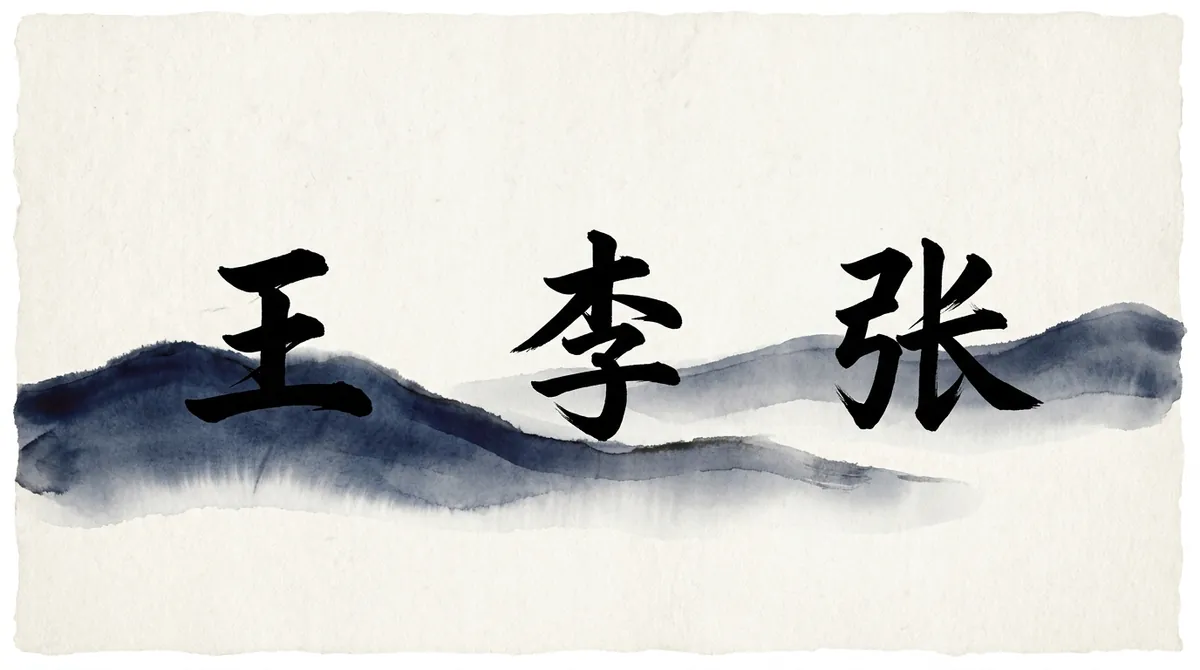
A handful of surnames cover a remarkable share of China's 1.4 billion people. According to the Ministry of Public Security's national name report for 2020 (published in February 2021 and based on household registration data), the five most common surnames, 王 (wáng), 李 (lǐ), 张 (zhāng), 刘 (liú) and 陈 (chén), are shared by 30.8% of the registered population. The ministry's 2019 report gives the full top ten as 王, 李, 张, 刘, 陈, 杨, 黄, 赵, 吴 and 周, with 王 in first place. 王 and 李 are close enough that some surveys put 李 first, so you'll see both called China's biggest surname.
For learners, that makes surnames some of the highest-frequency characters you'll meet. They turn up in news stories, TV dramas, textbooks and introductions, and recognising them instantly tells you "this is a person" before you've read the rest of the sentence. The most common full name of all, by the way, is 张伟 (zhāng wěi), shared by nearly 300,000 people in 2019.
For each surname below you'll find the character (with its traditional form where it differs), pinyin and tone, a pronunciation hint, the traditional account of its origin, famous bearers, and an example sentence. After the top ten there's a table of Hong Kong and Taiwan spellings, a section on two-character surnames like 欧阳 (ōuyáng), and the phrases you need to ask someone's surname politely.
1. 王 (wáng) - The Royal Surname
王 means "king". It's one of the first characters most learners meet, and as a surname you'll see it everywhere, from news reports to the teacher at the front of the class.
Origin and Meaning
Several unrelated families took the name 王. The best-known traditional account traces it to the Zhou dynasty royal house: descendants of princes such as Prince Jin (太子晋, tàizǐ jìn), the son of King Ling of Zhou, were known as "the king's family" and kept 王 as their surname. Other families adopted it later, sometimes as an honour granted by an emperor. The character has just four strokes, so it's an easy one to start with if you're practising stroke order.
For Mandarin Learners: 王 also appears in everyday words such as 王子 (wángzǐ, prince) and 国王 (guówáng, king). Recognising it instantly is an easy early win.
Pronunciation and Usage
- Pinyin: wáng (w + áng, 2nd tone, rising)
- English Pronunciation Hint: Sounds like "wahng", rising as if you're asking a question.
Famous bearers include the singer 王菲 (wáng fēi, Faye Wong). As with every Chinese name, the surname comes first: 王 is her family name and 菲 her given name.
Example Sentence:
王先生是我的邻居。 (wáng xiānsheng shì wǒ de línjū.) Mr Wang is my neighbour.
Surname + 先生 (xiānsheng, Mr) is the standard polite way to refer to a man you don't know well. For more on how single characters carry meaning, see our post on the meaning of Chinese symbols.
2. 李 (lǐ) - The Plum Tree Legacy
李 means "plum" (as in 李子, lǐzi, plum) and is neck and neck with 王 as China's most common surname. Its long history and its link to one of China's most celebrated dynasties make it a name you'll meet constantly in history and literature.
Origin and Meaning
The traditional story begins with 皋陶 (gāo yáo), a legendary minister in charge of justice under the early sage kings. His descendants took the surname 理 (lǐ), after the title of their office. Late in the Shang dynasty, the story goes, one of them fled persecution and survived by eating wild plums, so the family changed its name to the plum character 李. The name gained enormous prestige under the Tang dynasty (618–907), whose emperors were all surnamed 李, and who granted it to many loyal families.
For Mandarin Learners: 李 is 木 (mù, tree) on top of 子 (zǐ, child), a handy picture for remembering a fruit tree. Because of figures like the Tang poet 李白 (lǐ bái), it appears constantly in classical poems and history books.
Pronunciation and Usage
- Pinyin: lǐ (l + ǐ, 3rd tone, low and dipping)
- English Pronunciation Hint: Like the English name "Lee", but low and dipping.
The third tone gives you good practice with one of the trickiest tones for English speakers. Note that before another third tone it changes: 李老师 (lǐ lǎoshī, Teacher Li) is said as lí lǎoshī. For more on this, see our guide to tones in Chinese.
Example Sentence:
李娜是一位有名的网球运动员。 (lǐ nà shì yí wèi yǒumíng de wǎngqiú yùndòngyuán.) Li Na is a famous tennis player.
Li Na won the French Open in 2011 and the Australian Open in 2014, the first Asian player to win a Grand Slam singles title. The pattern "X 是一位 + profession" is a useful, polite way to introduce what someone does.
3. 张 (zhāng) - The Expansive Surname
张 (traditional 張) means "to open" or "to stretch out", and it's also one of the most common measure words in Chinese. That double life makes it a particularly useful character to know.
Origin and Meaning
According to legend, the surname was given to 挥 (huī), a grandson of the Yellow Emperor who was credited with inventing the bow and arrow. The character fits the story: it combines 弓 (gōng, bow), which gives the meaning, with 长 (cháng), which hints at the sound. Its original meaning was to draw a bowstring, which grew into "to open" or "to stretch".
For Mandarin Learners: Outside names, you'll use 张 every day as the measure word for flat things: 一张纸 (yì zhāng zhǐ, a sheet of paper), 两张票 (liǎng zhāng piào, two tickets), 一张桌子 (yì zhāng zhuōzi, a table). It's also a verb in words like 张开 (zhāngkāi, to open up).
Pronunciation and Usage
- Pinyin: zhāng (zh + āng, 1st tone, high and level)
- English Pronunciation Hint: Roughly "jahng", held high and flat with no rise or fall. The zh is made with the tongue curled slightly back.
Famous examples include the film director 张艺谋 (zhāng yìmóu) and the Hong Kong singer 张学友 (zhāng xuéyǒu), known in English as Jacky Cheung, Cheung being the Cantonese spelling. The simplified character has 7 strokes (the traditional 張 has 11).
Example Sentence:
张老师教我们中文。 (zhāng lǎoshī jiāo wǒmen zhōngwén.) Teacher Zhang teaches us Chinese.
Surname + title (老师 lǎoshī, teacher; 医生 yīshēng, doctor; 经理 jīnglǐ, manager) is how you address most people at work or school in China. Calling a teacher just "teacher" or by their given name would sound odd.
4. 刘 (liú) - The Warrior Lineage
刘 (traditional 劉) is the surname of the Han dynasty emperors, the dynasty that gave the Han Chinese their name. It's especially common in northern China.
Origin and Meaning
In classical Chinese, 刘 was an old word for a kind of axe-like weapon and could mean "to kill", which is why it has the knife component 刂 on the right. Tradition traces the surname to 刘累 (liú lěi), a descendant of the sage-king Yao who was said to raise dragons for a Xia king, and to a small Zhou-era fief called 刘. Its status soared when 刘邦 (liú bāng) founded the Han dynasty in 202 BC.
For Mandarin Learners: Historical dramas and novels are full of 刘. The best-known is 刘备 (liú bèi), the warlord who founded the Shu Han state in the Three Kingdoms period. A modern example is the Hong Kong star 刘德华 (liú déhuá), whose English name, Andy Lau, uses the Cantonese spelling.
Pronunciation and Usage
- Pinyin: liú (l + iú, 2nd tone, rising)
- English Pronunciation Hint: Close to "lyoh", rising. Pinyin iu is short for iou, so there's a faint o sound in the middle.
Watch out for 列 (liè, row, to line up), which shares the 刂 component and looks similar at a glance.
Example Sentence:
刘女士是我们的新经理。 (liú nǚshì shì wǒmen de xīn jīnglǐ.) Ms Liu is our new manager.
女士 (nǚshì, Ms) is the safe, polite title for a woman when you don't know her marital status. In mainland China most women keep their own surname after marriage, so Ms Liu's husband may well have a different surname.
5. 陈 (chén) - The Earth-Rooted Name
陈 (traditional 陳) is the fifth most common surname on the mainland, and the most common in Taiwan. It's particularly widespread in southern China, especially Guangdong and Fujian, and among overseas Chinese communities.
Origin and Meaning
The surname comes from the State of Chen (陈国, chén guó), which King Wu of Zhou granted to 妫满 (guī mǎn), said to be a descendant of the sage-king Shun. After Chen was conquered by the state of Chu in 478 BC, many of its people took the state's name as their surname. As a word, 陈 means "old" or "stale", as in 陈旧 (chénjiù, outdated), and "to display", as in 陈列 (chénliè, to put on display).
The character combines 阝 on the left, a form of 阜 (fù, mound) that often appears in characters to do with hills and places, with 东 (dōng, east) on the right.
For Mandarin Learners: 陈 is a good example of how one character gets many spellings. It's chén in pinyin, Chen in Taiwan, Chan in Hong Kong (from Cantonese) and Tan in Singapore, Malaysia and the Philippines (from Hokkien and Teochew). Mr Chan and Mr Tan may share exactly the same surname.
Pronunciation and Usage
- Pinyin: chén (ch + én, 2nd tone, rising)
- English Pronunciation Hint: Like "chun" in "church" with an n ending, rising.
A well-known bearer is the actor 陈坤 (chén kūn).
Example Sentence:
陈女士是我们的新老师。 (chén nǚshì shì wǒmen de xīn lǎoshī.) Ms Chen is our new teacher.
Swap in any surname and job to make your own version of this pattern.
6. 杨 (yáng) - The Growth Principle
杨 (traditional 楊) means "poplar", as in 杨树 (yángshù, poplar tree), and appears in the classic pairing 杨柳 (yángliǔ), poplars and willows, a common image in Chinese poetry.
Origin and Meaning
The surname is traditionally traced to a small Zhou-era state called Yang (杨国, yáng guó), in today's Shanxi province. After the state of Jin absorbed it, the land was given to a Jin noble family, and their descendants adopted 杨 as their surname. Later the Sui dynasty (581–618) was founded by 杨坚 (yáng jiān), which made the name imperial for a time.
For Mandarin Learners: 杨 is a clear example of a character with a meaning part and a sound part: 木 (mù, tree) on the left tells you it's a tree, and the right-hand part hints at the sound yáng. The 木 component appears in hundreds of characters to do with trees, plants and wood, so it's worth knowing well. Our post on radicals in Chinese explains how these components work.
Pronunciation and Usage
- Pinyin: yáng (y + áng, 2nd tone, rising)
- English Pronunciation Hint: "Yahng", with the a of "father", rising. It doesn't rhyme with the English word "young".
Famous bearers include 杨利伟 (yáng lìwěi), the first Chinese astronaut in space (2003), and the actress 杨幂 (yáng mì). For character recognition, try telling it apart from other tree characters such as 林 (lín, woods) and 柏 (bǎi, cypress), which are also surnames.
Example Sentence:
杨老师教我们中文。 (yáng lǎoshī jiāo wǒmen zhōngwén.) Teacher Yang teaches us Chinese.
Try saying 杨老师 and 张老师 one after the other: the only difference is the tone of the surname, rising for yáng and high and level for zhāng.
7. 黄 (huáng) - The Imperial Colour
黄 (traditional 黃) means "yellow", a colour with deep imperial associations in China. The surname is especially common in the south.
Origin and Meaning
The main traditional origin is the State of Huang (黄国, huáng guó), a small Zhou-era state that was conquered by Chu in 648 BC. Its people adopted the state's name as their surname. In people's minds the character is also tied to the legendary Yellow Emperor (黄帝, huángdì), traditionally regarded as an ancestor of the Chinese people, although the Yellow Emperor's own clan name is usually given as 姬 (jī) or 公孙 (gōngsūn), not 黄.
For Mandarin Learners: In the Ming and Qing dynasties, bright yellow was reserved for the emperor, so 黄 links to a whole set of cultural associations. In Hong Kong, 黄 is spelled Wong, exactly like 王, because the two surnames sound the same in Cantonese. If you meet a Mr Wong, you can't tell which character he uses until you ask.
Pronunciation and Usage
- Pinyin: huáng (h + uáng, 2nd tone, rising)
- English Pronunciation Hint: Like "hwahng", rising. The h is breathier than in English, close to the ch in Scottish "loch".
Famous examples include the actors 黄晓明 (huáng xiǎomíng) and 黄渤 (huáng bó).
Example Sentence:
黄女士最喜欢的颜色是黄色。 (huáng nǚshì zuì xǐhuan de yánsè shì huángsè.) Ms Huang's favourite colour is yellow.
This sentence uses the same character as a name and as a colour, a nice way to fix both in your memory. Colours and numbers both carry strong associations in Chinese culture; see our post on why 8 is a lucky number for another example.
8. 赵 (zhào) - The First Name in the Hundred Family Surnames
赵 (traditional 趙) has no everyday meaning beyond the surname and the old state it comes from, but it holds a special place: it's the very first surname in the 百家姓 (bǎijiāxìng, Hundred Family Surnames), the classic rhyming list of surnames that children once learned by heart.
Origin and Meaning
Tradition traces 赵 to 造父 (zào fù), the charioteer of King Mu of Zhou, who was rewarded with the town of Zhaocheng (赵城, zhàochéng). His descendants later ruled the State of Zhao, one of the seven Warring States, formed when the state of Jin split up in the fifth century BC. Much later, 赵匡胤 (zhào kuāngyìn) founded the Song dynasty in 960. The Hundred Family Surnames was written early in the Song, which is why it opens with the emperor's surname: 赵钱孙李 (zhào qián sūn lǐ).
For Mandarin Learners: 赵 is made of 走 (zǒu, to walk) and a small extra part. 走 is one of the most useful verbs in Chinese, and it appears as a component in characters to do with movement, such as 起 (qǐ, to rise) and 超 (chāo, to overtake).
Pronunciation and Usage
- Pinyin: zhào (zh + ào, 4th tone, falling)
- English Pronunciation Hint: Roughly "jow" (rhyming with "now"), said with a sharp, firm fall, as if giving an order.
Famous bearers include the actresses 赵薇 (zhào wēi, Vicki Zhao) and 赵丽颖 (zhào lìyǐng). In Taiwan the name is usually spelled Chao, and in Hong Kong Chiu.
Example Sentence:
赵经理今天不在办公室。 (zhào jīnglǐ jīntiān bú zài bàngōngshì.) Manager Zhao isn't in the office today.
Note that 不 changes to bú before the fourth tone of 在.
9. 吴 (wú) - The Southern Realm
吴 (traditional 吳) is strongly associated with the Yangtze River Delta, the area around Shanghai, Suzhou and Hangzhou, where the ancient state of Wu was based.
Origin and Meaning
The State of Wu (吴国, wú guó) flourished in the Spring and Autumn period, in what is now southern Jiangsu, with its capital near modern Suzhou. Tradition says it was founded by 太伯 (tàibó), an uncle of King Wen of Zhou, who left the north and settled among the southern peoples. Wu was conquered by its rival Yue in 473 BC, and many of its people took 吴 as their surname. The region kept the name: the dialects spoken there, including Shanghainese, are still called 吴语 (wúyǔ, Wu Chinese). Don't confuse the surname with Eastern Wu in the Three Kingdoms period, which was named after the region and ruled by the 孙 (sūn) family.
For Mandarin Learners: 吴 has the mouth component 口 (kǒu) on top. Spotting familiar components like this makes new characters much easier to remember.
Pronunciation and Usage
- Pinyin: wú (w + ú, 2nd tone, rising)
- English Pronunciation Hint: Like "woo", rising as if asking "Who?"
Famous bearers include the action star 吴京 (wú jīng) and the actor 吴彦祖 (wú yànzǔ), known in English as Daniel Wu. In Hong Kong, 吴 is spelled Ng, from its Cantonese pronunciation.
Example Sentence:
吴女士是一位著名的演员。 (wú nǚshì shì yí wèi zhùmíng de yǎnyuán.) Ms Wu is a famous actress.
Note the tone change: 一 is said yí before the fourth tone of 位.
10. 周 (zhōu) - The Complete Circle
周 shares its name with the Zhou dynasty (c. 1046–256 BC), the longest-ruling dynasty in Chinese history. It's also a common everyday word, which makes it doubly worth learning.
Origin and Meaning
Interestingly, the Zhou royal family's own clan name was 姬 (jī). After the dynasty ended, many of its descendants took the dynasty's name, 周, as their surname. The Zhou period produced thinkers such as Confucius and Laozi, so the name carries strong cultural associations. As a word, 周 means "all around" or "complete", as in 周围 (zhōuwéi, surroundings), and "week", as in 周末 (zhōumò, weekend).
For Mandarin Learners: You'll meet 周 as "week" long before you study the Zhou dynasty: 这周 (zhè zhōu, this week), 上周 (shàng zhōu, last week), 下周 (xià zhōu, next week). Its balanced eight-stroke shape is also good handwriting practice.
Pronunciation and Usage
- Pinyin: zhōu (zh + ōu, 1st tone, high and level)
- English Pronunciation Hint: Like "joe", held high and flat.
Famous bearers include 周恩来 (zhōu ēnlái), the first Premier of the People's Republic of China, and the Taiwanese pop star 周杰伦 (zhōu jiélún), known as Jay Chou, Chou being the Taiwanese spelling.
Example Sentence:
你认识周经理吗? (nǐ rènshi zhōu jīnglǐ ma?) Do you know Manager Zhou?
Just outside the top ten come 徐 (xú) and 孙 (sūn), followed by names such as 马 (mǎ), 朱 (zhū), 胡 (hú) and 郭 (guō).
The Top 10 at a Glance, with Hong Kong and Taiwan Spellings
The same surname can look completely different in English depending on where the family comes from. Mainland China uses pinyin. Hong Kong spellings follow Cantonese pronunciation. Taiwanese passports have traditionally used older Wade-Giles-style spellings, although families choose their own. Mainland China and Singapore write the characters in simplified form, while Hong Kong and Taiwan use traditional characters (see our guide to learning traditional Chinese).
| Rank | Simplified | Traditional | Pinyin | Hong Kong | Taiwan (common) | Meaning or source |
|---|---|---|---|---|---|---|
| 1 | 王 | 王 | wáng | Wong | Wang | king |
| 2 | 李 | 李 | lǐ | Lee | Lee, Li | plum |
| 3 | 张 | 張 | zhāng | Cheung | Chang | to open, stretch |
| 4 | 刘 | 劉 | liú | Lau | Liu | an ancient axe |
| 5 | 陈 | 陳 | chén | Chan | Chen | old; State of Chen |
| 6 | 杨 | 楊 | yáng | Yeung | Yang | poplar |
| 7 | 黄 | 黃 | huáng | Wong | Huang | yellow |
| 8 | 赵 | 趙 | zhào | Chiu | Chao | State of Zhao |
| 9 | 吴 | 吳 | wú | Ng | Wu | State of Wu |
| 10 | 周 | 周 | zhōu | Chow | Chou | all around; week |
The ranking is different outside the mainland. In Taiwan, 陈 (陳) and 林 (lín) are the two most common surnames, and in Hong Kong 陈 (Chan) is the most common. The Wikipedia list of common Chinese surnames has rankings for each region.
Two-Character Surnames: 欧阳, 司马 and Friends
Almost all Chinese surnames are a single character, but a few are two characters long. They're rare, but they stand out, and several belong to famous historical figures:
- 欧阳 (ōuyáng): the most common compound surname today, borne by the Song dynasty writer 欧阳修 (ōuyáng xiū).
- 司马 (sīmǎ): originally an official title, roughly "master of horses". The historian 司马迁 (sīmǎ qiān) wrote the Records of the Grand Historian.
- 诸葛 (zhūgě): made famous by 诸葛亮 (zhūgě liàng), the brilliant strategist of the Three Kingdoms.
- 上官 (shàngguān) and 东方 (dōngfāng): familiar to anyone who reads martial arts novels.
With a compound surname, the whole two-character unit is the family name, so 司马迁 is Mr 司马, not Mr 司. A three-character name doesn't always mean a compound surname, though: most Chinese names are a one-character surname plus a two-character given name, like 周杰伦.
Using Surnames in Conversation
A few phrases let you put all this into practice:
- 您贵姓?(nín guìxìng?) "What is your (honourable) surname?" The polite way to ask, especially with someone older or in a business setting.
- 免贵姓王。(miǎn guì xìng wáng.) A modest reply: "No need for 'honourable', my surname is Wang."
- 我姓李,叫李明。(wǒ xìng lǐ, jiào lǐ míng.) "My surname is Li, and my name is Li Ming." 姓 (xìng) is for the surname, 叫 (jiào) for the full name.
- 老王 (lǎo wáng) and 小王 (xiǎo wáng): friendly forms of address between colleagues and friends. 老 ("old") is used for someone older than you, 小 ("little") for someone younger.
For more on introductions and choosing a Chinese name for yourself, see what is your Chinese name?
Turn Surnames into Sentences
Recognising these ten characters gives you an easy advantage: when one appears in a text, you know straight away that a person is being mentioned, whether it's a news story about 刘博士 (liú bóshì, Dr Liu) or a drama about the 陈 family. The next step is to use them, not just recognise them.
- Become a surname spotter: notice the top surnames in your graded readers, shows and podcasts. Each time you hear one, you reinforce its sound and tone.
- Make your own sentences: take a surname and a pattern you know: 黄先生是中国人。(huáng xiānsheng shì zhōngguó rén, Mr Huang is Chinese.)
- Use surnames to practise titles: 王老师 (wáng lǎoshī), 李医生 (lǐ yīshēng), 张经理 (zhāng jīnglǐ). It's more natural than practising "teacher" or "doctor" on its own.
Every surname you meet inside a sentence brings other words along with it. In 那位是杨小姐 (nà wèi shì yáng xiǎojiě, that's Miss Yang), you're reviewing 那位 (nà wèi, that person, polite) and 小姐 (xiǎojiě, Miss) as well as 杨. Learning from whole sentences like this is called sentence mining, and it's one of the most effective ways to build vocabulary past the beginner stage.
Mandarin Mosaic is a sentence-mining app for iOS and Android built on this idea. It tracks the words you know and teaches new ones in sentences with one new word where possible, with audio for every sentence and spaced repetition to bring words back before you forget them. You can also add your own sentences, such as the examples in this post, as a custom pack. Try it free at Mandarin Mosaic.