Mid-Autumn Festival in Chinese: 中秋节, Greetings and Mooncakes
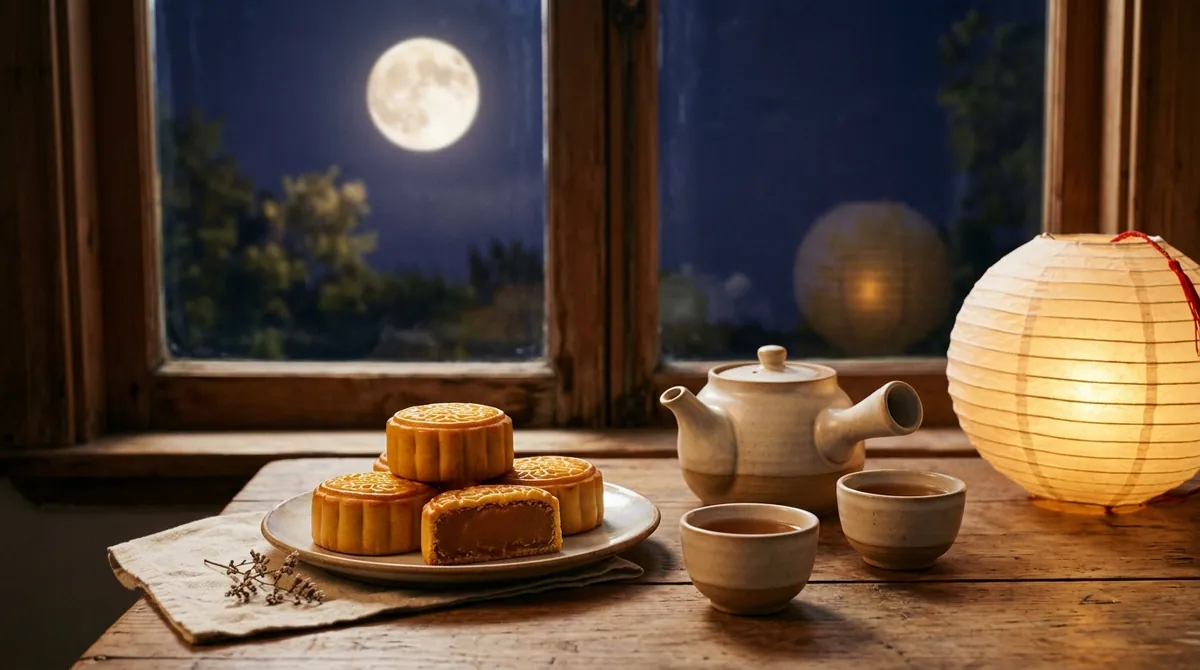
For Mandarin learners, the Mid-Autumn Festival in Chinese is called 中秋节 (zhōngqiū jié). It is a culturally significant time for families to come together, give thanks for the harvest, and celebrate under the glow of a full moon.
What the Mid-Autumn Festival Means in Chinese
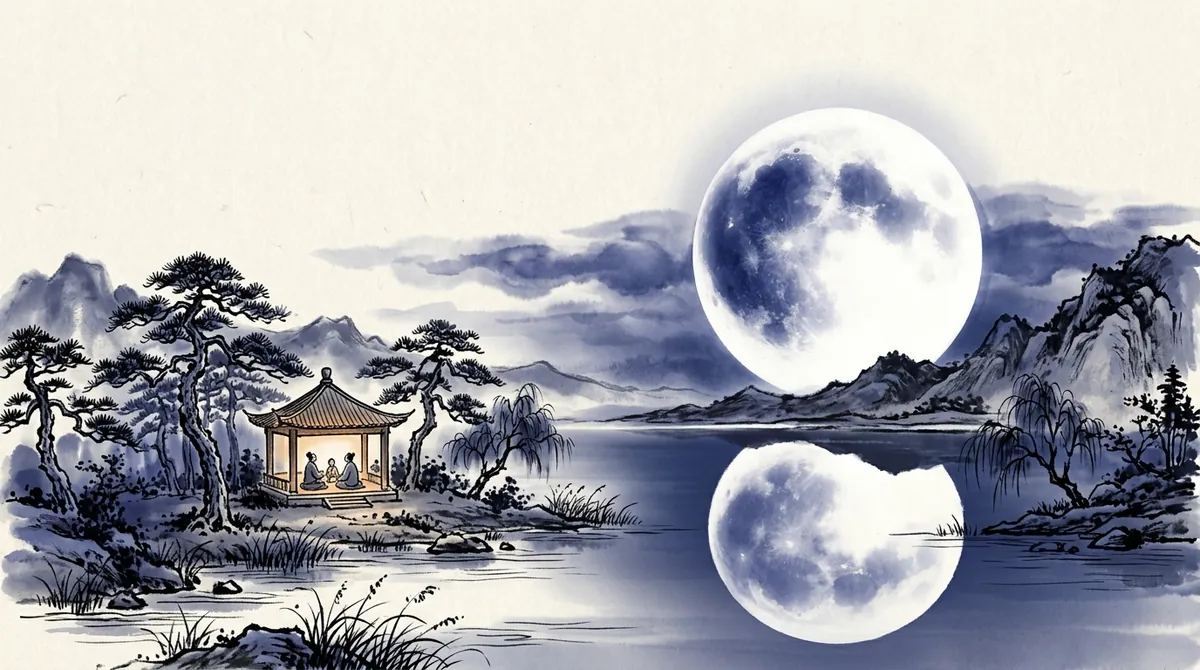
The Mid-Autumn Festival, or 中秋节 (zhōngqiū jié), is one of the most important holidays in Chinese culture, second only to the Lunar New Year. Its name gives you a direct clue about its timing: it translates literally to "middle autumn festival," as it falls right in the middle of autumn on the 15th day of the 8th lunar month.
At its very core, the festival is all about gathering and completeness. This brings us to a crucial concept for any student of Chinese: 团圆 (tuányuán), which means "reunion." The entire holiday revolves around this single idea—families travelling, sometimes great distances, to be together.
The Symbolism of the Full Moon
The connection between the full moon and family is deeply woven into the festival's DNA. The moon on this night isn't just a beautiful sight; it's a potent symbol with layers of meaning.
- Completeness: The moon's perfect, unbroken circle mirrors the idea of a complete family circle, with everyone present.
- Unity: Just as there is only one moon visible to everyone, the family is seen as a single, unified whole.
- Longing: For family members who can't make it home, gazing up at that same moon creates a poignant sense of connection to their loved ones far away.
This powerful symbolism is why one of the central activities is admiring the moon, or 赏月 (shǎngyuè). Families gather outside, often with snacks and tea, simply to appreciate the moon's beauty together. If you're curious about how symbols shape the culture, you can dive deeper into the meaning of Chinese symbols in our other guide.
The heart of 中秋节 (zhōngqiū jié) is perfectly captured by the idea of 团圆 (tuányuán). The roundness of the moon reflects the completeness of a family reunited, making it a celebration of togetherness, gratitude, and shared heritage.
Grasping this core concept of reunion gives you a solid foundation for understanding all the related vocabulary and customs. It transforms the holiday from a date on the calendar into a rich, meaningful experience that beautifully illustrates just how central family is in Chinese society.
The Legend of Chang'e and the Moon
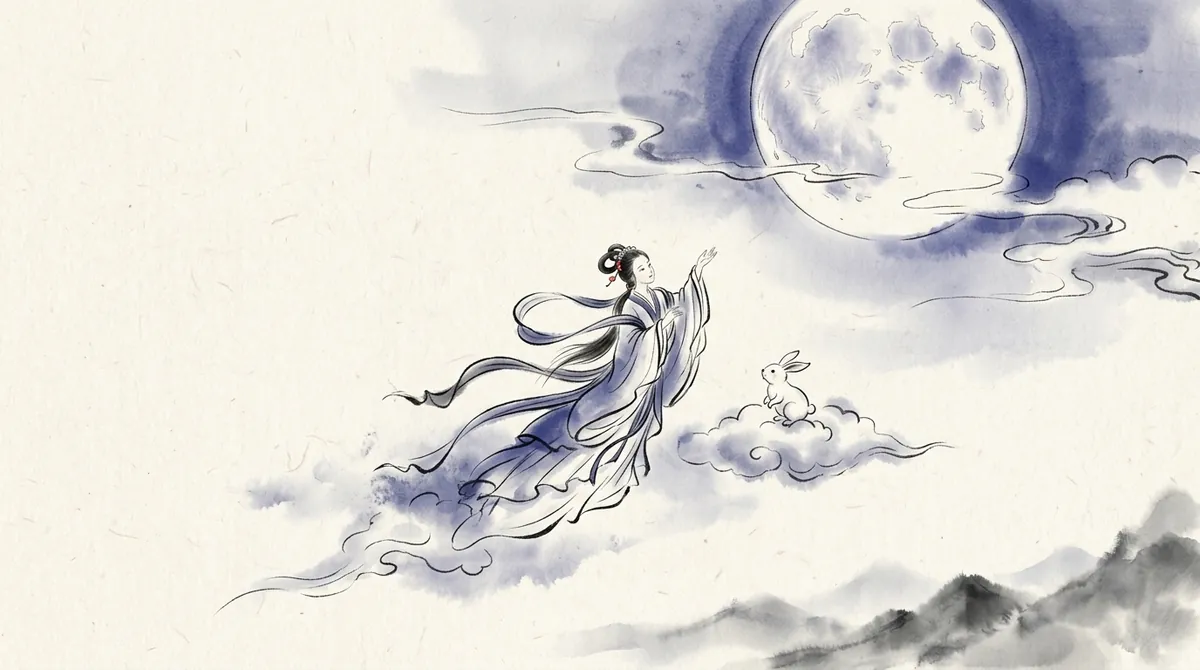
To really get to the heart of the Mid-Autumn Festival, you need to know the story that gives the celebration its soul. This is the ancient legend of 嫦娥 (cháng'é), the Moon Goddess, and her husband, the heroic archer 后羿 (hòuyì). It’s a beautiful, bittersweet tale of heroism, love, and sacrifice that has been told for more than two thousand years.
The story goes that long, long ago, ten suns beat down from the sky, scorching the earth and making life unbearable. People suffered terribly until Houyi, a masterful archer, stepped up. With incredible skill, he shot down nine of the ten suns, leaving just one to give gentle warmth and light. He was hailed as a hero.
For his bravery, the gods gifted Houyi an elixir of immortality, known in Chinese as 仙丹 (xiāndān). But Houyi loved his wife Chang'e more than anything and couldn't imagine an eternal life without her. So, he chose to remain mortal and gave the precious elixir to Chang'e to keep safe.
A Fateful Decision
One day, while Houyi was out hunting, one of his apprentices—a greedy man named Peng Meng—broke into their home and tried to steal the 仙丹 (xiāndān). Chang'e knew she couldn't fight him off. To protect the elixir from falling into the wrong hands, she made a split-second, desperate choice: she drank it herself.
Almost immediately, her body became weightless. She began to float up, away from her home and her beloved husband. She drifted higher and higher into the night sky until she finally landed on the moon, the closest place she could be to Earth to watch over Houyi.
Legend says that Chang'e made her home in the 月宫 (yuègōng), or the "Moon Palace." It’s believed she still lives there today, a solitary but gentle goddess, with only a Jade Rabbit for company.
When Houyi returned home and realised what had happened, he was utterly heartbroken. Consumed by grief, he looked up at the full, bright moon and was stunned to see a shimmering figure that looked just like his wife. He rushed to set out an offering of her favourite fruits and cakes in their garden, hoping she could see his tribute from her place in the sky.
This simple act of love and remembrance sparked a tradition that continues to this day. Every Mid-Autumn Festival, families gather to make offerings to the moon, honouring the beautiful and selfless Moon Goddess, Chang'e. The story transforms the moon from just a celestial body into a powerful symbol of love, sacrifice, and unbreakable bonds, adding a profound layer of meaning to the festival.
How Modern Families Celebrate the Festival
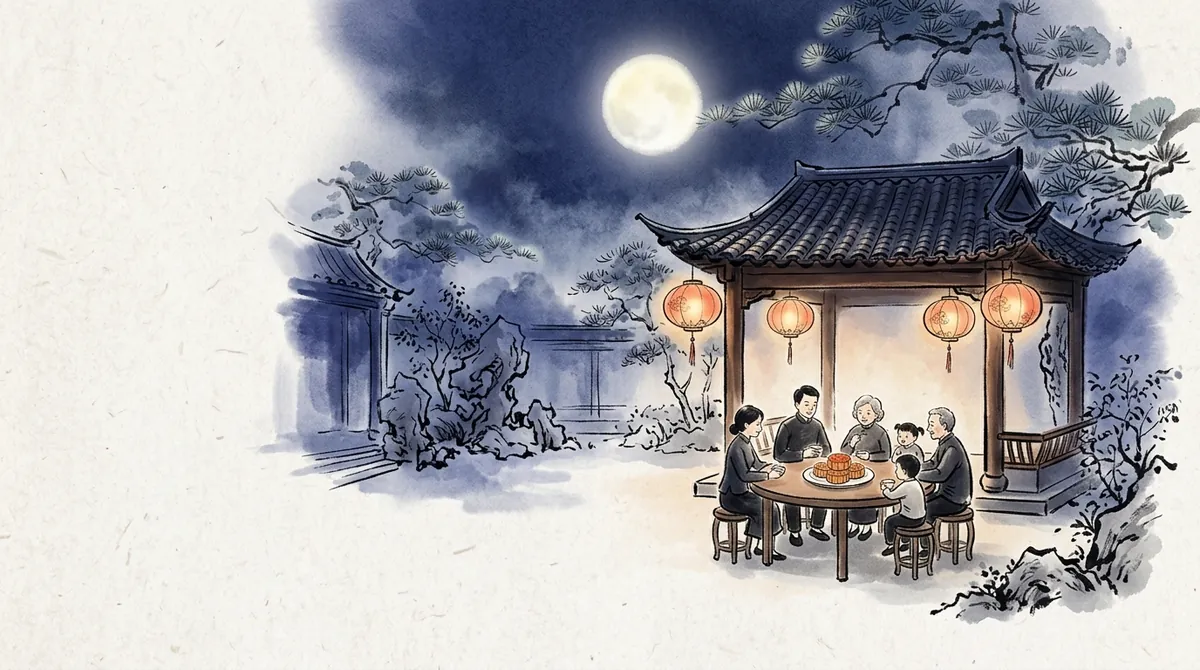
While the ancient legends provide a beautiful backdrop, the heart of the festival today beats strongest inside the family home. It’s a lively blend of old traditions and modern life, all centred around three core activities: eating, moon-gazing, and soaking up precious time together.
The evening nearly always kicks off with the 团圆饭 (tuányuánfàn), or reunion dinner. This is a significant event where families gather around a big table piled high with seasonal dishes, catching up on life and just enjoying being in the same room. The whole point is abundance and togetherness, driving home the festival’s central theme.
For anyone learning Mandarin, this setting is a goldmine for practical vocabulary around food and family chat.
The Iconic Mooncake
You can’t have a Mid-Autumn Festival without its most famous food: the 月饼 (yuèbǐng), or mooncake. These dense, round pastries are much more than a simple dessert. They’re a powerful symbol of family unity and wholeness, shaped to mirror the full moon hanging in the sky.
Sharing a mooncake is a ritual in itself. It’s often cut into small wedges, one for each family member, as a gesture of togetherness.
The sheer variety of mooncakes is staggering and really showcases China's rich culinary landscape. The flavours change dramatically from one region to another, making it a fascinating world for any foodie or language learner to explore.
- Sweet Fillings: The most classic style, especially popular in southern China, uses fillings like sweet lotus seed paste (莲蓉, liánróng) or red bean paste (豆沙, dòushā). You’ll often find a salted egg yolk in the centre, symbolising the moon.
- Savoury Fillings: In other parts of the country, you might bite into a mooncake filled with savoury minced meat (鲜肉, xiānròu), cured ham, or a sweet-and-savoury mix of nuts and seeds, sometimes with ham (五仁, wǔrén).
- Modern Twists: These days, bakers get incredibly creative. You can find "snow skin" mooncakes made with glutinous rice, and even fillings like chocolate, ice cream, or durian.
Gifting beautiful boxes of mooncakes to family, friends, and colleagues in the weeks before the festival is also a vital social custom.
The act of sharing a 月饼 (yuèbǐng) is a physical representation of 团圆 (tuányuán). Just as the family shares one moon in the sky, they share one mooncake at the table, reinforcing their connection and shared identity.
Admiring the Moon and Lighting Lanterns
After the big dinner, families often head outside to 赏月 (shǎngyuè), which means to admire the full moon. This isn't just a passive activity; it’s a cherished moment to sit together, sip tea, eat fruit and mooncakes, and simply appreciate the night's beauty. It’s a quiet, reflective tradition that connects them not just to each other, but to countless generations who gazed upon that very same moon.
Adding to the magic is the tradition of lighting lanterns, or 点灯笼 (diǎn dēnglóng). Kids especially love carrying colourful paper lanterns, often shaped like animals, cars, or their favourite cartoon characters. In many parks and public squares, you'll find elaborate lantern displays that create a spectacular sight for everyone to enjoy.
These modern activities are a fantastic opportunity to practise describing colours, shapes, and feelings in Chinese. You can even try recreating this festive vibe by finding ways to build Chinese immersion at home.
Celebrating the Moon Festival in the UK
The glow of the Mid-Autumn Festival travels far beyond China’s borders, and its traditions are kept vibrantly alive right across the United Kingdom. For Chinese international students, British Chinese families, and recent arrivals, these celebrations are a powerful and comforting link back to their heritage, transforming familiar UK cityscapes into hubs of festive activity.
This provides a fantastic opportunity for Mandarin learners to see the language and culture in a relatable, local context. Attending these events lets you see Mid-Autumn traditions firsthand, bridging the gap between textbook learning and real-world experience. You’ll hear greetings, see familiar symbols, and feel the community spirit that defines the holiday.
Major Celebrations in UK Cities
In cities such as London and Manchester, community events bring the festival's spirit to life for everyone to enjoy. These celebrations are a brilliant example of 文化交流 (wénhuà jiāoliú), or cultural exchange, where ancient traditions are shared with a wider, curious audience.
London's Chinatown has long been a focal point for these vibrant Mid-Autumn celebrations. The area buzzes with energy as thousands gather for performances, food stalls, and stunning lantern displays. These events can be especially poignant for those far from home, offering a taste of home during a holiday all about family reunion. You can see more about how London celebrates the Moon Festival on newseu.cgtn.com.
Community Gatherings and Cross-Cultural Vocabulary
Beyond the big public festivities, smaller community gatherings organised by university societies, cultural centres, and family associations play a crucial role. These events offer a more intimate setting for 海外华人 (hǎiwài huárén), or overseas Chinese, to connect and celebrate together. For a Mandarin learner, these gatherings are invaluable.
Participating in UK-based celebrations offers a unique chance to learn vocabulary relevant to the diaspora experience. Terms like 文化交流 (wénhuà jiāoliú) and 海外华人 (hǎiwài huárén) become more than just words on a list; they represent real people and living traditions.
These celebrations really highlight the global significance of the festival. You get to observe how core customs are adapted and preserved thousands of miles from their origin.
- Mooncake Sharing: Bakeries across the UK sell traditional and modern mooncakes, continuing the vital custom of sharing these symbolic treats with loved ones.
- Lantern Displays: While perhaps on a smaller scale, parks and community halls are often decorated with beautiful lanterns, echoing the colourful displays seen across Asia.
- Family Reunions: The fundamental principle of 团圆 (tuányuán) remains central. Families make a special effort to gather for a festive meal, even if it's in a London flat or a Manchester home.
Seeing how Chinese communities in the UK celebrate the festival provides a rich, multi-layered learning experience. It shows that culture isn't static but a dynamic, living force that travels with people, creating new forms of celebration while honouring ancient roots.
Essential Greetings and Festival Vocabulary
Now that you’ve got a handle on the stories and traditions, it’s time to get practical. Let’s look at the actual Chinese words and phrases you’ll need to talk about the Mid-Autumn Festival. Think of this as your toolkit for moving from just knowing about the festival to actually being a part of the conversation.
First things first, you need to know how to wish someone well. There's a specific greeting for this holiday.
The go-to greeting is 中秋快乐 (zhōngqiū kuàilè), which simply means "Happy Mid-Autumn Festival!" The character 快 (kuài) might mean "fast," but here it joins with 乐 (lè), meaning "happy," to form 快乐 (kuàilè)—the word for "happy" or "joyful."
This phrase is your all-purpose greeting. You can use it with friends, family, and colleagues in the days leading up to the festival and on the day itself. To get it right out loud (zhōngqiū kuàilè is two first tones, then two fourth tones), the Chunking Chinese fluency trainer has you speak short phrases like this and scores the sound and tone of every character.
Core Festival Vocabulary
To really talk about what’s happening during the festival, you need a few key words. These are the nouns, verbs, and adjectives that form the foundation of any conversation about the holiday. Getting these down will make you sound much more natural and informed.
Here's a list of the absolute must-know words:
- 月饼 (yuèbǐng) - Mooncake: This is the most iconic food of the festival, a symbol of family reunion.
- 灯笼 (dēnglóng) - Lantern: These are lit to brighten up the night, creating that magical festival atmosphere.
- 赏月 (shǎngyuè) - To admire the moon: This verb perfectly captures the main event of the evening—gathering with loved ones to gaze at the full moon.
- 团圆 (tuányuán) - Reunion: This concept is the beating heart of the festival, all about family coming together.
- 圆 (yuán) - Round: An incredibly important adjective. The roundness of the moon and the mooncakes symbolises completeness and unity.
Once you’ve mastered these, you’ll have the confidence to describe what you’re seeing and doing. If you’re looking for even more ways to build your conversational skills, our guide on common phrases in Chinese is a great next step.
Mid-Autumn Festival Greetings and Phrases
Beyond the basic greeting, there are plenty of other ways to express good wishes that show a deeper appreciation for the culture. Using these will make your greetings feel more thoughtful and heartfelt.
Here are some common greetings and useful phrases you can use to celebrate the festival with friends and family.English Phrase Chinese Characters Pinyin Happy Mid-Autumn Festival! 中秋快乐 / 中秋快樂 zhōngqiū kuàilè Wishing you and your family a happy Mid-Autumn. 祝你和你的家人中秋快乐 zhù nǐ hé nǐ de jiārén zhōngqiū kuàilè Wishing you a perfect life, just like the full moon. 祝你生活像中秋的月亮一样圆满 zhù nǐ shēnghuó xiàng zhōngqiū de yuèliang yíyàng yuánmǎn May the round moon bring you a happy family. 月圆人团圆 yuè yuán rén tuányuán
Learning these phrases is the perfect way to connect with the festival on a more personal level. They give you the tools to share in the joy of the holiday and offer sincere good wishes to everyone celebrating.
Common Questions About the Mid-Autumn Festival
As you get more familiar with the festival, you'll probably have a few questions. Let's tackle some of the most common ones to give you a clearer picture of this beautiful holiday.
We'll start with a practical question that trips a lot of people up.
Why Does the Festival Date Change Every Year?
You've probably noticed the festival lands on a different day in September or October each year. That's because it follows the Chinese lunar calendar, not the Gregorian calendar.
The date is always the 15th day of the 8th lunar month. This specific day was chosen because it's when the moon is said to be at its brightest and fullest—a perfect match for the festival's core theme of completeness and family reunion.
Here are the next few dates:
| Year | Mid-Autumn Festival |
|---|---|
| 2026 | Friday 25 September |
| 2027 | Wednesday 15 September |
| 2028 | Tuesday 3 October |
| 2029 | Saturday 22 September |
Why Are Mooncakes So Important?
Mooncakes, or 月饼 (yuèbǐng), are so much more than just a seasonal treat. They're the symbolic heart of the whole celebration. Their perfectly round shape is a nod to the full moon, which in turn represents the idea of 团圆 (tuányuán), or family togetherness.
There's a powerful ritual in sharing a single mooncake. It's cut into pieces and distributed to every family member. This simple act physically symbolises that the family is whole and united, just like the unbroken circle of the moon.
This tradition is what makes mooncakes such an essential part of the festivities.
Do Traditions Vary Across China?
Absolutely! While the main ideas of family reunion and moon-gazing are the same everywhere, the local traditions can look quite different from one region to another. China is a huge place with diverse cultures, so local customs add their own unique flavour to the holiday.
For example:
- In southern parts of China, like Guangdong and Hong Kong, you’ll find spectacular lantern carnivals are a major highlight.
- Over in Zhejiang province, one unique Mid-Autumn tradition is to watch the incredible tidal bore on the Qiantang River.
- Even the fillings inside mooncakes change dramatically by region, from the sweet lotus paste popular in the south to savoury meat fillings preferred elsewhere.
How Can I Respectfully Celebrate?
You don’t have to be Chinese to appreciate and respectfully take part in the festivities. The festival's themes—gratitude, family, and appreciating nature—are universal.
A great way to join in is by visiting a local celebration in your city, like a community event in London or Manchester. You could also try different kinds of mooncakes from a local Asian bakery. Or you could simply gather with friends and family for a meal and spend a moment admiring the full moon together. The key is to participate with curiosity and respect for the culture.
Ready to take your Chinese learning beyond festival vocabulary? Mandarin Mosaic helps you master words in context. Our app uses sentence mining to show you exactly how new vocabulary is used, making your study sessions more effective and engaging. Stop memorising isolated words and start understanding the language. Discover a smarter way to learn at https://mandarinmosaic.com.