Chinese Symbols and Their Meanings: 20 Common Characters

You’ve probably seen them everywhere, from tattoos to restaurant signs. But what most people call ‘Chinese symbols’ aren't just pretty pictures; they're the building blocks of one of the world's oldest and most fascinating writing systems.
Let's clear up a common misunderstanding straight away. These aren't symbols in the way a peace sign is. The correct term is Chinese characters, or hànzì (汉字) in Mandarin.
The English alphabet is phonetic – letters like T-R-E-E combine to create a sound. Chinese characters, on the other hand, are logographic. This means each character stands for a unit of meaning as well as a syllable of sound. Some characters are whole words on their own, while most modern words combine two characters. Think about the character 木 (mù); it doesn't just represent a sound, it brings the idea of a 'tree' or 'wood' to mind. Grasping this fundamental difference is the first real step to understanding how meaning works in Mandarin.
20 Common Chinese Symbols and Their Meanings
These are the characters people most often ask about, for tattoos, gifts and decorations. Where Taiwan and Hong Kong use a different traditional form, it's shown in the third column. Most characters have more than one meaning, so the main ones are given.
| Symbol | Pinyin | Traditional | Meaning |
|---|---|---|---|
| 爱 | ài | 愛 | love |
| 福 | fú | same | good fortune, blessing |
| 龙 | lóng | 龍 | dragon |
| 和 | hé | same | harmony, peace |
| 心 | xīn | same | heart, mind |
| 家 | jiā | same | home, family |
| 美 | měi | same | beauty, beautiful |
| 喜 | xǐ | same | joy, happiness (doubled as 囍 at weddings) |
| 寿 | shòu | 壽 | long life |
| 财 | cái | 財 | wealth, money |
| 安 | ān | same | peace, safety |
| 力 | lì | same | strength, power |
| 勇 | yǒng | same | courage, bravery |
| 忍 | rěn | same | patience, endurance |
| 梦 | mèng | 夢 | dream |
| 永 | yǒng | same | forever, eternal |
| 道 | dào | same | the way, path (as in Daoism) |
| 友 | yǒu | same | friend, friendship |
| 天 | tiān | same | sky, heaven, day |
| 月 | yuè | same | moon, month |
A single character on its own can read oddly to Chinese speakers, so check the section on tattoos and translations below before you commit to one. For the lucky number 8, see why 8 is the luckiest number in Chinese.
What Are Chinese Symbols Actually?
So, if they aren’t just random drawings, what are they? Chinese characters are a sophisticated system built from smaller components that follow logical patterns. Once you start to see these patterns, you can often make an educated guess at the meaning or even the pronunciation of a character you've never seen before.
For a Mandarin learner, this makes a big difference. You're not just memorising thousands of unique pictures; you're learning a logical system where elements recombine to create new meanings, much like building with LEGO bricks.
Traditionally, characters are sorted into six categories (六书, liùshū) based on how they were originally formed. Three of them are essential for any beginner to get to grips with.
The Building Blocks of Meaning
Pictograms: These are the most intuitive characters because they started out as simple drawings of the things they represent. It's easy to see how the character for a mountain, 山 (shān), looks like a mountain range with three peaks. They’re a fantastic entry point for learners.
Ideograms: These characters represent more abstract concepts. A classic example is 上 (shàng), which means 'up'. It’s just a short stroke above a longer baseline, visually showing something in an upward position. Simple, yet effective.
Phonetic Compounds: This is the big one. Phonetic compounds make up over 80% of all Chinese characters, so you’ll be seeing them a lot. They combine two different components: one part hints at the meaning (usually the radical), and the other suggests the pronunciation.
Once you understand these basic principles, Chinese characters stop being mysterious symbols and start feeling more like solvable puzzles.
To help you keep these ideas straight, here's a quick summary of the key terms you'll encounter as you start learning characters.
Key Concepts at a Glance
This table breaks down the core terminology you need to know. Getting familiar with these will make understanding how characters are constructed much easier.
| Term | What It Means for a Mandarin Learner |
|---|---|
| Logograph | A character represents a unit of meaning (a word, or part of one), not just a sound. |
| Pictogram | The character is a stylised drawing of a physical object (e.g., 山 for mountain). |
| Ideogram | The character visually represents an abstract idea (e.g., 上 for up). |
| Phonetic Compound | A character made of two parts: one for meaning (radical) and one for sound. |
| Radical | The component in a character that gives a clue about its meaning (e.g., the 'water' radical 氵). |
| hànzì (汉字) | The proper Mandarin name for Chinese characters. |
Think of these terms as your toolkit. With them, you're not just memorising shapes; you're decoding a logical and elegant system.
How Chinese Characters Build Meaning
When you first look at Chinese characters, it’s easy to see them as a jumble of complex, random drawings. But there’s a beautiful logic hiding in plain sight. Each character is constructed, not just drawn. Getting a feel for this system turns the daunting task of memorisation into an engaging puzzle. The meaning isn't arbitrary; it's built from distinct components.
Most characters fall into a few key categories based on how they were formed. While some are simple pictures, the vast majority combine basic elements to create meaning in a systematic way.
From Pictures to Abstract Ideas
The most straightforward characters are pictograms – essentially, stylised drawings of physical objects. If you look closely, you can almost see the original image within the modern character.
- 木 (mù): This character means 'tree', and you can clearly see its resemblance to a tree with branches spreading out and roots below.
- 山 (shān): Meaning 'mountain', this one looks like a range with three distinct peaks.
From there, the system evolved to represent more abstract concepts through ideograms. These use visual cues to suggest a meaning rather than drawing it directly. For example, the character 上 (shàng) means 'up', shown by a short vertical stroke pointing up from a longer horizontal line.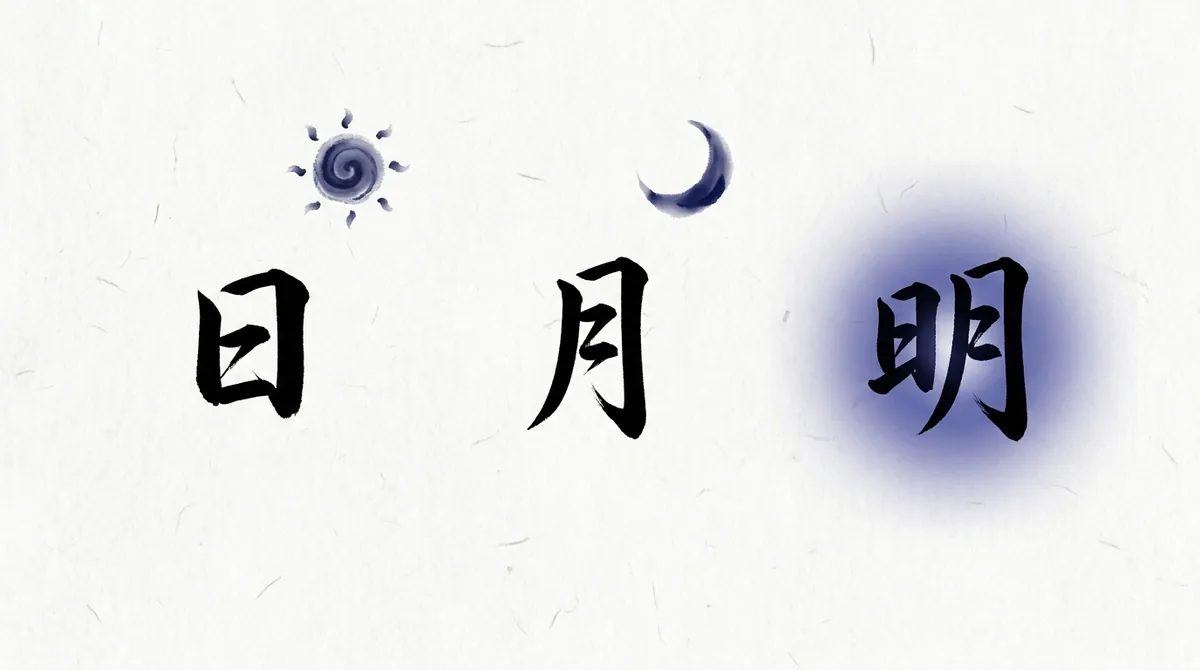
Pictograms and ideograms are the foundation, but the system really relies on combining these simple pieces to build thousands of characters.
The Real Breakthrough: Phonetic-Semantic Compounds
Now for the most useful category for any learner: the phonetic-semantic compound. These characters make up over 80% of all modern hànzì, and understanding them makes learning far more efficient. They are built from two parts:
- The Semantic Component (Radical): This part gives a clue about the character's general meaning. For instance, the water radical 氵 (from 水, shuǐ) usually signals something to do with water or liquid, as in 河 (hé, river) and 海 (hǎi, sea).
- The Phonetic Component: This part gives a hint about the character's pronunciation.
Think of it as a formula: Meaning Hint + Sound Hint = New Character. Once you learn the common radicals and phonetic components, you can start making educated guesses about new characters you come across.
Let’s look at a classic example. The character for mother is 妈 (mā). It's made of two parts: 女 (nǚ), which means 'woman' (the meaning hint), and 马 (mǎ), which means 'horse' but is used here for its sound (the sound hint). So, a woman who sounds a bit like mǎ gives you mā, mother. The same structure applies to thousands of characters, although the sound hint is often only approximate, because pronunciations have changed over the centuries.
Understanding this system also helps when deciding which character set to learn. If you're curious about the differences, our guide on learning Traditional Chinese characters explores how these same principles apply there too.
Recognising these building blocks transforms characters from intimidating symbols into logical constructions. Instead of trying to memorise a sea of strokes, you start to see the story and logic inside each one. It makes the entire process feel so much more manageable and, honestly, a lot more fun.
Common Characters and Their Cultural Significance
Understanding how Chinese characters are built is one thing, but exploring their cultural stories is where the language truly comes alive. Many characters carry meanings that go well beyond their dictionary definitions.
When you learn the stories behind the characters, they stick in your mind far better than rote memorisation. Let's look at a few of the most culturally significant characters you'll come across.
Blessing and Good Fortune 福 (fú)
The character 福 (fú), meaning 'good fortune' or 'blessing', is one of the most beloved and recognisable symbols in Chinese culture. You’ll see it everywhere, especially during Chinese New Year celebrations, often printed on red paper and slapped onto doors and walls.
There’s an interesting cultural quirk you’ll notice: people often hang the character upside down. Why? The Mandarin word for "upside down" is 倒 (dào), which sounds exactly the same as the word for "to arrive," 到 (dào).
Hanging it upside down creates a clever visual pun, suggesting that "fortune has arrived". This playful use of language shows just how deeply sound and meaning are woven together in Chinese culture, turning a simple decoration into an active wish for prosperity.
Power and Nobility 龙 (lóng)
In many Western stories, dragons are fierce, fire-breathing monsters to be feared and defeated. The Chinese 龙 (lóng), however, couldn't be more different. It's a symbol of immense power, good luck, strength, and nobility.
Historically, the dragon was closely tied to the Emperor of China, representing imperial power and authority; in the later dynasties, the five-clawed dragon was reserved for the emperor's use. Today, it remains a very positive and auspicious symbol.
The dragon embodies ambition, success, and good fortune. Unlike its Western counterpart, the Chinese dragon is a benevolent creature, seen as a controller of water and rainfall—essential for an agrarian society. This difference is a crucial cultural insight for any Mandarin learner.
The Complexity of Love 爱 (ài)
The character for 'love', 爱 (ài), is a beautiful example of how characters can tell a philosophical story. Its traditional form, 愛, is made of several parts that paint a rich picture of what love actually involves.
Right in the centre is the character for 'heart', 心 (xīn), which is why it's often read as saying that love is, first and foremost, a matter of the heart. At the bottom is 夊, a component associated with walking slowly, which popular explanations read as the gentle, patient side of love. (These readings are traditional interpretations rather than proven history.)
The modern, simplified version 爱 keeps the top of the character but replaces the heart and the bottom component with 友 (yǒu), meaning 'friend'. Critics of simplification like to point out that simplified 'love' has lost its heart, while others say love built on friendship isn't a bad idea either.
By looking beyond the literal translations, you start to see the profound cultural narratives packed into each stroke. It makes studying the language a much richer and more rewarding experience.
Avoiding Common Mistakes with Tattoos and Translations
The global fascination with Chinese characters has led many people to get them tattooed or use them in designs. And while the intention is almost always respectful, the results can sometimes be unintentionally hilarious or just plain embarrassing. The internet is full of cautionary tales, such as tattoos that turn out to say something like "soup" instead of the noble word the wearer had in mind.
These blunders happen for predictable reasons. A single Chinese character can have multiple meanings, pronunciations, and feelings attached to it, all depending on the context. What looks profound as a standalone symbol might mean something completely different when paired with other characters. Or worse, it could be an ancient term nobody has used for centuries.
Trying a direct, word-for-word translation from an English dictionary is almost always a recipe for disaster. All the crucial nuances of the language and culture get lost, leaving you with something literal but utterly nonsensical.
Why Direct Translations Fail
Relying on automated tools or a simple dictionary for something as permanent as a tattoo is a huge risk. These tools often miss the subtleties that a native speaker would spot in a heartbeat. A character might be technically correct but sound clunky, or carry an unintended double meaning.
Take the character 汤 (tāng). Sure, it means ‘soup’, but in classical Chinese it can also mean hot water, and it's a surname too. Without understanding its placement and the characters around it, its true meaning is up in the air. This is exactly why a quick search for an English word can give you a character that makes zero sense for what you actually want to say.
Another classic pitfall is mixing up classical and modern Chinese. A phrase that sounds wonderfully poetic might be pulled from an ancient text and feel completely out of place today – a bit like using "thou art" in a casual conversation.
The core issue is context. A character's true meaning is defined by the words around it, the situation it's used in, and the cultural background. Isolating a single symbol is like pulling one word from an English sentence and expecting it to carry the full weight of the original idea.
Ensuring Accuracy and Respect
To avoid becoming another online meme, it’s vital to take the right steps before you commit to a design or translation. Getting it right isn't just about accuracy; it's about showing genuine respect for the language and its culture.
Here’s how to make sure your translation is on point:
- Consult a Native Speaker: This is the most important step, hands down. A native Mandarin speaker can check the meaning, confirm it's culturally appropriate, and probably suggest even better ways to express your idea.
- Understand the Nuances: Don't just look up a single word like 'love' or 'strength'. Think about the entire concept you want to convey. Chinese often uses multi-character words (词语 cíyǔ) or idiomatic phrases to express complex ideas. You can explore some of these in our article on common Chinese idioms.
- Use a Professional for Important Documents: When you need to convert English phrases or official names into Chinese characters, nuances are everything, so use a qualified human translator rather than a machine.
By doing your homework and seeking expert advice, you can use Chinese characters in a way that is both meaningful to you and respectful of the culture they come from.
How to Learn and Remember Chinese Characters
Rote memorisation is the classic way to learn characters, but let's be honest, it's often slow and painfully frustrating. Just writing a character over and over doesn't really build a connection to what it means or how you'd actually use it. A far better approach is to learn characters in the context of real sentences, a method known as sentence mining.
This strategy is so powerful because it immediately shows you how a character works. Instead of just learning 木 (mù) in isolation, you might see it in the sentence 这张桌子是木头做的 (zhè zhāng zhuōzi shì mùtou zuò de), meaning "This table is made of wood." Straight away, you get its meaning, its usage, and how it combines with other characters (木头, mùtou, wood).
Mandarin Mosaic is built around this idea. Its HSK-levelled lessons show you sentences that contain just one new word, and you can tap any word to see its meaning and hear it pronounced.
Break Characters Down into Radicals
Another powerful strategy is to focus on learning radicals, the building blocks that give you a hint about a character's meaning. As we saw earlier, radicals like 氵 (water) are connected to water, and 女 (nǚ) is linked to women.
The traditional system has 214 radicals (the Kangxi radicals), and modern simplified dictionaries use around 200, but a few dozen common ones cover most of what you'll meet. When you come across a new character, you can often make an educated guess about its meaning just by looking at its radical. For instance, characters with the 口 (kǒu) radical are often related to the mouth, speaking or eating, as in 吃 (chī, eat) and 喝 (hē, drink).
This method turns memorisation into a logical puzzle. You're not just learning thousands of random pictures; you're learning a few hundred components that combine in predictable ways.
Use Spaced Repetition to Lock in Knowledge
Forgetting what you’ve just learned is one of the biggest headaches in language study. To fight back, Spaced Repetition Systems (SRS) are incredibly effective. SRS is a well-researched technique that schedules each review for when you're likely to be close to forgetting something.
An SRS algorithm keeps track of how well you know each character and schedules its next appearance based on your performance.
- Easy characters pop up less frequently.
- Difficult characters show up more often until you nail them.
This active recall process shifts information from your short-term to your long-term memory far more efficiently than cramming. You can find out more about how this works in our detailed guide to using spaced repetition for language learning.
Your Questions on Chinese Symbols Answered
As you dive into Mandarin, you'll naturally have a lot of questions about Chinese symbols. How they work, how many you need, which ones to learn... it's a lot to take in. Let's tackle some of the most common queries to give you a clear and solid strategy for learning them.
How Many Chinese Characters Do I Need to Learn to Be Fluent?
The idea of memorising over 50,000 characters is enough to make anyone want to quit before they start. But here's the good news: you don't need anywhere near that many. Not even close.
For real-world reading, you only need a fraction of the total. According to the official List of Frequently Used Characters in Modern Chinese, the 2,500 most common characters make up about 98% of the characters in everyday modern texts, and 3,500 cover more than 99%. You'll still meet unfamiliar words, because words combine characters in new ways, but that's the core you need for newspapers, websites and social media.
It’s all about frequency, not quantity. Modern learning apps and good strategies focus on these high-impact characters first, so you're not wasting time on symbols you'll rarely see. If you're wondering how fast to go, see our guide to how many Chinese characters to learn per day.
Think of it like this: a small handful of characters do most of the heavy lifting in the language. By focusing on them first, you get the biggest bang for your buck, making your path to reading proficiency much faster and more efficient.
Should I Learn Simplified or Traditional Chinese Characters?
This is a classic question for any new learner, and the answer really boils down to your own goals. Where do you plan to use your Chinese?
- Simplified Characters: These are used in mainland China, Singapore, and Malaysia. As the official script of the People's Republic of China, this is the standard for most learners today and the one you'll encounter most often.
- Traditional Characters: You'll find these in Hong Kong, Macau, and Taiwan. They're the original, more complex forms of the characters and offer a fascinating glimpse into the history and etymology of the language.
For most beginners, starting with Simplified Chinese is the most practical choice. Once you’ve built a solid foundation with Simplified, you’ll find picking up the Traditional forms much easier down the line. Many of the core components are the same, just with a few extra strokes.
Can a Chinese Character Have Multiple Meanings or Pronunciations?
Yes, absolutely, and it's worth understanding early. Many characters are what’s known as 多音字 (duōyīnzì), which means they have more than one pronunciation and, often, different meanings to go with them.
This is exactly why translating single words directly from Chinese often goes wrong.
Take the character 行. It can be pronounced xíng, meaning 'to walk' or 'okay'. But it can also be pronounced háng, meaning 'a row' or 'a profession'. Without seeing it in a sentence, you have no idea which one it is.
This is precisely why context is king. Learning characters inside full sentences is crucial because the surrounding words almost always make the correct meaning and pronunciation obvious. It’s how you build a true, intuitive feel for the language, rather than just memorising a list of disconnected symbols.
Ready to stop memorising isolated symbols and start understanding Chinese in context? Mandarin Mosaic is designed for exactly that. It uses sentence mining and spaced repetition to help you learn words and characters naturally, with HSK-levelled lessons and graded articles that introduce one new word per sentence.
Try it at Mandarin Mosaic.