Mandarin Mosaic vs Duolingo: Which Is Better for Learning Chinese?

Choosing between Mandarin Mosaic and Duolingo comes down to what you want from an app. If you want a fun, free introduction to Chinese and help building a daily habit, Duolingo is a good place to start. If you want to grow your vocabulary steadily through sentences you can understand, and read real Chinese sooner, Mandarin Mosaic's sentence-based approach is the stronger tool. Many learners use Duolingo first and move on later.
Mandarin Mosaic vs Duolingo: Which App Is Right for You?
Duolingo is the best-known language app in the world, with a Chinese course among its dozens of languages. Mandarin Mosaic is a smaller app built only for Mandarin. They take very different approaches.
Duolingo is built around gamification. Points (XP), leagues, streaks and short lessons keep you coming back every day. Lessons mix tapping words into translations, matching characters to their pinyin and meaning, listening and short speaking exercises. It's very good at getting you to practise daily and teaching you your first few hundred words.
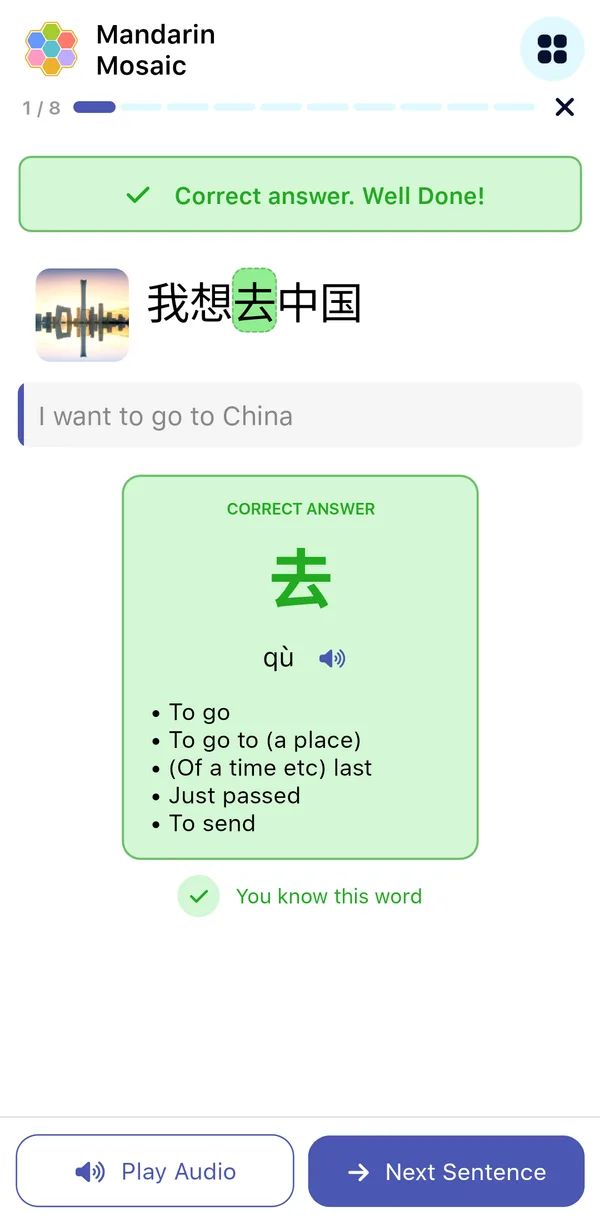
Mandarin Mosaic uses sentence mining and comprehensible input. The app keeps track of which words you know and gives you sentences where only one word is new, so you learn each new word in a full sentence you can already mostly understand. Spaced repetition then brings each word back, in a new sentence, just before you're likely to forget it.
The core difference: Duolingo follows a fixed course for everyone and makes it feel like a game. Mandarin Mosaic builds each lesson around the words you already know.
This matters as you progress. Many learners finish a stretch of Duolingo knowing plenty of words but struggling to follow real Chinese, which is the start of the "intermediate plateau". Mandarin Mosaic is designed to help at that stage. For a wider look at the options, see our guide to the best Mandarin learning apps.
Core Differences Between Mandarin Mosaic and Duolingo
| Feature | Mandarin Mosaic | Duolingo |
|---|---|---|
| Learning method | Sentence mining: one new word per sentence where possible, with spaced repetition | Gamified lessons along a fixed course path |
| Primary goal | Building vocabulary and reading comprehension | Daily habit, basic vocabulary and phrases |
| Content | HSK-levelled sentence packs, graded articles, your own sentences | Short sentences and phrases in themed units |
| Speaking practice | None | Repeat-after-me exercises; Video Call with Duolingo Max |
| Platforms and languages | iPhone and Android; Mandarin only | iPhone, Android and web; dozens of languages |
| Cost | 30-day free trial, then a limited free plan or Premium | Free with ads and an Energy limit; paid Super and Max |
For a light, game-like start, Duolingo has a lot going for it. For a structured way to build the vocabulary you need to read and understand Chinese, Mandarin Mosaic is the better fit.
Comparing the Core Learning Philosophies
The way the two apps teach Chinese is fundamentally different, and that shapes everything else.
Duolingo's method is all about gamification. Exercises are quick: matching pairs, picking words from a word bank to build a translation, listening, and repeating phrases aloud. Everyone follows the same course, in the same order.
The catch is that the sentences are short and chosen by the course, not by what you know. You learn 苹果 (píngguǒ, apple) and a handful of sentences around it, but you won't see it in many different contexts, and translating set phrases is not the same as understanding new sentences.
The Power of Gamification
Duolingo's gamified model is very good at one thing: getting you to open the app every day, which for many beginners is the biggest hurdle.
- Constant rewards: XP, streaks and league promotions give you a sense of achievement.
- A low barrier to entry: short, simple exercises feel much less intimidating than a textbook.
- Habit formation: the streak is a strong motivator, and consistency matters for learning anything.
This makes Duolingo a gentle on-ramp to Mandarin. The limits show when you want to move past the basics.
The Logic of Contextual Learning
Mandarin Mosaic is built on comprehensible input, often described as 'i+1': we learn best from material that contains just one new thing beyond our current level.
The app puts this into practice with sentence mining. Every new word arrives inside a complete sentence in which you know the other words. (Occasionally, in HSK packs and review lessons, a sentence has two new words if there's no suitable sentence with just one.) You see how the word connects to others, what grammar goes with it and how real sentences are put together. We look at the same idea from another angle in Mandarin Mosaic vs Anki.
Because the rest of the sentence is familiar, you're working out meaning rather than translating, and you pick up grammar patterns from many examples rather than from rules.
Feature Breakdown: Contextual Learning vs Gamification
Side by side, the features of each app follow from its philosophy. Mandarin Mosaic's features serve one study loop: meeting a new word in a sentence and reviewing it until you know it. Duolingo offers a varied set of exercises, rewards and a clear path to follow.
Building Vocabulary: The Contextual Difference
The biggest split is in how each app builds your vocabulary.
Mandarin Mosaic uses sentence lessons powered by spaced repetition:
- You get a sentence where one word is new to you, usually with that word blanked out for you to choose.
- Tap any word to see its pinyin and meaning and hear it.
- Once you know a word, the app schedules reviews of it, and each review shows it in a different sentence.
Duolingo teaches words like 猫 (māo, cat) and 狗 (gǒu, dog) through matching exercises and short sentences you translate, repeated across a unit. That works well for first memorisation, but you see each word in only a few fixed sentences.
For example, learning 去 (qù, to go) on Duolingo might involve matching it to "to go" and translating a short sentence. In Mandarin Mosaic, you'd meet it in a sentence like 我明天要去北京 (wǒ míngtiān yào qù běijīng, I'm going to Beijing tomorrow), and later in others, showing you how it works with time, intention and place. Our Duolingo Chinese review looks at the course in more detail.
Mastering Tones and Pronunciation
Getting tones right is essential if you want to be understood, and here each app has something the other lacks.
Mandarin Mosaic gives you lifelike text-to-speech audio for every sentence, and you can tap any word to hear it on its own. Hearing whole sentences helps you get used to the rhythm of Mandarin and to tone changes such as tone sandhi. But Mandarin Mosaic has no speaking or record-and-compare features, so it won't check your own pronunciation.
Duolingo has audio for its exercises and speaking exercises in which you repeat a phrase and the app checks it with speech recognition. With the top Duolingo Max tier you can also have short Video Call conversations with an AI character, Lily. That's more speaking practice than Mandarin Mosaic offers, although it's limited feedback compared with a tutor.
Integrated Tools vs Gamified Mechanics
Mandarin Mosaic's supporting tools keep you inside the sentence:
- Tap-to-look-up: every word shows its pinyin, meaning and audio without leaving the lesson.
- Focus words: pick words you want extra practice on.
- Chinese Articles: a graded news reader with the same tap-to-look-up support.
- Custom packs: add your own sentences, or import them from Anki decks, CSV or text files.
Duolingo's are built around motivation and variety:
- The path: a visual route through units and sections that unlock as you go.
- Character exercises: matching characters to pinyin and meaning. You can also switch from the word bank to typing your answers.
- XP and leagues: a competitive, social layer that rewards you for keeping up your streak.
Who Should Use Mandarin Mosaic and Who Should Use Duolingo
Neither app is simply "better"; the right one depends on where you are and what you want.
The Absolute Beginner Seeking a Gentle Start
If you're brand new to Mandarin and characters and tones feel like a lot, Duolingo is an approachable first step. Its simple exercises and game feel take the edge off starting a new language, and it's free.
- When to use Duolingo: to build a daily habit and find out whether you enjoy learning Chinese.
- When to switch to Mandarin Mosaic: once you know you're in it for the long haul and want faster vocabulary growth, or you feel you've hit a ceiling on Duolingo. Mandarin Mosaic also starts at HSK 1, so you can begin with it if you prefer.
The Frustrated Intermediate Learner
When it launched, Duolingo said its Chinese course covered HSK 1 to 3 and about half of HSK 4 (on the older HSK 2.0 scale), roughly CEFR A2. Since April 2026 the course runs on to CEFR B2, though Duolingo hasn't given an HSK level for the newer sections (see what HSK level Duolingo Chinese gets you to). Many learners who've done a lot of Duolingo find they know hundreds of words but still struggle with real conversations or articles. That's the intermediate plateau, and it's where Mandarin Mosaic is most useful.
By showing new words in sentences you can otherwise understand, Mandarin Mosaic helps you absorb grammar patterns and see how words are really used. If you can read simple phrases but anything longer is a struggle, you can start at your level (say, HSK 2 or 3) and build from there.
The Serious Self-Studier Aiming for Fluency
If your goal is to read and understand Mandarin at a high level, Mandarin Mosaic gives you more to work with. Its HSK packs go up to HSK 6 and the HSK 3.0 levels, the graded articles give you longer reading, and your own sentences can come from anything you're reading or watching. Lessons are focused on the sentence in front of you, with the dictionary and audio one tap away.
For speaking, neither app is enough on its own; add a tutor, a language partner or a dedicated speaking tool.
The Anki User Seeking Simplicity and Power
If you already use Anki for sentence mining, you know how well the method works and how long it takes to find good sentences, add audio and format cards.
- Ready-made sentences: HSK packs of sentences, each verified by a native speaker, with audio built in.
- Automatic scheduling: the app chooses sentences to fit your known words and schedules your reviews.
- Your existing decks: you can import Chinese Anki decks into a custom pack.
You give up Anki's total control over card design and its desktop app, but you save the time spent building cards.
Interface and Daily Experience
How an app feels day to day makes a big difference to whether you stick with it, and here the two apps are very different.
Duolingo's interface is famously playful: bright colours, Duo the owl, and celebratory sounds and animations for correct answers. It's designed to be a little addictive, so you protect your streak and chase a place in your league.
Engagement vs Deep Focus
Duolingo uses notifications, leagues and daily quests to keep Chinese at the front of your mind. That's great for habit building, but the game can become the point: it's easy to chase XP with easy lessons rather than learn new material.
Mandarin Mosaic is quieter. It shows a daily streak, but there are no leagues, points or mascots. A lesson is a series of sentences, with the dictionary and audio controls on the same screen.
Onboarding and Learning Curve
Duolingo's onboarding is very simple: its exercises feel familiar if you've played any mobile game, and you can start in seconds.
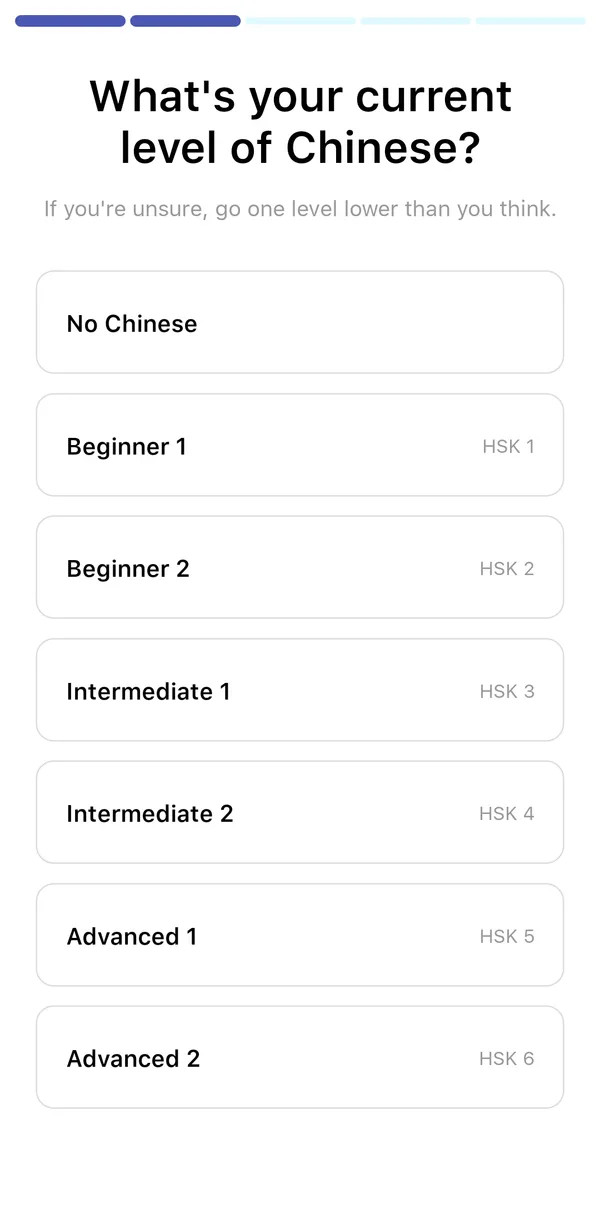
Mandarin Mosaic asks you to choose your starting level when you first open it, from No Chinese up to HSK 6, and marks the common words up to that level as known. A short tutorial then shows you how lessons work. It takes a few minutes longer, but it means your first lesson is pitched at your level rather than starting everyone at the same place.
Making Your Decision: A Mandarin Learning Roadmap
If you want a fun, free taste of Mandarin, Duolingo is a fine place to start. If you want to build the vocabulary to understand real Chinese, you'll want a more structured tool alongside or after it.
A sensible plan for many learners: use Duolingo to find out whether you enjoy learning Chinese, then make Mandarin Mosaic your main vocabulary tool once you're ready to commit.
Your Migration Plan: From Duolingo to Mandarin Mosaic
1. Assess your current level
If you've spent time on Duolingo, you probably know a fair number of words but struggle with longer sentences. Look at the HSK (汉语水平考试, hànyǔ shuǐpíng kǎoshì) vocabulary lists and see which level you mostly recognise.
2. Choose your starting level
When you set up Mandarin Mosaic, pick that level. If you know most HSK 1 words, choose HSK 1 so those words are marked as known and your lessons start with HSK 2 vocabulary. Because each sentence usually adds just one new word, the step up feels manageable.
3. Get used to the new routine
Instead of points, your measure of progress is the number of words you know and the sentences you can understand. Read the sentence, find the new word, tap anything you're unsure of, and listen to the audio.
A Sample Weekly Study Plan
You don't need hours a day. A focused 20 to 30 minutes every day is enough to make steady progress.
- Daily (20-30 minutes): do your reviews in Mandarin Mosaic first, then a new lesson.
- Twice a week (10-15 minutes): add listening, such as a beginner Chinese podcast, and notice the words from your lessons turning up.
- End of week (5 minutes): look through Your Vocabulary to see how many words you now know.
Where Duolingo Is the Better Choice
Duolingo is the better app for some learners:
- You want it free: Duolingo's whole course is free, with ads and a daily Energy limit. Mandarin Mosaic's free plan after the 30-day trial is limited to 1 lesson a day.
- You want speaking practice in the same app: Duolingo has speaking exercises, and Video Call with Max. Mandarin Mosaic has no speaking features.
- You need motivation more than structure: if streaks and leagues are what keep you practising, Duolingo does that very well.
- You learn several languages or use a computer: Duolingo covers dozens of languages and works in a web browser; Mandarin Mosaic is Mandarin-only and phone-only.
Frequently Asked Questions
Can I Use Both Mandarin Mosaic and Duolingo at the Same Time?
Yes. Some learners keep a Duolingo streak going for its speaking and listening exercises while using Mandarin Mosaic for vocabulary. If time is short, put most of it into whichever app is teaching you the most new material at your level. Our Anki vs Duolingo comparison covers a similar trade-off.
Is Mandarin Mosaic Too Advanced for a Complete Beginner in Chinese?
No. You can start with the HSK 1 packs, which cover the most basic words. Because each sentence usually has just one new word, you're not overwhelmed. Complete beginners will still want a course or textbook for pinyin, tones and grammar explanations, which Mandarin Mosaic doesn't teach directly.
How Quickly Will I See Progress with Mandarin Mosaic Compared to Duolingo?
It depends on how much you study, so be wary of any app that promises a timescale. The difference is in what you measure. Duolingo shows XP, streaks and units completed. Mandarin Mosaic shows the number of words you know, and you can test that progress against real text in its graded articles.
Is Mandarin Mosaic Just Another Flashcard App Like Anki?
No. It uses spaced repetition like Anki, but it automates the sentence-mining workflow that takes so long to set up in Anki:
- Ready-made HSK sentence packs, each sentence verified by a native speaker.
- Lifelike text-to-speech audio for every sentence.
- Tap-to-look-up for every word, without leaving the lesson.
Ready to build your Chinese vocabulary through sentences you can understand? Try Mandarin Mosaic free for 30 days. After that you can keep a limited free plan or subscribe from £7.92 a month billed yearly (£11.95 monthly), at the time of writing. Find out more about Mandarin Mosaic.