Mandarin Mosaic vs Clozemaster: Which Is Better for Learning Chinese?

Mandarin Mosaic and Clozemaster both teach vocabulary through fill-in-the-blank sentences, so at first glance they look alike. The difference is in how the sentences are chosen. Mandarin Mosaic tracks the words you know and picks sentences with just one new word, from levelled HSK packs. Clozemaster gives you a very large bank of sentences sorted by word frequency and lets you work through them at volume. Which suits you depends mostly on your level and how much structure you want.
Choosing the Right Mandarin Learning App
These two apps are built on different ideas about how vocabulary sticks. Mandarin Mosaic controls the difficulty of every sentence, so you always understand almost all of it. Clozemaster trades that control for breadth: thousands of real sentences, game-style rounds and points to keep you going.
In general, beginners and lower-intermediate learners get more from Mandarin Mosaic's controlled sentences, while learners who already know a few thousand words can use Clozemaster's volume to test and broaden what they know.
Mandarin Mosaic vs Clozemaster at a Glance
Mandarin Mosaic is designed for learners building their vocabulary and sense of grammar from the ground up, including anyone moving on from beginner apps or stuck at the intermediate plateau. Clozemaster suits learners who already have a decent vocabulary and want to see it in many different sentences, or who are learning more than one language.
| Aspect | Mandarin Mosaic | Clozemaster (Chinese) |
|---|---|---|
| Method | Sentence mining: sentences with one new word where possible (i+1), tested as cloze | Cloze (fill-in-the-blank) drills in high volume |
| Ideal learner | Beginners to upper-intermediates who want structured growth | Intermediate and advanced learners who want volume and review |
| Content | Levelled packs from HSK 1 upwards, each sentence verified by a native speaker | Sentences from Tatoeba, a volunteer-built database, grouped by word frequency |
| Languages and platforms | Mandarin only; iPhone and Android | 50+ languages; web, iPhone and Android |
| Cost | 30-day free trial, then a limited free plan or Premium | Free with a daily limit, or Clozemaster Pro |
Understanding Their Core Learning Philosophies
Both apps put words in sentences rather than on isolated flashcards. Where they differ is in how much of each sentence you're expected to understand already.
Mandarin Mosaic: One New Word at a Time
Mandarin Mosaic is built around comprehensible input, and specifically the 'i+1' idea: you learn best from material just one step beyond what you already know. The app keeps a record of your known words and chooses sentences in which you know everything except one new word. (In HSK packs and review lessons a sentence can occasionally have two new words, if no sentence with just one is available.)
Because you understand the rest of the sentence, the context does much of the work of explaining the new word. Say you meet 餐厅 (cāntīng, restaurant) in this sentence, and you know every other word:
我们明天去那家新餐厅吃饭。
wǒmen míngtiān qù nà jiā xīn cāntīng chīfàn.
We're going to eat at that new restaurant tomorrow.
You can almost work out what 餐厅 means before you check, and you also see how it's used: with 家 (jiā) as its measure word, after 去 (qù, to go). That's the core of sentence mining.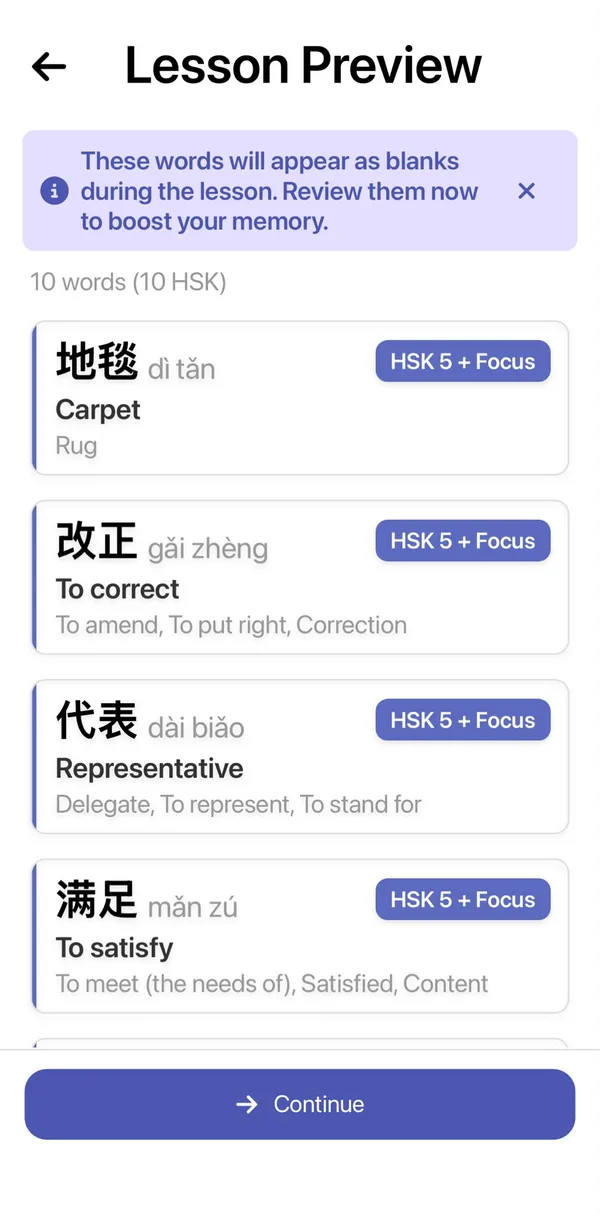
Clozemaster’s Mass Exposure Strategy
Clozemaster takes a different tack. It gives you a sentence with one word blanked out and asks you to fill it in, then moves straight on to the next. It doesn't check whether you know the other words in the sentence; instead it relies on volume. Over thousands of sentences you see common words in many different contexts and get faster at recalling them.
That makes it less suited to learning words from scratch and better at reinforcing words you've already met elsewhere. In the early stages you'll often hit sentences with several words you don't know, and you'll lean on the English translation to get through them.
Put simply, Mandarin Mosaic is about building your knowledge piece by piece; Clozemaster is about testing and broadening it through high-volume practice.
A Detailed Feature-By-Feature Breakdown
The learning philosophies give you the big picture, but your daily experience comes down to how each app handles reviews, audio and content.
Spaced Repetition System (SRS)
Both apps use spaced repetition, but they schedule different things.
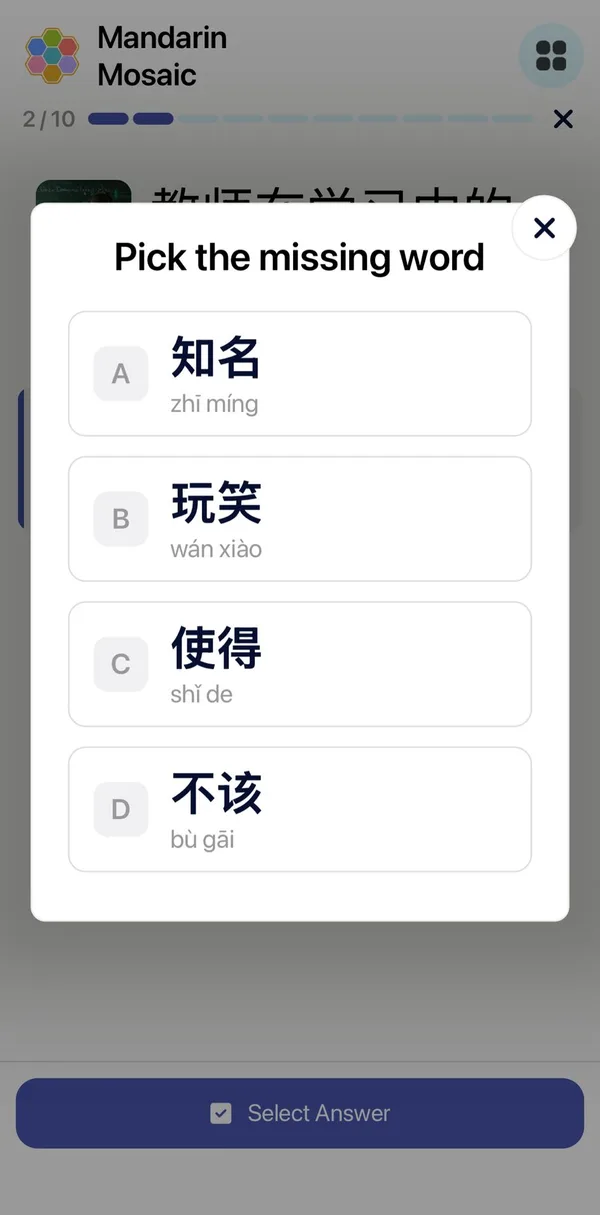
Mandarin Mosaic schedules words, not sentences. Once you've answered a new word correctly a few times (three by default), it becomes Known and gets a review date. Each correct review pushes the next one further away, and a mistake brings the word back sooner without resetting it to the start. When a word is due, you meet it in a fresh sentence rather than the same one again, so you can't simply memorise one sentence. Our guide explains how spaced repetition works in Mandarin Mosaic.
Clozemaster schedules sentences. By default, a sentence you answer correctly comes back after 1 day, then 10, 30 and 180 days (shown as 25%, 50%, 75% and 100% mastered), and a wrong answer resets it to 0%. Clozemaster Pro lets you change those intervals and how many reviews appear in each round.
Key difference: Mandarin Mosaic reviews each word in new sentences. Clozemaster reviews the same sentence on a fixed schedule.
Audio Quality and Implementation
For a tonal language, hearing every sentence matters. Both apps use text-to-speech rather than recordings of people.
In Mandarin Mosaic, every sentence can be played in lifelike text-to-speech, and you can tap any word to hear it on its own along with its pinyin and meaning. Clozemaster also reads sentences aloud with text-to-speech, and Clozemaster Pro adds a listening practice mode for many of its languages.
Neither app trains you to speak or checks your tones, so if pronunciation is your goal you'll need something else alongside either one.
Granular Feature Comparison for Mandarin Learners
| Feature | Mandarin Mosaic | Clozemaster (Chinese) |
|---|---|---|
| Primary method | Sentence mining (i+1) with cloze questions | Cloze questions at volume |
| Sentence selection | Based on the words you already know | Based on word frequency |
| Sentence audio | Lifelike text-to-speech for every sentence and word | Text-to-speech; listening mode with Pro |
| Content structure | Packs based on HSK levels (HSK 1-6 and HSK 3.0) | Collections by word frequency, such as Fluency Fast Track and Most Common Words |
| Answering | Pick the missing word from four options by default; typing is optional | Multiple choice or typing the missing word |
| Word lookups | Tap any word for pinyin, meaning and audio | English translation shown with each sentence |
| Your own content | Custom packs; import sentences from Anki decks, CSV or text files | Search and favourite sentences with Pro |
| Gamification | A daily streak, but no points or leaderboards | Points, streaks and leaderboards |
Content Library Depth and Structure
Mandarin Mosaic's sentences are arranged into packs that follow the HSK levels, starting at HSK 1, and every built-in sentence has been checked by a native speaker. You can study in Simplified or Traditional characters. You won't find yourself working on something far too hard or too easy, and you can add your own sentences in custom packs when you want to learn words from a book or show.
Clozemaster's library is much bigger, and it comes from Tatoeba, a volunteer-built collection of sentences and translations. The size is impressive, but quality varies: some sentences sound stilted or old-fashioned, and sorting by word frequency doesn't guarantee a smooth difficulty curve. You might meet a simple word in a long, complicated sentence.
That makes Clozemaster a good tool for learners who want to test what they know, but less suited to building knowledge from nothing. If you're curious about this style of practice, read our guides to cloze tests for learning Chinese and how cloze exercises work in Mandarin Mosaic.
Which App Fits Your Chinese Learning Goals
The better app is the one that meets you where you are. Here are the most common situations.
For Absolute Beginners Starting Their Journey
If you're just starting out, your priority is learning core words and seeing how basic sentences are built without being swamped. Mandarin Mosaic is the better fit here.
- A guided path: the HSK 1 packs introduce words in a sensible order.
- Learning in context: you meet basic words like 是 (shì, to be) and 我 (wǒ, I) inside full sentences you can understand.
- Audio for everything: you can hear every sentence and every word from day one.
You'll still want a course or textbook for pinyin, tones and basic grammar explanations, since neither app teaches those directly. A complete beginner in Clozemaster tends to meet sentences full of unknown words, which is discouraging rather than useful.
For Intermediate Learners Stuck at the Plateau
The intermediate plateau is that stage where you know a good number of words but real Chinese still feels out of reach. Often your knowledge is in pieces: you know the words, but not how they combine.
Mandarin Mosaic helps here by keeping each new sentence almost fully understandable, so you see familiar words in new patterns while adding vocabulary steadily. Clozemaster can also help at this stage if you already know most of the words in its frequency collections, since its volume shows you each word in many contexts.
For Advanced Learners Seeking Mass Exposure
At an advanced level (around HSK 5 or 6 and beyond), you have a solid grammar base and a large vocabulary. Your aim is to make that knowledge automatic and find the gaps. This is where Clozemaster is at its strongest. Working through hundreds of sentences quickly lets you:
- Test your recall speed across many different contexts.
- Find weak spots: the words you thought you knew but can't recall under pressure.
- Get broad exposure to words in a wide variety of sentences.
At this stage, the lack of structure matters less, and Clozemaster's frequency collections reach well beyond the HSK lists. Mandarin Mosaic still works for learning specific new words in context, including from your own sentences, but its built-in packs follow the HSK levels.
For Anki Users Wanting a Better Experience
Many serious learners use Anki, which is powerful but takes work to set up for Chinese. Which of these two apps suits you depends on what you use Anki for:
- If you make i+1 sentence cards by hand: Mandarin Mosaic automates most of that work. It picks sentences that match your known words, handles the scheduling, and can import your existing Chinese Anki decks into a custom pack.
- If you use Anki for high-volume word drills: Clozemaster offers a similar experience with ready-made content, wrapped in a more game-like design.
We compare those tools directly in Clozemaster vs Anki and Mandarin Mosaic vs Anki.
Building a Daily Routine with Either App
Whichever app you choose, the habit you build around it matters more than its features.
A Sample Mandarin Mosaic Workflow
Mandarin Mosaic works best when you learn a manageable number of new words each day and keep on top of your reviews.
- Do your reviews first (about 10 minutes): clear the words that are due, so they come back in fresh sentences before you forget them.
- Do a new lesson (about 15 minutes): tap any word you're unsure of to see its meaning and hear it, and play the sentence audio a few times to get the sound and tones.
- Recall a few sentences (about 5 minutes): try writing one or two of the day's sentences from memory, or say them aloud. This extra bit of active recall helps link the characters, sound and meaning.
A Sample Clozemaster Workflow
With Clozemaster, the routine is about volume and speed.
- Play a set number of sentences (about 15 minutes): keep moving and go with your gut; don't get stuck on any one sentence. On the free plan you're limited to 30 sentences a day.
- Watch your reviews (about 10 minutes): note the words you keep getting wrong; the app will bring those sentences back.
- Try a harder collection (about 5 minutes): a higher-frequency band shows you where your limits are.
For either app, a short session every day beats a long one once a week.
Combining Apps with Other Resources
Neither app will make you fluent on its own. To cover listening, speaking, reading and writing, mix in other kinds of practice:
- Speaking: try out the sentence patterns you've just learned with a language partner or tutor, or record yourself saying them and listen back.
- Reading: add graded readers. Meeting words from your app sessions in a story is good reinforcement.
- Listening: watch Chinese dramas or listen to podcasts, which train your ear for natural speech that's faster and less clear than app audio.
For more ideas, see these daily habits to boost your Chinese.
Cost, Subscriptions, and Long-Term Value
Both apps can be used for free, with a paid tier for more. Prices change, so check the app before you buy; the details below are correct at the time of writing.
Comparing the Free vs Paid Tiers
Clozemaster (Free vs Pro):
- Free: cloze practice across its sentence collections, limited to 30 sentences a day.
- Pro: a monthly or yearly subscription that removes the daily limit and adds listening practice, custom review intervals and round sizes, more detailed stats and offline downloads.
Mandarin Mosaic (Free vs Premium):
- Free trial: 30 days to try the full app.
- Free plan: after the trial you can keep a limited free plan: 1 lesson a day, 10 focus words, 1 custom pack and 10 custom sentences, with no sync between devices.
- Premium: from £7.92 a month billed yearly, or £11.95 monthly. It removes the limits and adds Cloud Sync and article generation.
Which Offers Better Long-Term Value?
If you're an advanced learner who mainly wants volume, Clozemaster's free plan may be all you need, and Pro is worth it if 30 sentences a day feels too few. If you're learning several languages, one Clozemaster subscription covers all of them.
If you're a beginner or intermediate learner who wants a structured path through the HSK levels, Mandarin Mosaic is likely to be the better use of your money. The 30-day trial is long enough to find out. For a wider look at the options, see our guide to the best Mandarin learning apps.
Where Clozemaster Is the Better Choice
Clozemaster is the better tool for some learners, and it's worth being clear about when:
- You're already advanced and want to drill large numbers of sentences beyond the HSK word lists.
- You learn more than one language: Clozemaster covers over 50, while Mandarin Mosaic only teaches Mandarin.
- You study at a computer: Clozemaster runs in a web browser as well as on phones; Mandarin Mosaic is phone-only.
- You like competition: points and leaderboards motivate some people, and Mandarin Mosaic doesn't have them.
- You want a lasting free option: Clozemaster's 30 sentences a day are more than Mandarin Mosaic's 1 lesson a day after the trial.
Frequently Asked Questions
Can I Use Mandarin Mosaic as a Complete Beginner in Chinese?
Yes. The sentence packs are organised by HSK level, starting at HSK 1, and each sentence usually introduces just one new word, so you're never thrown in at the deep end. Pair it with a course or textbook for pinyin, tones and grammar explanations.
Is Clozemaster Good for Learning Chinese Grammar?
It helps with pattern recognition: after thousands of sentences you start to notice common structures. It isn't built around grammar explanations, and neither is Mandarin Mosaic, but Mandarin Mosaic's sentences are easier to understand, so patterns are easier to spot. For explanations, use a reference such as the Chinese Grammar Wiki.
I Am an Advanced Student. Which App Is Better for Me?
- Mandarin Mosaic suits you if you want to learn specific new words in context, for example from your own sentences or the higher HSK packs.
- Clozemaster suits you if you want a large volume of sentences to test what you already know and find gaps.
How Does the Spaced Repetition System Differ Between the Apps?
Mandarin Mosaic schedules each word you know and shows it to you in a new sentence when it's due; a mistake brings it back sooner. Clozemaster schedules each sentence on fixed intervals (1, 10, 30 and 180 days by default) and resets it if you get it wrong.
Want to build your Chinese vocabulary one understandable sentence at a time? Try Mandarin Mosaic free for 30 days. After that you can keep a limited free plan or subscribe from £7.92 a month billed yearly (£11.95 monthly), at the time of writing. Find out more about Mandarin Mosaic.