 Mandarin Mosaic
Free on iPhone, iPad and Android.
Download on theApp Store Get it onGoogle PlayYour first month of Premium is free.
The 10 Best Mandarin Learning Websites in 2026

You've decided to learn Mandarin, opened a search tab, typed “mandarin learning website”, and hit the same wall everyone hits. One app promises fast fluency. Another promises perfect pronunciation. Another says reading is the answer. Another says flashcards are the answer. If you're new, that choice overload feels like progress, but it usually delays actual study.
The useful answer is that there isn't one perfect platform. There's a better or worse system. Mandarin is too broad for a single tool to carry everything. You need one place that teaches structure, one place that gives you understandable input, and one place that helps new words stick long enough to become usable.
So this list doesn't just rank websites. It shows what each one is good for, where each one falls short, and how to combine them into a study setup that moves you forward. Prices are as listed at the time of writing and change often. If you only want free resources, see our list of free ways to learn Mandarin online; for phone apps, see our guide to the best Mandarin learning apps.
1. Mandarin Mosaic
A common failure point looks like this. You finish a course lesson, recognise the grammar, pass the review, then blank when the same word shows up in a real sentence two days later. The issue usually is not effort. It is that the study system taught the word as an item to recall, not as language to use.
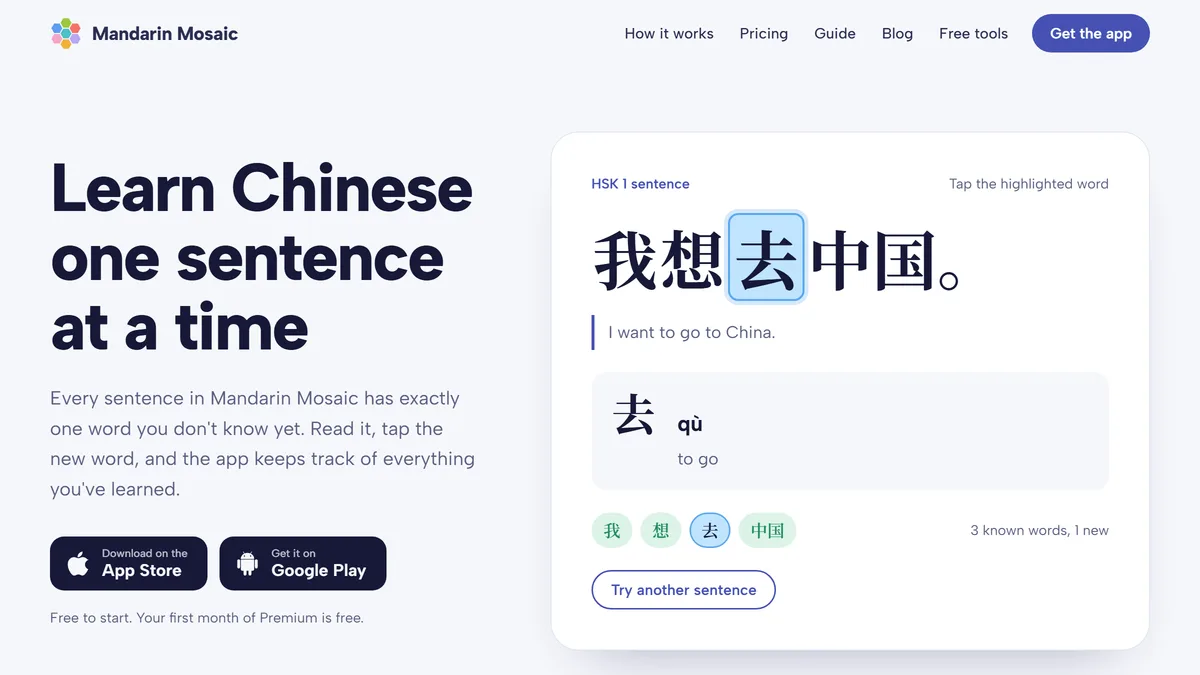
Mandarin Mosaic (our own app) is built around that gap. It focuses on sentence mining with enough structure that learners can keep doing it. Instead of asking you to build and maintain a complicated flashcard workflow, it gives you HSK-levelled lessons of sentences with one new word at a time, reviewed with spaced repetition, plus graded articles to read. That design reduces friction and keeps attention on the sentence itself, which is where retention usually starts to improve.
Why it works in a real study system
Sentence-based review works because Mandarin words rarely stay simple once you meet them in context. A translation is only the surface. You also need to see what words pair with it, where it sits in the sentence, what register it belongs to, and how native audio shapes your sense of timing and tone. Mandarin Mosaic pushes you toward that kind of learning without making you build the whole system from scratch.
The practical advantage is speed. Tap any word for its meaning and audio, then keep going.
That sounds minor until you compare it with a DIY setup.
A lot of sentence-mining systems fall apart because learners spend more time organising cards than reviewing language. If each session turns into tagging, editing, fixing formatting, and moving material between apps, consistency drops fast. Mandarin Mosaic trades some customisation for repeatability, and for many learners that is the right trade.
Practical rule: If your vocab tool creates daily admin work, it is probably hurting your study more than it helps.
It also fills a specific role in a broader Mandarin setup. Use a structured course to learn pronunciation, grammar order, and beginner foundations. Use graded reading or listening platforms for input. Use Mandarin Mosaic to catch the words and sentence patterns you want to keep. That is the part many learners skip, then wonder why completed lessons are not turning into active language.
Best fit
Mandarin Mosaic makes the most sense for learners who already know they need more than a course app. It is especially useful for:
- Course graduates: Learners who finished beginner content and need a workable bridge into sentence-level review.
- Intermediate learners: Learners with decent word recognition but weak reading or listening flow.
- Heritage speakers: Learners who understand more than they can actively produce and need tighter control over usage.
- Anki-fatigued learners: Learners who want spaced repetition without spending their study time maintaining a deck.
There are limits. It is a mobile app rather than a website, which will frustrate learners who prefer a highly customised desktop setup. At the time of writing there is a 30-day free trial, then a limited free plan (1 lesson a day, 10 focus words, no sync) or a paid plan from £7.92 a month billed yearly (£11.95 monthly).
One more point matters here. In a crowded market full of content, the hard part is rarely finding another lesson. It is keeping enough of what you study to make the next lesson easier. Mandarin Mosaic is strongest when you use it for that job.
2. Chunking Chinese (speaking fluency trainer)
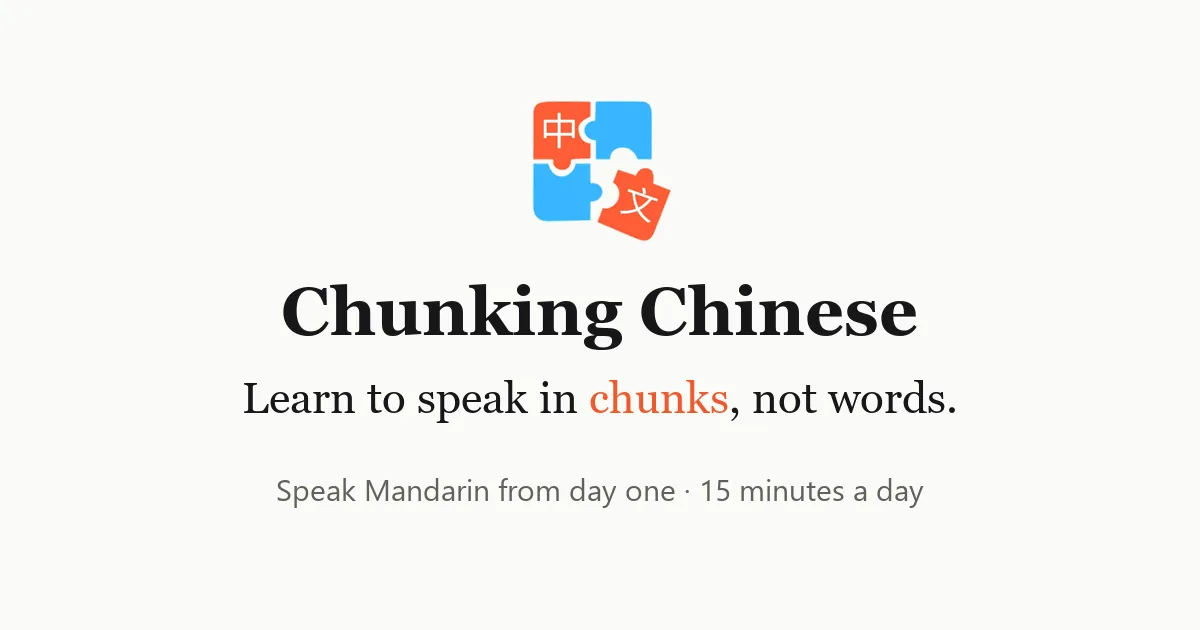
Chunking Chinese, our sister app, runs in the browser at chunkingchinese.com and does the one thing most sites on this list don't: it gets you speaking. Instead of single words, it teaches reusable chunks, short phrases like 我想问一下 (wǒ xiǎng wèn yíxià, "I'd like to ask") and 在哪里 (zài nǎli, "where is"), then has you combine them into new sentences out loud.
After a short placement between HSK 1 and HSK 5, each day is a loop of about fifteen minutes. You get an English prompt, answer by saying the Chinese, and it checks both your words and your pronunciation, scoring the sound and tone of each character. You can shadow a native recording first, turn the pronunciation feedback off, or type when you can't speak out loud, and you can add your own sentences and chunks.
Best for learners who understand more than they can say
It isn't a full course: it assumes some pinyin and basic characters, and it doesn't teach reading or writing. It's built to sit alongside a vocabulary and reading tool such as Mandarin Mosaic, turning words you recognise into sentences you can actually produce. At the time of writing it has a 7-day free trial, then costs $30 a month, with places opening in small groups from a waiting list. Our Chunking Chinese review covers it in detail.
3. HelloChinese

HelloChinese is one of the easiest starting points if you're at absolute beginner level and want something that doesn't overwhelm you on day one. It's mainly a phone app rather than a website. It gives you short lessons, pronunciation work, characters, listening, and speaking practice in a format that's easy to return to.
Its biggest strength is pacing. The app breaks Mandarin into manageable pieces and gives you a visible path forward. For beginners, that matters more than sophistication. If a platform feels confusing in the first week, most learners quit before they reach the useful parts.
Where it shines and where it stops
HelloChinese is good at getting you moving. The speech recognition, native audio exercises, placement options, and review tools make it feel active rather than passive. It's built for consistency, not depth.
That's also the limit. Once you reach lower-intermediate territory, the format can start to feel too controlled. You may still be completing lessons while your real reading and listening lag behind.
HelloChinese is a strong first course. It usually isn't the full long-term system.
The core lessons are free, and Premium unlocks everything, from around £9.99 a month on the UK App Store (cheaper on longer plans) at the time of writing.
Use HelloChinese if you need structure, accountability, and a friendly start. Don't use it as an excuse to postpone reading real sentences. The ideal move is to pair it with a contextual review tool once the beginner basics are in place.
4. Yoyo Chinese

Yoyo Chinese is for learners who want an actual teacher-led course, not a game. If you learn best when someone explains pronunciation clearly, breaks down grammar step by step, and keeps a coherent sequence, this platform does that very well.
The tone of the teaching is the appeal. Most lessons are taught by the founder, Yangyang Cheng. Some learners don't want to infer everything from repeated exposure. They want a human explanation first, then practice. Yoyo Chinese suits that mindset. It's a paid subscription (around US$20 a month, less on longer plans) with a one-off lifetime option, at the time of writing.
Best for explanation-heavy learners
The course structure covers beginner, intermediate, upper-intermediate, and character study. There's enough built-in support to keep self-learners moving without needing constant outside tutoring. It also overlaps naturally with HSK-style progression without becoming pure test prep.
The main trade-off is immersion density. Video instruction is useful, but it doesn't give you the same volume of reading or native-speed exposure you get from a dedicated graded reader. So if you rely only on this, comprehension growth may be slower than you expect.
A practical way to use Yoyo Chinese is simple:
- Use lessons for clarity: Learn pronunciation and grammar from the course.
- Use reading elsewhere: Add graded reading to make those explanations feel real.
- Use sentence review for retention: Save new structures into a contextual review tool so they don't fade.
If your frustration with beginner apps is that they feel shallow or gimmicky, Yoyo Chinese is often the better fit.
5. Chinese Zero To Hero!
Chinese Zero To Hero! makes the most sense for learners who want a clear HSK-shaped path. Some people need that external structure. They study better when vocabulary, grammar, and level expectations are mapped to a defined syllabus instead of scattered across a dozen tools.
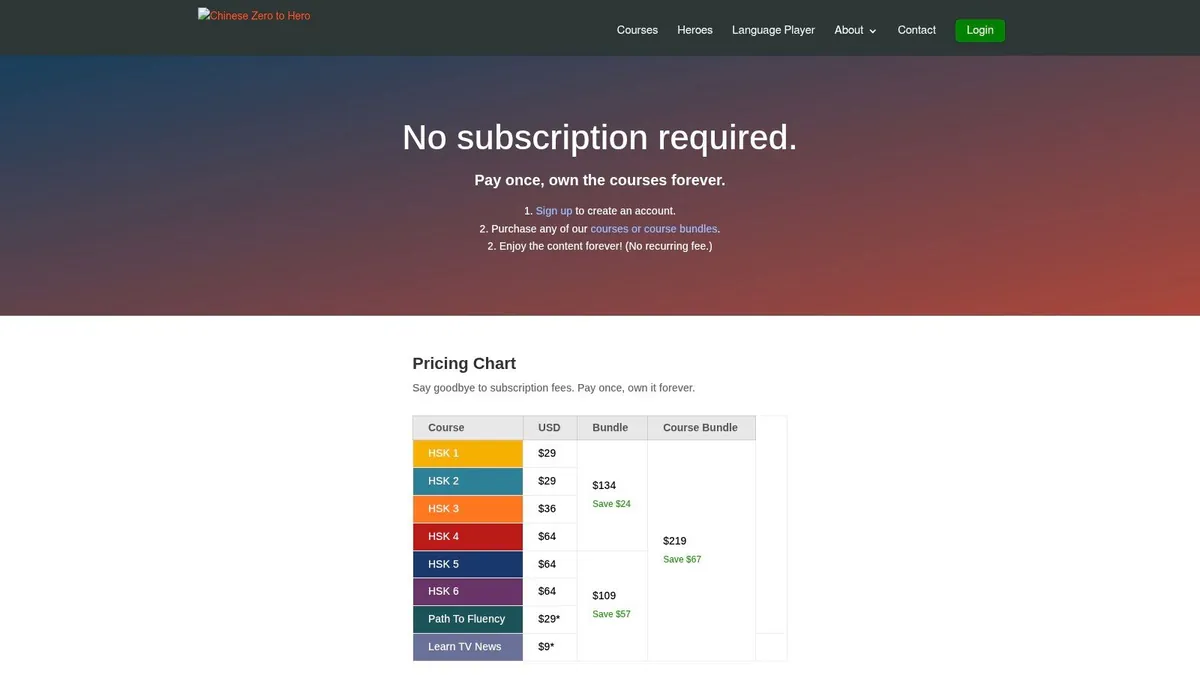
That's exactly what this platform does. It packages learning by HSK level and gives you explicit coverage rather than hoping you'll absorb things incidentally. There are plenty of free lessons on its YouTube channel and a few free courses; the HSK courses themselves are one-off purchases, per level or in bundles.
Good for syllabus-minded learners
This isn't the most interactive platform on the list, and that's important to say plainly. If you need constant feedback, game mechanics, or frictionless mobile review, it may feel static. But if you want ordered teaching and one-off purchases rather than only a subscription model, it has a clear advantage.
Chinese Zero To Hero! works best when you treat it as the spine of your study, not the whole body. Learn the syllabus there. Read elsewhere. Review in context elsewhere.
6. The Chairman's Bao
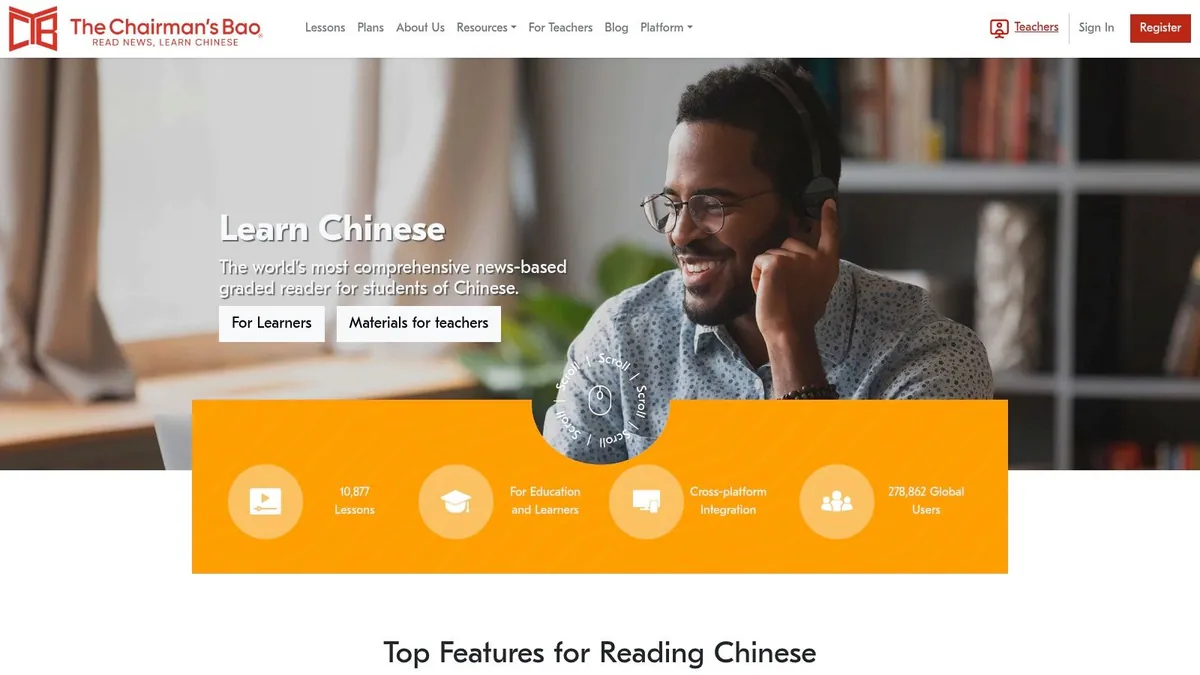
The Chairman's Bao is one of the strongest choices when you're ready to stop reading textbook dialogues and want current topics without jumping straight into full native news. It gives you news articles graded from HSK 1 to HSK 6+, with audio, vocabulary support, grammar notes, and exercises. There are free sample lessons; paid plans start from roughly £10 a month, cheaper on longer plans, at the time of writing.
That combination matters because intermediate learners often hit a dead zone. Beginner material feels too easy, but authentic native content is still too dense. A graded news platform solves that better than most generic course apps.
Why graded news is so useful
News-based reading gives you recurring vocabulary, proper nouns, current topics, and a stronger sense of how modern written Mandarin behaves. That's more transferable than memorising disconnected theme lists.
The downside is that this isn't a full speaking course, and it isn't trying to be one. You're building reading and listening strength here.
If your Mandarin study still lives almost entirely inside lessons, graded reading is usually the next upgrade with the highest payoff.
If you want to pair reading with a stronger retention workflow, this explanation of a Chinese sentence mining app fits well with how learners often use graded content. Read an article, notice useful patterns, then keep the best sentences alive in review instead of letting them disappear after one session.
The Chairman's Bao is especially useful for learners who want more serious subject matter without losing scaffolding.
7. Du Chinese
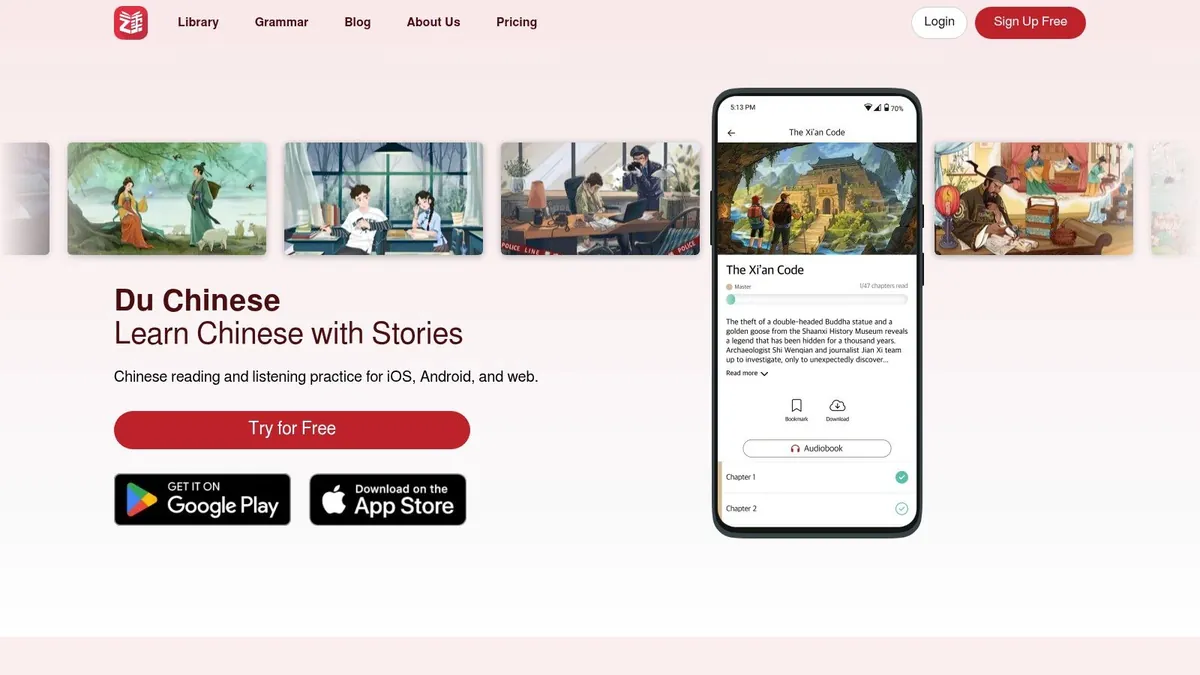
Du Chinese is often the easiest graded reader to turn into a daily habit. The interface is polished, the lessons are short enough to finish consistently, and the tap-to-translate workflow keeps reading from turning into constant frustration.
For many learners, this is the first place where Mandarin starts to feel readable instead of merely decodable.
The practical strength
It has over 3,000 lessons across six levels, from Newbie to Master. Some are free; the full library costs US$14.99 a month or US$119.99 a year on its website at the time of writing. The pinyin toggle, high-quality audio, adjustable speed, bookmarks, review system, and synced web-and-app experience all support one thing well. Repetition without much friction. That matters because reading progress in Mandarin comes from volume and continuity, not one heroic weekend.
The limitation is depth at the top end. If your goal is literary reading or deep advanced-domain vocabulary, short-form graded content won't cover everything. But for building a stable reading habit, Du Chinese is excellent.
A good use case looks like this:
- Morning: Do one short lesson and listen once with text.
- Evening: Re-read without pinyin.
- Review: Move the most useful unknowns into a sentence-based SRS tool.
That last step is what many people skip. They read a lot, enjoy the lesson, and still forget the key vocabulary a week later. Reading creates contact. Review creates retention.
8. Skritter

Skritter does one job better than almost anything else on this list. It teaches you to write Chinese characters by hand and retain them over time. There's limited free access; subscriptions cost roughly £10-£15 a month on the UK App Store, less on longer plans, at the time of writing.
If handwriting matters to you, that specialisation is valuable. If handwriting doesn't matter to your goals, Skritter can become a heavy commitment with limited return.
Use it for the right reason
A lot of learners assume they should practise handwriting because it feels serious. That's not a good enough reason. Handwriting takes time, and Mandarin already asks a lot from your schedule. You should use Skritter if you want strong character recall, stroke order confidence, textbook list support, and long-term review discipline.
You should not use it as your main all-purpose Mandarin website. It won't replace speaking, grammar development, or broad reading input.
For learners comparing review systems, this piece on an Anki alternative for Chinese is relevant because it highlights a common issue. Powerful review tools are useful only if the workflow matches your actual study habits.
Skritter's trade-off is simple. It's excellent for writing and character retention. It's narrow by design. That's a strength if you know why you're using it.
9. Hack Chinese
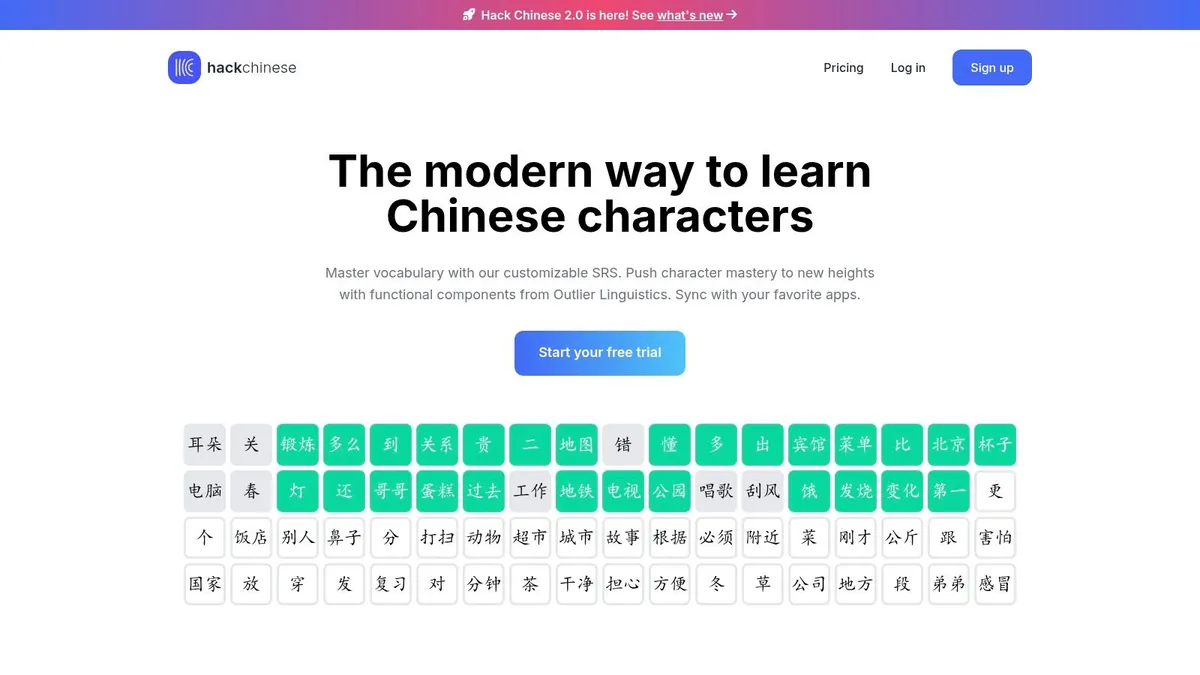
Hack Chinese is for serious vocabulary accumulation. It's web-first, efficient, and designed to help you push through large review volumes with as little friction as possible. After a free trial it costs around US$12 a month, or US$8 a month billed yearly, at the time of writing.
That makes it good for a specific kind of learner. If you already have reading material, listening material, and a course, but your weak point is word retention, Hack Chinese is useful.
Fast, efficient, and narrow
Its strengths are scheduling, custom lists, HSK support, and analytics. It gives you a clean environment for recognition-heavy review without trying to become everything at once.
Its weakness is equally clear. You won't get much speaking practice or rich grammar explanation there. So the tool works best as part of a larger system, not a standalone solution.
This also connects to a common intermediate problem: the plateau, where you keep studying but progress feels invisible. Targeted work on the words you keep meeting in your reading and listening is one of the more reliable ways through it; we cover others in how to break the intermediate Chinese plateau.
Hack Chinese can handle the active capture side well, especially if your study style is list-driven and efficiency-focused. If you need more context and grammar intuition, a sentence-first tool is usually the better companion.
10. maayot
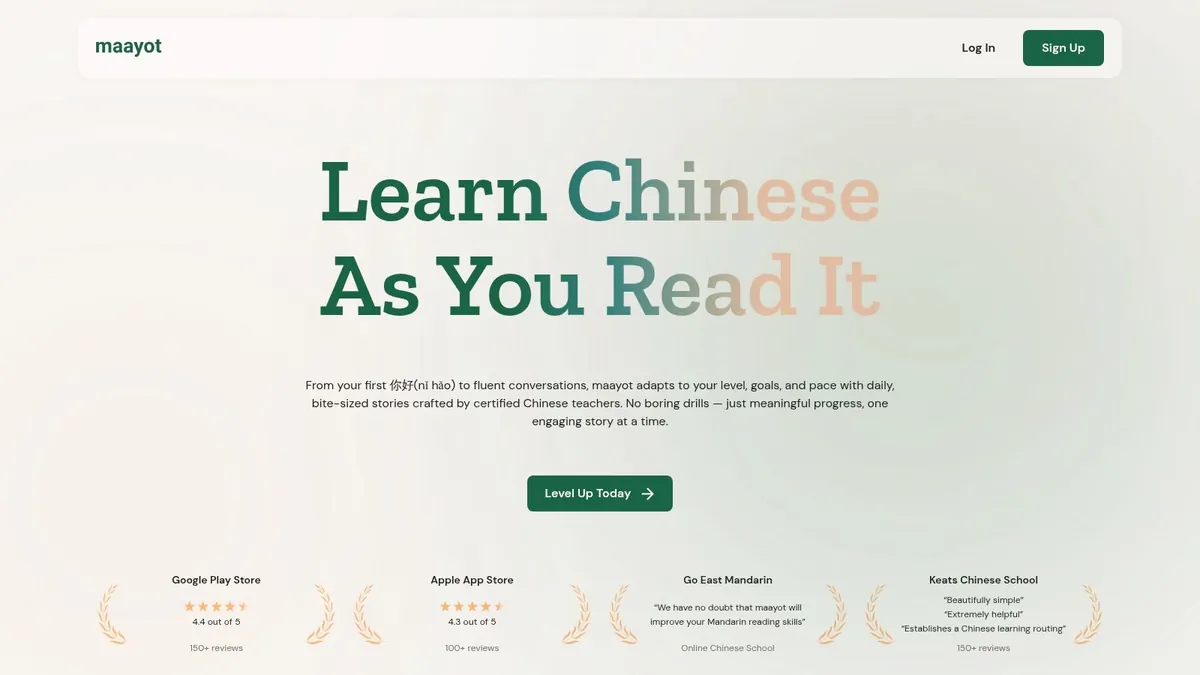
maayot sits in a useful middle ground between graded reading and daily accountability. It sends you a short graded story each day with audio, a pop-up dictionary and a quiz, and the Pro plan adds a teacher's correction of your writing and pronunciation. There's a free option; paid plans cost roughly US$10-15 a month, and Pro around US$50 a month, at the time of writing.
That daily format is the key feature. Some learners don't need a giant library. They need one good piece of content arriving regularly so they stop negotiating with themselves about what to study.
Strong for habit-driven learners
The modern topics and graded structure make it approachable, especially if you want something that feels contemporary rather than textbook-bound. It's also one of the better options if you want optional human feedback layered onto reading practice.
Its limitation is scope. This isn't a complete all-skills curriculum. It works best when you already know what role it plays in your system.
maayot is a solid answer if your main problem is consistency. It gives you a reason to read every day. You'll still need another tool if you want structured grammar teaching or deeper retention work.
Top 10 Mandarin Learning Websites Comparison
Prices are as listed at the time of writing.
| Product | Core features | UX & quality | Best for | Pricing & value | Unique selling point |
|---|---|---|---|---|---|
| Mandarin Mosaic | Sentence mining with only one new word per sentence; SRS; HSK‑levelled lessons; graded articles; tap a word for meaning and audio | Minimalist, mobile app, low‑friction | Duolingo/HelloChinese graduates, intermediates on plateaus, heritage & self‑directed learners | 30‑day free trial, then a limited free plan or from £7.92/month billed yearly (£11.95 monthly) | Automates sentence mining; context‑first vocab, see words in natural sentences |
| Chunking Chinese | Speaking practice with reusable sentence chunks; spoken English-to-Chinese prompts; per-character tone and sound scores; shadowing | Short daily speaking loop in the browser | Learners who understand more than they can say (HSK 1-5) | 7-day free trial, then $30/month (waiting list) | Makes you say whole sentences out loud and marks every character's tone |
| HelloChinese | Full beginner curriculum; speech recognition; characters & grammar paths; spaced review | Gamified, bite‑size lessons; clear progression; mainly a phone app | Absolute beginners → lower‑intermediate; daily habit builders | Free core lessons; Premium from around £9.99/month | Strong speech recognition and approachable gamification |
| Yoyo Chinese | Teacher‑led video courses; practice activities; flashcards; level pathways | High production value; systematic explanations | Learners who prefer clear teacher instruction over gamification | Subscription (around US$20/month, less on longer plans) or a one‑off lifetime option | Veteran teacher (Yangyang Cheng) + structured video lessons |
| Chinese Zero To Hero! | HSK‑mapped video courses and bundles; exam‑style grammar focus | Course‑style, syllabus driven | HSK preppers and learners wanting explicit exam alignment | Free YouTube lessons; HSK courses are one‑time purchases per level or bundle | Direct HSK alignment with level bundles and “Ultimate” options |
| The Chairman's Bao | Graded news articles with audio, vocab lists, grammar notes, exercises | Regularly updated, classroom‑friendly | Readers wanting current‑affairs vocabulary; teachers & study groups | Free sample lessons; paid plans from roughly £10/month | Levelled news content bridging textbook Chinese to real topics |
| Du Chinese | 3,000+ graded lessons; pop‑up dictionary; adjustable audio; SRS review | Polished reading experience; consistent quality | Learners building daily reading routines, from beginner to advanced | Some free lessons; US$14.99/month or US$119.99/year for the full library | Large, high‑quality graded reader library with strong audio |
| Skritter (Chinese) | Handwriting recognition; stroke feedback; character SRS; HSK decks | Focused, metric‑driven review for characters | Learners prioritising handwriting and long‑term character retention | Limited free access; roughly £10-£15/month, less on longer plans | Best‑in‑class handwriting practice with real‑time stroke feedback |
| Hack Chinese | Web‑first SRS vocab; HSK & custom lists; analytics and smart scheduling | Clean, minimal interface; efficient high‑throughput reviews | Serious self‑learners and HSK preppers focused on vocab volume | Free trial; around US$12/month or US$8/month billed yearly | Fast, analytics‑driven vocabulary memorisation workflow |
| maayot | Daily levelled short stories with audio, quizzes; teacher corrections on the Pro plan | Daily cadence; modern topics; mobile + web | Learners who want consistent daily graded reading and feedback | Free option; paid plans roughly US$10-15/month; Pro (with corrections) around US$50/month | Daily bite‑size graded stories with optional human feedback |
Your Next Step in Mastering Mandarin

You finish a lesson, feel productive, then realise two days later that almost none of the new words stayed with you. That usually is not a motivation problem. It is a system problem.
A good Mandarin learning website handles one job well. A course gives structure. A reader gives understandable input. A review tool helps you keep what you met. Progress gets easier when those pieces work together, because each study session feeds the next one instead of starting from zero.
Use this list to build a small stack with clear roles. Pick one course platform such as HelloChinese, Yoyo Chinese, or Chinese Zero To Hero! if you still need guided lessons. Add one reading source such as Du Chinese, The Chairman's Bao, or maayot so you are meeting real sentences early. Then add a retention layer for the language you encounter.
Mandarin Mosaic fits that third role well. As noted earlier, its value is practical rather than theoretical. Sentence mining keeps vocabulary attached to grammar and context, which makes review more useful than isolated word lists. That matters because many learners do enough study to recognise material, but not enough to recall and use it.
Most of the tools on this list build reading, listening and vocabulary, and give you little speaking practice. If speaking is your weak spot, pair one of them with Chunking Chinese (number 2 above).
For busy learners in the UK, that trade-off matters even more. Time is limited. School, work, commuting, and family life all compete with study. A setup built around short daily input plus targeted review is easier to maintain than long weekend catch-up sessions.
Start simple:
- Choose one core course. More platforms usually means repeated beginner content, not faster progress.
- Add one source of graded reading or listening. Input gives your vocabulary a job to do.
- Save useful sentences for review. Keep examples you want to understand, remember, and reuse.
- Protect a daily minimum. Twenty focused minutes beats a skipped week followed by a two-hour binge.
Stop comparing tools and assign roles instead. Pick one foundation tool from this list, one input source, and one review method. Learners improve faster when their tools support a repeatable study loop.