Level-Appropriate Chinese Sentences: How to Find and Use Them

You've probably had this moment already. You recognise a lot of characters, you've done the flashcards, you can handle app lessons, and yet a real Chinese sentence still slips away just when it should make sense.
That gap usually comes from studying words on their own, when real comprehension depends on how words behave together. Level-appropriate sentences, ones where you understand almost everything except one new word or pattern, train vocabulary, grammar and reading speed at the same time. This post explains what makes a sentence the right level, where to find such sentences, and how to fit them into a daily routine.
Why Your Chinese Study Has Stalled
The intermediate plateau usually doesn't mean you're lazy or untalented. More often, the material you study is pitched at the wrong level.
Many learners spend months memorising words one by one. That builds recognition, but it doesn't automatically build sentence processing. Chinese asks you to keep track of word order, topic-comment structure, omitted subjects, particles and meaning carried by context. If you only ever review words in isolation, you get very little practice at the thing that matters most: reading whole sentences smoothly.
Why words alone stop working
A flashcard can tell you that 觉得 (juéde) means "to feel" or "to think". It can't show you, on its own, how it's actually used: 我觉得这个问题不容易 (wǒ juéde zhège wèntí bù róngyì, I think this problem isn't easy) or 你觉得怎么样?(nǐ juéde zěnmeyàng?, what do you think?).
That's why learners say, "I know every word, but I still don't get the sentence." The missing piece is comprehensible input. The linguist Stephen Krashen argued in his input hypothesis that we acquire language by understanding messages pitched just beyond our current level, which he called "i+1": i is what you already know, and +1 is a small step past it. Sentence miners borrowed the term for sentences with exactly one unknown word.
Practical rule: If a sentence forces you to decode every part of it, it's too hard to teach you anything.
What level-appropriate sentences actually do
A good study sentence gives you a stable frame. Most of it is familiar, and one part is new. Because the rest makes sense, you can often work out the new item from context. Say you know every word here except 出差:
我明天去北京出差。 (wǒ míngtiān qù běijīng chūchāi.) I'm going to Beijing on a business trip tomorrow.
You can almost guess that 出差 (chūchāi) means a work trip before you check. That small act of working it out is what makes a word stick.
This matters even more in Chinese, where a lot of grammar is easier to absorb from repeated examples than from rules. You build intuition by seeing patterns recur in sentences you understand:
- Word order in action rather than in a grammar chart
- Particles like 了 (le), 着 (zhe) and 过 (guo) attached to meaning in context
- Topic-comment structures that feel odd at first but become normal through repetition
- Collocations such as 帮我一下 (bāng wǒ yíxià, give me a hand), 有意思 (yǒu yìsi, interesting) and 打算去 (dǎsuàn qù, plan to go), which are hard to master as isolated entries
If your Chinese has stalled, the fix usually isn't to work harder. It's to work with better sentences. Once your daily material is readable, repeatable and only slightly challenging, progress starts to feel steady again.
What Really Makes a Sentence "Level Appropriate"
The usual advice is simple: pick a sentence with one unknown word. That's a solid starting point, but it isn't the whole story.
A sentence can contain only one unknown word and still be poor study material. The difficulty may be hidden in the grammar, in how much information is packed in, or in a pattern you can't yet process quickly. In Chinese, those details matter a lot.
Four checks before you keep a sentence
Unknown vocabulary count
One new word is ideal. Two can work if the grammar is obvious and the context is strong. More than that usually turns review into decoding.Grammar load
Can you already recognise the structure? Topic-comment sentences, 把 (bǎ) sentences and long modifiers before a noun can be harder than they look.Sentence length
Length isn't the main problem, but it adds processing load. A short sentence with an unfamiliar structure can be harder than a longer one built from familiar chunks.Context clarity
Can you infer the new item from the rest of the sentence? If not, it's a weak learning sentence, even if it looks simple on paper.
Why grammar matters as much as vocabulary
It's easy to underestimate how much grammar adds to a sentence's difficulty. Compare these two, both made of fairly basic words:
- 我看完了那本书。(wǒ kàn wán le nà běn shū.) I finished reading that book.
- 那本书我看完了。(nà běn shū wǒ kàn wán le.) That book, I've finished it.
The second puts the topic first, which is completely normal in Chinese but trips up English speakers who expect the subject at the start. If you've never met that pattern, the second sentence is above your level even though every word is familiar.
A sentence can be made of known words and still be above your level if the structure is new to you.
How much do you need to understand?
For reading longer texts on your own, research suggests you need to know a very high share of the words. In a well-known study, Hu and Nation (2000) found that learners needed to know about 98% of the words in a text to read it for pleasure without help, which is roughly one unknown word in fifty. A single study sentence with one new word in ten is denser than that, but it works because you're not reading unaided: you're focusing on one sentence, with a dictionary and audio to hand. When you move on to longer texts, aim for that 98% level.
A simple way to judge fit
| Check | Good study sentence | Poor study sentence |
|---|---|---|
| Vocabulary | One clearly useful unknown item | Several unknown items competing for attention |
| Syntax | Familiar frame with one mild twist | Multiple unfamiliar structures |
| Length | Short to moderate, easy to re-read | Long enough that you lose the thread |
| Meaning | Obvious from context | Needs an explanation before it makes sense |
For more on why this works, see our guide to comprehensible input in Chinese.
Two examples
Better fit: 我今天不想做饭。(wǒ jīntiān bù xiǎng zuòfàn. I don't feel like cooking today.)
If 做饭 (zuòfàn, to cook) is new, the sentence is still easy to process.Worse fit: 这本书我昨天在图书馆借来的时候就觉得内容不太适合初学者。(zhè běn shū wǒ zuótiān zài túshūguǎn jiè lái de shíhou jiù juéde nèiróng bú tài shìhé chūxuézhě. When I borrowed this book from the library yesterday, I already felt the content wasn't really suitable for beginners.)
Even if only one word is new, the sentence asks you to track a topic placed first, a time clause, and an opinion all at once.
The best level-appropriate sentences can look almost boring at first glance. That's a feature, not a flaw: boring enough to understand, rich enough to teach.
How to Find Your Perfect "i+1" Sentences
You have two realistic options: use curated sentence packs, or mine your own. Both work, and they solve different problems.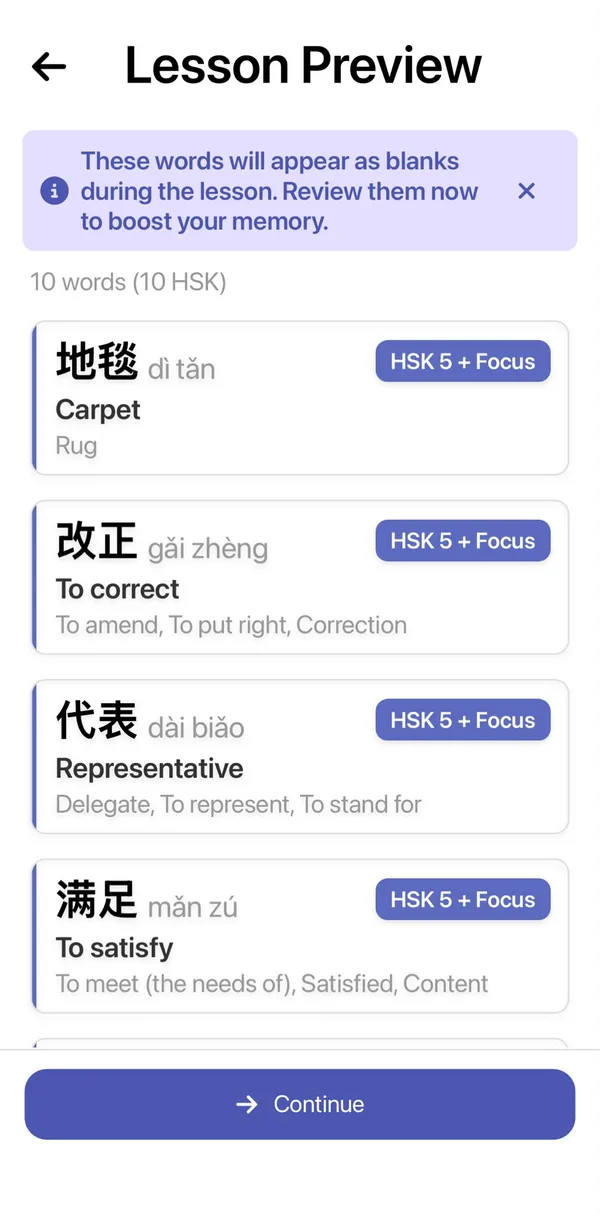
Option one: curated packs
Curated packs remove the decision fatigue. Someone has already chosen sentences for level, usefulness and progression. That matters, because self-learners often struggle less with motivation than with choosing material at the right level.
The trade-off is that curated content is efficient but less personal. You may get excellent sentences that have nothing to do with your favourite drama, your job or the topics you care about most.
Option two: self-mined sentences
Mining your own sentences gives you personal relevance. If you mine from a show you love, a podcast you replay or a graded reader on a topic you care about, you pay more attention and remember more.
But self-mining has traps. It's tempting to keep sentences because they're interesting, not because they're learnable, and those aren't the same thing. These rules of thumb work better than "one unknown word" alone:
- Keep sentences with a clear core meaning. If you can easily paraphrase a sentence, it's usually a good candidate.
- Prefer reusable patterns. A sentence that teaches 想 (xiǎng, want to), 可以 (kěyǐ, can), 应该 (yīnggāi, should), 比 (bǐ, compared with) or 先…再… (xiān…zài…, first…then…) will pay you back far more often than a rare literary phrase.
- Be wary of subtitle clutter. Dialogue from dramas is full of fragments, names, emotional filler and unfinished thoughts. Great for immersion, not always good for flashcards.
- Watch for hidden grammar jumps. Even with familiar vocabulary, relative clauses or topic shifts can make a sentence too costly to review.
- Prioritise sentences with audio. Hearing a sentence spoken naturally makes its rhythm and tones much easier to absorb.
Field test: If a sentence still feels useful without the scene or paragraph around it, it's probably strong enough to keep.
Which route fits your stage
| Approach | Strength | Weakness | Best for |
|---|---|---|---|
| Curated packs | Fast setup, reliable grading | Less personal | Beginners and plateaued learners |
| Self-mining | Personal relevance, targeted goals | More filtering work | Intermediate and advanced learners |
| Hybrid system | Stable core plus personal content | Needs some organisation | Most serious long-term learners |
If you want to try the hybrid route, start with our sentence mining guide for Mandarin learners, and see flashcards vs sentence mining for a side-by-side comparison of the two approaches.
Our app, Mandarin Mosaic, is built around this hybrid approach. It tracks the words you know and builds lessons from sentences with one new word where possible. In the built-in HSK packs and review lessons it allows at most two, and every built-in sentence has been checked by a native speaker. You can also make custom packs from your own sentences, or import them from Anki, CSV or text files; for those, the app picks the sentences with the fewest new words available, so the easier your mined sentences, the better it works. Our guide to sentence mining in Mandarin Mosaic walks through the setup.
A Simple System for Grading and Tagging Sentences
If you collect sentences yourself, a sentence bank gets messy fast. Without grades and tags, review turns into random browsing.
The goal isn't perfect classification; it's easy retrieval. When you want easier reading practice, travel vocabulary or examples of 把, you should be able to find them without digging.
A lightweight grading model
You don't need a complicated spreadsheet. Three labels are enough:
Difficulty
Easy, Medium or Hard, based on how much effort the sentence actually takes to read, not on pride.Unknown word count
Zero, one, or more than one.Grammar or function
For example comparison, result complement, experience with 过, topic-comment or question form.
That gives you real control without creating admin you'll abandon after a week.
The tags worth keeping
- Topic tags such as food, work, travel, family, study
- Source tags such as graded reader, podcast, drama, textbook
- Structure tags such as 是…的 (shì…de), 把 (bǎ), 被 (bèi), 越来越 (yuèláiyuè, more and more), 一边…一边… (yìbiān…yìbiān…, while)
- Use tags such as speaking, reading, formal, casual
A plain list of sentences can't tell you what to review when your goals change. Tags can.
Keep your tags useful, not clever. "Daily life" helps. "Interesting sentence" doesn't.
A practical review rule
- Easy sentences go into quick reading and audio repetition.
- Medium sentences are your main learning zone.
- Hard sentences get parked until the vocabulary or grammar behind them is familiar.
Most learners improve faster once they stop trying to squeeze value out of every sentence they meet. Some sentences belong in your active deck; others belong in a "not yet" pile.
Integrating Sentences into Your Daily Study Habit
A good sentence bank won't help if your daily routine is clumsy. You need a review loop that's quick enough to repeat every day and structured enough to build on itself.
The most effective routine is boring in the best way: read a sentence, work out the new word, check it, listen, read again, and recall it later.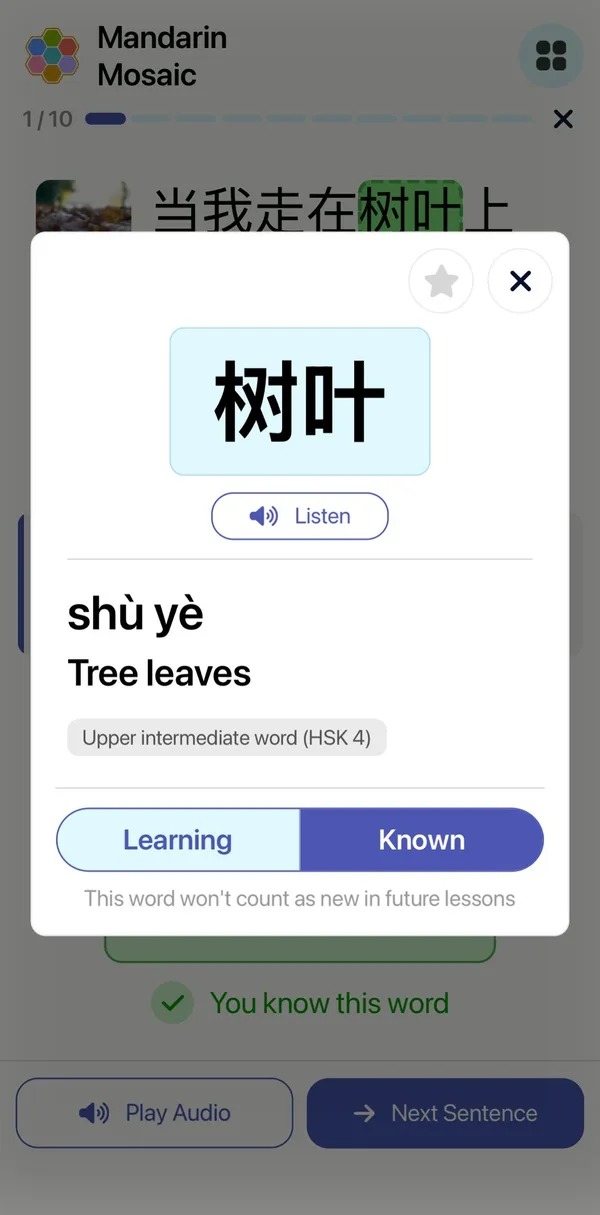
What a good session looks like
Start with reviews, not new items. That brings familiar sentence frames back into working memory and makes new material easier to absorb.
Then add a small number of new sentences. Read the whole sentence before looking anything up, and try to work out the unknown item from context. Then check its meaning, listen to the audio, and repeat the sentence aloud once or twice.
- Read silently first, so you test real comprehension.
- Look up second, with a quick tap rather than a separate dictionary, so you don't lose the thread.
- Listen next, so the rhythm and tones attach to the sentence.
- Shadow briefly, saying it along with the audio, so your mouth practises the chunk, not just your eyes.
- Recall it later, so the sentence becomes something you can retrieve, not merely something familiar.
Turning the new word into a fill-in-the-blank is an easy way to build in that last step. Mandarin Mosaic does this automatically: each lesson sentence becomes a cloze test with the new word (or a word due for review) blanked out, and you can tap any other word for its meaning and audio. See how cloze tests work in the app.
Why the timing of reviews matters
We forget new words quickly unless we meet them again. Spaced repetition schedules each review just before you're likely to forget, so a few minutes a day keeps a growing set of sentences fresh. This explanation of spaced repetition for language learning covers the core idea without the jargon.
Gamified apps are good at building early momentum, but they rarely give you enough repeated contact with full, level-matched sentences to build real grammar intuition. That repeated contact is what a sentence routine adds.
Add one small speaking layer
You don't need a full conversation every day, but you do need some active use. After reviewing a sentence, try one of these:
- Swap one detail, such as 今天 (jīntiān, today) for 明天 (míngtiān, tomorrow), or 北京 (běijīng) for 上海 (shànghǎi).
- Answer the sentence if it's a question.
- Retell it about your own life using the same structure: 我明天去北京出差 becomes 我下个星期去上海开会 (wǒ xià ge xīngqī qù shànghǎi kāihuì, I'm going to Shanghai for a meeting next week).
Read it, hear it, say it, then bend it slightly. That's where passive recognition starts turning into active control.
Consistency is what counts. Ten minutes of sentence work you can repeat every day beats a complicated system you rebuild every weekend.
From Sentences to Speaking with Confidence
Confidence in speaking Chinese doesn't come from collecting enough words. It comes from owning enough patterns.
When you study level-appropriate sentences, you're not just learning vocabulary in context; you're storing ready-made building blocks. After enough exposure, phrases like 你怎么知道的?(nǐ zěnme zhīdào de?, how did you know?), 我本来想去 (wǒ běnlái xiǎng qù, I was originally going to go) and 这个问题不太容易 (zhège wèntí bú tài róngyì, this problem isn't so easy) stop feeling like things you assemble from rules. They're just there when you need them.
That's why the method works at every stage. You read more smoothly because the sentences are at your level. You remember more because you review words in context. And you speak more naturally because your memory holds chunks, not loose parts.
The shift is mostly in how you choose. Stop asking whether a sentence is interesting enough to save, and ask whether it's learnable enough to repeat, recall and reuse.
One sentence today is enough. Then another tomorrow.
If you'd like this done for you, Mandarin Mosaic gives you HSK-levelled sentence lessons with one new word where possible, lifelike audio, tap-to-look-up words and spaced repetition, plus custom packs for the sentences you mine yourself. It's free to try for 30 days.