 Mandarin Mosaic
Free on iPhone, iPad and Android.
Download on theApp Store Get it onGoogle PlayYour first month of Premium is free.
Comprehensible Input for Chinese: How to Learn Mandarin by Understanding

You've probably had this moment already. You finish a unit in Duolingo or HelloChinese, recognise a fair number of characters, and feel fine when the app asks you to match words or fill gaps. Then you open a real Chinese article, or hear a native speaker at normal speed, and it all falls apart.
That doesn't mean you're bad at Mandarin. It usually means you've trained for recall in narrow exercises, not for understanding Chinese in context. The fix most experienced learners point to is comprehensible input: spending most of your study time reading and listening to Chinese you can mostly understand, with a little new language mixed in. This post explains the idea, where it comes from, what the research does and doesn't say, and how to find material at your level.
In short:
- Comprehensible input is Chinese you can mostly follow, with a small amount that's new.
- If you're looking up a word every few seconds, the material is too hard. Step down a level.
- Graded readers, learner podcasts, graded news and sentence mining provide it at different stages.
- Input builds understanding; speaking still needs practice of its own.
What is comprehensible input?

Comprehensible input is language you can understand, from what you already know plus the context, that contains a small amount of language you don't know yet. You're not expected to catch every detail, and you're not meant to drown in content far beyond you.
Think of learning to swim. Jump into deep water before you can float and you panic; stay on dry land reading about swimming and you never learn. You need to be in water you can handle.
Take this sentence:
我昨天在超市买了一把水果刀。
wǒ zuótiān zài chāoshì mǎile yì bǎ shuǐguǒdāo.
Yesterday I bought a fruit knife at the supermarket.
If you know everything except 水果刀 (shuǐguǒdāo, fruit knife), the sentence still makes sense: it's something you can buy at a supermarket, and you may already know 水果 (shuǐguǒ, fruit) and 刀 (dāo, knife). Check the meaning once and the word arrives attached to a real situation. That's far more memorable than 水果刀 on a bare flashcard.
| Study style | What your brain gets |
|---|---|
| A word on its own | An English label with weak connections |
| A sentence with one new word | Meaning, grammar, pronunciation, usage and context together |
Krashen's input hypothesis and i+1
The idea comes from the American linguist Stephen Krashen, who developed it from the late 1970s, most fully in his books Principles and Practice in Second Language Acquisition (1982) and The Input Hypothesis (1985). His central claim is that we acquire a language by understanding messages in it, not by studying its rules. He wrote this as i+1: "i" is your current level, and "+1" is language just beyond it, which you can understand because the rest of the message supports it.
The input hypothesis is one of five that make up his theory. Three more matter for learners:
- Acquisition versus learning. Krashen separated subconscious acquisition, which comes from input, from conscious learning of rules.
- The monitor. Consciously learnt rules act mainly as an editor, checking what you say or write, rather than as the source of fluent speech.
- The affective filter. Anxiety, boredom and embarrassment make input less effective, so relaxed, interesting material works better.
There's a clear summary of the theory and its critics on Wikipedia, and Olle Linge's guide to learning Chinese through comprehensible input on Hacking Chinese applies it specifically to Mandarin.
How much should you understand?
Krashen never put a number on "+1", but vocabulary research gives a useful guide. A widely cited study by Hu and Nation (2000) found that learners of English needed to know about 98% of the words in a short story to read it comfortably without help: roughly one unknown word in every fifty. A 2025 replication by Webb and colleagues found a less clear-cut picture. Comprehension did tend to rise with coverage, but the differences between 90%, 95% and 98% weren't statistically significant.
Both studies were about English, and Chinese adds its own twist: an unknown character can hide the sound as well as the meaning. So treat the numbers as a rule of thumb rather than a target:
- Reading for pleasure or listening without pausing: choose material where new words are rare, so you can follow the story without stopping.
- Intensive study with a dictionary: you can handle more, but if you're looking something up in every line, it's too hard to count as input.
Is input enough on its own?
Krashen's theory is influential but debated. Critics point out that parts of it are hard to test, and many researchers think he underrated output. Merrill Swain's output hypothesis, for example, argues that trying to speak and write makes you notice gaps in what you know. Even Hacking Chinese, which is strongly in favour of input, treats speaking and writing as skills that need their own practice.
The practical takeaway: make input the bulk of your study, because that's where vocabulary and a feel for grammar come from, but don't expect to become a confident speaker from listening alone. When you start speaking, it helps to reuse whole phrases you've heard many times rather than building every sentence word by word. The Chunking Chinese fluency trainer is built around that idea: it teaches reusable sentence chunks and gives feedback on your tones and pronunciation, character by character.
Learn Chinese faster with Mandarin Mosaic


Why flashcards and apps alone stall at the intermediate stage
Flashcards and gamified apps are useful at the start. They give you structure, feel productive and help you build your first few hundred words. The trouble starts when they become your whole system.
When you memorise a Chinese word on its own, you store a thin version of it: an English gloss and perhaps the character's shape. You don't learn how it behaves in a sentence, which words tend to appear around it, or how to catch it in fast speech. That's why learners so often say, "I know this word, but I didn't catch it."
Grammar works the same way. You can read an explanation of 了 (le) or 把 (bǎ), understand it on paper, and still hesitate when those patterns turn up in natural Chinese. The explanation helps you notice the pattern later, but it doesn't replace meeting it again and again in sentences you understand.
Mandarin makes this especially obvious:
- Characters carry a heavy load. For every word you learn a meaning, a written form and a pronunciation with tones, plus how it combines with other characters.
- Words shift in context. A word you know from a flashcard can still confuse you inside a natural sentence.
- Grammar becomes clear through exposure. Word order and particles such as 了 make far more sense after hundreds of examples than after one explanation.
None of this makes flashcards useless. Spaced repetition is an efficient way to remember words, as long as those words live inside sentences you've understood. If you feel stuck between textbook Chinese and the real thing, our post on breaking the intermediate Chinese plateau goes into more detail.
Where to find comprehensible input in Chinese

Different kinds of input suit different stages. These are the main options, with resources that exist at the time of writing. Prices and free allowances change, so check each site before you commit.
Graded readers
Graded readers are stories written with a limited vocabulary and controlled grammar, so you meet familiar structures repeated in slightly new ways rather than several unknown words in every line. For beginners and lower intermediates, they're the easiest way into real reading.
- Mandarin Companion publishes graded novels, many of them adapted from Western classics, in three levels: Breakthrough (150 characters), Level 1 (300 characters) and Level 2 (450 characters). They're sold as paperbacks and ebooks.
- Du Chinese is an app and website of short graded stories and articles across six levels, from Newbie to Master, with native-speaker audio and pop-up definitions. Some lessons are free; the full library needs a subscription.
Most graded readers come with audio. Listening while you read links characters to their sounds and tones, and rereading a story you've already finished is good input, not wasted time.
Graded news and articles
Once simple stories feel comfortable, graded news gives you adult topics at a controlled level. The Chairman's Bao publishes news-based lessons across six levels, starting at HSK 1, with audio and a built-in dictionary. There are free sample lessons, and full access is a paid subscription. Mandarin Mosaic also includes a reader of graded Chinese articles. For why news makes such good reading material, see why reading Chinese news is a great way to learn.
Learner podcasts and YouTube
Listening becomes useful input when the speech is clear, not too fast, and supported by context. A simple test: if you can follow the gist without pausing every few seconds, you're at the right level. If every sentence is a blur, step down.
- Comprehensible Chinese (YouTube and podcast) is almost entirely in Chinese. The host speaks slowly and uses repetition, rephrasing and visual support, so lower-level learners can follow without English. It's free.
- Mandarin Corner (YouTube) has interviews, vlogs and slow-Chinese videos subtitled in characters, pinyin and English, suited to lower intermediate learners and up. The videos are free, with transcripts and extra material on its website.
For how to choose and use podcasts, see our tips for learning Chinese from podcasts.
TV shows, films and native content
Native content is the goal, but for most learners it only becomes comprehensible at an upper-intermediate level. Chinese subtitles help, and shows set in everyday life, such as family dramas and sitcoms, are much easier than historical costume dramas. Before that level, a show with English subtitles is enjoyable but gives you little input, because you'll read the English rather than process the Chinese.
Sentence mining
Sentence mining means collecting sentences you almost fully understand, each containing one new word, and reviewing them with spaced repetition. It's i+1 at the smallest scale, and it's often the most practical option for intermediate learners, because you don't have to wait until a whole book is at your level.
Each sentence does several jobs at once:
我已经把报告发给客户了。
wǒ yǐjīng bǎ bàogào fā gěi kèhù le.
I've already sent the report to the client.
If 客户 (kèhù, client) is the only word you don't know, the rest of the sentence tells you what kind of word it must be, and you learn it with almost no effort. At the same time you're reinforcing 报告 (bàogào, report), 已经 (yǐjīng, already) and the 把 pattern in a sentence you might actually say. Our complete guide to sentence mining explains how to set it up, and level-appropriate Chinese sentences covers how to pick sentences at the right difficulty.
Which should you start with?
| If you are... | Start with... |
|---|---|
| A complete beginner | All-Chinese videos made for beginners, plus sentences built from the words you're learning |
| Building basic reading confidence | The easiest graded readers, with audio |
| Comfortable with simple text but weak at listening | Learner podcasts with transcripts |
| Stuck between textbook Chinese and real usage | Sentence mining and graded news |
| Upper intermediate | TV shows with Chinese subtitles and native articles |
Most learners end up combining several of these.
How to get the most from comprehensible input
- Choose topics you care about. Interest keeps you coming back, and it's easier to follow a story when you want to know what happens next.
- Follow the message, not every word. After a few minutes, ask whether you're following the meaning or just hunting for words you know. If you're only hunting, lower the difficulty.
- Guess, then check. Try to work out a new word from context before you look it up. Brief look-ups are fine when they restore your understanding.
- Read and listen together. Audio alongside text links characters to their sounds and tones, which reading alone can't do.
- Reread and relisten. Going back over familiar material lets you process it faster each time, and that speed is what makes real-time listening possible.
- Don't worry if it feels easy. Easy enough to follow is the point. You're still meeting known words in new combinations, which is how they become automatic.
A daily routine with Mandarin Mosaic
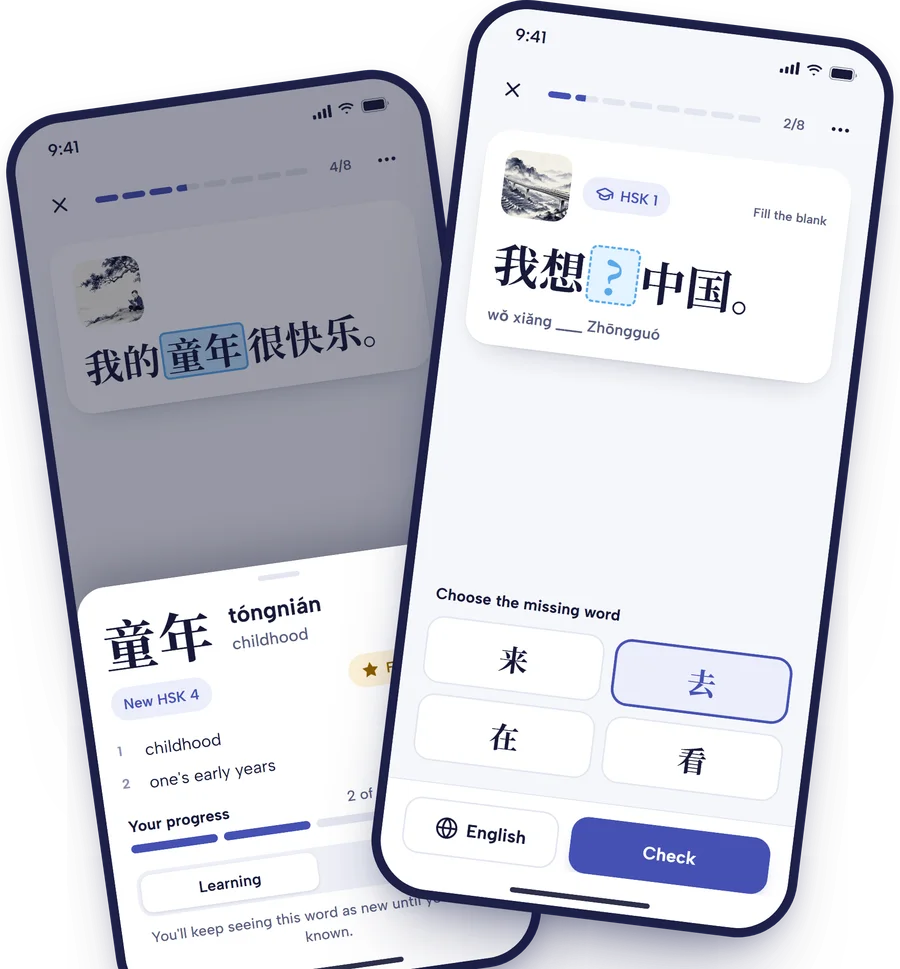
Sentence mining works well in theory, but doing it by hand is fiddly: finding sentences at the right level, checking definitions, adding audio and building cards. Mandarin Mosaic is our sentence-mining app, built to remove that setup. Its lessons are levelled by HSK, and each sentence introduces just one new word, so every sentence is i+1. A typical session looks like this:
- Work through a short lesson of new sentences at your level, tapping any word for its meaning.
- Review earlier sentences when spaced repetition brings them back, just before you'd be likely to forget them.
- When you have time, read one of the app's graded Chinese articles for some longer reading at your level.
It's a tool for building vocabulary and reading through input, not a speaking course, so pair it with listening and some speaking practice. New users get a 30-day free trial; after that there's a limited free plan or a paid subscription (at the time of writing).
Common problems and how to stay consistent

It feels too slow
Comprehensible input is less dramatic than cramming. You don't get the quick satisfaction of ticking off fifty cards, but slower-looking progress is often deeper progress. Instead of asking "How many words did I memorise today?", ask "Did Chinese feel a bit easier to understand today?" If a sentence pattern now makes sense without translating, that counts.
I can't find material at the right level
This is a real problem in Mandarin. Some content is too childish, some too advanced, and some is simple but about things you don't care about. If native content overwhelms you, use graded texts or level-appropriate sentences. If audio is too fast, choose learner audio with a transcript. If you want useful adult Chinese, pick graded news or sentences on topics you actually talk about. Material that constantly leaves you confused isn't input, so don't force it.
I keep slipping back to word lists
Isolated review is easy to organise, with a clear task and a quick finish line. Keep one rule: every new word should appear in a sentence you understand as soon as possible. A word attached to a situation is far easier to remember than a word on its own.
I'm consistent for a week, then I stop
Most learners don't need more intensity; they need less friction. One short daily session with material that's ready to go beats occasional heroic weekends. Keep the difficulty sensible and don't let the habit turn into a project about tools.
Frequently asked questions
Can a complete beginner learn Chinese through comprehensible input?
Yes, but the input has to be very simple at first: all-Chinese videos that use pictures and gestures, or short sentences built from the words you're learning. Many learners also learn pinyin and the tones explicitly at the start, because it makes everything they hear afterwards easier to make sense of.
Do I still need to study grammar and vocabulary?
A little explicit study speeds things up. A short grammar explanation helps you notice a pattern when you meet it, and spaced repetition helps words stick. The mistake is letting study replace input rather than support it.
Should I read characters or pinyin?
Characters, as early as you can. Pinyin is useful for pronunciation, but if you read only pinyin you won't be able to read real Chinese later. Use materials that let you check the pinyin of a word when you need it, and rely on it less as you go.