Is Mandarin Hard to Learn? Explained and Actionable
So, is Mandarin hard to learn? The honest answer is both yes and no. It throws some unique curveballs at English speakers, like mastering tones and memorising characters, but it’s also surprisingly straightforward in other ways, especially its grammar.
The Honest Answer About Learning Mandarin
Many would-be learners feel put off by Mandarin's reputation. You hear stories of tonal train wrecks and the seemingly impossible task of learning thousands of complex characters, making fluency feel like a distant dream. While those parts of the language definitely demand real effort, they only tell half the story.
The question isn't just "is Mandarin hard?" It's more about understanding what makes it tricky and what makes it surprisingly manageable. Getting your head around this balance is the first step to building a study plan that actually works. Instead of seeing Mandarin as one giant, unclimbable mountain, think of it as a new landscape with varied terrain—some steep climbs, for sure, but also some wonderfully flat, easy paths.
What to Expect on Your Journey
The early days are often all about getting your mouth and ears around the pronunciation and tones, which can feel completely alien at first. But at the same time, you'll start to uncover the simple beauty of its grammar, which doesn't have many of the headaches found in other languages. This means you can start building basic sentences much faster than you might expect.
To give you a clearer picture, let's break down what makes Mandarin both a challenge and refreshingly simple for English speakers.
Mandarin for English Speakers: A Quick Comparison
Here's a side-by-side look at the challenging and straightforward parts of learning Mandarin Chinese. It helps to see where you'll need to focus your energy and where you'll get some quick wins.
| The Challenging Aspects | The Straightforward Aspects |
|---|---|
| Tonal Language: The meaning of a word can change completely based on your vocal pitch, which requires careful listening and speaking practice. | Simple Grammar: There are no verb conjugations, tenses, or gendered nouns to memorise, making sentence structure very logical. |
| Character Memorisation: Learning thousands of characters (Hanzi) is necessary for reading and writing, which demands consistent, long-term effort. | Flexible Word Order: While there is a standard sentence structure, it's often more flexible than English, allowing for easier expression. |
| Different Sound System: Many Mandarin sounds don't have direct equivalents in English, requiring you to train your mouth to make new shapes. | Logical Vocabulary: Many words are formed by combining simpler characters, making new vocabulary intuitive once you know the building blocks. |
As you can see, the major hurdles are in the sound system and the script. But once you start building sentences, the grammatical logic offers a much smoother ride. It’s a trade-off, and knowing this from the start makes the entire process feel far less intimidating.
Navigating Mandarin Tones and Pronunciation
For many people dipping their toes into Mandarin, the whole idea of tones is the first big hurdle. It’s often the thing that makes them stop and ask, "is Mandarin really hard to learn?". The thought that the pitch of your voice can completely change a word's meaning feels pretty intimidating at first.
But here’s the thing: it’s less like learning a musical instrument from scratch and more like mastering an extension of something you already do naturally in English.
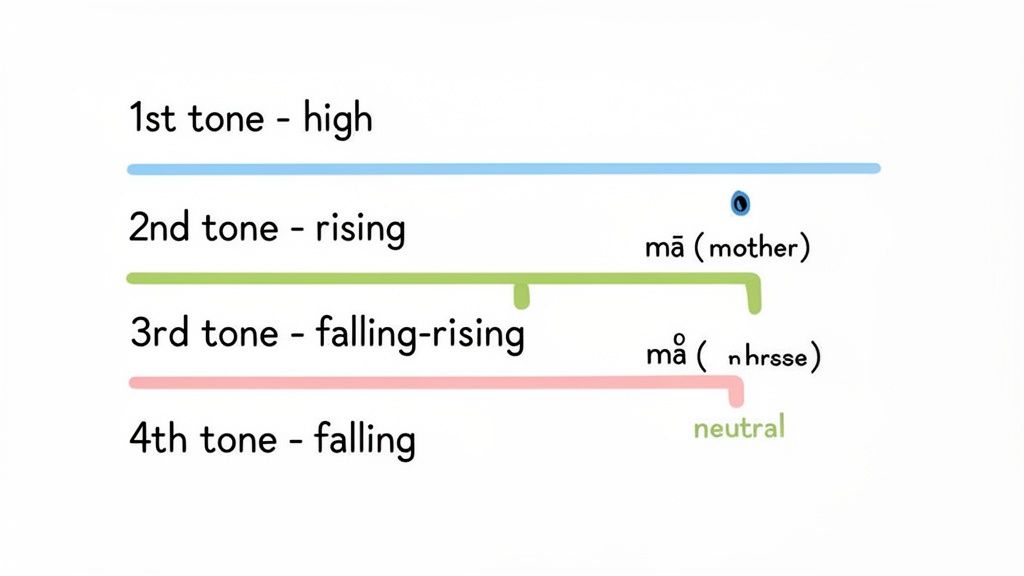
Just think about how your voice instinctively rises at the end of a question ("You're going?") but falls when you make a statement ("You're going."). You're using pitch to signal a different meaning. Mandarin simply takes this concept and organises it into a consistent system of four main tones, plus a fifth neutral one.
Understanding the Four Main Tones
These tones are what give Mandarin its signature melodic quality. Getting them wrong can lead to some funny—or just plain confusing—mix-ups. The classic example that every beginner learns is the syllable "ma," which can mean four wildly different things depending on your pitch.
- First Tone (mā): A high, level sound, like you're holding a single, steady note. This means "mother" (妈).
- Second Tone (má): A rising sound, a bit like the way your voice goes up when you ask, "What?". This means "hemp" (麻).
- Third Tone (mǎ): A dipping sound that falls and then rises again. This one means "horse" (马).
- Fourth Tone (mà): A sharp, falling sound, almost like you're giving a command. This means "to scold" (骂).
Mixing up "mother" (mā) and "horse" (mǎ) is a rite of passage for beginners, and it perfectly highlights just how crucial tones are. But don’t let that scare you. The key is to realise that mastering tones is a physical skill, kind of like developing muscle memory for a new sport.
If you want to get into the nitty-gritty, you can learn more about how Mandarin tones work in our detailed guide.
Tones are not an abstract grammatical rule to be memorised; they are a physical skill to be trained. Consistent listening practice trains your ear to hear the differences, while speaking practice trains your mouth to produce them accurately.
The Power of Context and Practice
In the beginning, trying to isolate and perfect each tone can feel stiff and robotic. This is where context becomes your absolute best friend. Native speakers don't consciously think about individual tones; they think and speak in phrases and entire sentences.
When you hear tones as part of a natural sentence, they become far easier to understand and mimic. This is exactly why a learning method centred on full sentences is so powerful. Instead of drilling isolated words out of context, you hear how they actually sound when they flow together.
Through consistent listening and repetition, your brain starts to pick up on the patterns automatically. It’s a process of training your ear, not just memorising a bunch of rules. With dedicated listening and speaking practice, tones will transform from a confusing puzzle into just another natural part of the language. They are a manageable learning curve, not the impassable barrier they might seem at first.
How to Actually Learn Chinese Characters
Staring at a page of Chinese characters, known as Hanzi, can feel like you’re trying to crack some ancient, unreadable code. It's often this visual complexity, more than anything else, that makes people throw their hands up and wonder if Mandarin is just too hard. The good news? There’s a hidden logic to these symbols that makes them far more approachable than they first seem.
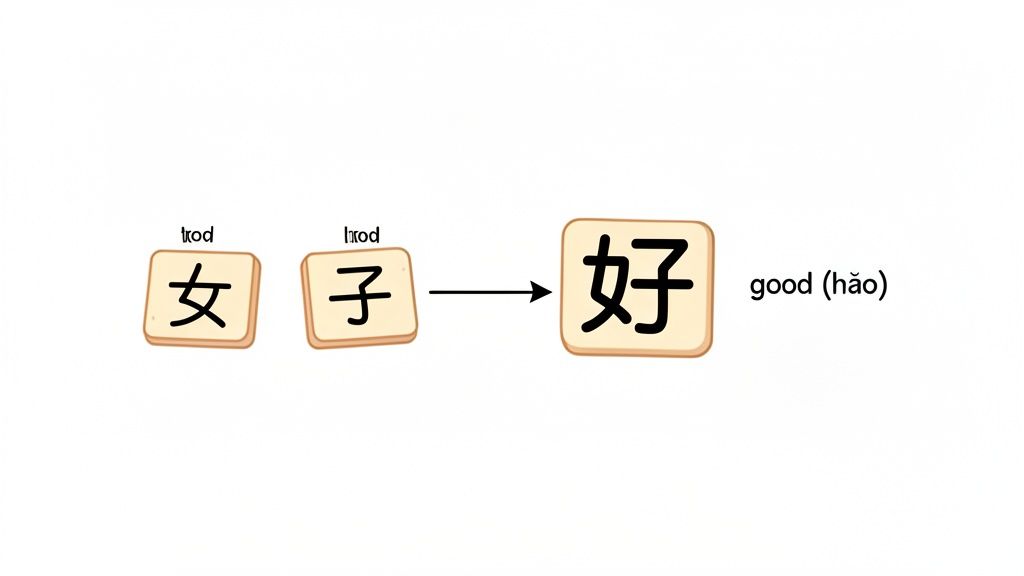
Chinese characters aren’t just a random jumble of strokes. Think of them more like Lego bricks. Many characters are built from simpler components, and the most important of these building blocks are called radicals.
The Logic of Radicals
Radicals are the recurring parts inside characters that often give you a clue about the meaning or, sometimes, the pronunciation. Once you start spotting these patterns, the whole system begins to click. Instead of memorising thousands of unique drawings, you’re just learning to see how a few hundred building blocks get combined in different ways.
Let's take a classic example:
- The character for 'woman' is 女 (nǚ).
- The character for 'child' or 'son' is 子 (zǐ).
Put them together, and you get 好 (hǎo), which means 'good'. The logic here—a woman with her child—creates a powerful visual story that sticks in your mind. It’s simple and elegant. You’ll see the 'woman' radical (女) pop up in related characters too, like 'mother' (妈, mā) and 'older sister' (姐, jiě), creating a whole family of connected meanings.
This system turns learning characters from a brute-force memory chore into a fascinating puzzle. You can learn more about getting started with these essential building blocks in our guide to understanding radicals in Chinese.
Ditch Rote Memorisation for Context
For decades, learners were told to spend countless hours writing characters over and over again, hoping to burn them into their memory. While repetition has its place, this method is painfully slow and often doesn’t work because it treats characters as isolated, abstract symbols. There’s a much better way: learn them in the context of real sentences.
The most effective way to learn characters is not by drilling them one by one, but by seeing them used in meaningful sentences. This way, you learn not just what a character is, but what it does.
When you come across a new character in a sentence, you instantly get a feel for its function, how it’s commonly used, and its relationship to the words around it. This contextual learning is the core idea behind the Mandarin Mosaic app. By showing you new vocabulary in complete sentences perfectly matched to your level, the app helps you build an intuitive grasp of how characters work together to create meaning.
This method completely changes the game. It’s no longer a frustrating memory test but an engaging and logical pursuit. By focusing on patterns and context, you'll be amazed at how quickly your reading ability improves, making the path to fluency feel much more achievable.
The Surprising Simplicity of Mandarin Grammar
After you’ve wrestled with tones and started recognising a few characters, you’ll run into Mandarin’s most welcome surprise: its grammar. For anyone who’s ever been bogged down by complex grammatical rules, Mandarin grammar is a breath of fresh air. It’s logical, consistent, and remarkably straightforward.
This is where the question “is Mandarin hard to learn?” gets a wonderfully simple answer. When it comes to grammar, it’s one of the most approachable major languages out there. It ditches many of the grammatical headaches that complicate other languages, letting you focus on what really matters: word order and meaning.
What Makes It So Simple?
The real beauty of Mandarin grammar lies in everything it doesn’t have. There are no confusing rules to memorise for verbs, nouns, or adjectives depending on who’s talking or what’s being discussed. This streamlined structure means you can start building your own sentences much, much earlier.
Let's break down the key features that make it so accessible:
- No Verb Conjugations: The verb ‘to be’ (是, shì) stays the same whether you’re talking about yourself, your friend, or a whole crowd. It just never changes.
- No Plurals: To make a noun plural, you often just add a character like 们 (men) for people. The noun itself doesn’t change its form at all.
- No Gendered Nouns: There's no need to memorise whether a table is masculine or a chair is feminine. Everything is neutral.
- No Tenses: Instead of changing verb endings for past, present, or future, Mandarin uses simple time words or particles. Adding 了 (le), for instance, just signals that an action is complete.
The core principle of Mandarin grammar is efficiency. It avoids fiddly modifications to words and instead relies on a logical, consistent word order to get the meaning across. Once you get the basic structure, it feels incredibly intuitive.
Sentence Structure in Action
The standard word order is Subject-Verb-Object (SVO), exactly like in English. This familiar pattern gives you a solid foundation to start building sentences right away.
For example, just look at how little the sentence changes when you go from a single person to a group.
- I am a student: 我是学生 (Wǒ shì xuéshēng)
- They are students: 他们是学生 (Tāmen shì xuéshēng)
Notice how the verb 是 (shì) and the noun 学生 (xuéshēng) stay exactly the same? The only thing that changes is the subject, from 我 (wǒ) to 他们 (tāmen). This kind of predictability is a massive advantage when you’re just starting out.
This topic-prominent structure lets you start forming your own sentences intuitively, as soon as you have a small bank of words. Rather than getting stuck on grammar rules, you can jump straight into communicating, which makes conversational progress feel much more within reach from day one.
Setting Realistic Timelines for Your Mandarin Journey
So, how long does it really take to get good at Mandarin? It's the question on every learner's mind, and getting the answer right is key to staying motivated for the long haul. The good news is, the old myth that Mandarin is "too hard to learn" is being busted every single day, and you don't have to look far for proof.
Just look at the UK's teenagers. In 2012, a little over 3,000 students sat their Mandarin GCSEs. Fast forward to 2023-24, and that figure has shot up to more than 7,800. That’s more than double in just over a decade, a massive surge while other languages are seeing a decline. You can read more about it in a recent British Council report.
What does this tell you? It's powerful social proof. If thousands of 16-year-olds can hit a recognised level of skill through steady, structured study, so can you.
The journey isn’t a single, monolithic climb. It’s a series of manageable stages, moving from basic conversation to comfortable reading and, eventually, fluency.
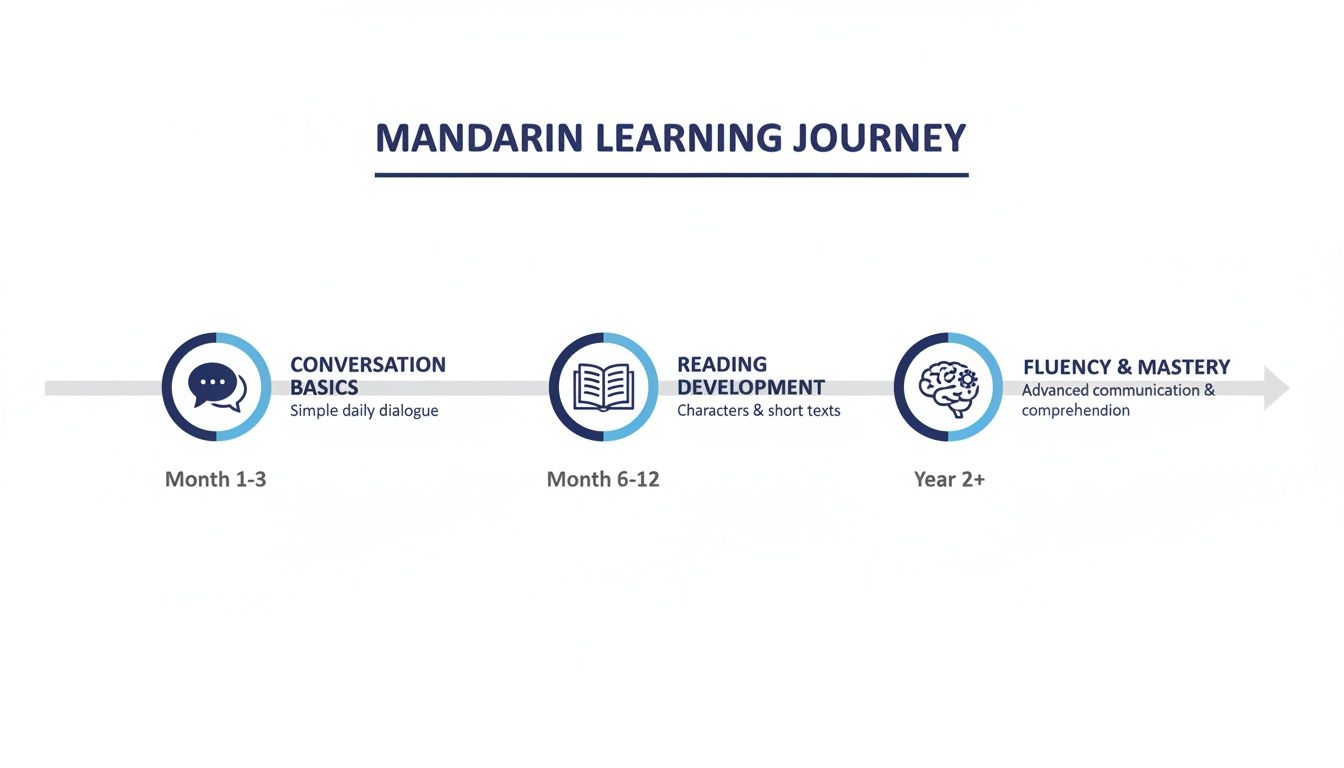
As you can see, you don't have to wait years to start having real conversations. Those early wins build a solid foundation for the deeper skills that follow.
What to Expect at Each Stage
Your personal pace will depend on your dedication, but we can map out a typical path using the HSK (Hanyu Shuiping Kaoshi) proficiency levels as our guideposts.
Basic Conversation (HSK 1-2): After 6–12 months of consistent effort, you should be able to handle simple introductions, order a meal, and ask for directions. This stage is all about building a core vocabulary and getting your ear tuned to the tones in everyday chats.
Intermediate Proficiency (HSK 3-4): This is where things get exciting. After about 1–2 years, you’ll find yourself discussing familiar topics in more detail, catching the main points of a TV show, and reading short articles (maybe with a little help).
Hitting this intermediate plateau is a huge milestone. It’s the point where you shift from reciting memorised phrases to actually building your own sentences. The language starts to feel like yours.
- Professional Fluency (HSK 5-6): Reaching this level is a serious commitment, often taking 3–5 years or more. At this point, you can navigate complex professional meetings, read newspapers without a dictionary, and understand a huge range of media with ease.
For a more detailed breakdown of what goes into these timelines, check out our guide on how long it takes to learn Mandarin.
The bottom line is that while fluency is a long-term goal, you can achieve meaningful, practical skills much sooner than most people think.
Building a Practical Mandarin Study Plan That Works
Knowing what makes Mandarin tricky is only half the battle. Knowing how to study is where you start to see real progress. A smart study plan isn't about cramming for hours on end; it's about building consistent, intelligent habits that fit into your life and keep burnout at bay.
The secret is all about balance. A good routine should weave together all four core skills—listening, speaking, reading, and vocabulary—without feeling like a massive chore. The aim is to create a sustainable learning loop where each activity naturally reinforces the others.
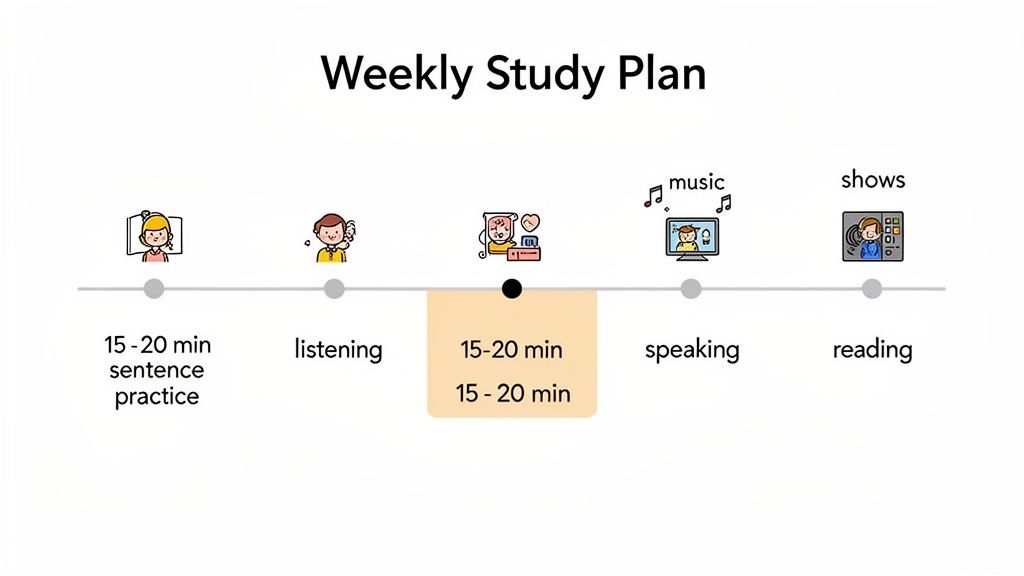
A Sample Weekly Routine
Believe me, consistency is so much more powerful than intensity. Small, daily actions compound into huge gains over time. Here's a simple, balanced schedule you can tweak to fit your own needs.
Daily Core Practice (15-20 minutes): This is your non-negotiable. Spend this time on sentence-based learning. When you use a tool like Mandarin Mosaic, you're not just memorising isolated words; you're seeing them in context. This builds a much stronger, intuitive grasp of how the language actually works.
Active Listening (2-3 times per week): Pop on a podcast or a graded reader with audio while you're commuting or washing the dishes. Don't stress about catching every single word. Just let the sounds and rhythms of Mandarin wash over you.
Speaking Practice (1-2 times per week): This is where the magic happens. Find a language partner or a tutor. Speaking is the ultimate feedback loop—it quickly highlights your weak spots and, more importantly, builds the confidence to actually use what you've learned.
The most effective study plans are built around a core daily habit. A short, focused session of sentence mining provides the contextual foundation that makes all other learning activities—like listening and speaking—more effective.
This kind of structure ensures you’re always moving forward. To help keep everything organised, you might consider using an AI Study Assistant to manage your resources and track what you've covered. At the end of the day, the answer to "is Mandarin hard to learn?" often comes down to how you learn. With the right techniques and a consistent plan, the path becomes a whole lot clearer.
A Few Lingering Questions About Learning Mandarin
As you get started on your Mandarin journey, a few common questions are bound to pop up. Getting straight, practical answers can help clear away the fog and give you the confidence to dive right in. It reinforces the idea that while learning Mandarin is a challenge, it's a long way from impossible.
How Long Does It Realistically Take to Become Conversational?
For a dedicated UK learner putting in about an hour a day, reaching a basic conversational level (HSK 2-3) typically takes between 6 to 12 months. At this stage, you'll be able to handle simple, everyday interactions like ordering food, asking for directions, or introducing yourself.
But let's be realistic: getting to a professional level of fluency (HSK 5-6) is a multi-year commitment. You're looking at 3-5 years of consistent, focused study. This is where using efficient, context-based methods from the very beginning can really pay off, helping you move through those crucial early stages much faster.
Should I Learn to Write Chinese Characters by Hand?
For most learners in this day and age, being able to type characters using Pinyin is far more practical than writing them out by hand. While handwriting can give you a deeper appreciation for how characters are put together, it's an incredibly time-consuming skill to build and maintain.
Our strong recommendation for beginners is to focus on character recognition first. This is the essential skill you need for reading. Once you have a solid foundation, you can always decide to learn handwriting later if it becomes a personal goal.
Is Mandarin More Difficult Than Other East Asian Languages?
Every language throws its own unique curveballs at English speakers. Mandarin's tonal system is definitely a major hurdle at the start, but its grammar is surprisingly simple and predictable compared to other major East Asian languages.
Many languages in the region have complex honorific systems and grammatical rules that can be a real headache to master. In contrast, Mandarin’s straightforward grammar often lets learners start building complete, logical sentences much earlier on. This can give you a huge boost in momentum and confidence right when you need it most.
Ready to stop wondering and start learning? With Mandarin Mosaic, you can build your vocabulary and grammar intuition from day one using our powerful sentence-mining method. Start your journey today.