 Mandarin Mosaic
Free on iPhone, iPad and Android.
Download on theApp Store Get it onGoogle PlayYour first month of Premium is free.
Chinese Idioms (成语): A Practical Guide for Learners

Sooner or later, every learner hits a four-character phrase that makes no sense. You know each character, but put together they say something like "horse horse tiger tiger" or "draw a snake, add feet". These are 成语 (chéngyǔ), Chinese idioms, and they turn up in everything from news headlines to everyday chat.
This guide explains what chengyu are, how they differ from other Chinese sayings, and which ones are worth learning first. Each one comes with its characters, pinyin, literal meaning, real meaning and a natural example sentence, plus some advice on learning them without sounding like a textbook.
What is a chengyu?
A chengyu is a fixed expression, usually four characters long, that comes from Classical Chinese. Most are drawn from old literature: philosophers such as Zhuangzi and Han Feizi, histories, poetry and later novels. Because they preserve the grammar and vocabulary of the classical language, they often read like a compressed sentence rather than a modern phrase.
A few things make a chengyu different from ordinary vocabulary:
- The form is fixed. You can't swap a character for a synonym or change the word order.
- The meaning is figurative. The literal meaning is usually a picture, and the real meaning is what the picture stands for.
- Many carry a story. Knowing the fable or historical event behind an idiom is often the easiest way to understand, and remember, what it means.
How many are there? By the strictest definition there are about 5,000, though some dictionaries list over 20,000, according to Wikipedia's overview of chengyu. You don't need anything like that many. A few dozen common ones will cover most of what you meet in everyday Chinese.
It also helps to know that understanding the individual characters only gets you so far. If you want to see how single characters build up meaning, our guide to the meaning of Chinese symbols is a good starting point. With chengyu, you still need the whole phrase and its story.
Chengyu and other Chinese sayings
Chengyu are the best-known type of Chinese idiom, but not the only one. Chinese groups its fixed expressions under the umbrella term 熟语 (shúyǔ), which also includes:
- 惯用语 (guànyòngyǔ): colloquial expressions, often three characters long, such as 拍马屁 (pāi mǎpì, literally "pat the horse's bottom"), meaning to suck up to someone, or 走后门 (zǒu hòumén, "go through the back door"), meaning to use connections to get something.
- 俗语 (súyǔ) and 谚语 (yànyǔ): popular sayings and proverbs, usually full sentences. For example, 三个臭皮匠,顶个诸葛亮 (sān ge chòu píjiang, dǐng ge zhūgě liàng): "three smelly cobblers are worth one Zhuge Liang" (the famously brilliant strategist), or two heads are better than one.
- 歇后语 (xiēhòuyǔ): two-part sayings where you say the first half and the listener supplies the punchline, often a pun. 外甥打灯笼——照舅 (wàisheng dǎ dēnglong, zhào jiù): "a nephew carrying a lantern lights the way for his uncle". 照舅 (light up the uncle) sounds the same as 照旧 (zhàojiù, as before), so the saying means "same as ever".
Some expressions cross over. 七上八下 (qī shàng bā xià, "seven up, eight down") is used as a chengyu meaning to feel anxious or unsettled, as in 心里七上八下 (xīnli qī shàng bā xià, "my heart is all over the place"). It is also the punchline of the 歇后语 十五个吊桶打水——七上八下 ("fifteen buckets drawing water from a well: seven going up, eight coming down").
| Type | Typical form | Register | Example |
|---|---|---|---|
| 成语 (chéngyǔ) | Four characters, classical grammar | Written and spoken; many lean formal | 画蛇添足 (huà shé tiān zú) |
| 惯用语 (guànyòngyǔ) | Often three characters | Colloquial | 拍马屁 (pāi mǎpì) |
| 俗语 / 谚语 (súyǔ / yànyǔ) | A full sentence | Everyday | 三个臭皮匠,顶个诸葛亮 |
| 歇后语 (xiēhòuyǔ) | Two parts, often a pun | Informal and playful | 外甥打灯笼——照舅 |
11 useful chengyu to learn first
These are common, genuinely useful idioms that you will meet in conversation, TV and reading, not obscure ones chosen to impress. They are roughly in order from everyday to more literary.
1. 马马虎虎 (mǎmǎhūhū)
- Literal meaning: horse horse tiger tiger
- Meaning: so-so; or careless, slapdash
- Example: 他写作业总是马马虎虎的,错字特别多。(tā xiě zuòyè zǒngshì mǎmǎhūhū de, cuòzì tèbié duō.) He always rushes his homework, and it's full of mistakes.
This is the one most learners know first, usually as a modest answer to 你的中文怎么样?(How's your Chinese?). In speech the second 马 is often said lightly: mǎmahūhū. There's a popular story about a painter who drew a creature with a tiger's head and a horse's body, but it was almost certainly invented to explain the phrase, so treat it as a memory aid rather than history.
2. 一举两得 (yì jǔ liǎng dé)
- Literal meaning: one action, two gains
- Meaning: to kill two birds with one stone
- Example: 骑自行车上班既省钱又能锻炼身体,真是一举两得。(qí zìxíngchē shàngbān jì shěng qián yòu néng duànliàn shēntǐ, zhēn shì yì jǔ liǎng dé.) Cycling to work saves money and keeps you fit: two birds with one stone.
Note the tone change: 一 (yī) becomes yì before a first, second or third tone, and yí before a fourth tone. You'll also hear 一箭双雕 (yí jiàn shuāng diāo, "one arrow, two eagles") and 一石二鸟 (yì shí èr niǎo, "one stone, two birds"), which matches the English saying word for word.
3. 入乡随俗 (rù xiāng suí sú)
- Literal meaning: enter a village, follow its customs
- Meaning: when in Rome, do as the Romans do
- Example: 在中国吃饭的时候,我也学着用筷子,入乡随俗嘛。(zài zhōngguó chīfàn de shíhou, wǒ yě xuézhe yòng kuàizi, rù xiāng suí sú ma.) When I eat in China I use chopsticks too. When in Rome!
A friendly, useful one for travellers. You may also see the variant 入境随俗 (rù jìng suí sú).
4. 半途而废 (bàn tú ér fèi)
- Literal meaning: give up halfway along the road
- Meaning: to give up halfway; to leave something unfinished
- Example: 学中文最怕半途而废,每天学一点也比放弃好。(xué zhōngwén zuì pà bàn tú ér fèi, měitiān xué yìdiǎn yě bǐ fàngqì hǎo.) The worst thing you can do with Chinese is give up halfway. A little every day beats quitting.
An early form of the phrase appears in the Doctrine of the Mean (中庸), and it's linked to the story of Yue Yangzi, whose wife cut through the cloth on her loom when he came home from his studies early, to show him that unfinished work is wasted work.
5. 熟能生巧 (shú néng shēng qiǎo)
- Literal meaning: familiarity produces skill
- Meaning: practice makes perfect
- Example: 声调一开始很难,但熟能生巧,多练就好了。(shēngdiào yì kāishǐ hěn nán, dàn shú néng shēng qiǎo, duō liàn jiù hǎo le.) Tones are hard at first, but practice makes perfect. Just keep at it.
The idea goes back to Ouyang Xiu's story of an old oil seller who pours oil through the hole in a coin without spilling a drop, and explains his skill with 我亦无他,惟手熟尔: "there's nothing to it, my hands are just practised."
6. 画蛇添足 (huà shé tiān zú)
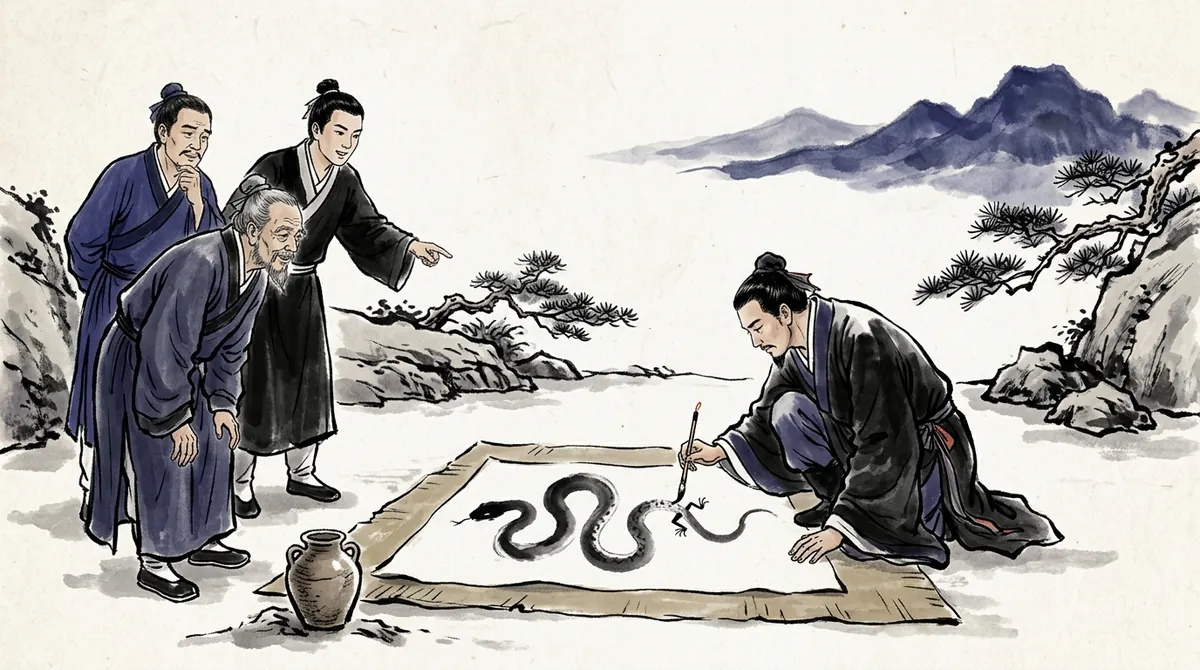
- Literal meaning: draw a snake and add feet
- Meaning: to spoil something by adding what isn't needed
- Example: 这个设计已经很好了,再加这么多颜色就是画蛇添足。(zhège shèjì yǐjīng hěn hǎo le, zài jiā zhème duō yánsè jiù shì huà shé tiān zú.) The design is already good. Adding all those colours would just spoil it.
From the Strategies of the Warring States (战国策): some servants are given one flask of wine and agree that whoever draws a snake first can drink it. The fastest finishes, then decides to add feet. While he's at it, another man finishes his snake, takes the wine and points out that snakes don't have feet. Use it when something was already fine and the extra effort made it worse, not for any mistake.
7. 对牛弹琴 (duì niú tán qín)
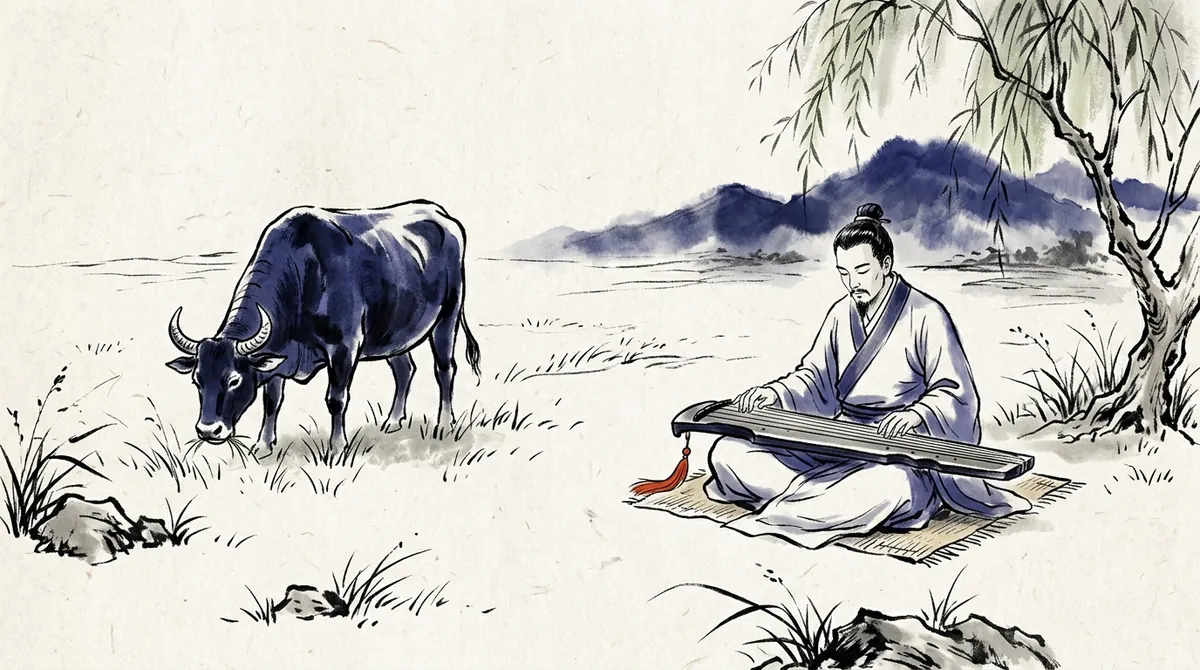
- Literal meaning: play the qin (a zither) to a cow
- Meaning: to waste your words on the wrong audience
- Example: 跟他讲古典音乐简直是对牛弹琴。(gēn tā jiǎng gǔdiǎn yīnyuè jiǎnzhí shì duì niú tán qín.) Talking to him about classical music is a complete waste of breath.
The story tells of the musician Gongming Yi, who played an elegant tune to an ox; it carried on eating as if nothing had happened. It can be insulting, since it compares the listener to a cow, so be careful who you say it to, and never say it to someone's face unless you're joking with a close friend.
8. 守株待兔 (shǒu zhū dài tù)
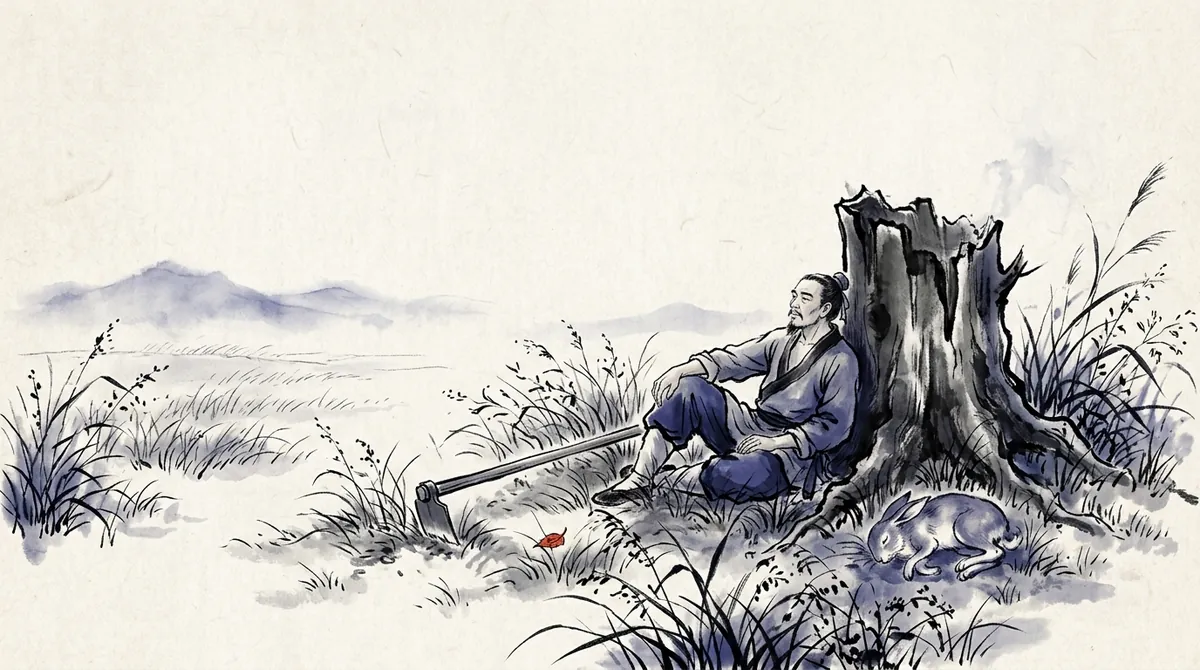
- Literal meaning: guard a tree stump, waiting for rabbits
- Meaning: to wait for luck instead of making an effort; to cling to something that worked once
- Example: 找工作不能守株待兔,得主动投简历。(zhǎo gōngzuò bù néng shǒu zhū dài tù, děi zhǔdòng tóu jiǎnlì.) You can't just sit and wait for a job to come to you. You have to send out your CV.
From the Han Feizi: a farmer in the state of Song sees a rabbit run into a tree stump and break its neck. He gives up farming to wait by the stump for another one, which never comes, and his fields go to ruin.
9. 塞翁失马 (sài wēng shī mǎ)
- Literal meaning: the old man at the frontier loses his horse
- Meaning: a blessing in disguise; bad luck may turn out to be good
- Example: 没拿到那份工作也许是塞翁失马,焉知非福。(méi nádào nà fèn gōngzuò yěxǔ shì sài wēng shī mǎ, yān zhī fēi fú.) Not getting that job might turn out to be a blessing in disguise.
It's short for 塞翁失马,焉知非福 ("the old man lost his horse, but who knows if it wasn't good luck?"), from the Huainanzi. An old man's horse runs off; his neighbours sympathise, but he asks how they know it's bad luck. The horse comes back with another fine horse; they congratulate him, and he asks how they know it's good luck. His son rides the new horse, falls and breaks his leg. Then war comes, most of the young men are called up and killed, and the son's injury saves his life. Note that 塞 is read sài here (frontier), not sāi (to stuff).
10. 井底之蛙 (jǐng dǐ zhī wā)
- Literal meaning: a frog at the bottom of a well
- Meaning: someone with a narrow outlook who thinks their small world is everything
- Example: 出国以后我才发现自己以前是井底之蛙。(chūguó yǐhòu wǒ cái fāxiàn zìjǐ yǐqián shì jǐng dǐ zhī wā.) It was only after I went abroad that I realised how little of the world I'd seen.
It goes back to a fable in the Zhuangzi, in which a frog living in a shallow well boasts about its home to a great turtle from the Eastern Sea, until the turtle describes the ocean. In speech, 井底 follows the third-tone rule and sounds like jíng dǐ. Like 对牛弹琴, it's a criticism, so it sounds most natural about yourself.
11. 自相矛盾 (zì xiāng máodùn)
- Literal meaning: one's own spear and shield against each other
- Meaning: to contradict yourself
- Example: 你说你没时间,又天天打游戏,这不是自相矛盾吗?(nǐ shuō nǐ méi shíjiān, yòu tiāntiān dǎ yóuxì, zhè bú shì zì xiāng máodùn ma?) You say you haven't got time, but you play games every day. Isn't that a contradiction?
Also from the Han Feizi: a man from the state of Chu boasts that his spears can pierce anything and his shields can stop anything. Someone asks what happens if you use one of his spears on one of his shields, and he has no answer. The story is also where the everyday word 矛盾 (máodùn, contradiction) comes from.
How to learn chengyu so they stick
Lists of idioms with an English gloss are easy to make and easy to forget. A few habits work much better.
Learn them in sentences
A chengyu on its own tells you what it means, but not how it's used. The sentence around it shows you whether it's praise or criticism, formal or casual, and what grammar it sits in: many chengyu follow 是, 真是 or 简直是, or act as a verb or adjective. That's why sentence mining suits idioms so well: when you meet one in a drama, article or graded reader, save the whole sentence, not just the four characters.
Learn the story, briefly
You don't need a history lesson, but a two-line version of the story gives you a picture to hang the meaning on. Once you've imagined the farmer waiting by his tree stump, 守株待兔 is hard to forget.
Review with spaced repetition
Chengyu are lower-frequency than everyday words, so you won't see each one often enough to learn it by exposure alone. Spaced repetition fills the gap by bringing each sentence back just before you're likely to forget it.
Say them out loud
Four syllables in a row, often with tone changes, are harder to say than they look. Practise the whole example sentence, not just the idiom, and watch for tone sandhi such as 一 changing to yì or yí and two third tones in a row (our guide to tones in Chinese covers the rules). If you want feedback while you speak, the Chunking Chinese fluency trainer teaches reusable sentence chunks and marks the tone and pronunciation of each character as you say them.
Pick the right ones
Prioritise idioms you've met more than once in material you actually read or watch. As John Pasden argues in The Chengyu Bias, and as Hacking Chinese also points out, many chengyu are rare, and time spent on common vocabulary usually pays off sooner. Learn the frequent ones well and let the rest come to you.
Using chengyu in speech: a few cautions
Chinese speakers do use chengyu in conversation, but selectively. A few things to watch for:
- Register. Some chengyu, like 马马虎虎, 一举两得 and 入乡随俗, are completely at home in casual speech. Others sound bookish or formal, and are more at home in essays, speeches and the news. If you've only ever seen an idiom in writing, it probably belongs there.
- Don't overdo it. One well-placed chengyu sounds natural. Three in a row sounds like you're reciting a textbook. Plain, clear Chinese is always better than a forced idiom.
- Meaning isn't usage. Knowing the English gloss doesn't mean you know where the idiom fits. 画蛇添足 is about unnecessary additions, not mistakes in general. Try to use an idiom only once you've seen it used in a similar situation.
- Mind the criticism. Several common chengyu, such as 对牛弹琴, 井底之蛙 and 守株待兔, are put-downs. Aimed at someone else, they can offend.
- Don't translate word by word. 七上八下 has nothing to do with numbers, and 马马虎虎 has nothing to do with animals. If a four-character phrase doesn't make sense literally, look it up as a whole.
If you want everyday expressions you can use straight away, our list of useful phrases in Chinese is a good companion to this guide.
Frequently asked questions
How many chengyu do I need to know?
There's no magic number. It's far better to understand and use 20 common idioms properly than to half-recognise 200. Start with the ones you keep meeting in your reading and viewing; you'll notice more as your level rises.
Is every four-character phrase a chengyu?
No. Chinese has plenty of ordinary four-character words and phrases, such as 电子邮件 (diànzǐ yóujiàn, email) or 公共汽车 (gōnggòng qìchē, bus), that aren't idioms. A chengyu has a fixed form, a figurative meaning and, usually, a classical source. Not every chengyu has exactly four characters, either: 五十步笑百步 (wǔshí bù xiào bǎi bù, "fifty paces laughing at a hundred paces", or the pot calling the kettle black), from the Mencius, has five.
What's the fastest way to look up an idiom?
A good dictionary app. Pleco is the standard choice for most learners and handles chengyu well, and Hanping Chinese is a popular alternative on Android. On a computer, MDBG works for a quick search. Pick one and stick with it.
Mandarin Mosaic is built on sentence mining and spaced repetition, so you learn new words, idioms included, inside real sentences at your level instead of on isolated flashcards. Find out more about Mandarin Mosaic.