 Mandarin Mosaic
Free on iPhone, iPad and Android.
Download on theApp Store Get it onGoogle PlayYour first month of Premium is free.
How Much Chinese News Can You Read at Each HSK Level? We Counted 55 Million Words

Not enough to read it comfortably, even at HSK 6. We checked about 55 million words of Chinese-language news from international outlets against the HSK word lists. A learner who knows every word up to HSK 3.0 level 6 knows about four words in five. Reading research puts comfortable reading at 95–98%, or one unknown word in every 20 to 50.
Key Findings
Measured 11 November 2026.
- Knowing every word on the HSK 3.0 lists up to level 6 covers about 80% of the words in Chinese news; comfortable reading needs 95–98%.
- HSK 6 is not enough to read the news comfortably: about one word in five is unknown, or roughly 200 in a typical 1,000-word article.
- Even the whole HSK 3.0 list, levels 7–9 included (about 11,000 words), covers about 89% of news words.
- Counting names such as 特朗普 (tèlǎngpǔ, Trump) as known, as reading research usually does, raises HSK 6 to 84% and levels 7–9 to 92%.
- At HSK 3.0 level 6, fewer than 1 news article in 100 reaches 95% coverage; with levels 7–9, about 4 in 100 do.
- At HSK 6, 28% of news sentences have no more than one unknown word; with levels 7–9, 58% do.
- The old HSK 2.0 lists up to level 6 (5,000 words) cover about 65%, partly because they list common words such as 中 (zhōng) and 但 (dàn) only inside longer words.
The data is free to reuse: download the table as CSV (CC BY 4.0). To see the figure for an article you want to read, paste it into our HSK level checker, which counts words the same way.
How Much of the News Each HSK Level Covers
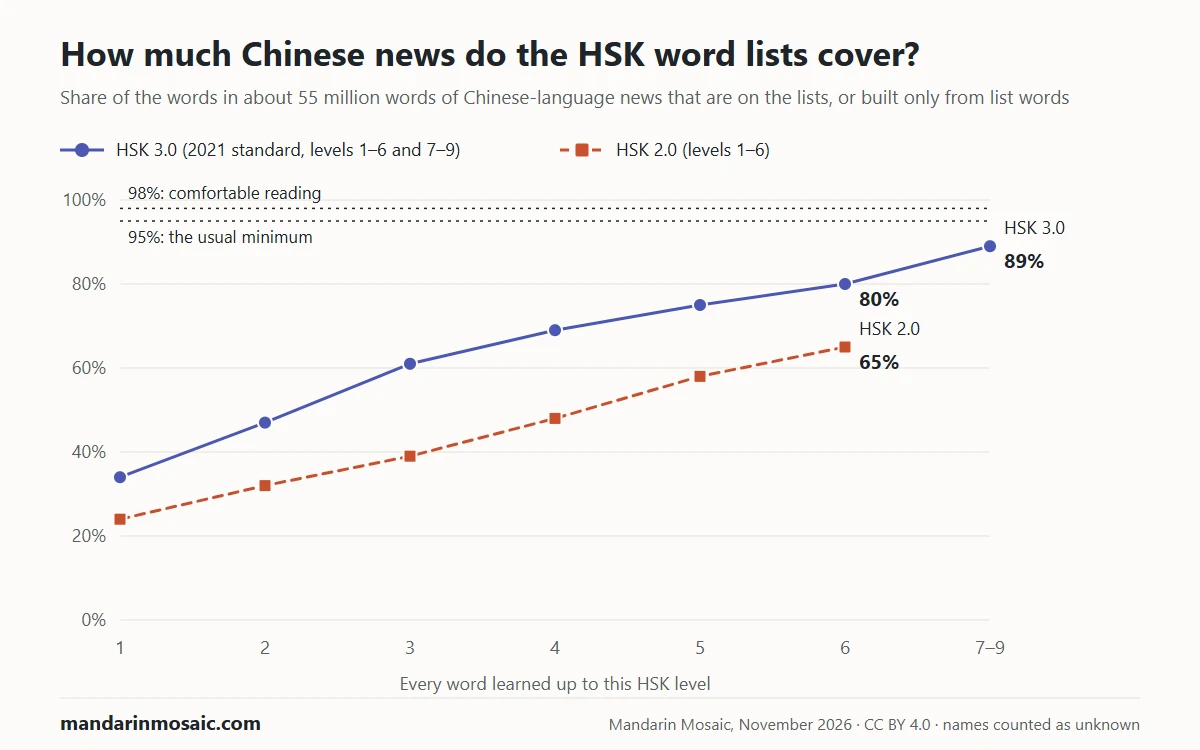
Each row assumes you know every word on the list up to that level, and nothing else. The columns split every Chinese word in the news into bands:
- On the list: the word itself is on the list at that level or below.
- Built from list words: the word isn't on the list, but it's made entirely of words that are, such as 一个 (yí gè, one), 这种 (zhè zhǒng, this kind) and 领导人 (lǐngdǎorén, leader). Most readers would understand these.
- Covered: the two together. This is the figure our HSK level checker gives.
- Names: names of people, places and organisations in the CC-CEDICT dictionary, such as 特朗普 (tèlǎngpǔ, Trump), 香港 (xiānggǎng, Hong Kong) and 俄罗斯 (éluósī, Russia).
- Other unknown words: everything else.
Counts of list words are cumulative. Numbers written in digits and words in Latin letters, such as 2025 or iPhone, aren't counted in any band; there are about 3 of them for every 100 Chinese words. Figures are rounded, so a row may not add up exactly. On a phone, swipe the tables sideways.
HSK 3.0 (the 2021 Standard)
| Level | Words on the list | On the list | Built from list words | Covered | Names | Covered, with names | Other unknown words |
|---|---|---|---|---|---|---|---|
| HSK 1 | 495 | 32% | 2% | 34% | 5% | 39% | 61% |
| HSK 2 | 1,239 | 44% | 3% | 47% | 5% | 52% | 48% |
| HSK 3 | 2,187 | 56% | 5% | 61% | 4% | 65% | 35% |
| HSK 4 | 3,159 | 63% | 6% | 69% | 4% | 73% | 27% |
| HSK 5 | 4,215 | 68% | 7% | 75% | 4% | 79% | 21% |
| HSK 6 | 5,333 | 72% | 8% | 80% | 4% | 84% | 16% |
| HSK 7–9 | 10,929 | 80% | 9% | 89% | 3% | 92% | 8% |
HSK 2.0 (the Old Six Levels)
| Level | Words on the list | On the list | Built from list words | Covered | Names | Covered, with names | Other unknown words |
|---|---|---|---|---|---|---|---|
| HSK 1 | 150 | 23% | 1% | 24% | 5% | 30% | 70% |
| HSK 2 | 300 | 30% | 2% | 32% | 5% | 37% | 63% |
| HSK 3 | 597 | 36% | 2% | 39% | 5% | 44% | 56% |
| HSK 4 | 1,195 | 45% | 3% | 48% | 5% | 53% | 47% |
| HSK 5 | 2,495 | 55% | 4% | 58% | 5% | 63% | 37% |
| HSK 6 | 4,994 | 61% | 4% | 65% | 5% | 70% | 30% |
Why HSK 2.0 scores so much lower. Part of the gap is how the old lists were written, not what an HSK 2.0 learner knows. They list 中国 (zhōngguó, China), 但是 (dànshì, but), 将来 (jiānglái, future), 应该 (yīnggāi, should) and 时候 (shíhou, time), but not 中, 但, 将, 该 or 时 on their own, and they list 我们 (wǒmen, we) but not 他们 (tāmen, they). Like our checker, we count a word only if the list has it. Single characters that HSK 2.0 lists only inside longer words make up about 10% of news. Counting them as known lifts HSK 2.0 level 6 to about 84%, which is still short of 95%. For which lists are which, see what changes in HSK 3.0, and for the words level by level, our HSK vocabulary lists.
What the Unknown Words Are
At HSK 3.0 level 6, the commonest unknown words fall into three groups:
- Formal, written-style words. 以 (yǐ, by means of; in order to), 之 (zhī, of), 及 (jí, and) and 则 (zé, then; whereas) are everywhere in news, but HSK 3.0 lists them only in the 7–9 band.
- News topics. 官员 (guānyuán, official) and 疫苗 (yìmiáo, vaccine) are also 7–9 words, and many topic words aren't on any list.
- Names. Countries, cities, leaders and companies, plus the sound-only characters of foreign names that the dictionary doesn't have, such as 斯 (sī) and 尔 (ěr).
What Coverage Means for Reading
Coverage is not comprehension. Knowing 80% of the words doesn't mean understanding 80% of an article: grammar, background knowledge and the sense of each word matter too, and an unknown word often carries the point of the sentence. But coverage sets a ceiling, and the research on it is fairly consistent:
- In a study of learners of English reading a short story, Hu and Nation (2000) found that most readers needed to know about 98% of the words to understand it well without help.
- Laufer and Ravenhorst-Kalovski (2010) suggested 95% as a minimal threshold and 98% as an optimal one, counting names as known.
- A 2023 replication of Hu and Nation couldn't fully reproduce the original results, so treat the thresholds as rules of thumb rather than laws.
These studies are on English, not Chinese. Chinese has no spaces between words, so an unknown word is harder to even spot, but the characters in it often hint at its meaning. In everyday terms:
- 98% is one unknown word in 50: about one every few lines. You read for pleasure.
- 95% is one in 20: about one a line. You follow the story, with some guessing.
- 80%, HSK 6, is one in 5: several in every sentence. You're studying, not reading.
How Many News Articles You Could Read at Each Level
A corpus average hides the spread: some articles are much easier than others. So we ran a sample of articles from the same news through our HSK level checker and counted how many reach each threshold. The sample is weighted to match the mix of easier and harder articles in the whole corpus. A typical article has about 1,000 Chinese words.
| Level | Typical article covered | Articles at 90%+ | Articles at 95%+ | Articles at 98%+ |
|---|---|---|---|---|
| HSK 3.0 level 4 | 69% | 0% | 0% | 0% |
| HSK 3.0 level 5 | 74% | 0% | 0% | 0% |
| HSK 3.0 level 6 | 80% | 1% | 0% | 0% |
| HSK 3.0 levels 7–9 | 88% | 36% | 4% | 0% |
| HSK 2.0 level 6 | 62% | 0% | 0% | 0% |
"Typical" is the median article. 0% means fewer than 1 article in 200. At HSK 6, almost no real news article is comfortable reading, and even with the whole 11,000-word HSK 3.0 list, only about 1 in 25 reaches 95%. That's a strong reason to choose your articles: the same checker will tell you in a few seconds whether an article is within reach.
How Many Sentences Have Just One New Word
Coverage counts words across a whole text, but you meet unknown words one sentence at a time. A sentence with one unknown word can usually be worked out from the words around it; with two or three, the guessing falls apart. That's the idea behind i+1, learning from sentences that are one step beyond what you know (our guide to level-appropriate Chinese sentences explains it). So we split the same articles into sentences and counted the unknown words in each, not counting names.
| Level | HSK 3.0: sentences with at most one unknown word | HSK 2.0: sentences with at most one unknown word |
|---|---|---|
| HSK 1 | 2% | 1% |
| HSK 2 | 4% | 1% |
| HSK 3 | 8% | 2% |
| HSK 4 | 13% | 3% |
| HSK 5 | 19% | 6% |
| HSK 6 | 28% | 9% |
| HSK 7–9 | 58% | – |
At HSK 6, about one news sentence in four is an i+1 sentence or easier; at levels 7–9, more than half are. Below HSK 4, almost none are. This is why sentence mining, collecting the sentences that are one word beyond you, works better from graded material than from raw news at the lower levels.
What This Means at Each Level
- HSK 1–3: real news isn't reading material yet. With 40% to 65% of the words not covered, you'd look up most of every sentence. Read graded readers and stories written for your level instead. The Chinese Articles reader in Mandarin Mosaic has graded stories for HSK 1–5, and shows how many of each news article's words are new to you, so you can move up to news gradually.
- HSK 4–5: news works as intensive study. At 70–75% coverage, short articles on topics you know are possible with a pop-up dictionary, slowly. Pick the easiest articles you can find, and check them in the level checker first.
- HSK 6: you can follow most news with help, but it's still work. The quickest gains are names (about 4% of news words) and the formal words above, such as 以, 之, 及 and 则, which turn up in almost every article. Our post on reading Chinese news covers how to use news to learn.
- Beyond HSK 6: the 7–9 list takes you to about 89%, or 92% with names. The last few points come from the vocabulary of the topics you read most, which no general list can give you.
If you're wondering how this fits the bigger question of fluency, see how many words you need to become fluent, and for how HSK levels compare with European ones, HSK vs CEFR.
Method and Limits
- The news. About 55 million words of Chinese-language news from international outlets, in Simplified characters. The text was split into words with a dictionary-based word segmenter built on CC-CEDICT. Only Chinese words count: punctuation, digits and Latin letters are left out of every figure.
- The lists. Mandarin Mosaic's copies of the HSK lists: the six HSK 2.0 levels, and HSK 3.0 as the 2021 standard (levels 1–6 and the 7–9 band). That's not the 2025 exam syllabus, whose lists are a little different (see HSK 3.0 changes). Our copies merge a few duplicate entries, so their word counts are slightly below the official totals.
- Counting rules. We use the same rules as our HSK level checker. A word is known if it's on the list at that level or below. A single character counts only if the list has it as a word on its own, which is why HSK 2.0 loses 中 and 但, and HSK 3.0 loses 着 (zhe), which it lists only inside longer words. Counting such characters as known gives an upper bound: about 84% for HSK 2.0 level 6 and 88% for HSK 3.0 level 6. For levels 7–9 it gives 98%, but that bound is generous, because it treats every character found in any of 11,000 words as known on its own, including the sound-only characters of foreign names.
- Compounds of list words. A word that isn't on either list is split into list words the way the checker splits text; if every part is known, it counts as built from list words. A word on the other HSK version's list isn't split, as in the checker, so 他们 counts as unknown on HSK 2.0.
- Names. A word counts as a name when every CC-CEDICT entry for it is a proper noun. Names that aren't in the dictionary, which includes most private individuals and many foreign names, fall into "other unknown words", so the true share of names is somewhat higher than the table shows.
- Articles and sentences. The per-article figures are the checker's own coverage figure for each article in the sample. Sentences are split at 。!?; and line breaks; fragments of fewer than three words are skipped, and words inside names aren't counted as unknown.
- Words, not characters. This is word coverage. If you know the characters in an unknown word, you can often guess it, so readers who know many characters will do a little better than these figures suggest. And knowing a word on the list doesn't mean knowing every sense of it.
- News only. Fiction, social media and subtitles have different vocabularies, so their figures will differ.
- Updates. We'll rerun the count each year.
Cite This Page
Mandarin Mosaic (2026). How Much Chinese News Can You Read at Each HSK Level? We Counted 55 Million Words. 11 November 2026. https://mandarinmosaic.com/blog/hsk-vocabulary-coverage-chinese-news. Data: CSV, CC BY 4.0.
Frequently Asked Questions
What HSK level do you need to read Chinese news?
No HSK level gets you to comfortable news reading on its own: knowing every HSK 3.0 word up to level 6 covers about 80% of the words in Chinese news, and the full 7–9 list about 89%. Reading research puts comfortable reading at 95–98%, so you also need news vocabulary and names beyond the lists.
Is HSK 6 enough to read a newspaper?
Not comfortably: at HSK 6 about one word in five in a news article is unknown, and fewer than 1 article in 100 reaches 95% coverage. You can follow the news with a dictionary, but it's study rather than relaxed reading.
How many words do you need to read Chinese?
For news, more than any HSK list gives you: the whole HSK 3.0 list of about 11,000 words covers about 89% of news words, or 92% counting names as known. For easier texts such as graded readers, far fewer words are enough, because they're written to stay within a level.
What percentage of words do you need to know to read Chinese?
Research on learners reading English suggests 98% for comfortable reading and about 95% as a minimum, and it's a reasonable guide for Chinese too. That means one unknown word in 50, or at most one in 20.