How to Learn Mandarin Faster Without Burning Out
Learning how to learn Mandarin faster isn't about finding a magic bullet; it's about adopting a smarter, more efficient strategy from the get-go. The real secret is shifting away from memorising isolated words and instead focusing on understanding vocabulary and grammar in real-world contexts. This simple change makes every new piece of information immediately useful and so much easier to remember.
Your Blueprint for Rapid Mandarin Acquisition
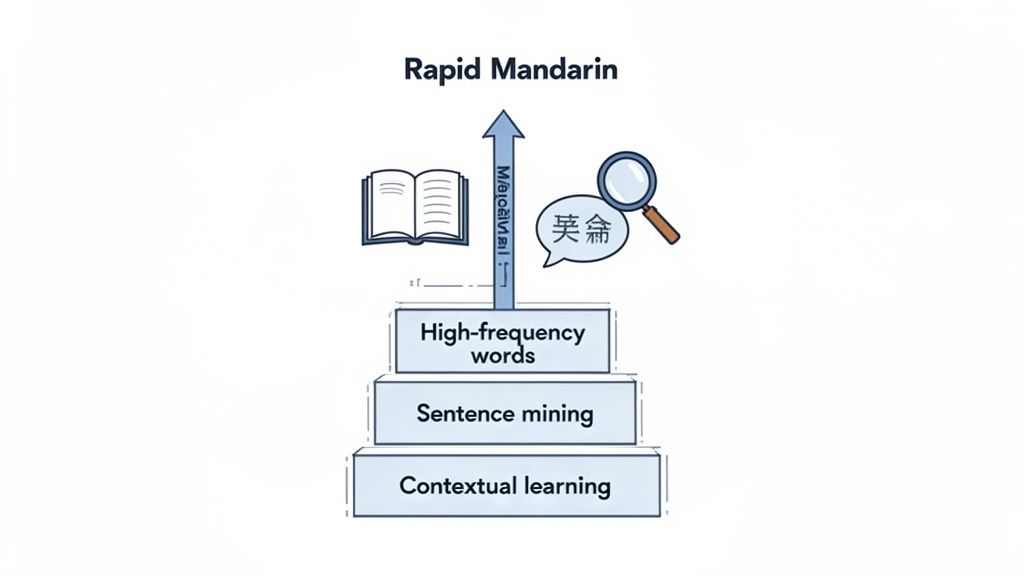
So many learners get stuck in the grind of traditional methods, like drilling endless lists of vocabulary on flashcards. While the intention is good, this approach often leads to burnout because it completely disconnects words from how they’re actually used. You might memorise the character for "apple" (苹果, píngguǒ), but that alone doesn’t help you order one at a market.
A much better approach centres on two powerful principles: sentence mining and contextual learning. This just means that your main source of study material should be real Chinese sentences, not isolated words.
The Power of Context
Think of it this way: learning a word in a sentence is like learning a new dance move as part of a full routine. You see how it connects to the steps before and after, understanding its purpose and rhythm. Learning a word from a list is like practising that same move in a vacuum—you might know the action, but you have no idea how it fits into the music.
By focusing on sentences, you achieve several goals at once:
- You see the word in action: You immediately get a feel for its function and common usage.
- You absorb grammar intuitively: Instead of memorising abstract rules, you start to recognise natural patterns in word order and structure.
- You build stronger memory connections: The context provides a rich web of associations, making the new word much harder to forget.
Start with High-Frequency Words
To make this method even more powerful, start by targeting sentences that use the most common words in Mandarin. Research consistently shows that knowing the top 1,000 most frequent words allows you to understand around 80% of everyday conversation.
Focusing on high-frequency vocabulary within real sentences creates a powerful feedback loop. You learn words that appear often, which in turn allows you to understand more of what you read and hear, accelerating your comprehension and motivation.
This strategy ensures that your initial efforts give you the biggest bang for your buck. You'll quickly go from knowing nothing to recognising familiar words and patterns in Chinese media, which is a huge confidence booster.
To see how these strategies stack up against older methods, let's break it down.
Core Strategies for Faster Mandarin Learning
| Strategy | Traditional Approach (Slow) | Accelerated Approach (Fast) |
|---|---|---|
| Vocabulary | Memorising long, isolated word lists. | Learning words within the context of real sentences. |
| Grammar | Studying abstract grammar rules from a textbook. | Absorbing grammar patterns naturally through exposure. |
| Focus | Random vocabulary, often from textbooks. | Prioritising the top 1,000 high-frequency words first. |
| Materials | Flashcards, word lists, and grammar drills. | Sentences from native content (shows, books, articles). |
| Outcome | Can recognise words but struggles to form sentences. | Can understand and create natural-sounding sentences. |
This comparison really highlights the difference in efficiency. The accelerated approach is all about practical application from day one.
This blueprint—combining sentence mining with a focus on high-frequency vocabulary—is the heart of a fast-track learning plan. To really kick things into high gear, you can also look into the latest educational technology. Exploring the best AI tools for education can introduce you to platforms that personalise your study sessions and offer instant feedback. It’s all about moving away from slow, frustrating memorisation and towards a system where every minute spent studying directly helps you understand and use Mandarin.
Building a Daily Study Habit That Actually Sticks
Knowing the best ways to learn Mandarin is one thing, but actually applying them day in, day out is what separates a dabbler from a fluent speaker. The most successful learners I’ve met don’t rely on heroic, multi-hour cram sessions. They build a system of small, manageable daily actions that become as automatic as brewing their morning tea.
This consistency is the real engine of rapid progress. Seriously, even 30 minutes of focused study each day will blow a single four-hour Sunday session out of the water over the course of a month. The goal is to make your study routine so ingrained that skipping it feels weird.
Design a Routine That Fits Your Life
First things first: forget trying to find a magical two-hour block of free time that doesn’t exist. The secret to a routine that sticks is designing it around the life you already have, not the other way around. Look for the small pockets of time you can steal back.
- 15 minutes on your morning commute? Perfect for drilling vocabulary with an app like Mandarin Mosaic.
- 20 minutes during your lunch break? Ideal for sentence mining a short article or listening to a podcast.
- 10 minutes before bed? A great time for some light reading in Chinese to wind down.
By splitting your study time into smaller chunks, it feels less intimidating and is far easier to slot into a packed day. You’re aiming for a balanced schedule that hits different skills—vocabulary, listening, active recall—without leading to burnout.
The most powerful study routine isn't the most intense one; it's the one you can stick with for months on end. Consistency compounds your effort, turning small daily gains into massive long-term progress.
This isn’t just theory; it’s a principle proven to work on a massive scale. In the UK, the Mandarin Excellence Programme (MEP) managed to dramatically accelerate learning simply by emphasising consistent weekly hours. Starting with under 400 participants, it's projected to reach over 16,000 students by 2025, smashing its original targets. This success story proves that structured, regular practice is the key—a model any self-learner can easily copy. You can explore the data on its growth and impact to see for yourself.
Use Habit Stacking to Make It Effortless
One of the slickest ways to build a new habit is to bolt it onto an existing one. This technique, known as habit stacking, removes willpower from the equation by piggybacking your Mandarin practice onto something you already do without thinking.
Instead of a vague promise to "study later," you create a specific, unbreakable rule:
"After I finish my morning coffee, I will immediately do my Mandarin Mosaic review for 15 minutes."
"As soon as I sit down on the train for my commute, I will open my graded reader."
This gives your brain a clear trigger. You're no longer deciding if you should study, only that the first action (coffee, train) is the cue for the next (Mandarin). For more ideas on this, check out our guide on daily habits to boost your Chinese.
Sample Schedules for Sustainable Progress
Your daily routine isn't set in stone; it'll evolve as you do. A beginner needs a different mix of activities than an intermediate learner. To give you a better idea, here are two sample schedules showing how you could structure your time.
Beginner's 30-Minute Daily Plan:
- 10 Minutes (Morning): Fire up your SRS app and review 20 vocabulary sentences. Focus on active recall, not just passive recognition.
- 15 Minutes (Lunch): Listen to a beginner-level podcast episode while following along with the transcript. Your mission: mine one new sentence.
- 5 Minutes (Evening): Practise writing 5-10 characters you’ve learned that week. It’s a small action that really helps cement them in your memory.
Intermediate Learner's 45-Minute Daily Plan:
- 15 Minutes (Morning): Blitz through your SRS flashcards, then read a short article in Mandarin, mining 2-3 new sentences from it.
- 20 Minutes (Commute): Challenge yourself by listening to an intermediate podcast or an audiobook without a transcript. This is pure listening muscle training.
- 10 Minutes (Evening): Find a short video clip and shadow the native speaker. Try to mimic their exact tone, rhythm, and flow.
Think of these as templates, not strict rules. The most important thing is to create a balanced, repeatable plan you can actually execute every single day. That's how you make steady progress an automatic part of your life.
Learn Vocabulary You'll Actually Use
Let’s be honest, memorising long, isolated lists of words is the biggest bottleneck for most Mandarin students. It’s a painfully slow and inefficient grind. Why spend hours drilling a word like "anteater" (食蚁兽, shíyǐshòu) when you can't even confidently ask for the bill (买单, mǎidān)? If you want to learn Mandarin faster, you have to get smart about the vocabulary you're learning.
The most powerful way to do this is to completely shift your mindset. Stop memorising words and start acquiring them naturally through context. This is the simple but profound idea behind sentence mining, a technique where you pull new vocabulary from real sentences you encounter.
The Power of One New Word
The magic of sentence mining is rooted in a concept called "i+1" (input plus one). The goal is to find sentences where you already understand everything except for one single word. This creates the perfect sweet spot for learning.
When you come across an "i+1" sentence, your brain uses all the surrounding context—the "i"—to figure out the meaning of that one unknown word—the "+1". It’s a far more active and engaging process than just looking up a definition in a dictionary.
For example, say you run into this sentence:
我的爱好是弹吉他。(Wǒ de àihào shì tán jítā.)
If you already know 我 (I), 爱好 (hobby), and 吉他 (guitar), your brain instinctively makes the connection that 弹 (tán) must be the verb for "to play" an instrument like a guitar. The word sticks because you didn't just learn a fact; you solved a tiny puzzle within a meaningful chunk of language.
By learning words in context, you're not just memorising a definition; you're building a network of connections. You absorb grammar, usage, and nuance all at once, which is why the vocabulary sticks so much better than with traditional flashcards.
This is exactly how children learn their native language, and it’s a remarkably effective way for adults to pick up a second one. You learn the words organically, complete with the grammatical patterns that tell you how to use them.
The simple flow below shows how to build this kind of focused practice into your day.
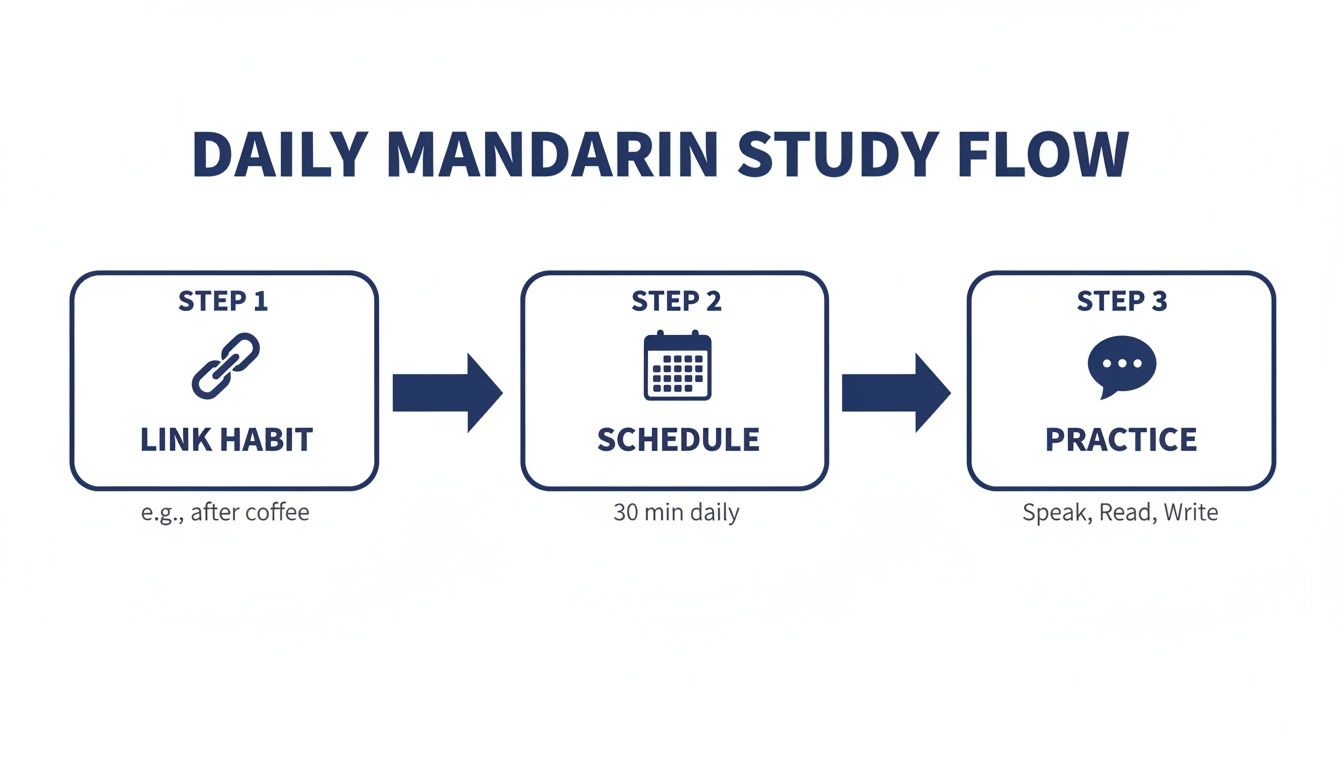
Effective study isn’t about gruelling, multi-hour sessions. It's about linking small, consistent habits to your existing schedule.
Building Your Sentence Deck with SRS
So, once you've "mined" a great sentence, what do you do with it? This is where a Spaced Repetition System (SRS) becomes your best friend. An SRS is basically a smart flashcard app that shows you information right before you're about to forget it, making your reviews incredibly efficient.
Forget the old single-word flashcards. Your new sentence-mining cards will look something like this:
- Front: 我的爱好是弹吉他。
- Back: 弹 (tán): to play (a stringed musical instrument)
This simple format is a game-changer. When you review the card, you're not just trying to recall the definition of 弹. You're challenged to understand the entire sentence, which reinforces the word, its pronunciation, and its grammatical role all at once.
Tools like Anki are popular for this, but they can be a bit tricky to set up. Our app, Mandarin Mosaic, is built around this exact workflow, automating the process so you can spend your time learning, not fiddling with settings. If you want a deeper dive into how these tools can seriously boost your memory, check out our guide to using memory flashcards for Mandarin.
Where to Find Your Sentences
The final piece of the puzzle is finding a steady stream of Chinese content that’s at the right level for you. You're looking for material that’s interesting enough to keep you hooked but not so hard that you get discouraged.
Here are a few goldmines for sentence mining:
- Graded Readers: These books are written for learners, with vocabulary and grammar carefully controlled for different levels. They are a fantastic source of "i+1" sentences.
- Song Lyrics: Chinese songs are a fun way to find natural, emotional, and memorable sentences. Look up the lyrics (歌词, gēcí) and mine away.
- Podcast Transcripts: Many podcasts for learners offer full transcripts. You can train your ear by listening, then read through the text to mine for new sentences.
- TV Show Subtitles: Watching Chinese dramas with Chinese subtitles is an incredible source of authentic, conversational language. Just pause when you hear an interesting phrase and add it to your SRS deck.
The real key is to pick content you genuinely enjoy. If you're mining sentences from articles on topics that fascinate you, the vocabulary will feel more relevant and be much easier to remember. This transforms studying from a chore into an act of discovery—and that’s the ultimate secret to learning Mandarin faster and sticking with it.
Develop an Intuitive Grasp of Chinese Grammar
The word “grammar” makes a lot of learners nervous. It conjures up images of dusty textbooks, complex conjugation tables, and endless lists of rules and exceptions.
But I’ve got good news for you when it comes to Mandarin: its grammar is surprisingly logical and much simpler than many European languages. There are no verb conjugations, no genders for nouns, and no complicated tenses to memorise.
The real secret to mastering Chinese grammar is to stop studying it in the traditional sense. Instead, your goal should be to absorb it naturally through massive exposure. You want to get to a point where you just know what sounds right, the same way you do in your native language.
Let Patterns Replace Rules
Instead of memorising a dry rule like "adjectives always go before the noun," you're better off seeing it in action hundreds of times through sentence mining. When you keep coming across sentences like 红色的苹果 (hóngsè de píngguǒ) for "red apple" and 漂亮的女人 (piàoliang de nǚrén) for "beautiful woman," that pattern gets baked into your brain without you ever needing a textbook.
This approach works so much better because it’s based on how people actually speak and write. You’re not just learning an abstract idea; you’re building up a huge mental database of correct examples. It's this process that helps you shift from slowly, consciously building sentences to producing them automatically.
True fluency in Chinese grammar comes from recognising patterns, not reciting rules. When you've seen a structure used correctly a thousand times, you develop an instinct for it that is far more reliable in a real conversation than a memorised chart.
This builds a deep, almost subconscious, understanding of how the language works. Think of it as the difference between knowing the rulebook of a game and having the instincts of a seasoned player who just knows the right move to make.
Deconstruct Key Grammar Points Organically
Some parts of Mandarin grammar, like particles and measure words, can feel a bit alien to English speakers at first. Trying to learn them from a list is a recipe for frustration. A far better way is to let them reveal themselves to you through context.
Let’s take three common grammar points and see how sentence mining makes them click:
The Particle 了 (le): This tiny word has a few different jobs, most often showing a completed action or a change in a situation. Instead of trying to nail down every nuance at once, just start collecting sentences. You’ll find
我吃饭了 (Wǒ chīfànle)for "I have eaten," and天冷了 (Tiān lěngle)for "It's gotten cold." Over time, the different uses become crystal clear just from seeing them in context.The Particle 的 (de): This is often used to show possession or to link an adjective to a noun. You'll mine sentences like
我的书 (wǒ de shū)meaning "my book," and蓝色的天空 (lánsè de tiānkōng)for "blue sky." Soon enough, the pattern becomes second nature.Measure Words (量词, liàngcí): In English, we say "a cup of tea" or "a piece of paper." Chinese applies this logic to almost everything. You don't say "one person," you say
一个人 (yī gè rén). You’ll pick these up naturally by mining phrases like三本书 (sān běn shū)for "three books," and那只猫 (nà zhī māo)for "that cat."
By focusing on real sentences, you learn these tricky concepts exactly as they’re meant to be used.
Your Grammar Learning Workflow
So, how do you put this into practice? Simple. You just build grammar observation right into your daily sentence mining routine. When you add a new sentence to your SRS deck, don’t just fixate on the new vocabulary word. Take an extra 10 seconds to look at the structure.
Ask yourself a few quick questions:
- What’s the word order here? How does it stack up against English?
- See any particles I know? What job does
了,的, or着seem to be doing in this sentence? - Is there a measure word? Take note of which one is used with which noun.
This quick analysis, repeated every day across dozens of sentences, is how you build an intuitive grammar engine. You're not forcing yourself to memorise anything; you’re just noticing patterns. Over time, these small observations add up, giving you a solid, practical command of Chinese grammar without the headache.
Turn Your Passive Knowledge into Active Skills

All the sentence mining in the world won’t help if you never actually open your mouth. Real progress kicks in when you start turning what you understand (passive knowledge) into what you can actually say (active skills). This is the leap from being a student of Chinese to being a user of Chinese.
The trick is to stop treating Mandarin like a textbook subject and start living in it, even in small ways. You don't need to pack your bags for Beijing to create an immersive environment; you just need to weave the language into your daily life.
Find Your Comprehensible Input
The bedrock of building active skills is comprehensible input. This just means listening to and reading stuff that's slightly above your current level. Think of it as the "i+1" principle for your ears—you get the gist, but there are enough new words and sentence patterns to keep you on your toes.
This practice trains your brain to process spoken Mandarin in real-time, which is a game-changer for your listening speed. Your main job here is to find a steady stream of this content that you genuinely enjoy.
Here are a few goldmines for comprehensible input:
- Podcasts for Learners: Kick things off with podcasts made for learners, like ChinesePod or Coffee Break Chinese. They usually speak a bit slower and break down tricky vocabulary.
- Chinese Dramas (C-dramas): Platforms like Netflix and Viki are packed with C-dramas. Pop on the Chinese subtitles to connect the sounds you’re hearing with the characters you know.
- Chinese Music: Find a C-pop playlist on Spotify and search for the lyrics (歌词, gēcí). Music is fantastic for getting phrases stuck in your head, thanks to all that repetition.
The secret to effective immersion is finding content you’d enjoy even if it were in English. When you’re hooked on the story or topic, listening practice stops feeling like a chore and becomes pure entertainment.
This mindset shift is what keeps you going for the long haul. A great way to really lock in new words and structures is by finding ways of seamlessly blending your reading and listening experiences.
Master Pronunciation with Shadowing
Once you've got your listening material sorted, it's time to start making the sounds yourself. One of the most powerful techniques for this is shadowing. It's dead simple but incredibly effective: you listen to a native speaker and mimic their speech as closely as you can, in real-time.
You’re not just repeating words. You’re trying to copy their exact rhythm, intonation, and even the emotion in their voice. It feels a bit strange at first, but it's like a workout for your mouth, training your muscles to produce unfamiliar sounds and nail those tricky tones.
Here’s a quick shadowing routine:
- Pick a short audio clip: Find a 1-2 minute clip of a native speaker talking clearly.
- Listen and read: Play it once or twice while reading the transcript so you know what’s being said.
- Shadow: Hit play again and speak along with the recording. Don't stress about perfection.
- Record and compare: Record yourself shadowing, then listen back and compare it to the original. This is where you’ll catch the subtle differences in your pronunciation.
Doing this for just 10 minutes a day will work wonders for your accent and fluency.
Put Your Skills into Practice
This is the final, and probably most important, step: actually using your Mandarin with real people. It's often the most nerve-wracking part, but it’s where the learning curve gets seriously steep. Real conversations force you to pull vocabulary out of your brain, build sentences on the fly, and handle unexpected questions.
Finding a language partner has never been easier. Apps like HelloTalk or Tandem are brilliant for connecting with native Mandarin speakers who are learning English. It’s a win-win exchange where you can help each other out.
Don't wait until you feel "ready"—you never will. Start small with simple text chats, then level up to short voice messages, and eventually, schedule a 15-minute video call. Making mistakes isn't just okay; it's a vital part of the process. Every single error is a chance to learn something new.
Got Questions About Learning Mandarin Faster?
Even with the best plan in the world, you’re going to have questions. It’s a totally normal part of the process. Let's tackle some of the most common ones I hear, so you can clear those mental hurdles and keep your momentum going strong.
How Long Until I Can Have a Basic Conversation?
This is the big one, isn't it? While there’s no magic number, you can get to a basic conversational level way faster than you probably think. If you stick to a consistent daily routine focusing on high-frequency words and sentence mining, most learners can handle simple chats—like ordering a coffee or introducing themselves—within three to six months.
The secret isn't about how many hours you clock in, but the quality of that time. Thirty minutes of focused, contextual learning every single day will get you much further than a few hours of passive listening once a week. Your progress is tied directly to how consistent you are and how smart your methods are.
Do I Really Need to Learn Chinese Characters From Day One?
It’s so tempting to kick this can down the road, I know. But putting off characters is a mistake that will only slow you down later. You should absolutely start by getting a feel for the sounds of Mandarin with Pinyin, but start weaving characters into your routine within the first few weeks.
Here’s a simple way to approach it:
- Weeks 1-2: Go all-in on listening and Pinyin. Build that solid auditory foundation first.
- Week 3 onwards: Start learning 5-10 characters a day.
- The Method: Don’t just memorise them from a list. Learn them as part of the sentences you’re already mining from your listening.
This way, you connect the character to its sound and its meaning in a real-life context, which makes it stick. If you ignore characters, you're cutting yourself off from the huge world of written Chinese—from subtitles to books—which you'll need for long-term progress.
Is It Possible to Learn Mandarin Tones Perfectly?
Let me free you from this burden: you don't need to be perfect. Your goal is to be clear, not to sound like a news anchor from Beijing. Tones are crucial, yes, but native speakers are masters of context. They can usually figure out what you mean even if your tones aren't 100% on point.
Don't let the chase for perfect tones paralyse you. Focus on getting them right in the words and sentences you practise daily. Your accuracy will improve naturally over time through consistent listening and speaking practice, especially shadowing.
Instead of stressing about perfection, zero in on minimal pairs—words that are identical except for the tone, like mā (妈, mother) and mǎ (马, horse). This kind of targeted practice gives you the biggest bang for your buck.
What If I Don’t Have Anyone to Practise Speaking With?
This is a classic worry, but honestly, it's easier to solve now than ever before. You don't need to be in China to find people to talk to. You’ve got options right on your phone.
- Language Exchange Apps: Platforms like HelloTalk or Tandem are brilliant for this. They connect you with native Mandarin speakers who are learning English. You can start with texting, then move on to voice notes and calls when you feel ready.
- Online Tutors: Services like italki or Preply offer affordable one-on-one lessons with native tutors. It's a structured, supportive way to get guaranteed speaking time.
- Shadowing: Never underestimate the power of talking to yourself! Shadowing native audio is a fantastic way to train your mouth muscles, nail the rhythm of the language, and build fluency without the pressure of a live conversation.
Combine these, and you'll get plenty of speaking practice no matter where you live. The only thing stopping you is not starting.
Ready to stop just studying Mandarin and start acquiring it? Mandarin Mosaic is built from the ground up on the principles of sentence mining and contextual learning. Our app automates the most effective workflows, helping you build a powerful vocabulary and an intuitive sense of grammar, one sentence at a time. Start learning smarter, not harder, by visiting https://mandarinmosaic.com.