Master how do you say that in chinese: Quick Phrases for Real Conversations
If you're going to learn just one phrase to help you learn other phrases in Chinese, this is it: 这个用中文怎么说? (Zhège yòng Zhōngwén zěnme shuō?). This single sentence is your key to unlocking countless new words. Honestly, it's often one of the first truly practical things learners master. It’s simple, effective, and pretty much universally understood by Mandarin speakers.
Your Essential Phrase for Asking in Chinese

Learning how to ask for a translation right there on the spot is a total game-changer. It turns every single interaction into a potential lesson, letting you learn vocabulary directly from your surroundings. Forget memorising endless lists from a textbook; you can just point to something and ask what it's called in Mandarin. Doing this builds a much stronger connection between the word and its real-world meaning.
Your go-to tool for this is the foundational phrase 这个用中文怎么说? (Zhège yòng Zhōngwén zěnme shuō?). Let's pull it apart to see why it works so well. Getting your head around the structure now will make it so much easier to tweak the question later for different situations.
Deconstructing the Core Phrase
Understanding each piece of this sentence helps lock the grammar into your brain, making it faster and more natural to recall when you're actually in a conversation. While Chinese grammar often follows a simple Subject-Object-Verb pattern, this question uses a slightly different (but very common) structure.
Here's a quick guide to how it all fits together.
Quick Guide to the Most Common Phrase
This table breaks down the essential phrase so you can see exactly what each part is doing.
| Component (Character) | Pinyin | English Meaning | Function |
|---|---|---|---|
| 这个 (zhège) | zhè ge | This / This one | The subject you are asking about. |
| 用 (yòng) | yòng | Use / Using | Specifies the language to be used. |
| 中文 (Zhōngwén) | Zhōng wén | Chinese language | The target language for the translation. |
| 怎么说 (zěnme shuō) | zěn me shuō | How to say? | The core question asking for the method. |
The structure is beautifully logical when you think about it: "This, using Chinese, how to say?" Once you've got this basic sentence down, you can start swapping out the parts to ask more specific questions. For example, you could replace "这个" (this) with an English word to ask for its direct translation.
Key Takeaway: Mastering "这个用中文怎么说?" is about more than just memorising one phrase; it's about learning a flexible sentence pattern. This single tool empowers you to actively hunt for new vocabulary from native speakers in any context, which will seriously speed up your learning.
If you're building up your conversational toolkit, you might also be interested in our guide on other essential phrases in Chinese. With this foundation, you're all set to explore some of the more nuanced ways of asking.
Adapting Your Question for Any Situation
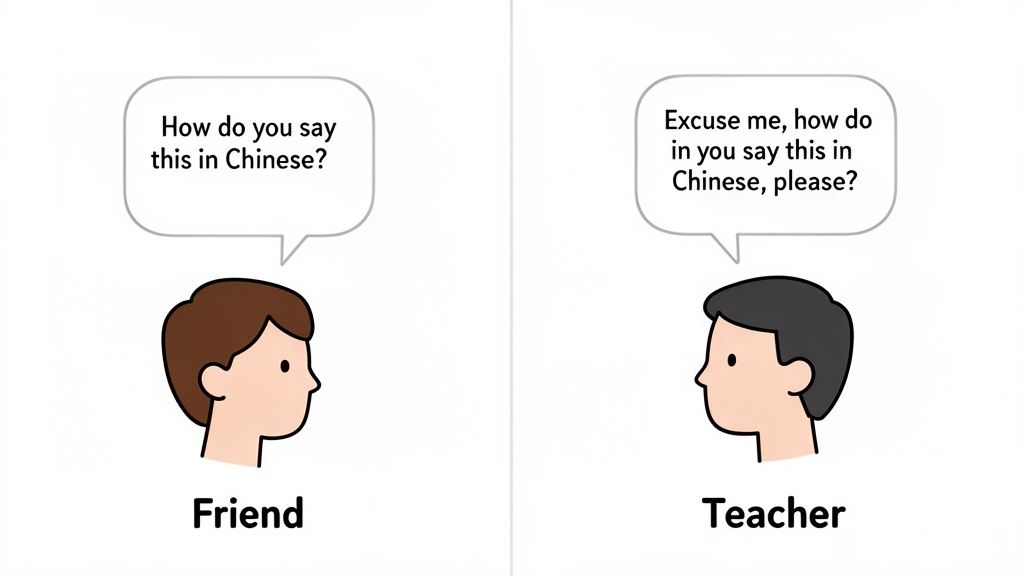
While 这个用中文怎么说? (Zhège yòng Zhōngwén zěnme shuō?) is your reliable, all-purpose phrase, real conversations need a bit more finesse. The way you ask a question often changes depending on who you're talking to. Getting this right is a huge step towards sounding less like a textbook and more like a natural speaker.
Adjusting your language for different social contexts is a crucial skill. The difference between asking a classmate for help and formally asking a professor might seem small, but it shows respect and cultural awareness.
Chatting with Friends and Peers
When you’re with friends or people your own age, you can afford to be more casual. The standard phrase we've covered works just fine, but you can also shorten it to sound even more relaxed and natural.
For instance, you could simply point and ask:
- 这个怎么说? (Zhège zěnme shuō?) - How do you say this?
- 中文怎么说? (Zhōngwén zěnme shuō?) - How do you say [it] in Chinese?
These variations are quick, direct, and exactly what you’d hear in everyday, informal chats. They work perfectly when the context is already clear—that you're pointing at something and just want the Chinese word for it.
Showing Respect in Formal Situations
In more formal settings—like speaking to a teacher, an elder, or a stranger you need help from—adding a touch of politeness goes a long way. The single most effective way to do this is by adding 请问 (qǐngwèn) to the beginning of your sentence.
请问 (qǐngwèn) literally translates to "please ask," but its function is much closer to "Excuse me, may I ask...?" in English. It immediately signals respect and makes your question feel less abrupt.
Pro Tip: Using 请问 (qǐngwèn) is a simple but powerful way to elevate your speech. It transforms a direct question into a polite request, making it appropriate for almost any formal interaction.
Let’s see how this looks in practice.
Formal Question Example
请问,这个用中文怎么说? (Qǐngwèn, zhège yòng Zhōngwén zěnme shuō?)
Excuse me, how do you say this in Chinese?
This small addition makes your question instantly more courteous. It’s perfect for the classroom, asking for help in a shop, or requesting directions from a local. As more people in the UK learn Mandarin, mastering these social nuances becomes key for effective communication.
The UK has seen incredible growth in Mandarin education, with GCSE entries rising by 160% over the last decade. This is partly thanks to initiatives like the Mandarin Excellence Programme, which started with fewer than 400 students and is projected to have over 16,000 participants by 2025. It shows there's a huge appetite for deeper language skills that go beyond just vocabulary. You can read more about the growth of Mandarin learning in the UK.
Using the right level of politeness doesn't just help you get the answer you need; it builds positive relationships with the people you speak to.
How to Ask About Specific Words and Ideas
Pointing at stuff is great, but your language journey will quickly move beyond the physical world. What happens when you want to know the word for an idea like "patience," a feeling like "nostalgia," or just a specific English word you can't think of a substitute for?
This is where you need to tweak the sentence structure slightly. Instead of pointing and using 这个 (zhège), you'll simply slot in the English word or concept. It's a small change, but it unlocks a whole new level of communication, letting you ask about anything, whether it's right in front of you or not.
The structure is wonderfully simple: [English Word] 用中文怎么说? ([English Word] yòng Zhōngwén zěnme shuō?).
Asking for a Translation
Let's imagine you're in a conversation about environmental issues and the word "sustainability" pops into your head. You can't just skip over it, so how do you find out the Chinese equivalent? You'd frame your question like this:
"Sustainability" 用中文怎么说? ("Sustainability" yòng Zhōngwén zěnme shuō?)
How do you say "sustainability" in Chinese?
This format is your go-to for directly requesting translations. It’s clear, direct, and tells the other person exactly what you need—the Chinese equivalent of an English term. For learners, this is an incredibly powerful tool for plugging vocabulary gaps on the fly. Of course, many learners rely on online tools, but if you're in China, it's worth knowing the practicalities of how to use Google in China.
Knowing What to Ask: Translation vs. Meaning
This is where a crucial distinction comes in that trips up a lot of beginners. Asking 怎么说 (zěnme shuō) is asking for a translation. But what if you hear a Chinese word and have no idea what it means? For that, you need a different phrase entirely.
To ask for a definition or meaning, you need to use 什么意思 (shénme yìsi). Mixing these two up can lead to some pretty confusing answers. If you ask for the "zěnme shuō" of a Chinese word, you're essentially asking "how do you say this word," which doesn't make much sense. You want to know what it means.
Key Takeaway: Use 怎么说 (zěnme shuō) when you have an English word and need the Chinese translation. Use 什么意思 (shénme yìsi) when you have a Chinese word and need its English meaning or definition.
Nailing this difference is fundamental to asking precise questions and getting the clear answers you need to keep your learning on track. As your vocabulary grows, you'll naturally want to start connecting ideas. Our guide on how to say 'and' in Chinese can help you build more complex sentences.
Choosing the Right Question for Your Needs
To make it crystal clear, here’s a quick comparison of when to use each question. Think of it as your cheat sheet for getting the information you need, whether it's a translation or a definition.
| Chinese Phrase | Pinyin | When to Use It | Example |
|---|---|---|---|
| ...用中文怎么说? | ...yòng Zhōngwén zěnme shuō? | When you have an English word and want its Chinese translation. | "Freedom" 用中文怎么说? (How do you say "freedom" in Chinese?) |
| ...是什么意思? | ...shì shénme yìsi? | When you hear or see a Chinese word and want to know its meaning. | "自由" 是什么意思? (What does "zìyóu" mean?) |
Mastering this simple distinction will make your interactions so much smoother. You'll spend less time feeling confused and more time having meaningful conversations and learning effectively.
Avoiding Common Pronunciation and Grammar Mistakes
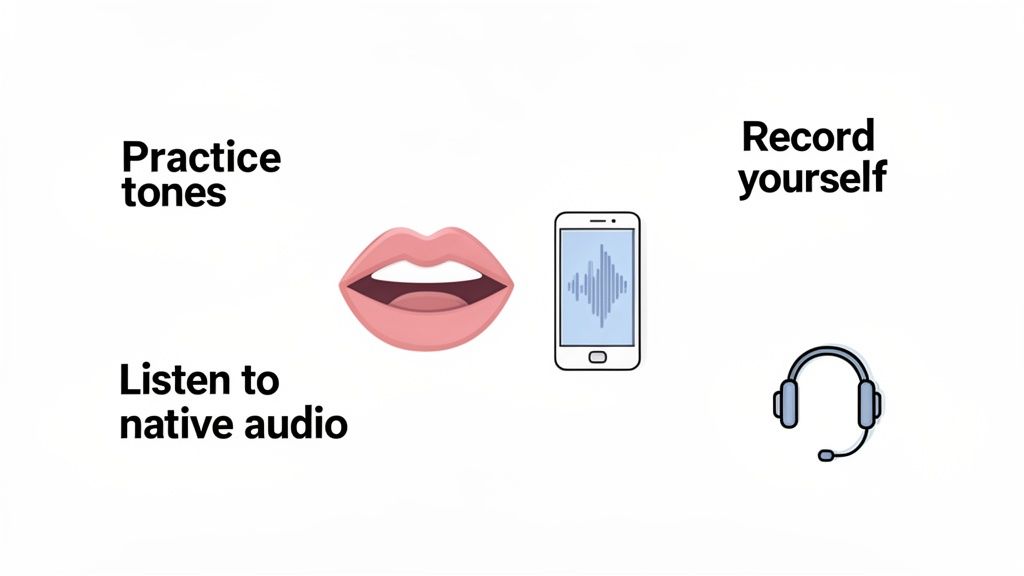
Knowing the right words is a great first step, but nailing the pronunciation and grammar is what really makes you understood. So many learners trip over the same hurdles. With a bit of focused practice, though, you can sidestep these common issues and turn a potentially confusing question into a crystal-clear one.
It’s completely normal to struggle with Mandarin sounds that don't really have an English equivalent. This just highlights why dedicated pronunciation work is so important, something that often gets overlooked in formal classes.
Demand for learning Mandarin is soaring. A 2025 British Council Language Trends England study revealed that while 37% of students aged 13 to 18 want to study Mandarin, only 5% get the chance. This gap means a lot of us have to figure out the tricky sounds on our own. You can dive into the full findings on Mandarin education demand for more details.
Nailing Tricky Pronunciation
Let's look at two of the most common trouble spots in our key phrases: the 'zh' sound in 这个 (zhège) and the tones on 怎么 (zěnme). Getting these right makes a world of difference.
Mastering 'zh' in 这个 (zhège): This 'zh' sound is often mispronounced as a 'j' or 'z'. To get it right, put your tongue just behind your top teeth like you're about to say 'd', but then release it into a sound like the 'j' in 'jam', keeping your tongue a bit flatter.
Correcting Tones in 怎么 (zěnme): This word uses a third tone (a low dipping one) followed by a neutral tone. A classic mistake is to pronounce both syllables with a heavy third tone, which sounds really unnatural. The trick is to let that second syllable, 'me', be light and quick.
Pro Tip: Record yourself saying these phrases and then play them back next to a native audio clip. Actually hearing the difference between your attempt and a native speaker's version is one of the fastest ways to fix your pronunciation. It’s an incredibly effective feedback loop.
Fixing Common Grammar Gaffes
Beyond the sounds themselves, word order trips a lot of people up. Chinese grammar can be simpler than English in many ways, but the structure is definitely different. A common mistake is just translating an English sentence structure directly into Mandarin.
For instance, a beginner might say 怎么说这个用中文? (Zěnme shuō zhège yòng Zhōngwén?). This is a word-for-word translation of "How say this using Chinese?", and it sounds awkward to a native speaker.
The correct, natural way to phrase it is 这个用中文怎么说? (Zhège yòng Zhōngwén zěnme shuō?). This follows a "Topic + Method + Question" pattern. If you think of it as, "This thing, using Chinese, how to say?", it starts to click. Focusing on these small grammatical details will make you sound much more natural when you ask, "how do you say that in Chinese".
If you want to go deeper into this, our in-depth article on mastering tones in Chinese is a great next step.
From Knowing to Doing: Practising Your New Phrases
Knowing the right phrases is one thing, but making them an instant reflex in a real conversation? That takes a solid study routine. The idea is to move from just passively reading these questions to actively using them. This is where a bit of structure, especially with a tool like a sentence mining app, can make all the difference.
Instead of letting these gems get lost in your notes, you can build a dedicated "asking questions" study pack. This means gathering all the variations we've talked about—from the basic 这个用中文怎么说? (Zhège yòng Zhōngwén zěnme shuō?) to more direct forms like "..." 是什么意思? (...shì shénme yìsi?)—and dropping them into your daily review queue.
How to Build a Practical Study Routine
Creating a focused study pack ensures you're not just memorising words, but getting entire sentence structures locked in. Whenever you come across a new way to ask for a translation, don't just jot it down; add it straight to your digital collection. Here's a simple workflow that works wonders:
- Collect Every Phrase: Each time you learn a new way to ask for a meaning or translation, add the full sentence to your app. For instance, you’d add both the casual 这个怎么说? (Zhège zěnme shuō?) and the more polite 请问,这个用中文怎么说? (Qǐngwèn, zhège yòng Zhōngwén zěnme shuō?).
- Use One-Tap Tools: When you get an answer in Chinese you don't recognise, a good app will let you tap on the new word to see its meaning and hear how it's said. This keeps your learning flow smooth and uninterrupted.
- Let Spaced Repetition (SRS) Do the Heavy Lifting: An SRS algorithm will then schedule these phrases for you to review at the perfect moment, just as you're about to forget them. This process is far more effective at building long-term memory than cramming ever could be.
This kind of active, tech-assisted learning is especially important for anyone studying on their own. While secondary school Mandarin programmes in the UK have seen some impressive growth, it's a different story at the university level, which has seen a sharp decline. In 2023, the number of students in Britain pursuing Chinese at university fell by a staggering 35% from its 2016 peak. For learners who want to keep making progress without formal education, mobile learning offers a crucial path forward. You can learn more about the changing landscape of Mandarin studies.
The Big Idea: The best way to learn how to ask "how do you say that in Chinese" is to practise asking it over and over. By creating a dedicated sentence pack in an SRS app, you turn a piece of passive knowledge into a communication skill you can actually use.
This systematic approach bridges the gap between knowing a phrase and truly owning it. It ensures that when you’re in a real conversation and need a word, the right sentence pops into your head automatically.
Common Questions About Asking for Translations
Once you start using these phrases in real conversations, you're bound to run into new situations and questions. Let's tackle some of the most common follow-ups I hear from learners. Getting these right will help you navigate those tricky moments with a lot more confidence.
How Do I Ask Someone to Write the Word Down?
This is a brilliant and incredibly useful follow-up. Someone says a new word, you get the pronunciation, but the characters are a mystery. What do you do?
You can ask, "你能写下来吗?" (Nǐ néng xiě xiàlái ma?), which simply means, "Can you write it down?"
This is a game-changer. It lets you capture the characters so you can look them up later or pop them into your study routine. If you want to be extra polite, especially with a stranger, you could add "麻烦你" (máfán nǐ) at the start. It’s a common way to say, "Sorry to trouble you."
What if I Don't Understand Their Answer?
It happens to all of us. Every single language learner has been there, so don't let it knock your confidence. The trick is having a polite phrase ready to go so you can keep the conversation moving.
A simple and respectful go-to is, "不好意思,我没听懂。" (Bù hǎoyìsi, wǒ méi tīng dǒng), meaning, "Sorry, I didn't understand." People almost always appreciate the honesty and will be happy to help you out.
You can also ask them to slow down a bit:
- 可以说慢一点吗? (Kěyǐ shuō màn yīdiǎn ma?) - Can you speak a little slower?
This shows you’re really trying to understand, and native speakers usually respond with a lot of patience. And for those times you need to understand whole chunks of dialogue, like in a video, checking out the latest insights on the 5 Best Video Translation Tools can be a huge help.
Remember: Admitting you don't understand isn't a failure. It’s a crucial part of learning that opens the door for clarification and, ultimately, a much deeper understanding.
Is It Rude to Ask Strangers for Help in China?
Not at all, as long as you're polite about it. Kicking things off with a simple "请问..." (Qǐngwèn...), which means "Excuse me, may I ask...," works wonders. It immediately sets a respectful tone.
Generally, people in China are incredibly supportive and often quite impressed when they see foreigners putting in the effort to learn their language. The main thing is to read the room. If someone is clearly rushing to catch a train or is deep in conversation, it’s probably best to find someone else to ask.
Will These Phrases Work Everywhere in China?
Yes, absolutely. Every phrase in this guide is Standard Mandarin (普通话 - Pǔtōnghuà). This is the official language used in schools, on TV, and in business right across mainland China, Taiwan, and Singapore.
While China is home to countless regional dialects—like Cantonese or Shanghainese—Standard Mandarin is the lingua franca that ties everything together. Sticking to these standard phrases is your safest bet for clear communication, ensuring you’ll be understood by Mandarin speakers pretty much anywhere you go.
Ready to turn these phrases into an active skill? Mandarin Mosaic helps you master real-world sentences with a smart, contextual learning system. Ditch confusing flashcards and start learning vocabulary the way it's actually used. Find out more at Mandarin Mosaic.