 Mandarin Mosaic
Free on iPhone, iPad and Android.
Download on theApp Store Get it onGoogle PlayYour first month of Premium is free.
Handwriting in Chinese: A Practical Guide for Learners
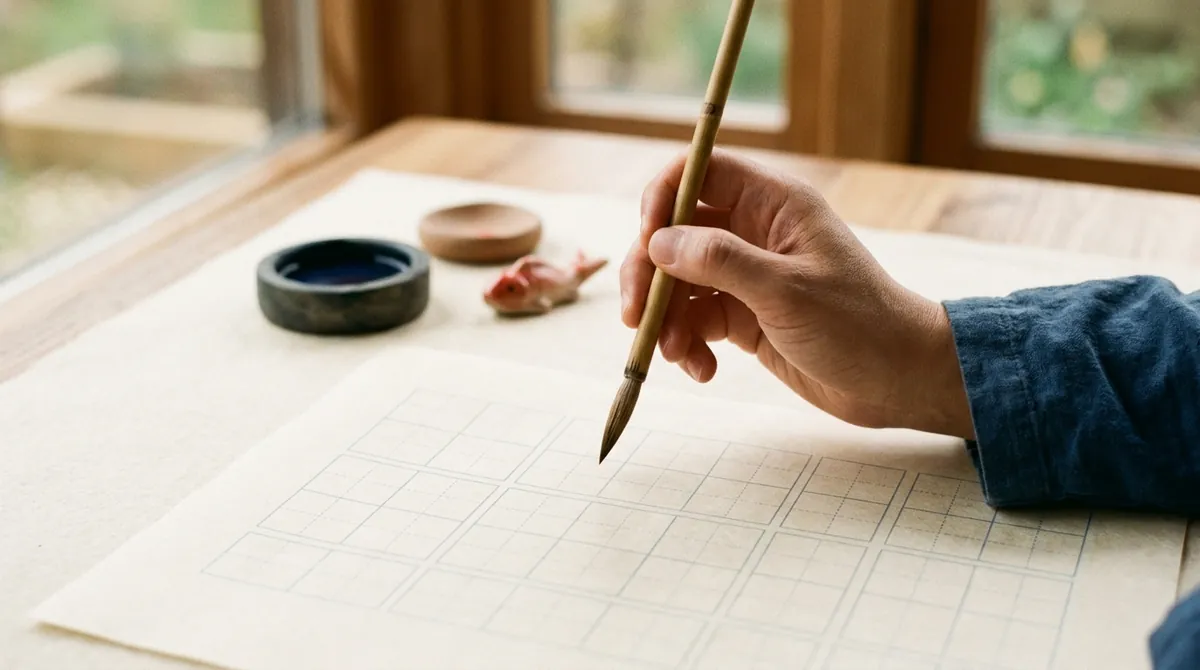
You're probably here because Chinese characters still feel uneven under your pen. You can recognise some on a screen, maybe type them with pinyin, maybe even read simple sentences, but when you try to write one from memory, everything falls apart halfway through. A line goes in the wrong direction. The character looks too wide, too tall, or just wrong.
That's normal.
Chinese handwriting feels hard at first because characters aren't built like alphabet words. They sit inside a square, they depend on proportion, and they reward order. The good news is that this isn't a talent problem. It's a systems problem. Once you understand the system, your writing starts to look clearer, and your memory for characters gets stronger too.
Why Handwriting Is Worth the Effort
A lot of learners assume handwriting is mainly about neatness. It isn't. Good Chinese handwriting starts with attention. When you write a character by hand, you have to notice where each part sits, which stroke comes first, and how the whole shape fits inside an invisible box. That mental effort helps the character stick.
If you've ever looked at a character like 警 (jǐng, police) or 餐 (cān, meal) and thought, “There's no way I'll ever write that,” pause there. You do not need to master thousands of forms at once. You need to learn how Chinese characters are organised, then practise in a calm, repeatable way.
Why writing helps memory
Typing lets you recognise. Handwriting forces you to recall.
That difference matters. Recognition is passive. Recall is active. When you write a character from memory, even slowly, you're rebuilding it stroke by stroke. That process exposes weak spots fast. You find out whether you know the left side only, whether you forget the bottom component, or whether you only remember the rough outline.
Practical rule: If you can only recognise a character on screen but can't rebuild it on paper, your knowledge is still partial.
That's not failure. It's useful feedback.
An old script with a logical core
Chinese script is ancient, but it isn't chaotic. Its earliest surviving forms are the oracle bone inscriptions of the Shang dynasty (c. 1250–1050 BCE), and modern character sets encode tens of thousands of characters. That sounds intimidating, but you only need a few thousand to read everyday Chinese, and the system becomes manageable once you see how characters are built from recurring parts.
Here's the mindset that helps most:
- Don't chase perfection: Aim for legibility and structure first.
- Don't copy mindlessly: Each repetition should have a purpose.
- Don't treat writing as separate from learning Mandarin: Handwriting supports reading, vocabulary, and sentence recall.
If your characters look clumsy right now, that's fine. Early progress in Chinese handwriting rarely looks elegant. It looks more controlled, more balanced, and more intentional. That's the right direction.
Decoding Characters with Stroke Order and Structure
Chinese characters stop feeling random when you start seeing parts inside the whole. A beginner often sees one dense shape. An improving learner sees components, direction, and balance.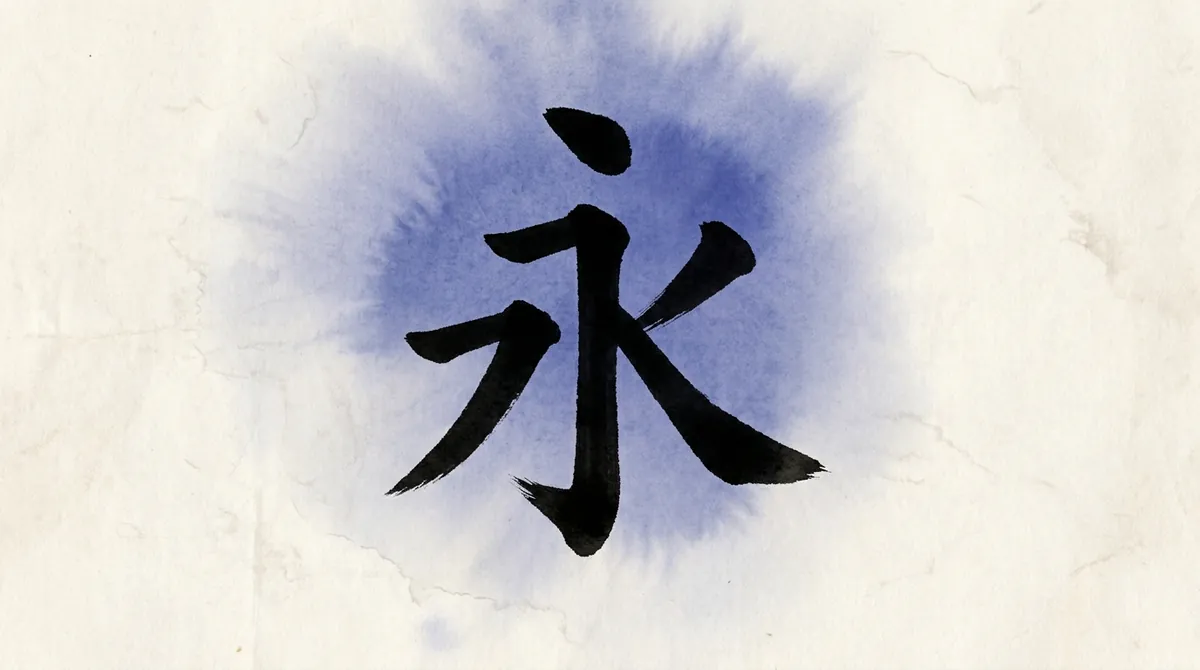
Characters are built, not drawn
Think of a character as a small structure inside a square frame. It has:
- Basic strokes, such as horizontal lines, vertical lines, dots, hooks, and falling strokes (named below)
- Components, often called radicals or character parts
- A layout, such as left-right, top-bottom, or outside-inside
Take 好 (hǎo, good). It isn't one mysterious picture. It contains 女 (nǚ, woman) on the left and 子 (zǐ, child) on the right. Once you can see that split, writing it becomes simpler. You're no longer trying to remember a single block. You're placing two known parts into one balanced shape.
That same habit scales up. More complex characters still rely on repeated building blocks, and many of those parts carry meaning, as our post on what Chinese characters mean shows.
The basic strokes and their names
Almost every character is written with a small set of basic strokes. Teachers and stroke-order charts use their Chinese names, so they are worth knowing:
- 横 (héng): a horizontal stroke, written left to right, as in 一 (yī, one)
- 竖 (shù): a vertical stroke, written top to bottom, as in the second stroke of 十 (shí, ten)
- 撇 (piě): a falling stroke that sweeps down to the left, as in the first stroke of 人 (rén, person)
- 捺 (nà): a falling stroke that sweeps down to the right, as in the second stroke of 人
- 点 (diǎn): a dot, a short stroke usually slanting down to the right, as at the top of 六 (liù, six)
- 提 (tí): a rising stroke that flicks up to the right, as in the fourth stroke of 我 (wǒ, I)
- 折 (zhé): a stroke that turns a corner, as in the top-right corner of 口 (kǒu, mouth)
- 钩 (gōu): a hook at the end of a stroke, as in 小 (xiǎo, small) and 了 (le)
Many strokes combine these. 横折 (héngzhé), a horizontal that turns down, forms the top-right corner of 口 and 日.
The main stroke order rules
Stroke order is not decoration. It's the writing path that keeps a character stable.
The core rules most learners need first are simple:
Top to bottom
If a character has an upper part and a lower part, write the upper part first.Left to right
If one component sits on the left and another on the right, begin on the left.Horizontal before vertical
When strokes cross, the horizontal stroke usually comes before the vertical one, as in 十.Left-falling before right-falling
When a 撇 (piě) and a 捺 (nà) meet, write the left-falling stroke first, as in 人 and 八 (bā, eight).Centre before the sides
When a character has a middle stroke with smaller parts on either side, write the middle first, as in 小 and 水 (shuǐ, water).Outside before inside
If a component encloses another part, build the enclosure first.Close the frame last
In fully enclosed characters, write the left, top and right sides, fill in the inside, then seal the bottom, as in 日 (rì, sun) and 国 (guó, country).
Correct stroke order makes a character easier to control. Your hand follows a path that supports proportion instead of fighting it.
Why the order matters
Some learners think, “If the final character looks roughly correct, why should the order matter?” Because order affects shape.
Standard stroke order also keeps your characters consistent from one attempt to the next, and it lets you read other people's faster, joined-up handwriting, which only makes sense if you know the order behind it. Hacking Chinese makes a good case for learning the rules properly in Handwriting Chinese characters: the minimum requirements.
When learners improvise the order, three things tend to happen:
| Issue | What it looks like | Result |
|---|---|---|
| Components drift | Left and right parts don't align | The character looks unstable |
| Stroke lengths change | One line becomes too long or too short | Proportion breaks down |
| Enclosures collapse | Boxes close too early or too late | Inner parts get squeezed |
A simple example
Look at the character 问 (wèn, to ask) in simplified Chinese. If you treat it as one shape, you may write the inside too early and ruin the spacing. If you understand the structure, you first write the frame 门 (mén, door), then place 口 (kǒu, mouth) in the space inside it.
That's the pattern to train: see structure first, then write.
Common Handwriting Mistakes Learners Make
Most handwriting problems aren't dramatic. They're small errors that steadily pile up. One stroke leans too far. One component sits too high. One enclosure closes too soon. The learner thinks, “My writing is messy,” but the actual issue is usually more specific.
Proportion problems
The most common mistake is poor proportion. A character should sit in a square, but beginners often stretch it vertically or spread it too wide.
Think about 明 (míng, bright). If 日 (rì, sun) becomes too large, 月 (yuè, moon) gets squeezed. If both sides are the wrong width, the character stops looking settled. Native readers may still guess it, but your writing becomes harder to trust.
Direction errors
Another frequent issue is writing the right stroke type in the wrong direction.
A learner knows the character has a right-falling 捺 (nà), but writes something closer to a straight line. Or a left-falling 撇 (piě) becomes too vertical. That changes the feel of the entire character. In Chinese, stroke direction isn't just visual. It helps define the identity of the form.
Small direction mistakes can make a familiar character look unfamiliar.
Closing boxes at the wrong time
Characters with enclosing parts often trip learners up. The writer sees a box shape and closes it too early. Then there's no room left for the inside component, so the centre gets cramped.
Common examples include 国 (guó), 回 (huí, to return) and characters built on the 门 (mén) frame. The fix is procedural. Don't think, “make a box.” Think, “build the outside, place the inside, then finish the enclosure.”
Writing from memory too soon
This mistake is less visible, but it causes many of the others. Learners often jump from reading straight to freehand writing without enough guided practice. Then they reinforce bad habits.
A better self-check is:
- If the character collapses immediately, trace it first
- If the shape is mostly there but uneven, copy it carefully
- If you can picture every part clearly, write it from memory
That sequence saves time because it reduces sloppy repetitions.
Effective Practice Methods for Legible Writing
You sit down to practise one character for five minutes, and by the end it looks worse than it did at the start. That usually is not a talent problem. It is a method problem.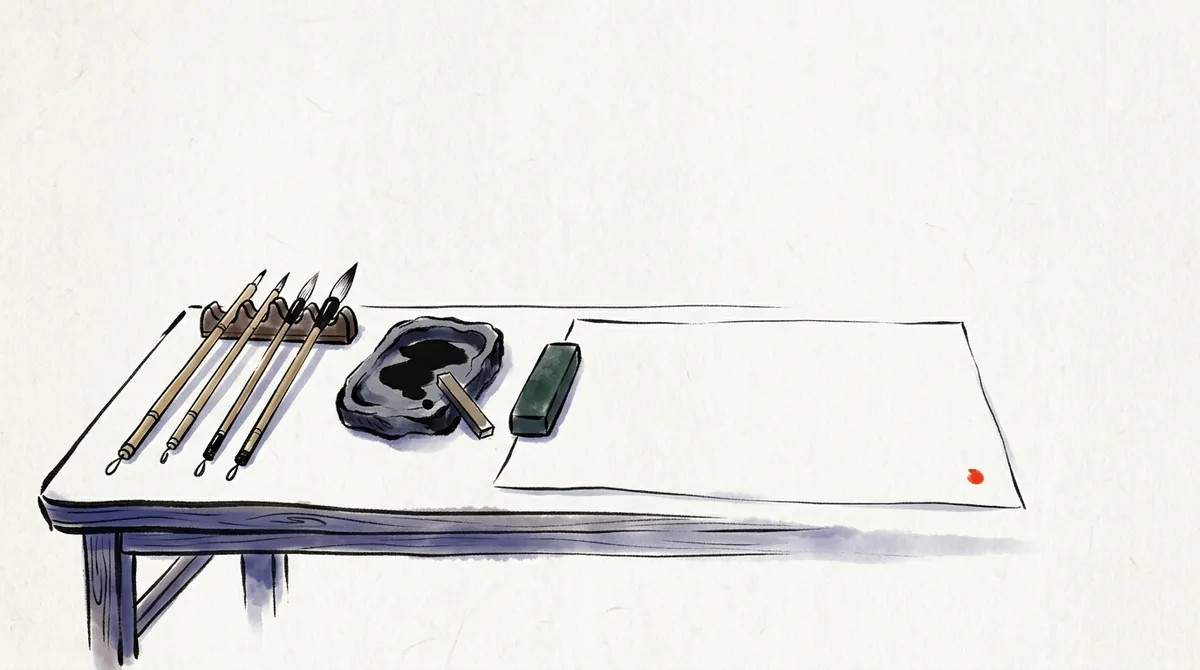
Legible Chinese handwriting comes from controlled repetition, clear visual feedback, and review spaced over time. The goal is not to fill pages. The goal is to train your eye and hand to agree on what a character should look like.
Choose paper that teaches placement
Beginners often treat paper as a minor detail. It is more like training wheels for character layout.
- 田字格 (tiánzìgé), the "田-shaped grid", gives you a centre point and four smaller zones, which helps with height, width, and where components should sit.
- 米字格 (mǐzìgé), the "米-shaped grid", adds diagonal guides, which make it easier to judge slant, spread, and symmetry.
If a character keeps leaning, shrinking, or drifting off-centre, use guided paper before blaming your memory. Good grids show you where the shape is going wrong.
This is why Chinese schoolchildren learn to write in 田字格 exercise books: the grid makes proportion and placement easy to see.
Use a three-stage drill
A good practice cycle works like scales for a musician. You build control first, then accuracy, then recall.
1. Trace for movement
Tracing is for learning the route. Your hand follows the stroke path, and your eyes notice where each line starts, turns, and finishes.
This helps most with characters that still feel visually slippery.
2. Copy for structure
The model remains visible, but you write the character yourself. At this point, you start checking whether the left side is too wide, the bottom is too heavy, or the enclosing shape is squeezing what sits inside.
Compare each attempt right away. One careful correction teaches more than ten rushed repetitions.
3. Write from memory for recall
Freehand writing shows whether the character is stored in memory. If the shape collapses, return to copying or tracing for a few rounds.
That is efficient practice, not a setback.
Keep sessions small enough to stay clean
Many learners improve faster with short, repeatable sessions than with occasional long sessions that turn messy halfway through. A practical target is a small set of characters taken from material you are already studying, then reviewed again over the next few days using a spaced repetition schedule that matches how memory fades.
A simple routine looks like this:
- Pick 5 to 10 useful characters from recent reading or app study (our post on how many characters to learn per day can help you set the number).
- Trace each one once or twice if the shape still feels unstable.
- Copy each one slowly, watching spacing and proportion.
- Write each one from memory.
- Mark the characters that still break apart, then review only those later.
This keeps handwriting tied to real vocabulary instead of random workbook pages. It also fits modern study better. If you meet a character in an app like Mandarin Mosaic, then write it by hand the same day, you connect recognition, meaning, and motor memory in one loop.
Use tools that reduce friction
Handwriting practice should be easy to start. Keep a notebook, a model sheet, and one pen in the same place. Small setup problems are enough to break consistency.
Judge progress by clarity, not volume
A full page of characters can feel productive. One well-written line often teaches more.
Ask three direct questions after each set:
- Are the parts sitting in the right places?
- Does the character keep a stable shape across repetitions?
- Can you still write it later without looking?
If the answer is no, slow down and reduce the number of characters. Legible handwriting grows from accurate habits repeated often enough to stick.
Integrating Handwriting into Your Digital Study Routine
Handwriting doesn't compete with digital study. It strengthens it.
A lot of learners separate the two. They do app study on one side, notebook drills on the other, and the activities never connect. That makes handwriting feel like extra work. It's more useful when it becomes a quick follow-up to something you've just read, heard, or reviewed.
Use digital tools to expose weak recall
A Chinese handwriting keyboard is a good test because it removes pinyin as a shortcut. iPhones and Android phones both offer one: add Chinese handwriting as a keyboard in your phone's settings (our guide to typing Chinese on any device walks through it). If you can only type a character by sounding it out, you may not know its written form well. If you can handwrite it into a device, you're testing visual memory more directly.
Try writing a character after seeing it in context. If the recogniser struggles with your input, that's often a sign to revisit the structure.
Build a simple paper-and-screen loop
A practical routine looks like this:
- Read first: Study a sentence and make sure you understand the word in context.
- Select one target: Don't write every unknown character. Pick the one that feels useful or unstable.
- Write immediately: Put the phone down and write the character by hand a few times while the sentence is still fresh.
- Return to the sentence: Read it again so the written form reconnects to meaning and usage.
This keeps handwriting tied to real Mandarin rather than isolated symbol practice.
Why Writing Characters Strengthens Your Mandarin
Writing characters by hand sharpens parts of Mandarin that typing can hide. It slows you down enough to notice the difference between similar forms. It forces you to see where components belong. It makes vague recognition become precise recall.
That matters when characters look close to each other. If you confuse forms easily, handwriting helps because it turns visual detail into physical action. You don't just “sort of remember” a character. You learn how it is constructed.
It also changes your relationship with vocabulary. A word stops being something you can tap and recognise. It becomes something you can reproduce, inspect, and use with more confidence. That depth supports reading, listening, and sentence memory.
Handwriting still matters because Mandarin is written with structure, not just sound. When you train that structure directly, the language becomes more solid in your mind.
If you want a study system that helps you learn Chinese through real sentences instead of isolated flashcards, Mandarin Mosaic is worth a look. Each sentence introduces one new word, spaced repetition brings it back before you forget it, and the lessons follow the HSK levels, which gives you a steady supply of useful characters to practise by hand.