Good Morning Chinese Mandarin: Master Good Morning in Mandarin Like a Native
If you want to wish someone a good morning in Mandarin Chinese, the go-to phrase you'll want in your back pocket is zǎo shàng hǎo (早上好). This is your all-purpose, polite greeting that works in pretty much any situation. Whether you're greeting a colleague, your teacher, or an elder, it's the perfect, respectful way to start the day.
Mastering the Most Common Mandarin Morning Greeting
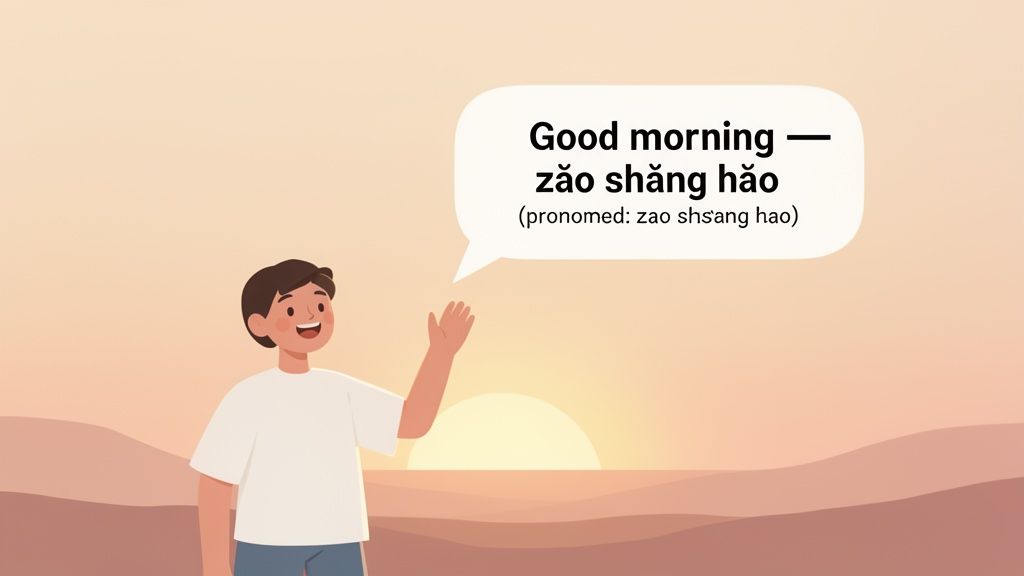
When you’re just starting to learn Chinese, the real goal is to start communicating confidently as soon as possible. For morning greetings in Mandarin, one phrase stands head and shoulders above the rest for its usefulness and politeness: 早上好 (zǎo shàng hǎo). Think of it as your reliable key to starting a friendly conversation before noon.
Literally, it translates to "early morning good," which is a simple and logical way to wish someone well. It carries a sense of respect and warmth, making it an excellent choice for just about anyone you meet. Using a time-specific greeting like this also sounds much more natural to native speakers than just a generic "hello."
And here's some good news for beginners: even if your tones aren't perfect yet, the context of saying zǎo shàng hǎo in the morning usually makes your meaning crystal clear. It's the ideal phrase to build your confidence and make the leap from being a passive learner to an active speaker.
Your Morning Greeting Cheat Sheet
To give you a head start, I've put together a quick-reference table. It breaks down the most essential morning greetings, how to say them, and the situations where they fit best. If you're curious about other useful expressions, you might find our guide to essential phrases in Chinese helpful too.
Mandarin Morning Greetings Quick Reference
Here’s a simple breakdown of the main ways to say 'good morning' in Mandarin.
| Greeting (Characters) | Pinyin (with Tones) | Formality and Usage |
|---|---|---|
| 早上好 | zǎo shàng hǎo | Formal/Polite: The standard, respectful greeting suitable for almost any situation. |
| 早 | zǎo | Informal: A quick, friendly "morning!" used with friends, family, and colleagues. |
| 早安 | zǎo ān | Polite: Means "good morning peace," common in Taiwan and sounds slightly softer. |
Keep this little table handy, and you'll always have the right greeting ready to go, no matter who you're talking to.
Understanding the Building Blocks of a Greeting
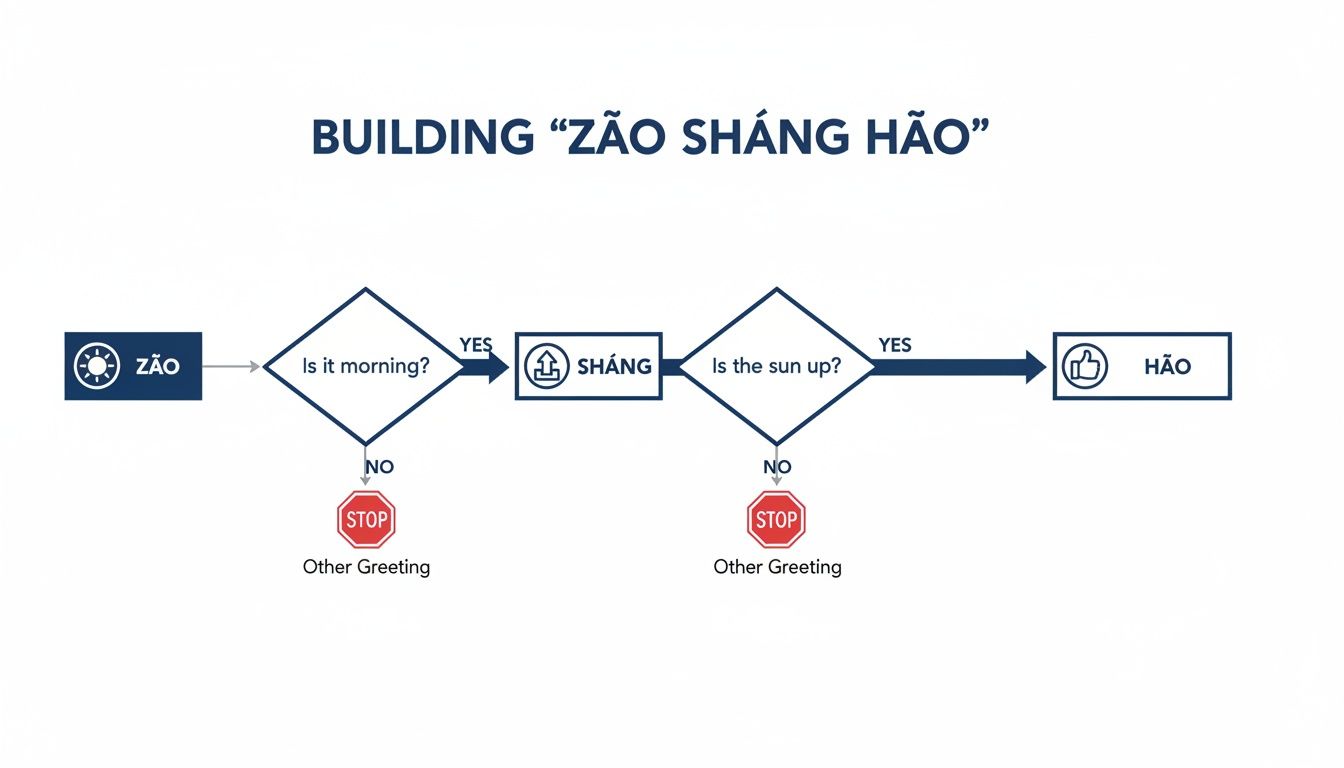
To really get a handle on any new Mandarin phrase, you need to look beyond just the sounds and see how it’s put together. Taking apart a greeting like 早上好 (zǎo shàng hǎo) is a bit like dismantling a clock; once you understand what each little piece does, the whole thing suddenly makes perfect sense.
Let’s break it down, character by character.
- 早 (zǎo) means "early" or "morning."
- 上 (shàng) translates to "up" or "on."
- 好 (hǎo) simply means "good."
So, when you put 早上 (zǎo shàng) together, it literally means "early up"—a pretty logical way to describe the morning, right? Then, just add 好 (hǎo) to the end, and you get "morning good," or as we’d say more naturally, "good morning." This kind of straightforward, logical structure is a pattern you'll see again and again in Chinese, which is great news for learners.
The Role of Pinyin and Tones
While the characters give us the meaning, Pinyin is our bridge to actually saying the words. It uses the familiar Roman alphabet to show us how Mandarin sounds, which makes it far less intimidating for English speakers. If this system is new to you, you can get the full rundown in our detailed guide on how to master Chinese Pinyin.
But Pinyin is only one half of the equation. The other critical part is tones. Mandarin is a tonal language, meaning the pitch you use when you say a word can completely change its meaning.
Think of tones as the melody of the language. It’s like how a rising pitch at the end of a sentence in English can turn a statement into a question ("You're going home?"). In Mandarin, getting the tone wrong can turn "mother" (mā) into "horse" (mǎ).
It's not just about individual sounds. To master Mandarin, you need to get a feel for the 'music of speech'—the overall rhythm, stress, and intonation, also known as what is prosody in speech. Getting the tones right for zǎo shàng hǎo (third tone, fourth tone, third tone) is the key to making sure people actually understand what you're saying.
Choosing the Right Greeting for Any Situation
You’ve got the building blocks of 早上好 (zǎo shàng hǎo), which is great. But just like you wouldn’t greet a close friend with a formal "Good day to you," knowing when to use which greeting is key to sounding natural in Mandarin. It's all about matching your words to the situation.
Think about walking into your office and seeing a colleague you know well. Instead of the full, slightly stiff zǎo shàng hǎo, you can just say 早 (zǎo). This single character is the Mandarin equivalent of a quick and friendly "Morning!". It’s casual, efficient, and what you’ll hear most often between friends, family, and coworkers. It’s a small word that signals a lot of warmth and familiarity.
Navigating Regional Differences
To add another layer of nuance, how people say good morning can change depending on where you are. While 早 (zǎo) is universally understood across the Mandarin-speaking world, you'll hear another common phrase, especially if you're talking to people from Taiwan.
In Taiwan, it’s quite common to hear 早安 (zǎo ān). The character 安 (ān) means "peace" or "quiet," so the greeting has a gentle, well-wishing feel to it—almost like saying "morning peace." It’s perfectly polite for most situations, but you’ll hear it much more in Taiwan than in Mainland China.
Think of it like the difference between "cheers" in the UK and "thanks" in the US. Both get the point across, but one immediately gives away a regional background. Using the right phrase shows you’ve been paying attention to the cultural details.
So, how do you choose? This table breaks down the common morning greetings to help you pick the right one for any situation.
Comparing Formal and Informal Morning Greetings
| Phrase | Pinyin | Formality | Best Used With |
|---|---|---|---|
| 早上好 | zǎo shàng hǎo | Formal | Elders, teachers, new clients, authority figures |
| 早安 | zǎo ān | Polite / Neutral | Anyone, especially common in Taiwan |
| 早 | zǎo | Informal | Friends, family, close colleagues, peers |
Choosing the right greeting is about more than just vocabulary; it’s about social awareness. Here’s a quick guide to help you decide on the fly:
- Meeting a new client or an elder? Stick with the formal and respectful 早上好 (zǎo shàng hǎo). It's always a safe and polite choice.
- Greeting a friend at a café? A simple and friendly 早 (zǎo) is perfect. It’s warm, casual, and exactly what a native speaker would use.
- Interacting with someone from Taiwan? Using 早安 (zǎo ān) can be a thoughtful way to show cultural awareness and connect a little more deeply.
By paying attention to these social cues, you move beyond just translating words and start truly communicating. You’re not just saying the right thing; you’re saying it in the right way.
How to Respond Naturally in Conversation
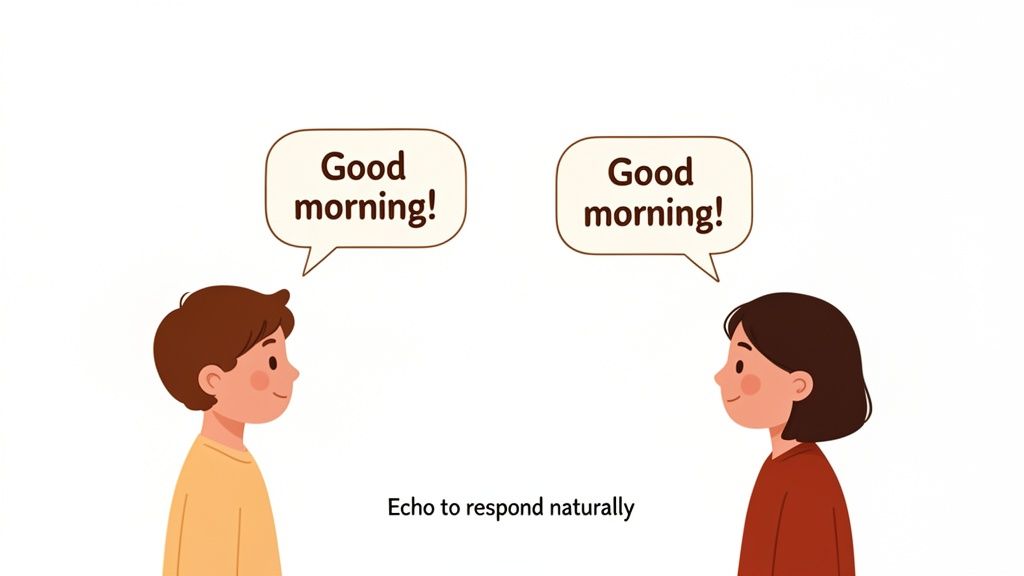
A greeting is a two-way street, so knowing how to reply is just as important as knowing how to kick things off. The good news? Responding to a "good morning" in Mandarin is incredibly simple. You don't need to memorise a whole new set of phrases at all.
The most common and natural way to respond is simply to echo the greeting back. If someone says 早上好 (zǎo shàng hǎo) to you, the perfect reply is a friendly 早上好 (zǎo shàng hǎo) right back at them. This works just the same for the more casual greetings, too.
Simple Dialogue Examples
Let's see how this plays out in a quick, everyday exchange.
- Person A (Colleague): 早! (zǎo!)
- You (Responding): 早! (zǎo!)
It really is that easy. This simple mirroring is the standard way to acknowledge the greeting and return the good wishes.
Responding to a greeting isn't just about vocabulary; it's about acknowledging the other person and keeping the social flow going. A simple, mirrored response shows you're engaged and polite, helping to strengthen that connection.
Of course, to truly respond naturally and confidently in Mandarin, you’ll want to continuously improve your conversation skills as a whole. Mastering these basic back-and-forth exchanges is a fantastic first step on that journey. For more conversational building blocks, check out our guide to essential Chinese basic phrases.
Common Mistakes to Avoid When Greeting in Mandarin
Every language learner stumbles a bit at first, but knowing the common pitfalls means you can sidestep them right from the start. When you're learning to say "good morning" in Chinese, a few small mistakes can lead to confusion or awkwardness. If you get a handle on these now, you’ll be greeting people with confidence in no time.
The biggest hurdle for English speakers? Getting the tones wrong. It’s a classic mistake. Since Mandarin is a tonal language, the pitch you use completely changes a word's meaning. Using a flat tone instead of a falling one can be the difference between two completely unrelated ideas, so getting your pronunciation practice in is absolutely key.
Another easy trap to fall into is a mismatch between your greeting and the social situation. Using the full, formal 早上好 (zǎo shàng hǎo) with a close mate can sound a bit stiff, almost like saying "Good morrow" in English. On the flip side, a casual 早 (zǎo) with an elder or a new client might come across as a bit too familiar.
Regional Misunderstandings
Finally, those regional differences can catch you off guard. As we’ve covered, 早安 (zǎo ān) is perfectly normal in Taiwan but much less common in Mainland China. Using it on the Mainland isn't a massive blunder, but it might subtly flag you as an outsider or someone who learned from Taiwanese materials.
Being aware of these nuances—tones, formality, and regional differences—is what separates a basic speaker from someone who really gets it. It shows you're not just memorising phrases but actually understanding the cultural fabric of the language.
Got Questions About Mandarin Greetings?
When you're learning a new language, it's the little details that often bring up the biggest questions. Let's clear up some of the common queries learners have about saying "good morning" in Mandarin, so you can use these phrases with total confidence.
Can I Use Zǎo Shàng Hǎo at Any Time of Day?
Definitely not. 早上好 (zǎo shàng hǎo) is strictly a morning greeting, usually reserved for the hours before 10 a.m. Think of it like saying "good morning" in English – it would sound pretty odd in the afternoon.
Once the morning passes, you'll want to switch to 下午好 (xià wǔ hǎo) for the afternoon or 晚上好 (wǎn shàng hǎo) for the evening. Getting the time of day right is a quick win.
Is It Okay to Just Say Nǐ Hǎo in the Morning?
Sure, it's okay. 你好 (nǐ hǎo) is never wrong, but it can sound a bit stiff or like you've just walked out of page one of a textbook. It's a bit like using "Greetings" in English – correct, but not very warm.
Opting for a time-specific greeting like 早 (zǎo) instantly makes your Mandarin sound more natural and friendly. It shows you're not just reciting vocabulary, but actually connecting with the person you're speaking to.
Using the right greeting for the time of day is one of those small details that makes a huge difference. It shows you're paying attention to the context, not just memorising words, and it's a simple step towards sounding less like a learner and more like a local.
Ready to move beyond isolated words and learn vocabulary in context? The Mandarin Mosaic app uses sentence mining to help you see how every new word is used naturally. Download Mandarin Mosaic and start building your grammar intuition today.