Unlocking Mandarin with Flash Cards Memory Science
Flashcards are a powerhouse for learning Mandarin, but only if you use them the right way. The most effective method moves beyond single words and dives straight into contextual sentences. Instead of just memorising characters in isolation, you embed new vocabulary into a complete thought. This helps you grasp grammar and usage naturally, giving your long-term retention a massive boost.
Why Traditional Flashcards Fail for Mandarin
If you’ve ever spent hours memorising hundreds of individual Chinese characters, only to find yourself struggling to string together a basic sentence, you're not alone. It’s a common frustration, and it points to a major flaw in the old-school approach to flashcards for a language as rich as Mandarin. Rote learning of isolated symbols often leads to burnout, not fluency.
The real issue is the complete lack of context. Your brain doesn't learn Mandarin in a vacuum; it thrives on building connections and understanding meaning through the relationships between words. When you memorise ‘车’ (chē - car) on its own, all you have is one fragile piece of information. But when you learn it in a sentence like ‘我的车是红色的’ (Wǒ de chē shì hóngsè de - My car is red), you instantly learn its meaning, its role in the sentence, and how it connects to other words.
The Science of Forgetting and Remembering
Let's face it, our brains are wired to forget information that isn't reinforced. This is the "forgetting curve" in action—a concept that shows how quickly our memory fades unless we actively work to recall what we've learned. Traditional study methods are often fighting a losing battle against this natural process.
This is where two powerful principles from cognitive science come into play:
- Active Recall: This is the simple act of pulling information from your memory, rather than just passively looking at it again. Forcing your brain to produce the answer when you see a prompt is far more powerful than just reading the answer on the back of a card.
- Spaced Repetition: This brilliant principle involves reviewing information at increasingly longer intervals. By seeing a flashcard just before you’re about to forget it, you strengthen that neural pathway, making the memory stick for good.
By combining active recall with spaced repetition, you essentially hack the forgetting curve at the most efficient moments. Your study sessions transform from a brute-force effort into a smart, scientific process for building lasting memory.
Moving from Words to Sentences
Making the switch from simple word lists to sentence-based flashcards is the key to unlocking these principles for Mandarin. This approach, often called sentence mining, ensures every new character you learn is immediately grounded in how it’s actually used. It's the difference between collecting a pile of individual bricks and actually building a solid wall.
If you want to dive deeper into this, we've got a detailed guide comparing Chinese flashcards vs sentence mining.
This method is exactly where modern language learning is heading. In the UK, the language learning software industry is projected to hit £172.6 million in revenue by 2025, a trend driven by the demand for smarter, context-rich systems. This growth shows people want apps that integrate proven memory techniques like Spaced Repetition Systems (SRS). You can read more about this trend on IBISWorld. This evolution makes the humble flashcard a more powerful memory-building tool than ever before.
Building a Smarter Mandarin Flashcard System
Forget about the mind-numbing grind of making flashcards one by one. The most effective way to build long-term memory in Mandarin isn’t about brute-force memorisation; it's about discovery and context. This method is called sentence mining, and it’s all about creating your flashcards from real sentences you come across in your day-to-day learning.
The idea is refreshingly simple. Instead of learning words floating in a void, you learn them inside a complete thought. This immediately shows you how a word actually behaves, what it connects to, and the grammar holding it all together. When you do this, you’re not just memorising a definition; you’re internalising the patterns that are the true foundation of fluency.
Many learners hit a wall with traditional, isolated flashcards. They start with a single word, feel the frustration of not knowing how to use it, and eventually burn out before realising context was the missing piece all along.
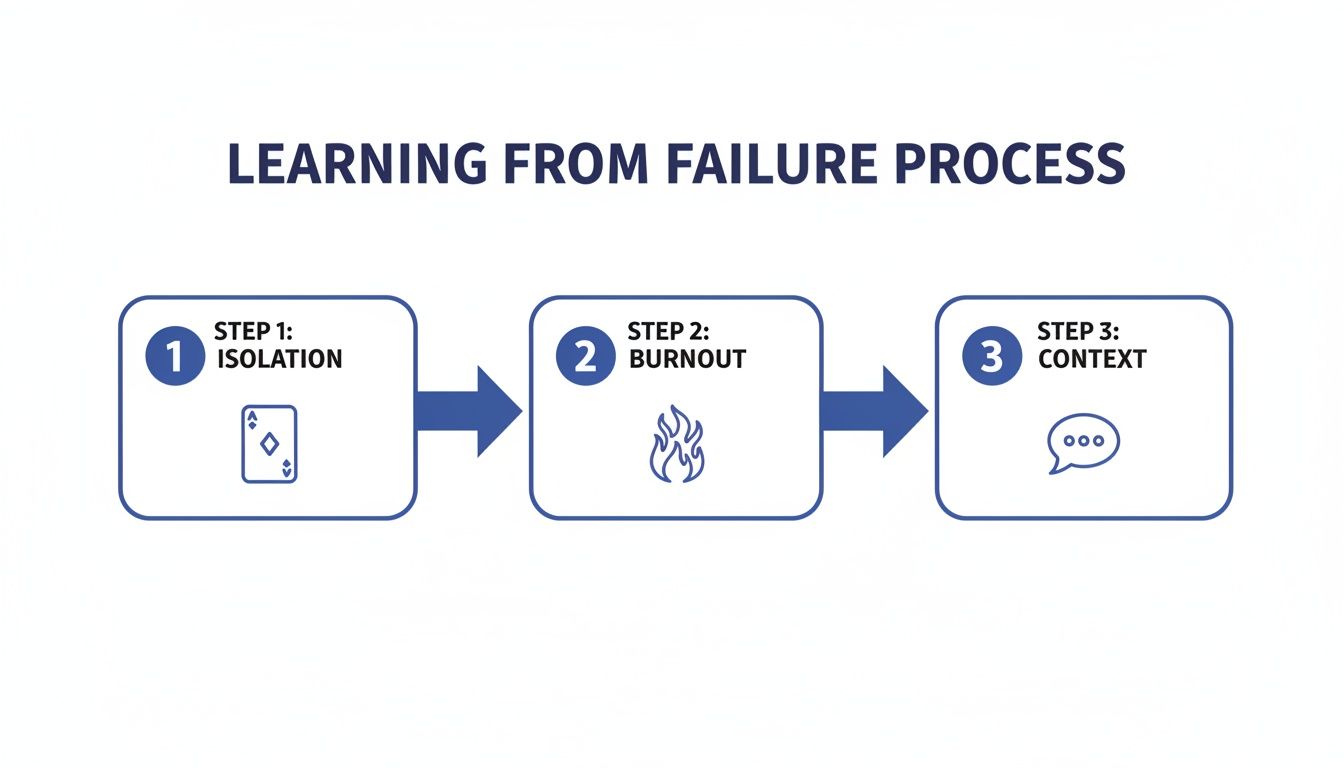
This process shows why starting with context-rich sentences is so crucial. It gives you the framework you need for learning that actually lasts.
The Power of Comprehensible Input
To get the most out of sentence mining, you need to stick to the 'i+1' principle. This just means that every new flashcard you create should contain only one new word or character you don't know (the '+1'). The rest of the sentence (the 'i') should be stuff you already understand.
This approach gives your brain what linguists call comprehensible input. Because you get almost the entire sentence, you can often figure out the meaning of the new word just from its surroundings. It’s a far more natural and powerful way to pick up vocabulary than just drilling a long list of words.
For instance, if you already know ‘我喜欢’ (wǒ xǐhuān - I like) and then you see the sentence ‘我喜欢苹果’ (wǒ xǐhuān píngguǒ - I like apples), your brain can easily latch onto and absorb the new word, ‘苹果’.
The goal here is steady, incremental progress. Each 'i+1' sentence is a small, manageable step that builds on what you already know. This stops you from feeling overwhelmed and strengthens your overall memory foundation.
Finding and Creating Your Sentences
The best sentences are always the ones you find yourself. They come from content you're genuinely interested in, which naturally makes the whole process more engaging and memorable.
Here are a few great places to start mining for sentences:
- Graded Readers: These are books written specifically for Mandarin learners at various levels.
- Chinese TV Shows or C-dramas: Pop on the subtitles and grab authentic, everyday dialogue.
- Podcasts for Learners: Many of these come with full transcripts, which are perfect for pulling sentences from.
For a really rich source of authentic Mandarin, you could even explore techniques for translating YouTube videos to find phrases for your flashcards. The trick is to find material that pushes you a little but doesn't feel impossible.
Once you’ve got a sentence, the next move is turning it into a powerful study tool. This is where modern apps like Mandarin Mosaic completely change the game. Instead of you doing all the manual work, the system serves up sentences at your level and automatically highlights that single new word for you. This frees you up to focus purely on learning, while the spaced repetition algorithm behind the scenes handles all your review scheduling for maximum retention. To get a better handle on how that works, have a look at our guide on the science behind spaced repetition.
Integrating Flash Cards into Your Daily Routine
Mastering Mandarin isn't about cramming for hours on end; it’s about building a consistent, sustainable habit that slots neatly into your life. The secret to making flash cards stick is weaving them into the small, otherwise dead pockets of your day. The goal is to make reviewing as automatic as checking your phone or brewing your morning coffee.
Instead of aiming for a vague target like "study for an hour," get specific. Pinpoint those moments you can snatch for a quick review. Your daily commute, the queue at the coffee shop, or the five minutes before a meeting starts—these are golden opportunities. A well-designed app keeps your flash cards ready to go, turning that downtime into genuinely productive learning.
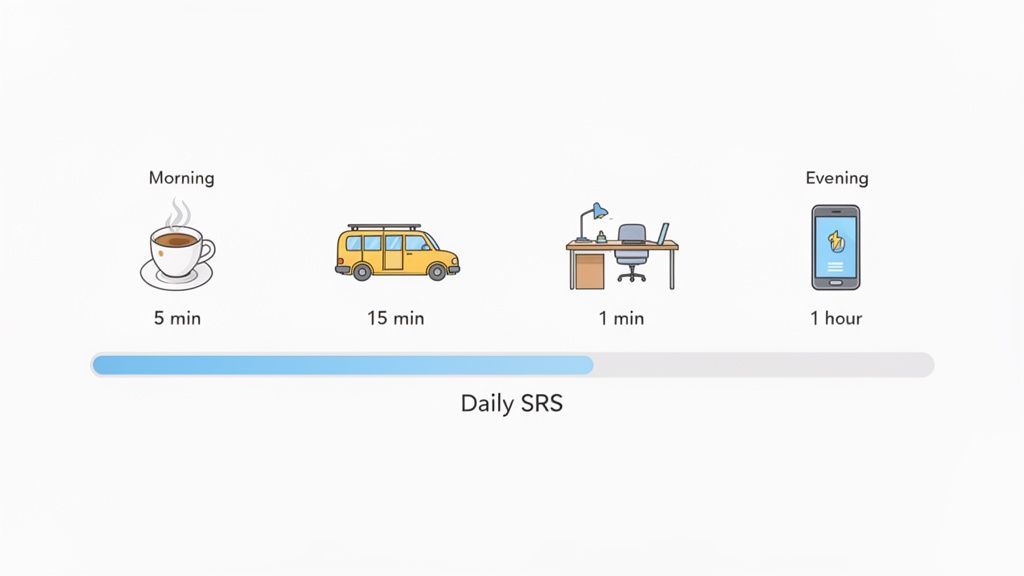
Crafting Your Personal Study Schedule
There’s no one-size-fits-all solution here—your ideal schedule is built around your lifestyle. But the principle is always the same: short, frequent reviews are far more powerful than long, infrequent ones. This keeps your memory fresh and stops reviews from piling up into a task you dread.
Think of these sample plans as a starting point to build from:
- The Busy Professional: Five minutes over breakfast, ten minutes on your lunch break, and another five before bed. That’s 20 minutes of focused, high-impact review spread across your day.
- The Dedicated Student: Two 15-minute sessions—one in the morning, one in the afternoon—is perfect. This gives you enough time to tackle new cards and clear your daily review queue without feeling overwhelmed, keeping your momentum high.
The real trick is to establish a rhythm. A consistent routine trains your brain to expect Mandarin practice, making it feel less like a chore on your to-do list and more like a seamless part of your day.
Let Your SRS Be Your Guide
Here’s where modern flash card systems really shine: they take all the guesswork out of studying. A Spaced Repetition System (SRS) is the engine that drives your flash cards memory retention, automatically deciding what you need to review and when. You no longer have to manually track which words are new, which ones you keep forgetting, or which ones you've almost mastered.
The SRS algorithm handles it all for you. It intelligently balances new material with reinforcing older knowledge right at the moment you’re about to forget it. For example, a word you nail instantly might not show up again for weeks, while a tricky one could reappear the very next day. This optimised scheduling means every minute you spend is as effective as it can be.
This automation is what makes daily practice truly sustainable. Platforms like Mandarin Mosaic manage the entire review cycle, so you can focus on the only thing that matters: engaging with the language. Your only job is to show up and trust the system to guide you.
Advanced Techniques to Supercharge Your Memory
Once you've got a consistent daily routine nailed down, you can start layering in some more advanced strategies to make your flashcard practice even more powerful. These techniques go beyond simple reviews. They're all about creating deeper, more flexible connections in your brain to speed up your journey to fluency in Chinese.
It’s about studying smarter, not just harder, to get the most out of every single session.
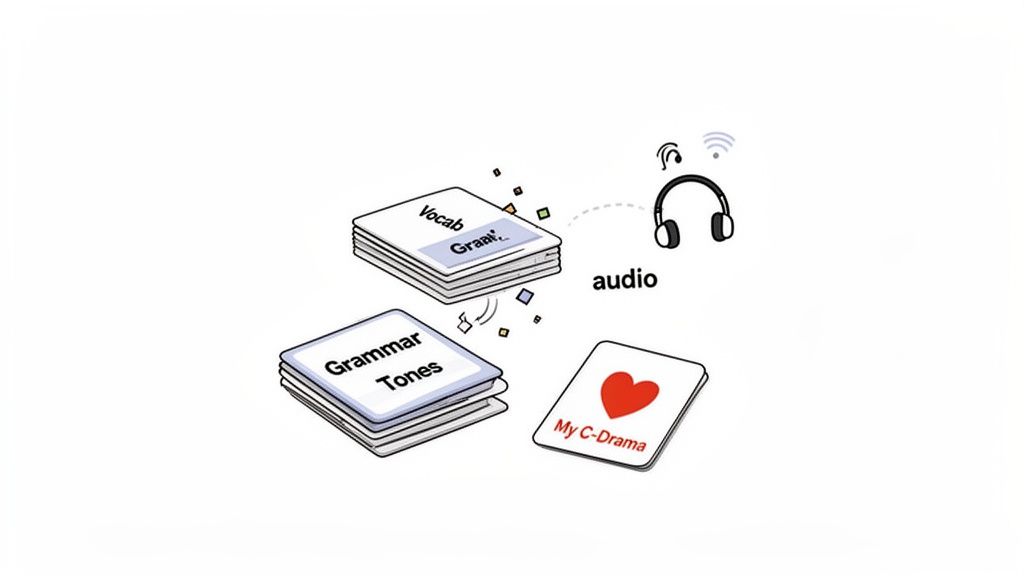
This means shifting from a linear, predictable study path to something more dynamic. By mixing up what you study, you force your brain to work a bit harder to retrieve information. Paradoxically, this makes that information stickier and easier to recall when you actually need it in a real conversation.
Embrace the Power of Interleaving
Interleaving is just a fancy term for mixing different topics or types of problems into a single study session. So, instead of hammering one grammar point until you've mastered it, you intentionally switch between several. You might review five flashcards on measure words, then jump to five on time expressions, and finish with five on food vocabulary.
Honestly, this method feels harder in the short term. But the research is clear: it leads to significantly better long-term retention. It forces your brain to constantly load and reload different mental models, which strengthens your ability to tell the difference between similar concepts—a crucial skill for navigating the subtleties of Mandarin.
It’s a powerful way to build a more robust and adaptable understanding of the language.
Prioritise High-Quality Audio for Tones
For Mandarin, audio isn't an optional extra; it's absolutely essential. The tonal nature of the language means getting the pronunciation wrong can completely change the meaning of a word. Relying on Pinyin alone is a classic mistake that can lead to ingrained pronunciation errors that are incredibly difficult to fix later on.
Every single one of your flashcards should have crystal-clear, native audio attached. Make it a habit to listen to the audio every single time you review a card, even if you think you know it. Mimic the pronunciation out loud to train your muscle memory alongside your cognitive recall.
Mandarin Mosaic's lifelike audio ensures you're always hearing the correct tones and intonation, making it a non-negotiable part of your practice. This constant exposure tunes your ear to the music of the language.
Make It Personal with Custom Decks
The most memorable learning is always tied to your personal interests. If you love watching C-dramas or reading Chinese web novels, use them! Create custom flashcard decks based on sentences you encounter in content you genuinely enjoy. This personal connection makes the vocabulary and grammar points far more meaningful and, as a result, much easier to remember.
This approach is incredibly effective. Learning platforms focused on Chinese are moving toward this contextual, interest-driven model. Integrating spaced repetition systems has been shown to boost retention significantly, and this personalised approach makes the whole process even stickier.
To go deeper on various advanced learning strategies and techniques, checking out resources from other learning platforms can offer some valuable perspectives. And for a specific technique that works brilliantly with sentence cards, take a look at our guide on using cloze tests for learning Chinese.
Common Mandarin Flash Card Mistakes and How to Fix Them
Even the most powerful study tools can go wrong if you don't use them correctly. With flash cards, it's surprisingly easy to fall into habits that feel productive but are secretly slowing down your progress in Mandarin. Figuring out what these common pitfalls are is the first step to building a system that actually sticks for the long haul.
A lot of learners end up accidentally sabotaging their own efforts. By spotting these patterns, you can make a few simple tweaks that will seriously improve your recall and make your study time so much more valuable.
Creating Overly Complex Cards
One of the biggest mistakes is cramming way too much information onto a single flash card. When you make a card with multiple new words, a fiddly grammar point, and a long translation, your brain just doesn't know where to look. It becomes an exercise in decoding the card itself rather than actually learning the new concept.
This is where the 'one new word' principle is your best friend. By making sure each sentence card introduces just a single unknown element, you create a focused, manageable learning task. Your brain can easily lock onto and absorb the new information from the context you already get.
The Fix: Stick to the 'i+1' rule religiously. The front of your card should be a simple Mandarin sentence, and the back should give you just enough context for that one new word. Mandarin Mosaic’s system handles this for you by highlighting the single new word in blue, keeping your focus exactly where it needs to be.
Memorising the Card, Not the Concept
Ever seen a flash card and known the answer in a split second, only to draw a complete blank when you hear the word out in the wild? That happens when you’ve memorised the card—its specific font, layout, or phrasing—instead of truly internalising what the word means.
To get around this, you have to mix up the context and actively test yourself in different ways. Your goal is to build a flexible understanding you can actually use in a real conversation, not just during your review sessions.
Here are a few ways to break out of this trap:
- Say it Aloud: Always speak the sentence out loud when you review it. This pulls in your auditory memory and gets your pronunciation muscles working.
- Create Your Own Sentence: After you nail a word, try to quickly make up a new, simple sentence with it. This is the ultimate test to see if you really understand how it's used.
- Reverse the Test: Every now and then, look at the English translation and try to produce the full Mandarin sentence from scratch.
Failing to Be Consistent
Consistency is the engine that drives any good memory-building strategy, especially one built on spaced repetition. Skipping a few days of reviews might not feel like a huge deal at the time, but you're letting the forgetting curve win. Your review queue will quickly snowball into an intimidating mountain, making it even tougher to get back into the swing of things.
The fix is to make your review habit small and sustainable. Forget about heroic two-hour sessions once a week; aim for ten minutes every single day. Using an app with cloud sync means your reviews are always there for you, whether you’ve got five minutes on the bus or a fifteen-minute coffee break. The key is to make it an automatic part of your daily rhythm.
Your Questions on Mandarin Flash Cards Answered
Getting started with a new study method always kicks up a few questions. As you begin weaving sentence-based flash cards into your Mandarin learning, you'll probably run into some common queries. Getting straight answers can help you stay on track and really get the most out of your time.
Below, I've tackled the most frequent questions learners ask about using flash cards for building long-term memory in Chinese. These tips come from experience and are designed to help you dodge common pitfalls and build a solid, effective routine right from the get-go.
How Many New Mandarin Flash Cards Should I Learn Each Day?
There's no single magic number here, but a sustainable and seriously effective goal for most learners is 10 to 20 new sentence cards per day. The real key is consistency, not cramming. Think about it: learning 10 new words in context every single day is far more powerful for your long-term memory than trying to brute-force 100 into your brain once a week.
Remember, your daily review load will naturally grow over time as the Spaced Repetition System (SRS) brings older cards back for you to reinforce. Starting with a manageable number of new cards is absolutely crucial. It's how you build a habit that actually sticks without leading to burnout.
The goal isn't to see how many cards you can blast through, but how many you can truly internalise. A steady, daily input of 10-20 new contextual sentences will build a formidable vocabulary over time.
Are Digital Flash Cards Better Than Paper Cards for Chinese?
For a language as nuanced as Mandarin, digital flash cards have some massive, undeniable advantages. While the charm of physical cards is nice, the practical benefits of a digital system are just too good to ignore if you're serious about learning Chinese.
Here’s why they come out on top for Chinese:
- Integrated Audio: You simply can't learn Mandarin without mastering the tones. Digital cards can embed crystal-clear, native audio right into your reviews, which is a total game-changer.
- Automated SRS: A good digital system uses a Spaced Repetition System to automatically schedule your reviews. This takes all the guesswork out of what to study and when, ensuring you're always working on what your brain needs most to remember.
- Unmatched Convenience: Little things like a one-tap dictionary, highlighting unknown words, and syncing across all your devices are just impossible with paper.
While paper cards can be fun for some occasional practice, the sheer efficiency and power of a dedicated digital system make it the superior choice.
Can I Become Fluent in Mandarin Just by Using Flash Cards?
Contextual sentence flash cards are an incredibly powerful tool. They are the engine for your memory, helping you internalise the thousands of words and grammatical patterns that form the very foundation of fluency.
However, they are one tool in the toolbox, not the entire workshop. To reach true fluency, you have to combine that knowledge-building with other forms of active practice. Think of flash cards as your training ground—they get you fit for the real world. You also need to be actively listening to podcasts, watching TV shows, speaking with language partners, and doing lots of reading. It's this combination that turns memorised knowledge into an active, usable skill.
Ready to build a smarter, more effective Mandarin study habit? Mandarin Mosaic automates the entire sentence mining process, so you can focus on what matters most: learning. Experience the power of contextual flash cards with lifelike audio and an intelligent SRS today. Discover more at https://mandarinmosaic.com.