 Mandarin Mosaic
Free on iPhone, iPad and Android.
Download on theApp Store Get it onGoogle PlayYour first month of Premium is free.
Family in Chinese: Words for Family Members and Relatives
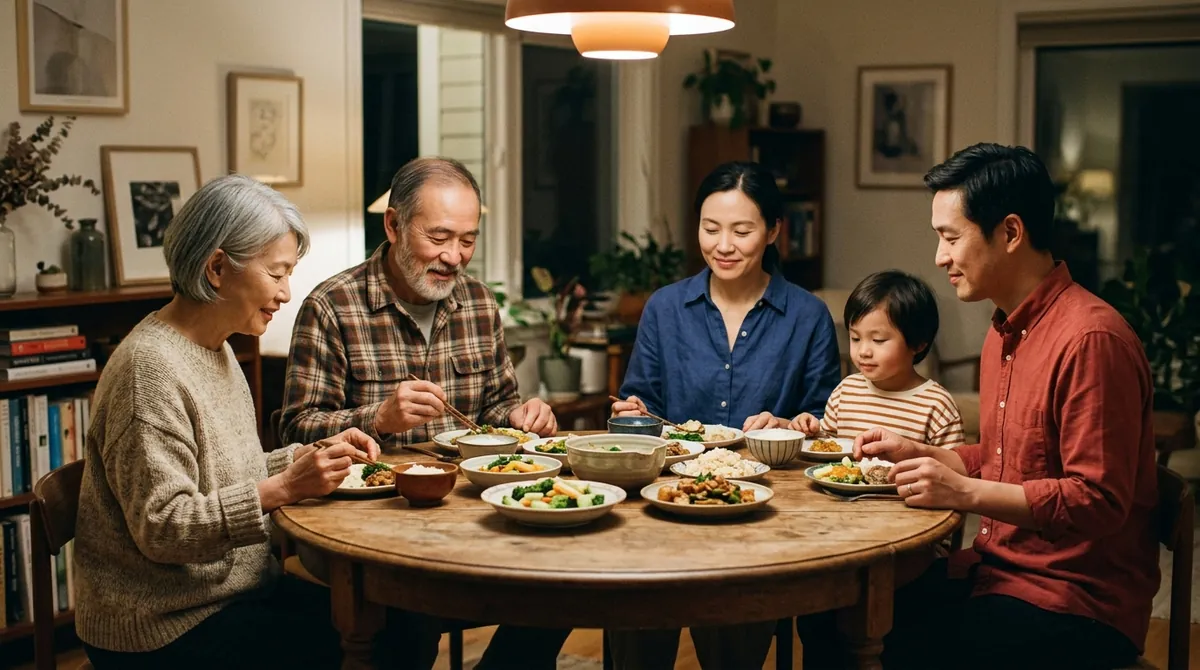
When you start learning about family in Chinese, you’re not just memorising words. Family terms shape how people address each other every day, from relatives to friends’ parents. It all starts with one word.
Understanding Family Beyond Translation
The first and most important word to grasp is 家 (jiā). This single character carries a rich, warm meaning that goes far beyond a simple translation. Think of it not just as your ‘family’, but as your home—the physical and emotional space where you truly belong.
The character itself tells a story. It’s a combination of a ‘roof’ (宀) and a ‘pig’ (豕). The usual explanation is that in ancient China, keeping pigs was a sign of a settled household, so a pig under your roof meant a home.
家 (jiā), 家人 (jiārén) and 家庭 (jiātíng)
As you get a little further into your Chinese studies, you’ll bump into two related terms: 家人 (jiārén) and 家庭 (jiātíng). All three are about family, but they’re used differently, and learning the difference is a big step towards sounding more natural.
家 (jiā): This is the personal, warm, and emotional word. It’s what you use when talking about your home, your household, or your family in a close, intimate sense. For example, if you're heading home, you say 我回家 (wǒ huí jiā).
家人 (jiārén): This means ‘family members’, the people in your family. For example, 我很想我的家人 (wǒ hěn xiǎng wǒ de jiārén) means “I really miss my family.”
家庭 (jiātíng): This term feels more formal and sociological. It refers to the ‘household’ or ‘family’ as a social unit. You'll see it used in formal writing, news reports, or when discussing concepts like “family background” (家庭背景, jiātíng bèijǐng).
Getting this distinction right is your first win. 家 (jiā) feels personal and warm, whereas 家庭 (jiātíng) is more neutral and is often used when talking about families in general. It's the difference between talking about "my family" and "the family unit."
Words for Your Immediate Family
Now that you've got your head around 家 (jiā) and 家庭 (jiātíng), it's time to get practical and learn the words you'll use to talk about your immediate family. These are the terms you’ll hear and say constantly.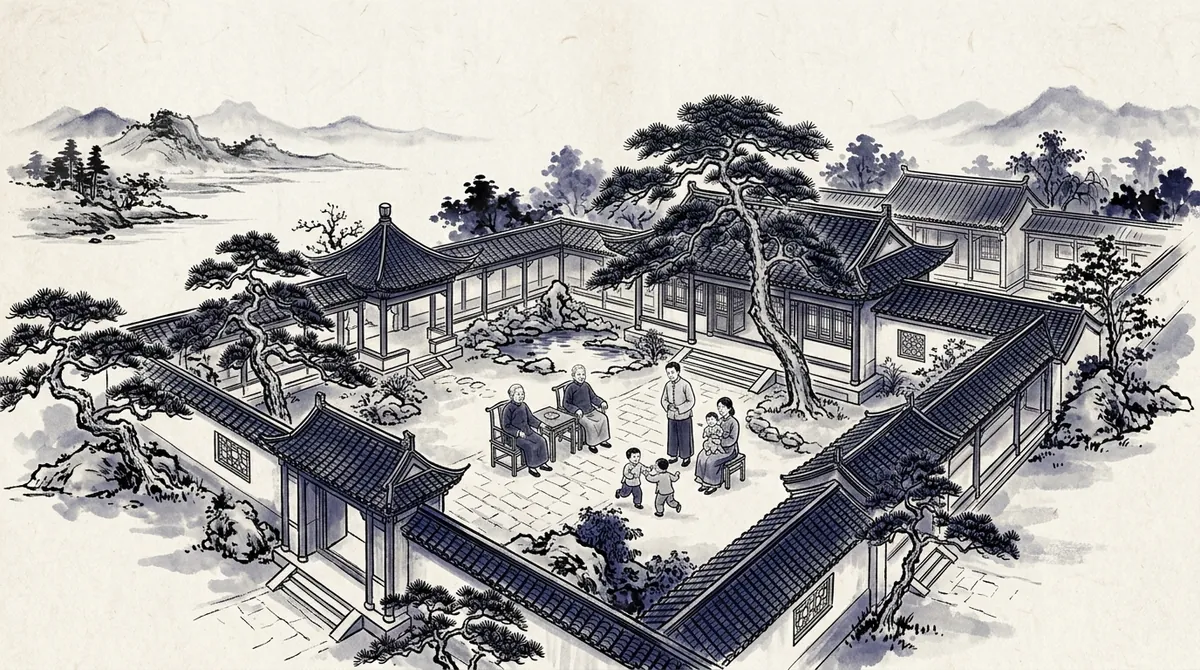
Parents and Siblings: The Core Six
First things first, let’s cover the people closest to you. In Chinese, there’s a collective word for parents: 父母 (fùmǔ). It’s a bit more formal, like the English term 'parents', but incredibly useful to know.
When you're talking about them individually in a casual way, you'll use these:
- 爸爸 (bàba) - Dad
- 妈妈 (māma) - Mum
These are the default, everyday terms you’ll hear kids and adults alike using. For example, if you want to introduce your mum, you'd say: 这是我妈妈 (zhè shì wǒ māma), which simply means, "This is my mum." With close family, the 的 (de) in 我的 (wǒ de, ‘my’) is usually dropped. The more formal words 父亲 (fùqīn, father) and 母亲 (mǔqīn, mother) appear mainly in writing and formal speech.
Now, for your siblings. This is where Chinese gets a bit more specific. There is a collective word for siblings, 兄弟姐妹 (xiōngdì jiěmèi), but for an individual brother or sister you normally say whether they're older or younger. It might seem like an extra detail, but it’s part of showing respect and getting the family order right.
Here are the four terms you need to lock in:
- 哥哥 (gēge) - Older brother
- 弟弟 (dìdi) - Younger brother
- 姐姐 (jiějie) - Older sister
- 妹妹 (mèimei) - Younger sister
All four are the same syllable said twice, with the second one in a light, neutral tone. The words for younger siblings, 弟弟 (dìdi) and 妹妹 (mèimei), both start with a sharp, falling fourth tone, which is a handy memory hook. The older ones differ: 哥哥 (gēge) starts with a high, flat first tone and 姐姐 (jiějie) with a low third tone.
这是我哥哥 (zhè shì wǒ gēge). This is my older brother. This simple structure, "zhè shì wǒ [family member]," is a handy template. You can swap in any family member to make a new sentence.
Once you’ve got these six core words down (parents and the four sibling types), you've built a solid foundation for introducing the people closest to you.
Immediate Family Members in Chinese
To make things even clearer, here's a quick-reference table with the essential terms for your immediate family. It's perfect for a quick review or when you're building your first flashcards.
| English Term | Chinese Character | Pinyin (with Tones) | Simple Usage Note |
|---|---|---|---|
| Dad | 爸爸 | bàba | The most common, everyday term. |
| Mum | 妈妈 | māma | Just like 'Dad', this is the standard term. |
| Older Brother | 哥哥 | gēge | Always use for a brother older than you. |
| Younger Brother | 弟弟 | dìdi | Always use for a brother younger than you. |
| Older Sister | 姐姐 | jiějie | The correct term for any sister older than you. |
| Younger Sister | 妹妹 | mèimei | The correct term for any sister younger than you. |
Keep this table handy as you practise.
Navigating the Chinese Kinship System
If you’ve ever felt completely overwhelmed by the sheer number of Chinese words for 'aunt' or 'uncle', you're definitely not alone. What first looks like a confusing web of terms is actually an incredibly logical and precise map of your family relationships. This system organises family with an elegance that reflects deep-seated cultural values.
The Logic Behind the Labels
The Chinese kinship system identifies relatives based on three key factors. Once you get your head around these principles, the whole structure clicks into place and the vocabulary starts to make perfect sense.
- Paternal vs. Maternal Lineage: The most critical distinction is whether a relative comes from your father’s side or your mother’s side. The two sides of the family almost always have completely different sets of terms.
- Generation: A relative's generation in relation to you—like your parents' generation or your own—determines the base term you'll use.
- Age and Gender: Within a generation, the titles often change based on whether the person is older or younger than your parent, as well as their gender.
For example, you don't just have one 'grandmother'. You have a 奶奶 (nǎinai), who is your father's mother, and a 外婆 (wàipó), your mother's mother. That character 外 (wài), meaning 'outside', is a common flag for your maternal side, showing they are outside the traditional paternal line.
- 爷爷 (yéye) - father's father
- 奶奶 (nǎinai) - father's mother
- 外公 (wàigōng) - mother's father
- 外婆 (wàipó) - mother's mother
In northern China, many people call their mother's parents 姥爷 (lǎoye) and 姥姥 (lǎolao) instead of 外公 and 外婆. Both pairs are correct; which one a family uses depends on where they're from.
This precision is deeply embedded in the culture, reflecting the traditional importance placed on family structure and lineage. In Chinese society, the family unit is a cornerstone, and these specific kinship terms are a living part of that.
Uncles, Aunts, and Cousins Explained
Let’s apply this logic to the notoriously complex terms for uncles and aunts. On your father's side, his brothers are distinguished by age.
- 伯伯 (bóbo) or 伯父 (bófù): Your father’s older brother.
- 叔叔 (shūshu): Your father’s younger brother.
On your mother's side, though, there's just one term for her brothers, no matter their age: 舅舅 (jiùjiu). Aunts work in a similar way:
- 姑姑 (gūgu): Your father’s sister.
- 阿姨 (āyí) or 姨妈 (yímā): Your mother’s sister. Some families simply say 姨 (yí), often with a number, such as 二姨 (èr yí), your mother's second sister.
Cousins follow the same split. Children of your father's brothers are 堂 (táng) cousins, who traditionally share your surname: 堂哥 (tánggē) is an older male cousin on that side. All other cousins are 表 (biǎo) cousins, such as 表姐 (biǎojiě), an older female cousin. If you're curious about how surnames pass down, see our guide to the most common Chinese surnames.
Realising that Chinese kinship terms are a formula—combining lineage, generation, age, and gender—transforms them from a list to be memorised into a system to be understood. Once you grasp the rules, you can often predict the correct term.
This logical framework extends to all your relatives, creating a clear map of your extended family. To look up any relative, from your grandfather's younger brother to your wife's sister's husband, try our Chinese relatives calculator, which gives each term with pinyin and audio.
Practical Sentences for Real Conversations
Knowing the vocabulary for family members is a great start, but the real magic happens when you start using those words in actual conversations. It's time to move from theory to practice and see how these terms fit into the flow of everyday Mandarin.
Let’s put it all together with some common questions and answers you’re likely to hear.
Asking About Family
One of the first questions you’ll probably be asked when making new friends is about your family size. There's a classic, go-to phrase for this.
你家有几口人? (nǐ jiā yǒu jǐ kǒu rén?) How many people are in your family?
You’ll notice the measure word 口 (kǒu), which literally means 'mouth'. It’s used for counting the members of a household, and is often explained as counting 'mouths to feed'.
Answering is just as straightforward:
- 我家有四口人。(wǒ jiā yǒu sì kǒu rén.) – There are four people in my family.
From there, you can easily list who they are:
- 爸爸、妈妈、哥哥和我。(bàba, māma, gēge hé wǒ.) – Dad, Mum, my older brother and me.
Notice that 和 (hé, ‘and’) goes only before the last item, and joins nouns. Our guide to how to say ‘and’ in Chinese explains when to use other words instead.
These question-and-answer pairs are perfect for sentence mining. When you use an app like Mandarin Mosaic, you absorb these structures naturally by seeing them in a complete, meaningful context.
Describing Your Family Members
After the initial introductions, you might want to share a little more about your family, like what they do for a living or where they are. These sentence patterns are incredibly useful.
To talk about their jobs:
- 我姐姐是医生。(wǒ jiějie shì yīshēng.) – My older sister is a doctor.
- 我弟弟是学生。(wǒ dìdi shì xuésheng.) – My younger brother is a student.
To say where they live:
- 我奶奶住在上海。(wǒ nǎinai zhù zài shànghǎi.) – My paternal grandmother lives in Shanghai.
- 我外公外婆跟我们住在一起。(wǒ wàigōng wàipó gēn wǒmen zhù zài yìqǐ.) – My mum's parents live with us.
One more useful word is 子女 (zǐnǚ), ‘sons and daughters’ or ‘children’. You'll often hear it in 独生子女 (dúshēng zǐnǚ), ‘only child’. Under the one-child policy (from 1980 until two children were allowed nationally from 2016), many families, especially in cities, had just one child, although the rules varied and there were exceptions. Many people from that generation have no brothers or sisters, so cousins can feel like siblings, and an older cousin is often simply called 哥哥 or 姐姐.
Avoiding Common Cultural Mistakes
Getting family vocabulary right in Chinese is more than a memory game. It’s also about the cultural rules that give those words their meaning. Get the etiquette right and you’ll sound more natural and show respect.
One of the biggest rules is how you address people. In English, you might call a friend’s dad "Mr. Smith." In China, you'd almost never use an elder's name directly. Instead, you use their title. A friend’s father is 叔叔 (shūshu) and their mother is 阿姨 (āyí). Using these titles isn't just polite; it's a fundamental sign of respect.
This same principle applies within your own family. As we've seen, you normally distinguish between an older brother, 哥哥 (gēge), and a younger one, 弟弟 (dìdi), because age order within the family matters.
When Family Terms Are Used for Friends
Here's where things get interesting. The lines around 'family' are surprisingly flexible and often stretch to include close friends. It’s very common to use family terms to show closeness and affection to people who aren’t related to you at all.
For example, a close male friend who is older than you can be affectionately called 大哥 (dàgē), which literally means 'eldest brother'. This single term packs in a huge amount of respect and camaraderie. In the same way, you might call an older female friend 姐姐 (jiějie).
This habit reveals a key cultural insight: the idea of 'family' can be a much wider, more inclusive circle of trusted people. It’s not something strictly defined by blood.
By using terms like 大哥 (dàgē) or 姐姐 (jiějie) with friends, you aren't just being friendly. You are signalling that you see them as part of your inner circle, a gesture that builds strong personal connections.
Key Etiquette to Remember
To help you feel more confident, here are a few practical tips to keep in mind when talking about or to someone's family. These small adjustments can make a huge difference in how you're perceived.
- Always use titles for elders: Address your friend's parents as 叔叔 (shūshu) and 阿姨 (āyí). Never jump to their given names unless you're specifically invited to.
- Acknowledge the age hierarchy: When you talk about siblings, always use the correct term for older versus younger (哥哥/姐姐 vs. 弟弟/妹妹).
- Embrace flexible terms for friends: Close, older friends can be called 大哥 (dàgē) or 哥 (gē) for men and 姐 (jiě) or 姐姐 (jiějie) for women. It’s a good way to show warmth and familiarity once you know someone well.
These cultural points matter just as much as the vocabulary itself. The way Chinese speakers express affection within families can also be quite subtle, and you might find our guide on different ways to say "I love you" in Mandarin an interesting read.
Frequently Asked Questions About Chinese Family
As you get to grips with Chinese family vocabulary, you’ll naturally run into a few common questions. Let's clear up some of the usual sticking points and help you navigate the cultural side of things with a bit more confidence.
Why Are There So Many Different Words for Relatives?
This is often the first big surprise for learners. The sheer number of words exists because Chinese kinship terms are incredibly precise. They map out a person's exact relationship based on their lineage (paternal vs. maternal side), their gender, and their age relative to you or your parents.
For example, your dad’s older brother is your 伯伯 (bóbo), but his younger brother is your 叔叔 (shūshu). This reflects a culture that has traditionally valued clear family roles and age order. Once you understand the logic, that long list of words starts to feel like a predictable system.
How Do I Address My Friend's Parents?
When you meet a friend's parents, it's polite to use respectful titles rather than their names. You should call their father 叔叔 (shūshu) and their mother 阿姨 (āyí).
Think of these as polite, all-purpose titles for any adult who is roughly your parents' age. Using them shows respect and helps create a friendly, familiar vibe right from the start.
A simple rule of thumb: always default to titles for your elders. Calling someone older than you by their first name can come across as disrespectful, unless they’ve specifically invited you to do so.
What's the Difference Between 家 (jiā) and 家庭 (jiātíng)?
While both words translate to 'family', they have quite different vibes.
家 (jiā) is the word you'll use most. It’s warm and personal, meaning 'home' or 'family' in an intimate, emotional sense. It’s about the feeling of belonging. You’d say 我回家 (wǒ huí jiā), which means "I'm going home."
家庭 (jiātíng) is more formal and neutral. It refers to the 'household' or 'family' as a social unit. You'll see this in writing or formal discussions, like in the term 家庭背景 (jiātíng bèijǐng), which means 'family background'.
A good way to think about it is that 家 (jiā) is where the heart is, while 家庭 (jiātíng) is the box you'd tick on a census form.
Is Sentence Mining Good for Learning These Terms?
Yes, absolutely. Sentence mining is perfect for getting your head around complex vocabulary like Chinese kinship terms. Instead of just trying to brute-force a list into your brain, you learn each word in a complete, meaningful context.
For example, you could learn 舅舅 (jiùjiu) (mother's brother) with a full sentence like: 我舅舅住在伦敦 (wǒ jiùjiu zhù zài lúndūn) – "My maternal uncle lives in London."
This approach helps the words stick by creating much stronger mental connections. Pair this technique with a spaced repetition system (SRS), and you'll move these terms into your long-term memory without dull drills. Our post on sentence mining for Chinese explains how to get started.
Ready to stop memorising lists and start learning words in context? Mandarin Mosaic is designed for exactly that. Our app uses sentence mining and spaced repetition to help you build vocabulary and grammar intuition naturally. Try Mandarin Mosaic free for 30 days.