 Mandarin Mosaic
Free on iPhone, iPad and Android.
Download on theApp Store Get it onGoogle PlayYour first month of Premium is free.
Duolingo Chinese Alternatives: 9 Apps for What It Misses

The best Duolingo alternative for Chinese depends on what Duolingo isn't giving you. For a Chinese-only course that teaches handwriting and explains grammar, switch to HelloChinese, or SuperChinese for a syllabus mapped to the HSK. To learn words in real sentences and start reading, use Mandarin Mosaic. To practise speaking with feedback on every tone, use Chunking Chinese or a tutor. Many learners keep Duolingo for the daily habit and add one of these for the part it misses.
A word on bias: Mandarin Mosaic is our app, and Chunking Chinese is our sister app. We've included them because they fill two of Duolingo's biggest gaps, and every entry says where Duolingo (or another app) is the better choice. Prices are from the UK App Store and the apps' own sites at the time of writing.
Which Duolingo Alternative Do You Need?
| If you want | Try | Cost at the time of writing |
|---|---|---|
| Vocabulary in real sentences, and graded reading | Mandarin Mosaic | 30-day free trial, then a free plan or Premium from £7.92 a month |
| Speaking practice with feedback on every tone | Chunking Chinese | 7-day free trial, then $30 a month |
| A Chinese-only course with handwriting and grammar notes | HelloChinese | Free core lessons; Premium from £9.99 |
| A structured course up to HSK 5 | SuperChinese | PLUS from £11.99 a month |
| Clear grammar explanations | LingoDeer | £14.99 a month or £99.99 a year |
| Graded stories to read | Du Chinese | Some free lessons; about £13 a month |
| Writing characters by hand | Skritter | Some free decks; from £9.99 a month |
| Audio lessons for the commute | Pimsleur | About £19 a month |
| Real conversation with a person | A tutor on italki or Preply | Often $10–40 an hour |
What Duolingo Does Well, and Where It Falls Short for Chinese
Duolingo is good at what it's built for. It's free, it makes a daily habit easy, and it introduces pinyin, tones and your first characters gently. Since April 2026 its Chinese course runs all the way to CEFR level B2, and it has Stories and DuoRadio for listening practice. If you're enjoying it and still learning from it, there's no rush to stop.
For Chinese in particular, though, it leaves some gaps:
- You recognise characters but don't write them. Exercises have you match and choose characters. We couldn't find any handwriting or stroke-order practice in the Chinese course.
- Grammar is taught by example. You pick up patterns from repeated sentences, with little explanation up front. Duolingo's April 2026 update added its Explain My Answer feature to the expanded courses, Chinese included, but that explains a mistake after you make it rather than teaching the rule first.
- Speaking is marked loosely. Because Chinese has so many words that sound alike, Duolingo says it marks speech by sound: if you say tā, "any character whose pronunciation is close enough will be considered a match". That's kind to beginners, but it doesn't give you tone-by-tone feedback. Video Call, its AI conversation feature, needs Duolingo Max and, for Chinese, an iPhone at the time of writing.
- Simplified characters only. There's no Traditional option for Mandarin (see what Duolingo Chinese teaches).
- No longer reading. Reading stays inside the course's short sentences, dialogues and Stories. There's no library of longer texts at your level.
- An unclear finish line. Duolingo's only HSK claim dates from 2017, and it hasn't said what HSK level the new B1 and B2 sections reach. Our post on what HSK level Duolingo gets you to looks at the evidence.
For the full picture, see our Duolingo Chinese review.
9 Duolingo Alternatives for Chinese

Each entry says what it does better than Duolingo, where Duolingo is still better, and what it costs. They're grouped by the gap they fill, so you don't need all of them: pick the one or two that match what you're missing.
1. Mandarin Mosaic: Vocabulary in Real Sentences, and Reading
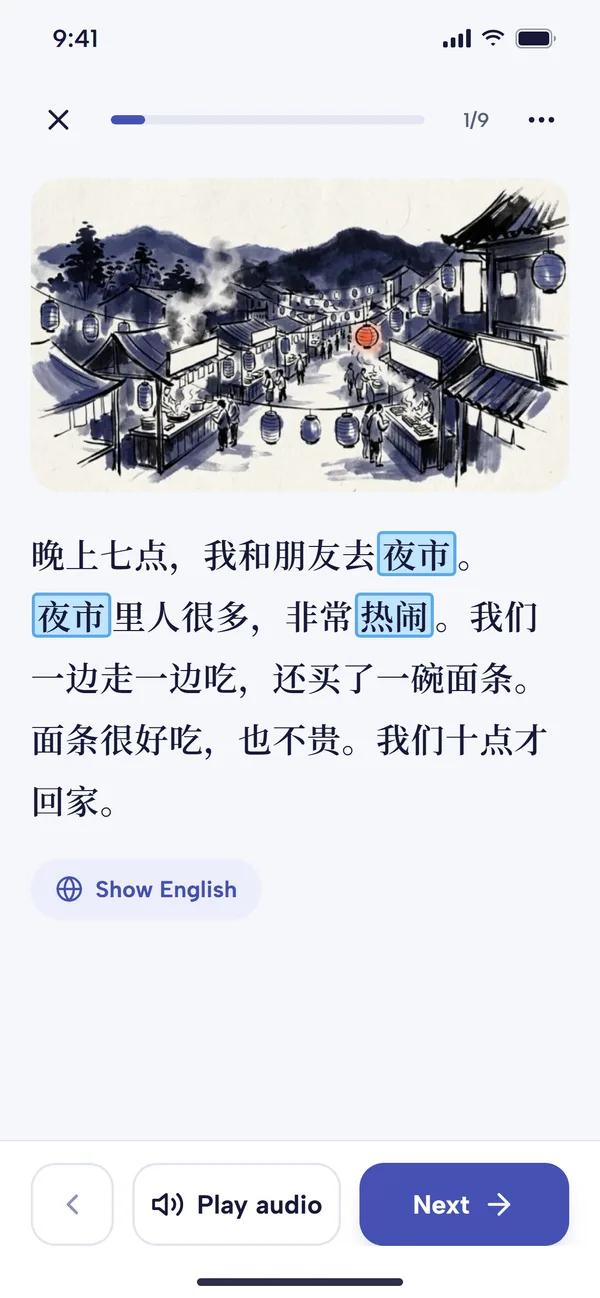
Mandarin Mosaic is our app, and it's built for the stage after a beginner course. It teaches through whole sentences that each contain one new word where possible, so every new word arrives with context you already understand. That's the sentence-mining method. Spaced repetition brings words back just before you'd forget them, and HSK-levelled lesson packs (HSK 1–6 and the new HSK 3.0 levels) give you a path to follow.
Its Chinese Articles reader goes where Duolingo stops: longer graded stories and news at your level, with the words you don't know yet highlighted and audio for every article. You can also import Anki decks or your own word lists.
- Better than Duolingo at: learning words in sentences you can understand, reading longer texts, and Traditional characters, which it supports alongside Simplified.
- Where Duolingo is better: games, streaks and leagues for motivation. Mandarin Mosaic also has no speaking exercises, no handwriting and no grammar lessons, and it's phone-only (iOS and Android).
- Best for: learners who've done the basics on Duolingo and want to build vocabulary and start reading.
- Price: a 30-day free trial, then a free plan with one lesson a day, or Premium from £7.92 a month billed yearly (£11.95 monthly).
Our Mandarin Mosaic vs Duolingo comparison goes into more detail.
2. Chunking Chinese: Speaking With Feedback on Every Tone
Chunking Chinese, our sister app, fills Duolingo's other big gap: actually saying things. It teaches reusable chunks, short phrases like 我想问一下 (wǒ xiǎng wèn yíxià, I'd like to ask), and has you combine them into sentences out loud. You get an English prompt, say the Chinese, and it checks what you said and scores the sound and tone of each character. Where Duolingo accepts anything that sounds close enough, Chunking Chinese highlights the syllables that drifted.
- Better than Duolingo at: producing whole sentences yourself, and precise feedback on your tones.
- Where Duolingo is better: it's free and suits complete beginners. Chunking Chinese assumes you know some pinyin and basic characters (it covers HSK 1–5) and doesn't teach reading or writing.
- Best for: learners who understand more than they can say.
- Price: a 7-day free trial, then $30 a month. New places open in small groups from a waiting list.
Read our Chunking Chinese review, or try the fluency trainer.
3. HelloChinese: The Closest Like-for-Like Switch
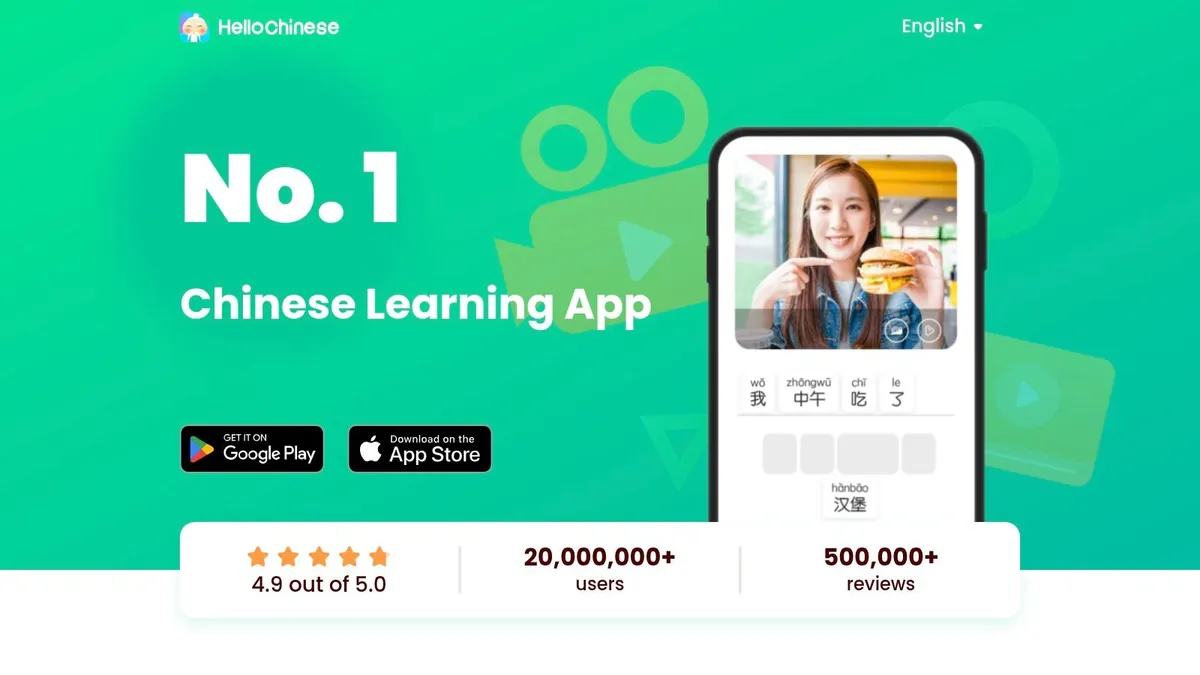
If you like Duolingo's style but want a course built only for Chinese, HelloChinese is the natural switch. It's still short, game-like lessons, but with grammar notes, handwriting practice, speech recognition that checks your pronunciation, and a course based on HSK levels. Its main course was rebuilt around the new HSK standard in 2025 and now runs to upper intermediate, with over 2,500 words. Premium+ adds graded stories and a characters course, and it supports both Simplified and Traditional characters.
- Better than Duolingo at: handwriting, grammar explanations, pronunciation feedback and Traditional characters.
- Where Duolingo is better: it's free all the way through, while HelloChinese's free lessons only go so far.
- Best for: beginners who want a gamified app that takes Chinese seriously.
- Price: free core lessons; Premium from £9.99 and Premium+ from £15.99 on the UK App Store, with cheaper longer plans.
| HelloChinese vs Duolingo | Duolingo | HelloChinese |
|---|---|---|
| Cost | Free, with ads and an Energy limit | Free core lessons; the full course needs Premium |
| Characters | Simplified only | Simplified or Traditional |
| Handwriting | None that we could find | Stroke-order practice |
| Grammar | Mostly by example | Notes in the lessons |
| Speaking | Marked by sound, loosely | Speech recognition with pronunciation feedback |
| Course length | To CEFR B2 | Built on the new HSK levels, beginner to upper intermediate (2,500+ words) |
4. SuperChinese: A Structured Course up to HSK 5
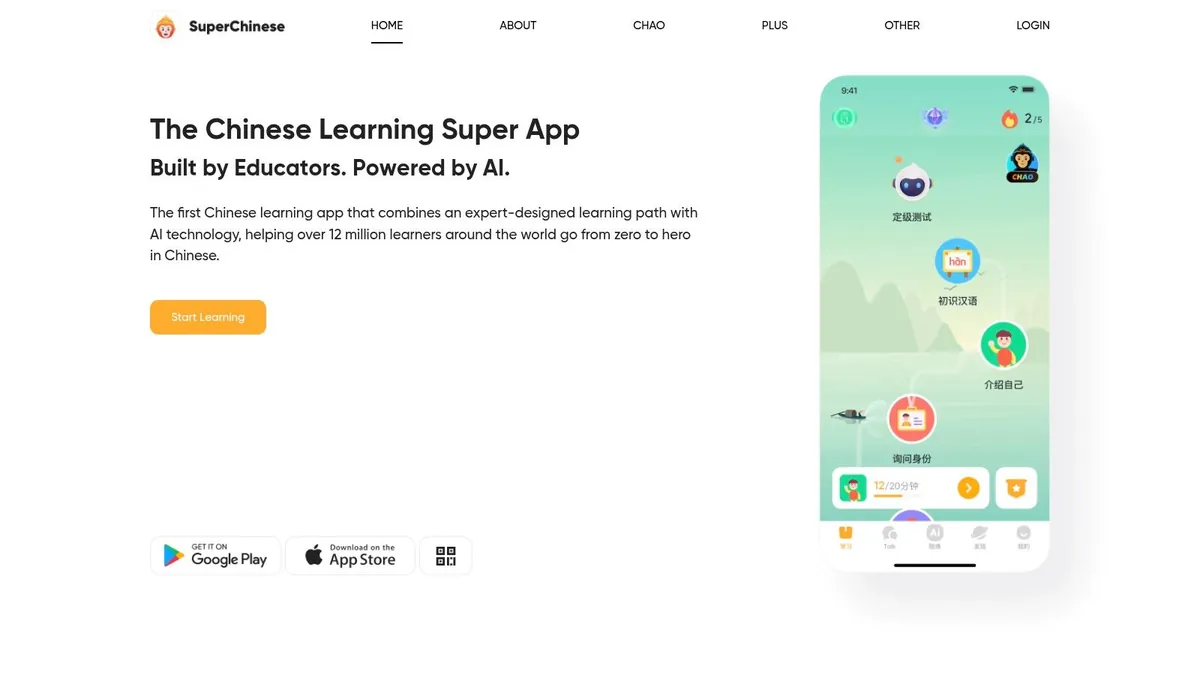
SuperChinese is another Chinese-only course, with a clearer syllabus than Duolingo: short lessons that it says take you from beginner to HSK 5, with AI feedback on your pronunciation. CHAO, its AI tutor for role-play conversations, is sold separately.
- Better than Duolingo at: a syllabus mapped to the HSK, grammar in context and pronunciation correction.
- Where Duolingo is better: cost. SuperChinese's free version is limited, and the AI tutor costs extra.
- Best for: learners working towards an HSK exam who want an app to follow.
- Price: PLUS from £11.99 a month on the UK App Store (cheaper yearly); the CHAO tutor from £23.49 a month.
5. LingoDeer: Clear Grammar Explanations
LingoDeer feels like Duolingo with the explanations added. Its lessons come with clear "Tips & notes" on grammar, so you learn why a sentence is built the way it is, and it has character-writing drills and stories. Its Chinese course is aimed at HSK 1–3.
- Better than Duolingo at: explaining grammar, and recorded audio from native speakers.
- Where Duolingo is better: it's free, and its course now goes further.
- Best for: beginners who like to understand the rules.
- Price: £14.99 a month or £99.99 a year on the UK App Store, with lifetime options; one subscription covers all its languages.
6. Du Chinese: Graded Stories to Read
Du Chinese is a library of over 3,000 short graded readings, from Newbie to Master level, each with audio, tap-to-translate and grammar notes. It's the easiest way to start reading real paragraphs instead of single sentences, and you can switch between Simplified and Traditional characters.
- Better than Duolingo at: reading longer texts, listening to natural audio, and Traditional characters.
- Where Duolingo is better: it's a course; Du Chinese is reading practice, so it won't teach you from scratch.
- Best for: learners with a few hundred words who want to read every day. Our guide to comprehensible input explains why that helps so much.
- Price: some lessons are free; subscriptions from about £13 a month on the UK App Store, less on longer plans.
The Chairman's Bao is a similar option built around graded news, from about £10 a month.
7. Skritter: Writing Characters by Hand
Skritter does one thing Duolingo doesn't do at all: you write each character on screen, stroke by stroke, and spaced repetition schedules your reviews. It has decks for every HSK level, including the new HSK 3.0, and supports Simplified, Traditional or both.
- Better than Duolingo at: handwriting and remembering how characters are built.
- Where Duolingo is better: everything else. Skritter doesn't teach grammar, listening or speaking.
- Best for: learners who want to write, or who keep mixing up similar characters. Our post on handwriting in Chinese covers stroke order.
- Price: some free decks; from £9.99 a month on the UK App Store, less on longer plans.
8. Pimsleur: Audio Lessons for Listening and Speaking
Pimsleur is the opposite of Duolingo's tap-and-match style: 30-minute audio lessons where you listen and answer out loud, which suits a commute or a walk. The Mandarin course has five levels of 30 lessons, which Pimsleur says takes you to high intermediate, plus about 100 reading exercises.
- Better than Duolingo at: listening, and getting you to answer out loud without looking at a screen.
- Where Duolingo is better: price, characters and variety. Pimsleur teaches very few characters and covers far less vocabulary per hour.
- Best for: learners with time to listen but not to look at a screen.
- Price: about £19 a month on the UK App Store; you can try a free lesson in the app, and Pimsleur's website offers a 7-day free trial. See our Pimsleur review.
9. A Tutor on italki or Preply: Real Conversation
No app replaces talking to a person. On italki or Preply you can book one-to-one lessons with a Mandarin teacher by video, at times that suit you. A good tutor corrects your tones, explains grammar when you get stuck, and gives you the real conversation practice Duolingo can't.
- Better than Duolingo at: conversation, corrections and anything you want to ask.
- Where Duolingo is better: cost, and practice whenever you have five spare minutes.
- Best for: anyone who wants to speak, once a week or so alongside an app.
- Price: italki says lessons with Chinese tutors typically cost $10–40 an hour. Preply tutors range from about £2 to over £30 per 50-minute lesson. Both offer trial lessons.
For free conversation practice, a language exchange is worth a try too.
Two Free Tools to Keep Alongside Any of Them
- Pleco is the standard Chinese dictionary app. The dictionary is free, and paid add-ons such as camera lookup and flashcards cost £9.99 each, or £29.99 for the Basic Bundle.
- Anki is free flashcard software on Windows, Mac, Linux, Android and the web (the iPhone app is £24.99). Our list of the best Chinese Anki decks will get you started. If Anki itself feels like hard work, see our Anki alternatives for Chinese.
How to Move On From Duolingo

You don't have to quit Duolingo to move on. What matters is which app does the main work:
- If you're in the early sections and enjoying it, keep going and add one thing it lacks: Pleco for looking up words, and either HelloChinese for handwriting or a weekly tutor for speaking.
- If you've finished the A2 sections, or the lessons feel easy but real Chinese doesn't, make something else your main study. Build vocabulary in sentences and start reading (Mandarin Mosaic, Du Chinese), and keep Duolingo for five minutes a day if the streak keeps you going.
- If you understand far more than you can say, your gap is speaking. Add daily speaking practice (Chunking Chinese, a tutor or Pimsleur) before adding more vocabulary.
Whatever you choose, keep the habit Duolingo gave you: the same time each day, little and often. If you've stalled after the beginner stage, our post on the intermediate plateau explains why it happens and what helps, and our full list of the best Mandarin learning apps compares 12 apps side by side.
Frequently Asked Questions
Is Duolingo Good for Learning Chinese?
It's good for getting started and for building a daily habit, and the course now goes up to B2. On its own, it's weak on handwriting, grammar explanations, tone feedback and longer reading, so most learners add at least one other tool. Our Duolingo Chinese review has the details.
Is There a Free Alternative to Duolingo for Chinese?
None of the apps here gives a whole course free, but you can get a long way without paying. HelloChinese's core lessons are free, Pleco's dictionary is free, Anki is free (except on iPhone), Du Chinese has free readings, and Mandarin Mosaic has a free plan with one lesson a day after its 30-day trial.
Is HelloChinese Better Than Duolingo?
For Chinese specifically, HelloChinese teaches more of what matters: handwriting, grammar notes, pronunciation feedback and Traditional characters. Duolingo is free all the way through. Many learners start on one and move to the other; see the comparison table above.
Can I Use Duolingo and Another App Together?
Yes, and it usually works best. Duolingo is good at the habit, so pair it with an app for the part it misses: reading and vocabulary, speaking, or writing. Just make sure the second app gets most of your time once Duolingo starts to feel easy.
What's the Best Duolingo Alternative for Traditional Chinese?
Duolingo's Mandarin course is Simplified only. Mandarin Mosaic, HelloChinese, Du Chinese and Skritter all support Traditional characters. Our guide to learning Traditional Chinese explains the differences.
Ready to go beyond Duolingo? Mandarin Mosaic teaches Chinese through real sentences with one new word at a time, with audio, graded articles and spaced repetition. At the time of writing, there's a 30-day free trial, then a free plan with one lesson a day, or Premium from £7.92 a month billed yearly (£11.95 monthly). Get it on iOS or Android.