Mastering communication with language: From Context to Real-World Mandarin
It’s a frustration every Mandarin learner knows well: you’ve crammed thousands of words into your brain, but when it comes to having a real conversation, you freeze. What gives? This happens because real communication isn’t just about having a big vocabulary; it’s about knowing how to put those words to work. Let's break down how to go from passively knowing words to actively using them with confidence.
Why Knowing 1000 Words Is Not Enough

Ever stood in a kitchen with a pile of amazing ingredients but no recipe? That’s what it feels like to know a ton of Mandarin words but be unable to string a decent sentence together. You’ve got all the parts, but you can’t quite figure out how to assemble them into something meaningful. This gap between knowing words and actually using them is where so many learners get stuck.
This isn't just a challenge for Mandarin learners; it’s a universal communication challenge. As the world becomes more interconnected, bridging communication gaps in any context has become a critical skill for everyone. The core issue remains the same: knowing the pieces is not the same as knowing how to use them effectively.
Moving Beyond Rote Memorisation
Traditional learning methods often hammer home the importance of memorising long vocabulary lists. And yes, building your word bank is crucial, but it's only the first step on a very long road. True fluency comes from grasping the unwritten rules of conversation—the context, the subtle meanings, and the natural back-and-forth.
The real measure of your Mandarin skill isn't how many words you can recall, but how well you can use them to get something done—whether it's asking for directions, sharing a joke, or making a new friend.
To get there, you need a system that connects what you know to what you can do. Just memorising words often leads to forgetting them almost as fast as you learn them. We've all been there. (If you want to know why this happens, check out our guide on the forgetting curve and how to beat it.)
The solution? Learn words in their natural habitat: the sentence. This way, you don't just internalise the word itself, but its function, its flavour, and how it fits into the real world. It’s the most direct path to genuine communicative skill in Mandarin.
Unlocking the Hidden Meaning in Mandarin
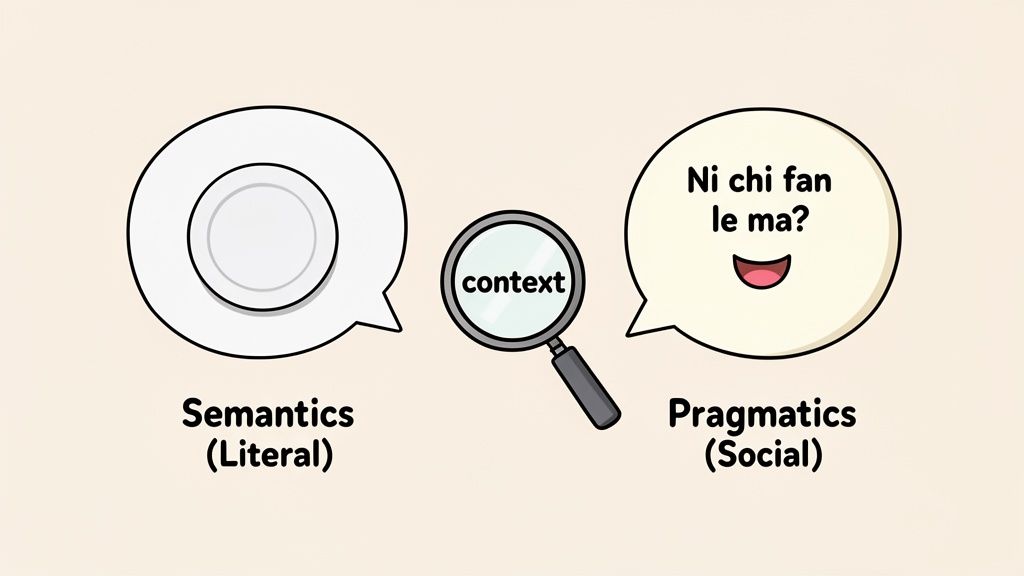
As you get deeper into your Mandarin journey, you’ll quickly realise that context is everything. Just knowing the dictionary definition of a word gets you only halfway there; you also need to understand the hidden social rules that guide how words are actually used. This is where we run into two core ideas that are vital for real communication: semantics and pragmatics.
Think of semantics as the literal, dictionary meaning of a sentence. It’s the “what.” Pragmatics, on the other hand, is all about the intended meaning behind the words. It's the “why” and “how” – the social intelligence that lets us figure out what someone really means.
It’s an interesting thought that even AI struggles with this stuff. The field of Natural Language Understanding (NLU) is all about teaching computers to interpret intent, which just goes to show how complex this is even for us humans.
The Difference Between Saying and Doing
In Mandarin, the gap between what is said and what is meant can feel massive. The exact same sentence can be a greeting, a question, or a complaint, all depending on the situation, who’s talking, and even their tone of voice. This is where a lot of learners get tripped up, leading to some pretty awkward interactions.
A classic example is the phrase 你吃饭了吗? (Nǐ chīfànle ma?).
- Semantics (Literal Meaning): “Have you eaten yet?” It's a direct question about food.
- Pragmatics (Intended Meaning): “How are you?” or simply “Hello.” It's a casual greeting, especially between friends or neighbours.
If you answer this by giving a detailed breakdown of your lunch, you'd be grammatically perfect but socially a bit strange. It shows you’ve got the semantics down but have missed the pragmatic cue, marking you as an outsider to the cultural context.
The key takeaway here is that language is an action. You're not just stating facts; you're performing social functions like greeting, apologising, requesting, or complimenting. Mastering pragmatics means learning how to perform these actions in a way that feels natural to native speakers.
To help illustrate this, let's look at a few common Mandarin phrases and see how their literal meaning differs from their real-world use.
Semantics vs Pragmatics in Mandarin Communication
| Mandarin Phrase | Literal Meaning (Semantics) | Contextual Meaning (Pragmatics) | What This Teaches Learners |
|---|---|---|---|
| 你吃饭了吗? (Nǐ chīfànle ma?) | Have you eaten yet? | A casual greeting, like "How are you?" or "Hey." | Greetings are often indirect and tied to showing care. |
| 慢慢吃 (Màn man chī) | Eat slowly. | "Enjoy your meal," said to someone who is eating. | Phrases of courtesy often sound like gentle commands. |
| 随便看看 (Suíbiàn kànkan) | Look around casually. | "Just looking, thanks," said to a shop assistant. | This is a polite way to decline help without saying "no." |
| 下次再说 (Xià cì zàishuō) | We'll talk about it next time. | A soft way of saying "no" or "I'm not interested." | Direct refusal can be seen as impolite; indirectness is preferred. |
As you can see, understanding the pragmatic meaning is essential for navigating everyday conversations and avoiding misunderstandings.
From Literal Meaning to Social Context
Getting a handle on this distinction is your first big step towards thinking more like a native speaker. It’s about training yourself to look beyond the words on the screen and start paying attention to the social situation they live in. Who is speaking? What’s their relationship? Where are they?
By noticing these contextual clues, you start to build an intuitive feel for the language. This is what helps you sidestep common blunders and get your own point across with more accuracy and nuance, making your conversations flow much more smoothly.
How to Build Conversations Instead of Just Sentences
Once you realise language is all about action and social context, the next logical step is to look at how sentences link together. Fluent communication isn't about trading single, isolated sentences back and forth; it's about weaving them into a coherent whole. Think of telling a story or sending a series of text messages that actually make sense. This is where two critical concepts come into play: discourse and register.
Simply put, discourse is how you connect ideas to form a larger piece of communication, like a conversation or an email. Register, on the other hand, is about tweaking your language to fit the social situation. Getting both right is what separates learners stuck reciting textbook dialogues from those who can navigate real, dynamic conversations in Mandarin.
Understanding Your Audience with Register
Imagine you need to ask for a small favour in Mandarin. How you phrase that request depends entirely on who you’re talking to. This social awareness is the very heart of register. In Chinese, this is often incredibly explicit, with different words and levels of politeness needed for different relationships.
Let's take a practical example. You need to borrow a pen.
- To a close friend (Informal): 你有笔吗?借我一下。(Nǐ yǒu bǐ ma? Jiè wǒ yīxià.) - "Got a pen? Lend me it for a sec." This is direct, casual, and perfectly normal between mates.
- To a respected professor (Formal): 老师,不好意思,请问您有笔吗?可以借我用一下吗?(Lǎoshī, bù hǎoyìsi, qǐngwèn nín yǒu bǐ ma? Kěyǐ jiè wǒ yòng yīxià ma?) - "Professor, excuse me, may I ask if you have a pen? Could I borrow it for a moment?" Here, you use formal terms like
您(nín) and polite phrases to show the proper respect.
Using the informal phrase with your professor wouldn't just be grammatically clumsy; it would be socially awkward, even rude. It shows that choosing the right words is about building relationships, not just spitting out information.
True communication happens when your words align with the social expectations of the moment. It’s about making the other person feel comfortable and respected, which is the foundation of any successful conversation.
To build conversations effectively, you need to do more than just talk; you have to listen well, too. Paying close attention to how others speak in different situations is a fantastic way to learn register naturally. For anyone looking to level up this skill, mastering active listening pays huge dividends in your Mandarin learning.
Weaving Sentences into Discourse
While register handles the social tone, discourse takes care of the logical flow. It’s the invisible thread connecting your sentences, making sure your conversation makes sense from start to finish. Think of it as the difference between a random list of facts and a well-told story where each part builds on the last.
The global importance of clear communication is immense. In a world where business, technology, and culture are increasingly interconnected, the ability to communicate effectively in a second language like Chinese opens up a vast number of personal and professional opportunities. The economic and social value of these skills is powerful, and mastering them begins with understanding how to build coherent discourse.
Using Sentence Mining to Develop Real Fluency
So far, we've talked about the theory behind what makes communication work—things like context, social cues, and the flow of a conversation are far more important than just memorising word lists. Now, it's time to bridge that theory with a powerful, hands-on method for learning Mandarin: sentence mining.
This technique is the perfect tool for the job because it teaches words in their natural habitat. Instead of learning a word like 打算 (dǎsuàn - to plan) in isolation, you learn it inside a complete, context-rich sentence like 我打算下个星期去北京 (Wǒ dǎsuàn xià ge xīngqī qù Běijīng - I plan to go to Beijing next week).
A single sentence like this does so much more than a traditional flashcard ever could. It teaches you the new word, reinforces grammar patterns (下个星期 for "next week"), and shows you exactly how a native speaker would use it. This is the whole idea behind apps like Mandarin Mosaic, which are built to develop this intuitive understanding from your very first lesson.
How Sentence Mining Builds Intuition
The process is brilliantly simple but incredibly effective. You find a sentence that has just one word you don't know. Because the other 99% of the sentence is already familiar, you can often figure out the new word's meaning from context alone—just like you would in a real conversation.
You then take this complete sentence, the "mined" item, and add it into a Spaced Repetition System (SRS). This is basically a smart flashcard system that knows exactly when you're about to forget something and shows it to you right then. This process pushes the entire language pattern from your short-term memory into your long-term memory. If this is new to you, our guide on the essentials of sentence mining is a great place to start.
This approach builds a deep, gut-level feel for Mandarin that memorising single words just can't touch. You aren't just learning vocabulary; you're internalising the real building blocks of speech.
From Sentences to Conversations
By focusing on whole sentences, you're directly practising the skills of discourse and register we covered earlier. Every sentence becomes a tiny piece of a potential conversation, already equipped with the right tone and structure.
You can see how these individual sentences stack up to build the skills you need for real-world conversation.
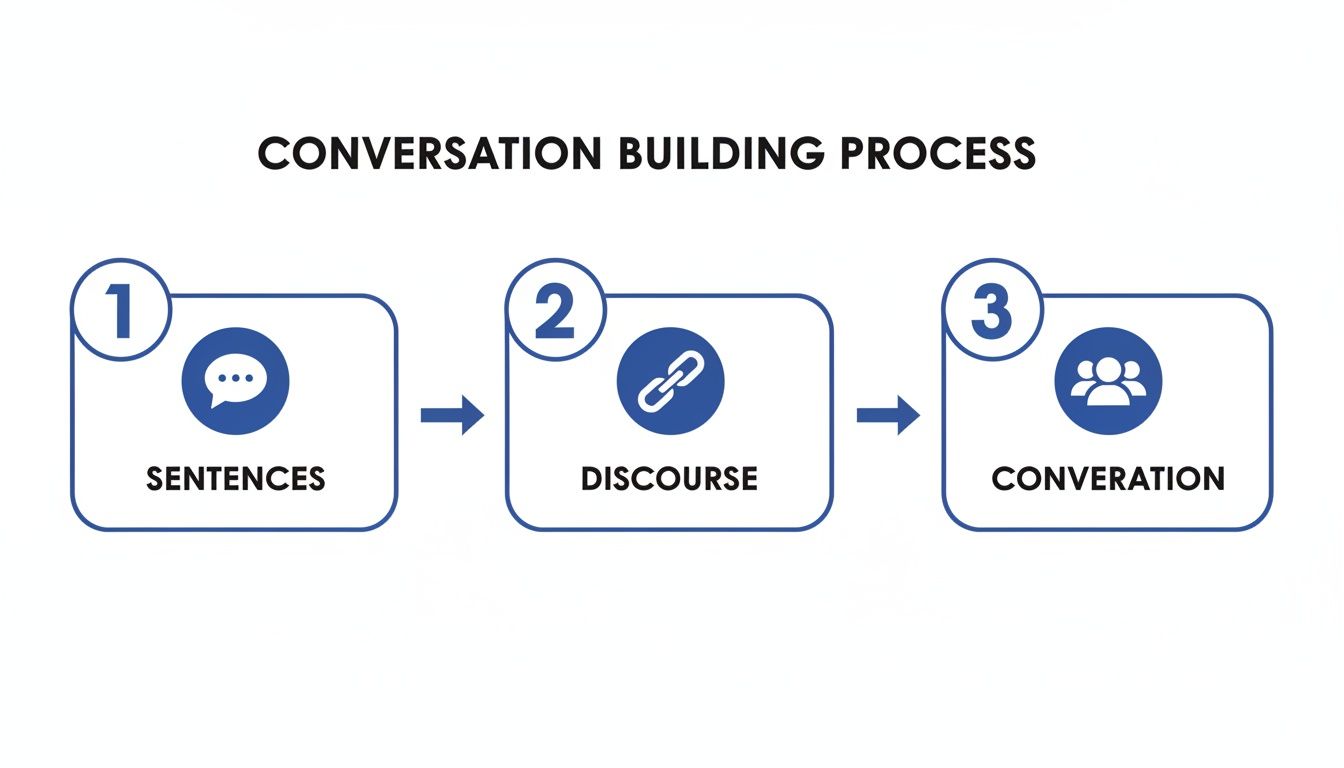
The flowchart shows it clearly: mastering individual sentences is the foundation. That allows you to connect ideas through discourse, which ultimately gets you to confident, natural conversations.
Sentence mining is the bridge between passive knowledge and active skill. It trains your brain to recognise and produce natural Chinese sentence patterns, making your speech sound less like a textbook and more like a native speaker.
Instead of translating word-by-word from your native language in your head, you start to think directly in chunks of Mandarin. This is a huge shift for any learner. It's the difference between building a car from scratch every time you want to drive versus just getting in and turning the key. Your brain learns to pull up entire phrases automatically, freeing up mental space to focus on what you actually want to say.
A Practical Guide to Your Mandarin Study Routine
Knowing the theory is one thing, but turning that knowledge into a consistent habit is where the real magic happens. So, let’s get practical and build a study routine around contextual learning that will transform your daily sessions into a powerful engine for Mandarin fluency.
This shift towards practical, communication-focused learning reflects a broader understanding of the value of language skills. There's a growing realisation that Mandarin is a tool for connection, not just another subject to pass an exam on. Embracing this mindset is the first step towards a more effective study routine.
Building Your Context-Focused Routine
To make this really work, your study time has to be active, not passive. Forget just memorising word lists. Your goal is to analyse, understand, and internalise how real sentences work out in the wild.
Here’s a simple, step-by-step way to approach it:
- Pick Your Source Material: Choose content you actually enjoy. It could be a Chinese TV show, a podcast you find interesting, or a book you can't put down. This keeps things engaging and gives you authentic examples of the language in action.
- Create Custom Sentence Decks: As you watch or listen, use an app like Mandarin Mosaic to "mine" sentences that have new words or interesting grammar. This builds a personalised study deck that’s directly tied to what you care about.
- Analyse for Social Cues: When a new sentence pops up, don’t just look up the new word and move on. Ask yourself some deeper questions: Who is saying this? What’s their relationship to the other person? What are they trying to achieve with this sentence? This is how you start training your pragmatic awareness.
Getting the Most Out of Your SRS Reviews
Spaced Repetition Systems (SRS) are fantastic tools, but a small tweak in how you use them can make a world of difference. Stop thinking about just recalling the meaning of a single word. Instead, treat every sentence card as a complete communicative act.
Think about a sentence like
慢慢吃(Màn man chī). Don't just translate it as "eat slowly." Recall the social context: it’s a warm, polite way to say "enjoy your meal" to someone who is already eating. This simple shift reinforces the sentence's function, not just its literal meaning.
This change in mindset is huge. You're no longer just memorising vocabulary; you're building a mental library of the right phrases to use in specific social situations.
Finally, listen closely. Tools with high-quality native audio are non-negotiable for getting Mandarin's tones and rhythm right. Play each sentence multiple times, and try to mimic the intonation and flow. This auditory practice is absolutely critical for making sure you sound clear and natural when you speak. For more ideas on weaving these habits into your day, check out our guide on daily habits to boost your Chinese learning.
Your Path to Confident Mandarin Communication
The journey to fluency isn’t measured by how many words you’ve memorised. It's measured by your ability to actually use them in real life. True communication is an active skill, a blend of vocabulary and the subtle arts of context, social cues, and conversational flow. It’s about understanding not just what a sentence means, but what it does.
This is a powerful shift in perspective. Moving away from rote memorisation and towards contextual understanding is the key to breaking through those frustrating learning plateaus. Methods like sentence mining are built for this exact purpose, helping you internalise language patterns the same way native speakers do.
By focusing on how sentences work in the real world, you bridge the gap between knowing Chinese and truly speaking it. This approach transforms study from a chore into a direct path towards expressing yourself with nuance and confidence.
Start Your Journey Today
The principles we’ve talked about provide a clear roadmap. The next step is to put them into practice and experience the difference for yourself. Start paying attention to the context behind every sentence you learn. Ask yourself not just "What does this mean?" but "How would I use this?"
By adopting a context-driven approach with a tool like Mandarin Mosaic, you can stop just learning words and start building real conversations. You have the ability to move beyond textbook phrases and connect with people through confident, natural communication. The path is clear—it's time to take the first step.
Frequently Asked Questions
When you're ready to move past textbook drills and start having real conversations, a few questions naturally pop up. Here are some of the most common ones from Mandarin learners just like you.
Is Sentence Mining Really Better Than Using Flashcards?
For genuine communication skills? Absolutely. Traditional flashcards are fine for memorising words in isolation, but that’s not how conversations work. Language doesn't happen in a vacuum; it’s all about context.
Sentence mining has a massive advantage because it teaches you new words inside complete, natural sentences. You learn the word, its grammar, and how to actually use it all at the same time. This helps you build an intuitive feel for how Mandarin is really spoken—something a single word on a card can never give you.
How Quickly Will I See My Speaking Skills Improve?
While fluency is a long-term journey, you’ll likely notice real improvements in your understanding and your ability to piece together proper sentences within a few weeks of consistent, daily practice. The secret ingredients are consistency and the right approach.
Using a Spaced Repetition System (SRS) with full sentences is the fastest way to get there. The system cleverly reminds you of natural language patterns at just the right time, embedding them into your long-term memory. Over time, these patterns become second nature, so you can speak more automatically and with way more confidence.
Can I Use This Method As A Complete Beginner?
Yes, sentence mining works wonders for beginners, as long as you start with material that’s right for your level. Jumping into advanced content will just leave you feeling frustrated. The best strategy is to start with sentences that only introduce one new word at a time.
For beginners, the goal is to build a solid foundation in real-world sentence patterns without feeling overwhelmed. This method allows you to learn grammar and vocabulary organically from your very first day of study.
Look for tools like Mandarin Mosaic that provide sentence packs curated specifically for beginners. This structured approach ensures you build your skills step-by-step, laying a strong foundation for everything that comes next.
Ready to stop memorising words and start building real conversations? Mandarin Mosaic is designed to help you master Mandarin through sentence mining and contextual learning. Start your journey to confident communication today.