 Mandarin Mosaic
Free on iPhone, iPad and Android.
Download on theApp Store Get it onGoogle PlayYour first month of Premium is free.
Chinese Study Plan: A Week-by-Week Plan for Every Level

A good Chinese study plan is the same few blocks every day, with the targets changing as you go. Spend most of your time learning new words inside sentences and reviewing them with spaced repetition, and add a little listening, reading, speaking and character work each day. Start with pinyin and tones for the first two weeks, aim for about 150 words by the end of month one, and then add roughly 10 new words a day. Below is the daily routine on one screen, then a plan for each stage, from your first week to the intermediate plateau, and how to adjust it to your time and your goal.
This is a plan: what to do and when. For keeping the habit going, see our posts on daily habits for Chinese and a Chinese learning morning routine. The word counts and timings below are targets for steady daily study, not promises. People learn at different speeds, and that's fine.
The Daily Routine on One Screen
Pick 30 or 60 minutes and do the blocks in this order. Reviews come first, because skipping them is what makes a plan fall apart.
| Block | 30 minutes | 60 minutes | What to use |
|---|---|---|---|
| 1. SRS review of words you've learned | 5 min | 10 min | Your spaced-repetition reviews (in Mandarin Mosaic, Review Lessons) |
| 2. New words, each in a sentence | 10 min | 15 min | Sentences with one new word each, in a fill-in-the-blank (cloze) lesson |
| 3. Listening | 5 min | 10 min | Audio at your level: lesson audio, a learner podcast, Listen Later |
| 4. Reading | 5 min | 10 min | A graded story or article with only a few new words per page |
| 5. Speaking | 5 min | 10 min | Saying sentences aloud, shadowing, a speaking app or a tutor |
| 6. Characters | Fold into reading | 5 min | Writing this week's new characters by hand, or a handwriting app |
Four rules make the routine work:
- Same time, every day. Five days of 30 minutes beats one three-hour Sunday. Spaced repetition only works if you turn up when the reviews are due.
- Clear reviews before learning new words. If reviews keep piling up, learn fewer new words for a few days rather than skipping them.
- Learn words in sentences, not lists. A word met in a sentence you understand comes with its grammar and its usual partners. That's the idea behind sentence mining.
- Check progress once a week, not every day. Count known words, and note one thing you can do now that you couldn't a month ago.
The Stages at a Glance
The plan has four stages. The word targets assume about 60 minutes a day, six days a week. At 30 minutes, expect roughly half the new words in the same time.
| Stage | Rough timing at 60 min a day | Known words at the end | Main focus |
|---|---|---|---|
| 1. Absolute beginner | Weeks 1–4 | About 150 | Pinyin, tones, survival phrases |
| 2. Beginner to HSK 2–3 | Months 2–6 | About 1,200–1,500 | Core vocabulary in sentences, basic grammar, first conversations |
| 3. Intermediate, HSK 4–5 | A year or more | About 3,000–4,000 | Graded reading, podcasts, regular speaking and writing |
| 4. Past the plateau | Whenever progress stalls | Keeps growing | Native content and more output |
HSK levels make handy milestones, but the word lists depend on which version you mean. The old exam (HSK 2.0) still in use has six levels. The 2021 standard set out nine levels, and the exam syllabus published in November 2025 lowered the counts at the lower levels. These are the cumulative totals, from Wikipedia's HSK article:
| Level | HSK 2.0 (old exam) | 2021 standard | 2025 exam syllabus |
|---|---|---|---|
| HSK 1 | 150 | 500 | 300 |
| HSK 2 | 300 | 1,272 | 500 |
| HSK 3 | 600 | 2,245 | 1,000 |
| HSK 4 | 1,200 | 3,245 | 2,000 |
| HSK 5 | 2,500 | 4,316 | 3,600 |
| HSK 6 | 5,000 | 5,456 | 5,400 |
| HSK 7–9 | – | 11,092 | About 11,000 |
For how long the whole process takes, see how long it takes to learn Mandarin. The US Foreign Service Institute puts Mandarin in its hardest group for English speakers, at about 88 weeks or 2,200 class hours of full-time study to reach professional working proficiency (US State Department). An hour a day is a long road by that measure, so plan in months and years, not weeks.
Stage 1: Absolute Beginner, Weeks 1–4

The first month is about sounds. If you learn pinyin and tones properly now, every word after this is easier to hear, say and remember. Don't rush to characters or grammar yet.
| Week | Focus | Daily tasks | Milestone by the end of the week |
|---|---|---|---|
| 1 | Pinyin and the four tones | Go through the initials and finals with audio on a pinyin chart. Say each tone on one syllable (mā, má, mǎ, mà) and the neutral tone. Learn your first 20 words | You can read any pinyin syllable aloud and tell the four tones apart when you hear them |
| 2 | Tone pairs and tone changes | Practise two-syllable words in all tone pairs. Learn the third-tone change: 你好 (nǐ hǎo, hello) is said ní hǎo. Learn the numbers 一 to 十 (yī to shí). Reach 50 words | You can say a two-syllable word from its pinyin with the right tones, most of the time |
| 3 | First sentences and survival phrases | Start a beginner sentence course (in Mandarin Mosaic, the HSK 1 lessons). Learn the survival phrases below as whole chunks. Learn 是 (shì, to be), 有 (yǒu, to have) and 吗 (ma, the yes/no question word). Reach 100 words | You can introduce yourself in three sentences and ask a yes/no question |
| 4 | Building the daily habit | Switch to the full daily routine above. Add a 5-minute beginner listening clip a day, and look up words in a dictionary app such as Pleco. Reach 150 words | About 150 words known, and the 30- or 60-minute routine feels normal |
Our guides to learning Chinese pinyin, the four Mandarin tones and tone sandhi cover weeks 1 and 2 in detail.
Survival Phrases for Your First Month
Learn these as fixed chunks. You don't need to understand every part yet.
| Chinese | Pinyin | Meaning |
|---|---|---|
| 你好 | nǐ hǎo | Hello |
| 谢谢 | xièxie | Thank you |
| 不客气 | bú kèqi | You're welcome (不 bù becomes bú before a fourth tone) |
| 对不起 | duìbuqǐ | Sorry |
| 没关系 | méi guānxi | It doesn't matter / that's OK |
| 我叫…… | wǒ jiào… | My name is… |
| 我是英国人 | wǒ shì yīngguó rén | I'm British |
| 我听不懂 | wǒ tīng bu dǒng | I don't understand (what I hear) |
| 请说慢一点 | qǐng shuō màn yìdiǎn | Please speak a bit more slowly |
| 多少钱? | duōshao qián? | How much is it? |
| 我要这个 | wǒ yào zhège | I'd like this one |
| 洗手间在哪儿? | xǐshǒujiān zài nǎr? | Where's the toilet? |
Stage 2: Beginner to HSK 2–3, Months 2–6
The HSK levels in this plan follow the current exam syllabus (2025), where HSK 3 is about 1,000 words and HSK 4 about 2,000.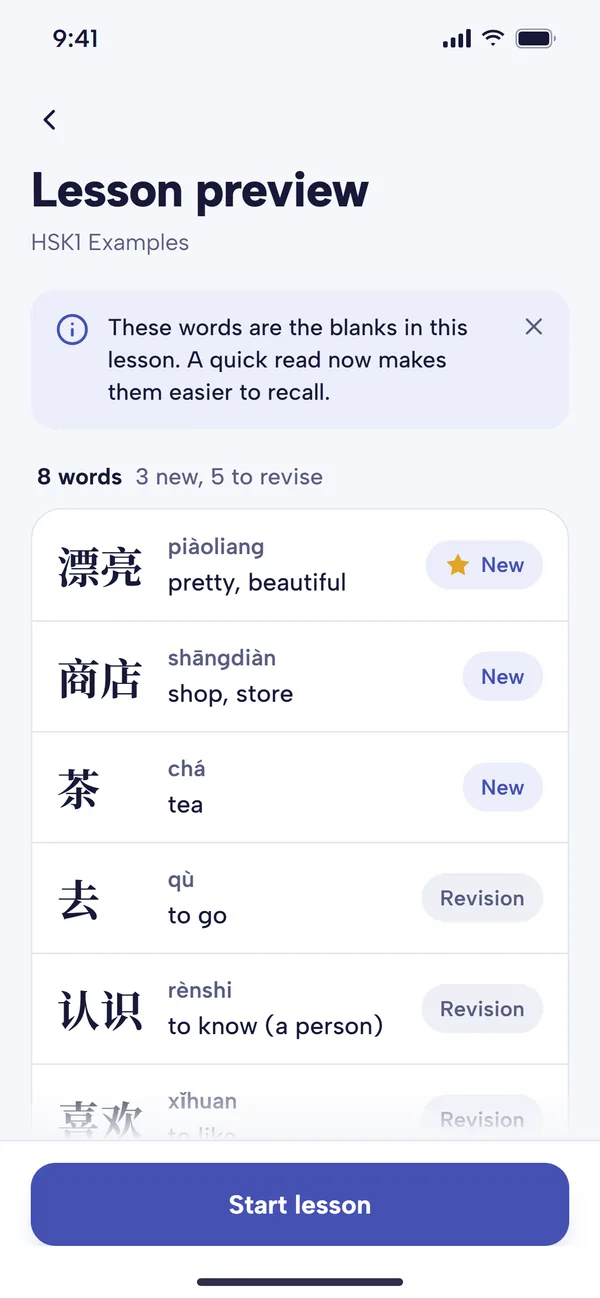
This is where the daily routine does the heavy lifting. Aim for about 10 new words a day, always in sentences, and keep your reviews clear. Grammar comes in small pieces: one point a week is plenty. The Chinese Grammar Wiki sorts grammar points by level, so work through its A1 points, then A2.
Mandarin Mosaic is built for this stage. Its Lessons are HSK lesson packs (HSK 1–6 and the New HSK 3.0 levels) made of sentences with one new word each where possible, the i+1 idea. You fill in the missing word, which is active recall, and spaced repetition brings each word back in Review Lessons just before you'd forget it. Words you keep getting wrong can go into Focus Words for extra practice. Our sentence mining guide shows how it works step by step.
A Typical Week in Stage 2
Do blocks 1 and 2 (reviews and new words) and 5 minutes of speaking every day. Then give the rest of the hour to one focus that changes through the week:
| Day | Every day (about 35 min) | Plus this focus (about 25 min) |
|---|---|---|
| Monday | Reviews, new words, speaking | Grammar: read one grammar point and write three sentences with it |
| Tuesday | Reviews, new words, speaking | Listening: one episode of a beginner podcast, twice |
| Wednesday | Reviews, new words, speaking | Reading: one graded story at your level |
| Thursday | Reviews, new words, speaking | Conversation: a tutor lesson or a language exchange |
| Friday | Reviews, new words, speaking | Characters: write this week's new characters by hand |
| Saturday | Reviews, new words, speaking | Longer listening or reading: catch up on anything you skipped |
| Sunday | Reviews only | Rest, and the weekly check: count your words, note what's got easier |
Monthly Milestones in Stage 2
| End of | Known words (60 min a day) | What you should be able to do |
|---|---|---|
| Month 2 | About 400 | Finish HSK 1 material. Order food, buy things, ask simple questions about someone |
| Month 3 | About 650 | Use 了 (le), 的 (de) and 不/没 (bù/méi) without stopping to think. Follow a slow beginner podcast with the transcript |
| Month 4 | About 900 | Read a short graded story with only a few new words per page. Hold a 5-minute conversation on familiar topics |
| Month 5 | About 1,150 | Start HSK 3-level material. Compare things with 比 (bǐ) and talk about past experiences with 过 (guo) |
| Month 6 | About 1,200–1,500 | Read one graded article a day. Talk for 10–15 minutes with a patient partner |
From about month 2, start speaking practice that gives you feedback. A weekly lesson with a tutor on italki or Preply is the classic option. For daily practice in between, the Chunking Chinese fluency trainer gives you an English prompt, has you say the Chinese aloud, and scores the sound and tone of each character. It assumes you already know some pinyin and basic characters, which is why it fits here rather than in week 1.
Stage 3: Intermediate, HSK 4–5
At intermediate level the daily routine stays, but more of your hour moves from the app to real content. You're learning words from what you read and hear, not only from a course. Expect this stage to take a year or more at an hour a day: the words get rarer, so each one takes more meetings to stick.
| Block | Per day (60 min) | What it looks like |
|---|---|---|
| Reviews and new words | 20 min | HSK 4–5 lesson packs, plus sentences you've saved from your own reading. About 10 new words a day |
| Graded reading | 15 min | One graded article a day, chosen so only a few words per page are new. Save good sentences to study later |
| Listening | 10 min | An intermediate podcast, first with the transcript, then without. Listen again to articles you've already read |
| Speaking | 10 min | Daily speaking drills or shadowing, plus a tutor lesson once or twice a week |
| Writing | 5 min | A few sentences in a journal, three times a week, using this week's new words. Have a tutor correct one entry a week |
In Mandarin Mosaic, Chinese Articles is the graded reader for this block. You can sort articles by the share of new words to find one at your level, tap any word for its meaning and audio, and save a sentence you like into your own pack. Add an article to Listen Later and its audio becomes a playlist you can play with the screen off, on a walk or the commute. For other material, see our lists of Chinese podcasts for learners and Chinese study books.
| Milestone | Known words | What you should be able to do |
|---|---|---|
| Early HSK 4 | About 2,000 | Read graded articles with only a few new words per page. Follow intermediate podcasts with a transcript |
| Late HSK 4 | About 3,000 | Follow intermediate podcasts without a transcript most of the time. Talk for 30 minutes about your work, plans and opinions |
| HSK 5 | About 3,600–4,300 | Read simplified news and easy native articles with a dictionary to hand. Write a short email that a tutor only lightly corrects |
Stage 4: Breaking the Intermediate Plateau

Somewhere around HSK 4, many learners feel stuck: they study every day but stop noticing progress. Usually it's because course material has stopped stretching them and they aren't producing much Chinese yet. Our post on the intermediate Chinese plateau explains the causes. This is a four-week reset you can run whenever progress stalls:
| Week | Change | How |
|---|---|---|
| 1 | Audit what you really know | Go through your known words and move any you've forgotten back to learning. In Mandarin Mosaic, Your Vocabulary lists your known words level by level, and a word's details have a Learning / Known switch. Note your weakest skill |
| 2 | Swap course material for native content | Replace half your graded reading with something made for native speakers on a topic you like: a podcast, a YouTube channel, a drama with Chinese subtitles. Mine sentences from it |
| 3 | Double your output | Two tutor lessons, daily speaking drills, and a journal entry every day. Speaking is usually the skill furthest behind |
| 4 | Measure and reset | Repeat something you did in week 1 (read the same article, retell the same story) and compare. Keep what worked as your new routine |
How to Adapt the Plan
15 Minutes a Day vs 2 Hours a Day
| Block | 15 minutes a day | 2 hours a day |
|---|---|---|
| SRS review | 5 min | 15 min |
| New words in sentences | 8 min (3–5 new words) | 20 min (15–20 new words) |
| Listening | Lesson audio, plus podcasts on the commute | 25 min |
| Reading | A few times a week instead of a lesson | 25 min |
| Speaking | 2 min saying the day's sentences aloud | 20 min, with a tutor two or three times a week |
| Characters and writing | Skip for now, or do it at weekends | 15 min |
At 15 minutes a day, protect the reviews and new words above everything else and use dead time (commuting, cooking) for listening. At 2 hours, don't put all the extra time into new words. Reviews grow with every word you add, and the time spent reading, listening and speaking is what turns known words into words you can use.
An Exam Goal vs a Speaking Goal
| Aiming for an HSK exam | Aiming to speak | |
|---|---|---|
| Where new words come from | The official word list for your level and exam version | Everyday phrases and chunks you'll actually say |
| Characters | Reading from day one, and handwriting where the exam asks for it | Recognition is enough at first. Handwriting can wait |
| Main extra practice | Past papers, timed, once a week in the last two months | Speaking every day, and a tutor two or three times a week |
| How to measure progress | Mock-test scores | Record yourself telling the same story each month and compare |
If you're not sure whether the exam is worth it, read should you take the HSK? before building your plan around it. Many learners do both: the word lists give the plan its structure, and the speaking practice keeps it useful.
Simplified vs Traditional Characters
The plan is the same either way; only your materials change. Choose Simplified if you're heading for mainland China or Singapore, or the HSK. Choose Traditional for Taiwan or Hong Kong. Taiwan has its own test, the TOCFL, and many Taiwanese materials teach zhuyin (bopomofo) rather than pinyin. Stick to one set for at least your first year, and check that each app and book you use supports it. Mandarin Mosaic does both, and you can switch in Settings. Our guide to learning Traditional Chinese covers the differences.
Frequently Asked Questions
How Should I Structure My Chinese Study?
Do the same blocks every day, in this order: review the words you've learned, learn new words in sentences, then a little listening, reading and speaking. Add one changing focus a day, such as grammar on Monday and a tutor lesson on Thursday. Set targets by stage (about 150 words in month one, then about 10 new words a day) and check them once a week.
How Many Hours a Day Should I Study Chinese?
Thirty to sixty minutes a day, every day, is enough for steady progress, and 15 minutes still keeps you moving. Consistency matters more than length, because spaced repetition depends on you reviewing when words are due. Above about two hours a day, more reading, listening and speaking helps more than more new words.
Can I Make My Own Mandarin Curriculum?
Yes. Use an HSK word list as the spine, take one grammar point a week from a graded list such as the Chinese Grammar Wiki, and fill each day with the six blocks in this plan. The risk with a home-made curriculum is gaps, so check yourself against the milestones for your stage, and get a tutor or a speaking app to check your speaking.
What Should I Learn First in Chinese?
Pinyin and the four tones, in your first week or two. After that, learn the most common words in short sentences, plus a few survival phrases like 你好 (nǐ hǎo, hello) and 我听不懂 (wǒ tīng bu dǒng, I don't understand). Characters come in gradually as you learn words, rather than as a separate subject at the start.
Want a backbone for your daily new words and reviews? Mandarin Mosaic teaches Chinese through real sentences with one new word at a time, with HSK lesson packs, spaced repetition, graded articles and audio. It's on iPhone and Android, and at the time of writing Premium's first month is free (cancel any time), and there's a limited free plan. Get it on iOS or Android. For the speaking side of the plan, try the Chunking Chinese fluency trainer.