Choosing a Chinese Study Book That Actually Works
See that Chinese study book gathering dust on your shelf? You’re not the only one. So many learners hit a wall, not because they’ve lost motivation, but because the book they bought isn’t the right one for them. Figuring out why your progress has ground to a halt is the first real step to turning that book from a paperweight into your best learning partner.
Why Your Chinese Study Book Is Gathering Dust
It’s a story I’ve heard countless times from Mandarin learners. You buy a highly-recommended textbook, bursting with promise, only to find it sitting on your shelf, untouched, a few weeks later. This isn’t a sign you’ve failed or that you lack discipline. More often than not, it just means there’s a major disconnect between the book and how you actually learn.
The most common reason is also the simplest: the book is at the wrong level. If it’s too easy, you’ll get bored. If it’s too advanced, you’ll just get frustrated and give up. When every page feels like a dense wall of characters and grammar you’ve never seen before, it’s completely natural to start avoiding it. This is exactly why a quick 'flick-through' test in the bookshop or a look at the online preview is so important.
The Learning Style Mismatch
It’s not just about the difficulty, though. Your book might not gel with how you prefer to learn. Some people really thrive on structured grammar explanations and drills, while others need conversational dialogues and real-world examples to stay engaged. A visual learner, for instance, is going to have a tough time with a text-heavy book that has zero diagrams or illustrations.
Think about these common mismatches:
- The Grammar-Heavy Textbook: This is gold for analytical learners who want to deconstruct Chinese grammar. But for someone who just wants to start speaking, it can feel incredibly dry and impractical.
- The Dialogue-Focused Guide: Fantastic for getting your conversational skills up and running, but it might leave you with a shaky foundation in reading and writing if you don't use other resources alongside it.
- The Character-Only Workbook: You absolutely need this for literacy, but if you only use this, your learning can feel totally disconnected from actually speaking Chinese.
The goal isn't to find a "good" book; it's to find the right book for you. Realising you’ve got a mismatch isn’t a setback—it’s the crucial first step towards finding a resource that will genuinely help you make progress.
Hitting the Intermediate Plateau
Finally, a lot of learners ditch their books when they hit the infamous "intermediate plateau." This is that frustrating stage where the quick wins of the beginner phase start to disappear. The book that was once your trusted guide can suddenly feel like it’s not teaching you anything new or useful for navigating more complex, real-life chats.
At this point, the problem isn't always the book itself. It's often the lack of a clear strategy for using it to break through this tough stage. Without an active learning routine, like sentence mining or consistent review, even the best book in the world won’t deliver the results you're after.
How to Select the Right Chinese Study Book
Walking into the language section of a bookshop can feel pretty overwhelming. Shelves are groaning with Chinese study books, all promising fluency. It's easy to get stuck in "analysis paralysis" and either walk away empty-handed or grab the one with the nicest cover.
But picking the right book is your first real step towards making progress. A little thought now saves you from buying a book that just ends up gathering dust. It really comes down to three things: your current level, what you're trying to achieve, and how you actually like to learn. Nail these, and you’ll find a resource that clicks.
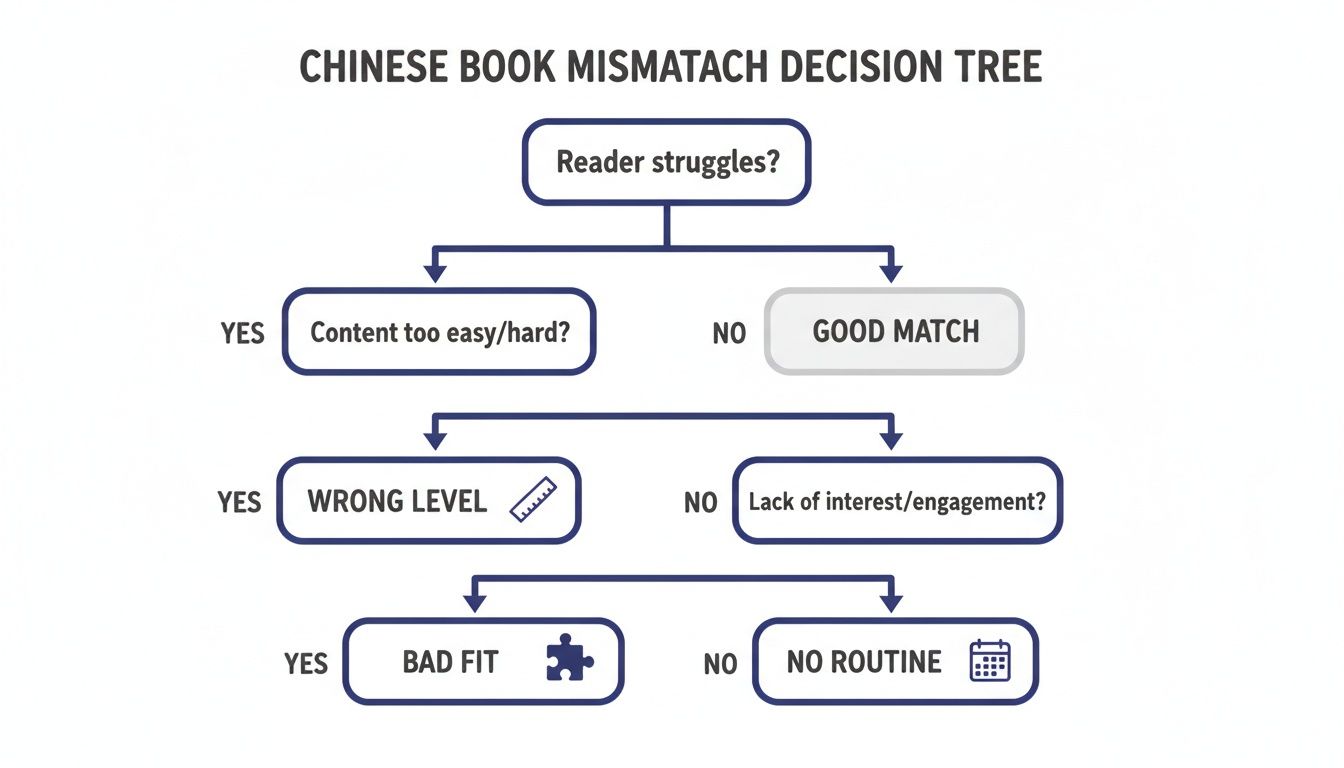
As you can see, a bad match usually happens because the book is too hard or too easy, doesn't fit your goals, or you just don't have a solid routine to support it.
Matching the Book to Your Mandarin Level
This is the big one. There's no point trying to run before you can walk. An absolute beginner (HSK 1-2) needs a book loaded with Pinyin, simple grammar explanations, and core vocabulary. Anything else will just be frustrating.
On the flip side, if you're a lower-intermediate learner (HSK 3-4), you should be looking for books that introduce more complex sentences and, crucially, start weaning you off Pinyin. It's time to get comfortable with the characters themselves.
A great little trick is the "95% rule". Open a random page. If you understand about 95% of what's there, it's perfect. That remaining 5% is your sweet spot—challenging enough to keep you learning, but not so hard that you want to give up. If you're under 90%, it's probably too tough for now.
Defining Your Primary Learning Goal
Why are you learning Chinese in the first place? Your answer completely changes the kind of book you need.
If you’re dreaming of chatting with locals in a Shanghai café, your best bet is a book packed with dialogues, real-world situations, and good quality audio. A textbook focused on daily life will serve you far better than one on ancient poetry.
But what if you need Mandarin for your career? Then you'll want a specialised business Chinese textbook. These cover things like professional etiquette, industry-specific vocabulary, and formal emails—stuff you just won't find in a general coursebook. If you need more ideas, our guide on how to learn Chinese from books offers some deeper strategies for lining up resources with your goals.
To make this a bit clearer, here's a quick reference table to guide your choice.
Matching Your Chinese Study Book to Your Learning Goal
| Primary Goal | Recommended Book Type | Key Features to Look For |
|---|---|---|
| Conversational Fluency | Dialogue-focused textbooks, graded readers | Lots of audio, everyday scenarios, cultural notes |
| Business Proficiency | Specialised business coursebooks | Professional vocabulary, formal communication, case studies |
| Passing HSK Exams | Official HSK standard coursebooks, mock test books | HSK-specific vocab lists, grammar drills, practice exams |
| Reading Skills | Graded readers, dual-language books | Controlled vocabulary, glossaries, engaging stories |
Think of this table as a starting point. Your personal goals might be a mix of these, but it helps to narrow down the massive selection of books out there.
Finding a Book That Suits Your Learning Style
Finally, think about how your brain works. We all absorb information differently, and a good Chinese study book should play to your strengths.
- Are you a visual learner? You'll want books with clear stroke order diagrams, helpful illustrations, and maybe some colour-coding to make grammar points stand out.
- Do you learn by listening? If so, the audio component is non-negotiable. Check that the book comes with high-quality, downloadable MP3s or has a companion app. No audio, no deal.
- More of an analytical type? Look for a book that really breaks down the 'why'. You'll thrive with detailed grammar explanations, pattern drills, and clear linguistic rules.
Don't just grab the most popular title off the shelf. By taking a moment to think about your level, your goals, and your personal style, you can pick a Chinese study book that will feel less like a chore and more like a genuine partner on your path to fluency.
Building a Study Routine That Gets Results
So you’ve found the perfect Chinese study book. That’s a massive win, but the real work starts now. A great book is only as effective as the routine you build around it. Simply reading pages passively won't get you far; the secret is to turn reading into an active, engaging process that builds lasting knowledge.
This is where you shift from being a reader to being a Chinese language detective. Your goal isn't just to finish a chapter, but to pull out valuable, usable sentences from it. This approach transforms study time from a chore into a focused, productive habit that delivers real, measurable wins each week.

From Passive Reading to Active Learning
Most learners read a dialogue, look up a few words, and move on. That’s passive learning. Active learning, on the other hand, means you break down the material, engage with it, and make it your own. It’s the difference between watching a football match and actually getting on the pitch to play.
One of the most powerful techniques for this is sentence mining. Instead of creating lists of isolated vocabulary words, you hunt for complete sentences that are almost entirely understandable to you, except for one new element.
This "i+1" approach—where 'i' is what you already know and '+1' is the new word or grammar point—is incredibly effective. It provides immediate context, showing you exactly how a new word gets used naturally.
The real breakthrough in Chinese learning happens when you stop memorising words and start acquiring sentences. A sentence gives you grammar, context, and a new vocabulary word all in one package, making it far more memorable and useful.
Creating Your Daily Study Loop
Consistency is far more important than intensity. A marathon two-hour session once a week is much less effective than 20-30 minutes of focused study every single day. The key is to create a sustainable loop you can stick to without burning out.
Here’s a practical daily routine built around your Chinese study book:
- Set a Tiny Goal: Don't try to conquer a whole chapter. Aim to find just 5-10 high-quality sentences that contain one new piece of information each. This is a manageable and motivating daily target.
- Mine Your Sentences: As you read, actively look for these "i+1" sentences. When you find one, write it down. For any effective Chinese study routine, mastering how to take study notes that actually work is key to transforming passive reading into active learning.
- Engage the Audio: If your book has audio resources, use them. Listen to the sentence you've mined several times. Try to mimic the native speaker's pronunciation, tone, and rhythm. Shadowing—speaking along with the audio—is a brilliant way to improve your accent.
- Review Yesterday's Finds: Before you start mining for new sentences, take five minutes to quickly review the sentences you found the day before. This constant, spaced review is what cements the new language in your long-term memory.
Breaking Down a Real-World Example
Let's say you're an HSK 2 level learner, and you come across this sentence in your book:
我明天要去银行换钱。 (Wǒ míngtiān yào qù yínháng huàn qián.)
You might already know 我 (I), 明天 (tomorrow), 要 (want), 去 (to go), and 钱 (money). The only new word for you is 银行 (yínháng), meaning "bank." This is a perfect sentence to mine. You've just learned a new word in a perfectly natural context that you can immediately understand and use.
This approach is far more powerful than just seeing "银行 = bank" on a vocabulary list. You've learned how to use it in a sentence, which reinforces the grammar you already know and gives you a practical phrase. Creating a collection of these simple but powerful habits is fundamental, as outlined in our guide to daily habits to boost your Chinese. Your book is no longer just a source of information; it's a goldmine of personalised learning material.
Pairing Your Book With the Right Technology
A well-chosen Chinese study book gives you structure and expertly curated content. But let's be honest, a book on its own is static. To really bring the language to life, you need to pair it with the right tech. This is where you create a powerful hybrid learning system that bridges the gap between the printed page and the active recall your brain needs for fluency.
It’s all about making your book’s content portable, interactive, and smart. The goal is to digitise the sentences you mine from your book, making your study sessions incredibly efficient. Forget about those clunky paper flashcards you have to manually create and sort. A dedicated app can house all those valuable, context-rich sentences you’ve carefully picked out, automating the most tedious parts of learning.
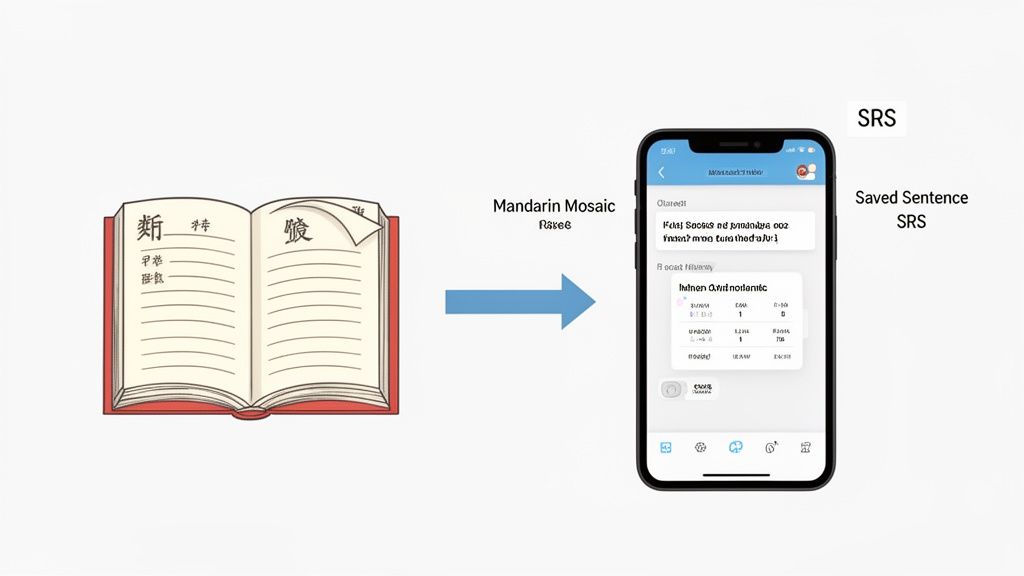
This image nails the core idea: taking the fantastic, meaningful content from your book and giving it superpowers with the smart review capabilities of a modern app.
Automating Your Learning with Spaced Repetition
The real magic happens when technology takes over your review schedule. An app like Mandarin Mosaic is built around a Spaced Repetition System (SRS). As soon as you add a sentence, the app’s algorithm figures out the perfect moment to show it to you again—right before you’re about to forget it.
This completely removes the guesswork from studying and makes every single review session count. You no longer have to manually sift through flashcards, trying to decide what's "easy" and what's "hard." The system tracks how you perform on each sentence and optimises your study time for you. To really get into the nitty-gritty of how this works, check out our complete guide to Spaced Repetition.
By letting an SRS app manage your reviews, you free up mental energy to focus on what humans do best: finding new, interesting sentences in your Chinese study book and understanding the nuances of the language.
Creating a Seamless Study Experience
Modern Chinese learning apps add layers of functionality a physical book just can't compete with. This integration turns passive reading into an active, multi-sensory learning experience.
Here are a few features that will transform your study flow:
- Instant Definitions: Stuck on a character? Just tap it. You’ll get an immediate dictionary definition without breaking your focus or having to reach for another book.
- Lifelike Audio Playback: You can hear your mined sentences spoken by a native speaker. This is absolutely crucial for getting your pronunciation and listening skills up to scratch.
- Vocabulary Tracking: The app keeps a running tally of words you know and words you’re learning, giving you a clear, motivating picture of your progress.
This need for effective digital tools is becoming more obvious in UK education. The number of students taking the GCSE in Mandarin has more than doubled to over 7,800 in the last decade, but state schools often lack the resources of their private counterparts. As demand grows, accessible technology becomes essential for bridging that gap.
This combined approach lets you study your book’s most valuable content anywhere. Suddenly, that downtime on the bus or waiting in a queue becomes a genuinely productive Mandarin practice session. To push your learning even further, it’s worth exploring the latest AI tools for students that can help organise your notes and manage your study schedule.
Common Mistakes That’ll Stall Your Progress
Grabbing a great Chinese study book and a solid companion app is a fantastic start, but even the best tools won’t stop you from hitting a wall. Learning Mandarin is a marathon, not a sprint. Along the way, it’s all too easy to stumble into common traps that slow you down or, even worse, make you want to give up altogether.
One of the sneakiest culprits is passive reading. This is when you read a chapter, nod along, and feel like you get it, but you haven't actually wrestled with the material. A week later, you can barely remember the new words or grammar points. Passive reading feels like learning, but it’s an illusion that doesn't build any real, lasting knowledge.
The Pitfalls of Inefficient Learning
Another classic mistake is trying to learn every single new word you come across. When you’re stopping to look up a dozen new words in one paragraph, you’re just setting yourself up for cognitive overload. This strategy isn’t just inefficient—research shows our brains can only handle so much new information at once—it's also seriously demotivating.
These habits often lead to the biggest roadblock of them all: neglecting consistent review. Without a structured way to revisit what you’ve learned, the natural process of forgetting kicks in. That perfect sentence you mined last Tuesday will be a distant memory by next Monday unless you actively pull it back into your working memory.
The goal isn’t to cram as much as possible in one sitting. Real learning is about strategic exposure and active recall over time, turning that fleeting knowledge into a permanent skill.
To sidestep these hurdles, you need to shift your mindset from "learning more" to "learning smarter." Instead of just reading, try the 'read, cover, and recall' technique. After reading a sentence with a new word, cover the page and try to say or write the sentence from memory. This simple action forces your brain to actually retrieve the information, not just recognise it.
And to avoid vocabulary burnout? Stick to the 'one new element' rule. Only focus on sentences where you understand everything except for one word or one grammar point. This makes sure each new piece of information is anchored in solid context, making it far easier to stick.
Practical Fixes for Common Roadblocks
Building a strong study habit means knowing what these traps look like and having a plan to get around them. Here are a few practical solutions to keep you on the right track:
- Make Review a Non-Negotiable: Don't leave reviewing to chance or when you "feel like it." Use an SRS app like Mandarin Mosaic to automate the process, ensuring you see new material at the perfect time for retention.
- Quality Over Quantity, Always: Focus on deeply learning five perfect sentences a day rather than just skimming fifty. This focused effort builds a much stronger and more flexible foundation for fluency.
- Mix Up Your Skills: Don't just bury your head in the book. Make sure to integrate listening by using your book's audio resources. Shadowing the speaker is a brilliant way to connect the characters on the page to how they actually sound.
By spotting these mistakes early, you can tweak your strategy and make sure every minute you spend with your Chinese study book is a productive step towards your goal.
Got Questions About Chinese Study Books? We've Got Answers
Stepping into the world of Chinese learning materials can feel a bit like navigating a maze. Are you just starting out? Trying to fine-tune your study habits? Getting straight answers can make all the difference.
Think of this as your quick-fire guide to building a smarter, more effective learning routine with the right book in hand.
How Do I Know if a Chinese Study Book Is at the Right Level for Me?
There’s a simple trick for this called the "95% rule." Just open a book to any random page and start reading. If you understand about 95% of what you see, you've found your perfect match.
That little 5% gap is the sweet spot. It’s challenging enough to teach you something new, but not so difficult that you feel like giving up. If you're understanding less than 90%, the book is probably a bit too advanced for now – and that's okay! Just set it aside for later.
How Many New Sentences Should I Learn From My Book Each Day?
When it comes to learning, consistency always beats cramming. A realistic and highly effective target is just 5 to 10 quality sentences a day. This approach helps you sidestep the burnout that comes from trying to force-feed your brain too much information at once.
When you drop these sentences into a Spaced Repetition System (SRS) app, the tech takes care of all the review scheduling for you. This leaves you free to focus on the fun part: hunting for useful new examples that build your vocabulary and grammar intuition naturally.
The real goal isn't to hit some magic number. It's about creating a daily habit you can actually stick with. Five sentences you truly understand are worth far more than fifty you've skimmed and will forget by next week.
Can I Use Novels or Children’s Books Instead of a Textbook?
Absolutely! Once you’ve got a handle on the basic grammar, materials like graded readers and, eventually, native content like novels are brilliant sources for sentence mining. The most important thing is to use content you genuinely find interesting – that's a massive motivator.
The core principles don't change, no matter what you're reading.
- Pick a book that’s at the right level for you.
- Actively hunt for sentences that contain just one new word or grammar point.
- Use these sentences to systematically build out your knowledge of Chinese.
This method keeps you learning in context, which makes new words and structures much easier to remember and actually use in conversation.
Ready to turn your Chinese study book into a powerful learning engine? Mandarin Mosaic helps you digitise the sentences you find, automating your reviews with a smart Spaced Repetition System so you never forget what you've learned. Try it today and make every study session count. Learn more at the official Mandarin Mosaic website.