 Mandarin Mosaic
Free on iPhone, iPad and Android.
Download on theApp Store Get it onGoogle PlayYour first month of Premium is free.
The 7 Best Chinese Sentence Mining Apps in 2026

Stop memorising words in isolation. If you’ve ever “learned” a Chinese word in a flashcard app and then blanked when it appeared in a real sentence, you’ve hit the same wall most Mandarin learners hit. Single-word study feels tidy, but Mandarin is much easier to retain when you see how a word behaves with particles, measure words, collocations, and sentence rhythm.
That’s where a sentence mining app comes in. Instead of collecting disconnected vocabulary, you build your learning around real input. You read, watch, or listen to Chinese, save useful sentences, then review them with enough context to make them stick. The problem is that most tools only solve one part of the workflow. One app is good for reading, another for capture, another for review, and suddenly your “simple system” becomes a pile of tabs and exports.
This list is built around the full workflow. Content, mining, review. Below are the tools that belong in a serious Mandarin learner’s toolkit.
1. Mandarin Mosaic
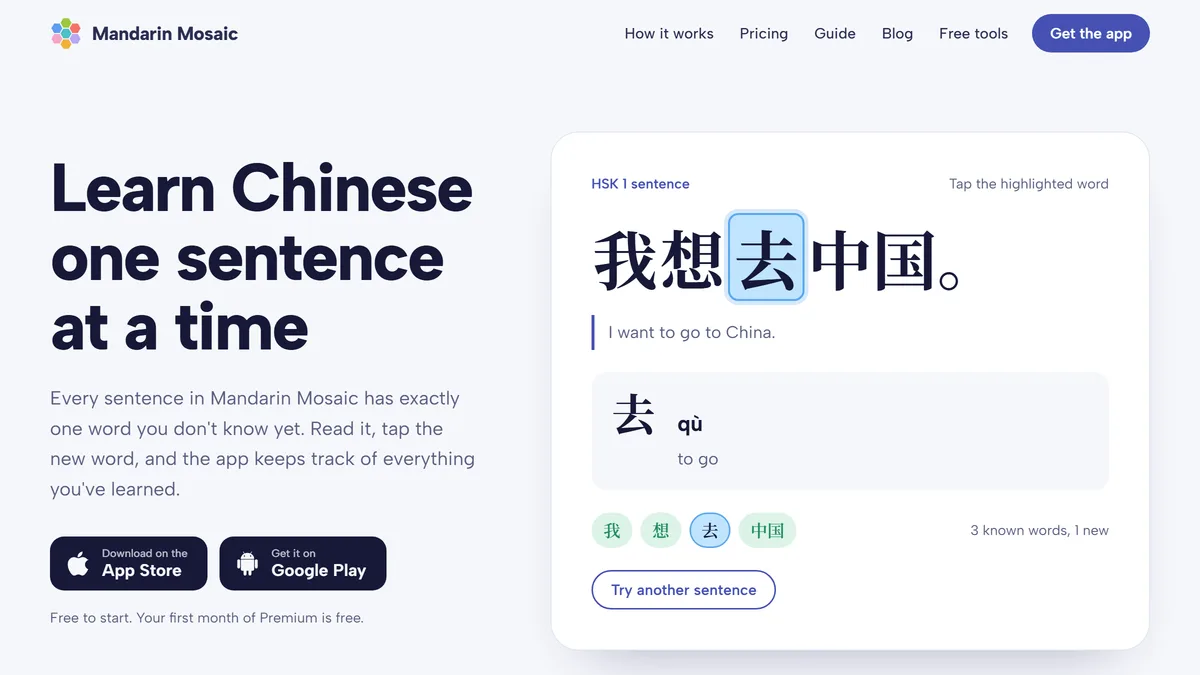
Mandarin Mosaic is the best choice if you want the sentence mining method without building the machinery yourself. Most learners don’t fail because sentence mining is ineffective. They fail because setting up decks, choosing sentences, tagging vocabulary, and managing reviews becomes a hobby of its own. Mandarin Mosaic strips that friction out.
The app is built around a simple idea that works well for Mandarin. Learn from sentences calibrated to your level, and see only one new word at a time. That matters because Chinese becomes much easier to absorb when the sentence is mostly familiar and your attention lands on one unknown item, not three at once.
Why it works in daily use
The strongest part of Mandarin Mosaic is that it handles the complete workflow inside one mobile app. You don’t need a separate reader, dictionary, audio tool, and SRS setup just to study one useful sentence. You open the app, read the sentence, tap for meaning, hear natural audio, and move on.
That’s the kind of workflow that survives busy weeks.
“an awesome app to automate the sentence mining process”
That endorsement comes from Will Hart, a YouTuber and the 2022 UK Chinese Bridge champion. It matches the app’s main strength. Automation without killing the value of context.
A few features stand out in practice:
- One new word at a time: You’re not decoding a whole sentence from scratch. You’re learning how a single new item behaves in natural Mandarin.
- One-tap meanings and audio: Fast lookups matter. If a tool interrupts your concentration, you’ll mine fewer sentences.
- Built-in spaced repetition: Reviews happen in the same environment where you learned the sentence.
- Curated and custom packs: You can follow a structured path or build packs around your own interests.
For learners who want more examples of contextual Chinese, Mandarin Mosaic’s guide to sentences in Chinese fits naturally with this study style.
Best for and trade-offs
Mandarin Mosaic is especially strong for learners who’ve outgrown beginner apps but don’t want the overhead of an Anki-heavy workflow. Daisy Ward, a language teacher and intermediate Mandarin learner, calls it her go-to app for growing her vocabulary, replacing others she had tried, such as Anki. That lines up with the kind of learner this suits best. Someone who wants consistent exposure and consistent review, not constant setup.
There are limits. At the time of writing, there’s a 30-day free trial, then either a limited free plan (1 lesson a day, 10 focus words, no sync between devices) or Premium from £7.92 a month billed yearly (£11.95 month to month). And if your focus is handwriting, deep corpus analysis, or highly specialised domain vocabulary, you may still want another tool alongside it.
Still, as a Chinese sentence mining app, this is the cleanest all-in-one option on the list. It does the thing most learners need. It gets you studying faster and keeps you in Chinese longer.
2. LingQ

LingQ is for readers. If your ideal study session involves importing an article, a transcript, or a graded lesson and mining useful vocabulary as you read, it’s one of the better choices. It’s less elegant than Mandarin Mosaic, but more flexible once you build a reading habit.
What LingQ does well is keep the reading-to-review loop short. You tap unknown words or phrases in context, save them as LingQs, and review them later through built-in SRS. That makes it strong for Chinese learners who want to mine from longer texts rather than isolated example sentences.
Where LingQ fits in the workflow
LingQ works best when “content” is your starting point. You bring in Chinese material or use its lesson library, then mine while reading. It’s a good fit for transcripts, essays, dialogues, and adapted reading.
Its strengths are practical:
- Import-driven study: Good if you already collect Chinese articles or transcripts.
- Phrase and sentence support: Useful because many Chinese meanings only become clear in chunks.
- Audio plus text: Helpful for matching reading with listening.
- Long-term library building: Once you’ve imported enough material, it becomes a useful personal archive.
Practical rule: Use LingQ if you already know where your Chinese input is coming from. Don’t use it if you’re hoping the app itself will give you a perfectly guided sentence plan.
That’s the main trade-off. The interface can feel busy, especially if you prefer a cleaner mobile experience. And while the workflow is coherent, it isn’t as straightforward as Mandarin Mosaic for learners who just want ready-to-review sentences without managing imports.
For serious Chinese readers, though, LingQ is still one of the better tools for mining through volume. Our LingQ for Chinese review covers its prices, the free plan's limits and how well it splits Chinese text into words.
3. Migaku

Migaku shines when your Chinese comes from video, subtitles, and web content instead of graded sentence packs. If you watch Chinese YouTube channels, drama clips, or subtitled media and want to turn those lines into review cards, Migaku is built for that kind of mining.
This is a more technical tool than Mandarin Mosaic, but it’s also more media-rich. You can create cards with audio, screenshots, and sentence context, which makes them much more vivid than plain text flashcards.
Best use case
Migaku is strongest for learners who say, “I hear useful Chinese all the time, but I never capture it properly.” With the browser extension and mobile tools, the process becomes much faster. Click, define, save, review.
That makes it a strong option for intermediate learners who are leaning into real content and want to move beyond textbook Chinese.
- One-click sentence capture: Good for mining from subtitles and webpages.
- Media-rich cards: Audio and screenshots help memory.
- SRS plus Anki compatibility: Useful if you already have an established review system.
- Cross-device study: Important if you mine on desktop and review on mobile.
If you’re comparing sentence-based study with standard deck building, Mandarin Mosaic’s comparison of flashcards and sentence mining for Chinese is a useful companion read.
The trade-off
Migaku can feel expensive if you only need a basic Chinese sentence workflow. It makes more sense for learners who will use the audiovisual side heavily. If you’re mostly reading short Chinese sentences and want low-friction review, Mandarin Mosaic is simpler.
Mine from video only if you’re willing to review what you save. Otherwise you’re collecting clips, not learning Chinese.
That’s where many learners go wrong with Migaku. The tool is powerful, but it rewards disciplined users more than casual ones.
4. Pleco
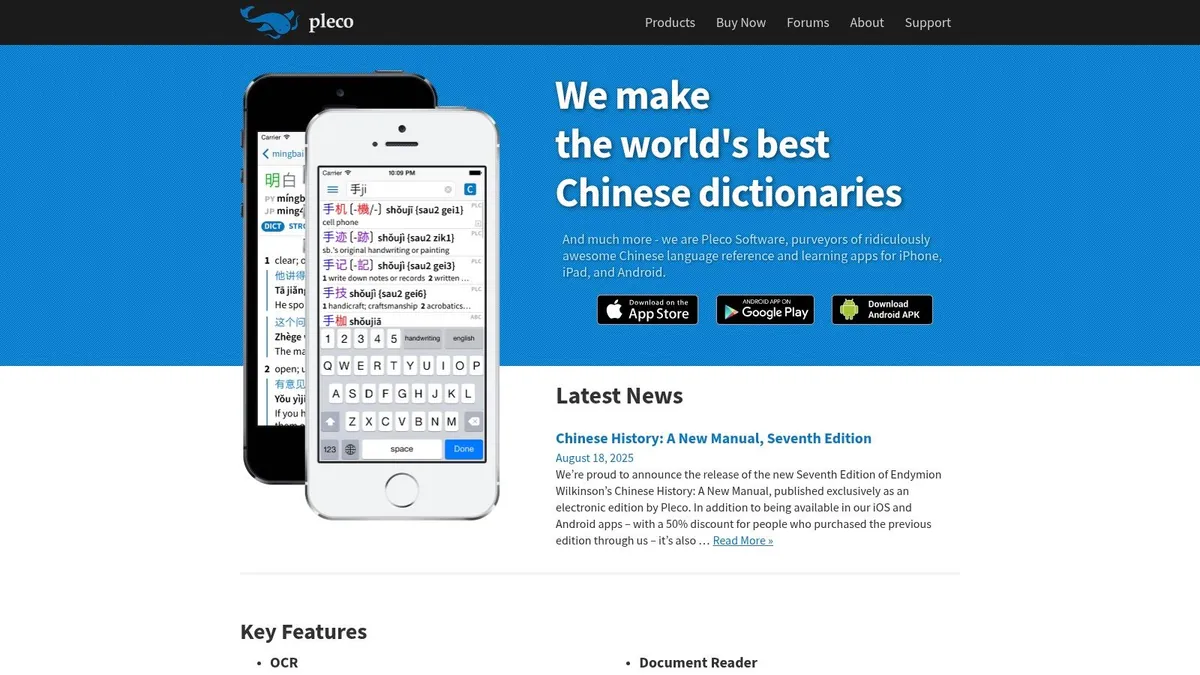
Pleco isn’t marketed as a sentence mining app, but many learners end up using it that way anyway. It’s still the dictionary app most serious Chinese learners keep installed, and its Document Reader and flashcard system (paid add-ons; the dictionary itself is free) make it more useful for mining than people sometimes realise.
If you already have Chinese text sources, Pleco becomes a practical mining environment. Load a document, tap through unknown words, inspect definitions quickly, and save what matters. It’s less guided than Mandarin Mosaic and less immersive than Migaku, but it’s stable and dependable.
Why Pleco stays in the toolkit
Pleco’s biggest strength is trust. The app is fast, its dictionary support is deep, and it handles Chinese text well on mobile. When I’m checking whether a sentence is worth saving, I care more about lookup speed and accuracy than fancy presentation. Pleco delivers that.
Its value comes from combining several roles:
- Document Reader: Lets you mine from articles, copied text, and other Chinese documents.
- Pop-up definitions: Fast enough to preserve reading flow.
- Built-in flashcards: Good enough for many learners who don’t want a separate review app.
- Optional extras: OCR and other add-ons make it more versatile over time.
The catch is that Pleco doesn’t hand you a sentence-mining path. You bring the material. You decide what to save. You maintain the system. That’s fine for self-directed learners, but not ideal if you want a guided mobile workflow with automatic difficulty control.
Who should choose it
Choose Pleco if your Chinese study already revolves around authentic text and you want a strong reader-plus-dictionary foundation. Don’t choose it as your only sentence mining system if you know you struggle with consistency or setup friction.
For many learners, Pleco works best as the supporting tool rather than the main study environment. Mandarin Mosaic handles structured sentence review better. Pleco handles on-the-spot Chinese lookup better.
5. Readlang

Readlang is the minimalist’s option. It isn’t trying to be a giant Chinese platform. It’s trying to make reading and saving useful language frictionless, and that narrower focus is why some learners love it.
For Chinese, Readlang works best when you’re reading online and want fast phrase capture without a lot of ceremony. Click a word or phrase, save it with the source sentence, then review it later or export it elsewhere.
When Readlang beats bigger apps
Readlang is easy to underestimate because the interface feels light. That’s also the reason it works. If a bigger app makes you fiddle with settings every session, the lighter tool often wins because you use it.
It’s a strong fit for browser-based Chinese study:
- Quick word and phrase translation: Good for web reading.
- Sentence context saved automatically: Essential for real retention.
- Export options: Useful if you prefer reviewing elsewhere.
- Cross-platform simplicity: Good on modest devices and in the browser.
The downside is that Readlang gives you less built-in Chinese structure. You won’t get the curated progression you get from Mandarin Mosaic or the polished graded reading feel of Du Chinese. You curate most of the material yourself.
Field note: If your sentence mining habit keeps collapsing under too many features, a simpler tool is often the better tool.
That’s the essential case for Readlang. Not power. Consistency.
6. Du Chinese

Du Chinese is the polished graded-reader option. It’s excellent for learners who want curated Chinese reading with sentence-level support, strong audio, and very little setup. If your current problem is that authentic content still feels too rough, Du Chinese gives you a bridge.
At the time of writing, its library includes more than 3,000 readings, which is a big advantage if you don’t want to hunt for your own material. You open the app, read something at your level, tap words, hear the audio, and review vocabulary inside the same ecosystem.
Why learners stick with it
Du Chinese reduces decision fatigue. That matters more than people think. A learner who spends less time choosing content often spends more time reading Chinese.
It’s especially effective from beginner through lower-intermediate stages:
- Large graded lesson library: You don’t need to source material elsewhere.
- Sentence-level audio: Useful for matching rhythm and comprehension.
- Tap-to-define support: Keeps reading moving.
- Built-in review: Enough structure for regular practice.
If you’re deciding between broader Mandarin study apps, Mandarin Mosaic’s breakdown of the best Mandarin learning app gives extra context.
Limitation
Du Chinese is better at curated reading than open-ended mining. You can mine from what’s in the app, but it’s not the best tool if your workflow depends on importing your own transcripts, articles, or subtitle lines. Mandarin Mosaic also feels more intentionally built around sentence acquisition itself, rather than reading first and mining second.
Still, for learners who need a clean path into contextual Chinese, Du Chinese remains one of the strongest options.
7. The Chairman's Bao

The Chairman’s Bao is where sentence mining meets current affairs. If you’re tired of textbook dialogues and want Chinese that feels more connected to everyday life, this platform does that well. The content is graded, but the tone is more news-driven and topical than most beginner-friendly readers.
That makes it useful for learners who want to build reading range while still keeping sentences manageable.
Why it’s different
A lot of Chinese apps teach through stories or generic dialogues. The Chairman’s Bao teaches through news-style pieces, which gives your mined sentences a different flavour. You get more current vocabulary, more formal structures, and more exposure to how written Mandarin handles public topics.
Its appeal is straightforward:
- Regularly updated lesson library: Fresh material matters when motivation dips.
- HSK-aligned levels: Helpful if you want some structure.
- Audio and vocabulary support: Enough context to mine effectively.
- Built-in review tools: Good for keeping the loop closed.
This is a good app for learners who already know they enjoy reading about real events more than reading staged learner dialogues. It can also pair well with a more dedicated review system if you want to save only the most useful sentences.
Where it falls short
The Chairman’s Bao is less flexible than tools built around importing your own Chinese sources. You’re mostly working inside its content ecosystem. For many learners that’s perfectly fine, but it does mean less freedom if your best learning material comes from podcasts, personal reading, or video transcripts.
For a complete mobile-first workflow, Mandarin Mosaic still feels smoother. For graded news-style reading with sentence-mining potential, The Chairman’s Bao earns its place.
Top 7 Chinese Sentence-Mining Apps Compared
| Product | Setup effort | Platforms and cost | What you get | Best for | Key advantages |
|---|---|---|---|---|---|
| Mandarin Mosaic | Low, turnkey mobile app | iOS/Android; limited free plan after 30-day trial; Premium from £7.92/month (yearly) for unlimited use and sync | Faster contextual vocabulary retention; durable sentence-level grammar | Learners who want focused, efficient sentence mining and daily practice | One-new-word-per-sentence; SRS + one-tap meanings; curated packs; minimalist UI |
| LingQ | Moderate, content import and curation | Web/mobile; free accounts can save only 20 LingQs; Premium for unlimited | Improved reading fluency and large vocabulary built from input | Sustained reading, mining personal articles/ebooks/transcripts | Large graded library; import pipeline; phrase saving → SRS |
| Migaku | Moderate–High, extension + apps workflow | Browser extension + mobile apps; paid subscription after a free trial | Media-rich sentence cards and stronger listening/contextual recall | Mining videos (YouTube), audiovisual content creation | One‑tap video mining; auto audio/screenshots; Anki compatibility |
| Pleco | Low, install + optional add‑ons | Mobile device; free dictionary; paid add-ons (buy‑once) for flashcards, Document Reader, OCR and extra dictionaries | Accurate lookup and reliable sentence mining from loaded texts | Dictionary-first users mining web/docs/clipboards | Fast pop‑up definitions; quality dictionaries; OCR & stroke order |
| Readlang | Low, lightweight web/extension tool | Browser or web; free plan with limited phrase translations; Premium for unlimited | Quick sentence capture and simple SRS review | Lightweight browser-based mining on low‑end devices | Minimal interface; quick exports to Anki/Quizlet; fast workflow |
| Du Chinese | Low, curated app with graded lessons | Mobile app; subscription for full content | Gradual reading/listening comprehension gains (beginner→intermediate) | Learners who prefer curated graded reading and listening | Polished graded lessons; high‑quality audio; clear sentence breakdowns |
| The Chairman's Bao | Low, graded news platform | Web/mobile; subscription (1 month to 2 years at the time of writing) | Up‑to‑date vocabulary and comprehension aligned to HSK | Learners wanting news‑style, HSK‑levelled daily practice | Daily news lessons; HSK alignment; built‑in SRS and vocab lists |
Your Next Step: Building a Sustainable Study Habit

The best sentence mining app isn’t always the one with the most features. It’s the one that keeps you in Chinese every day. That’s the standard I’d use.
If you want the most efficient path, Mandarin Mosaic is the strongest pick because it connects the whole workflow. You get level-appropriate sentences, one new word at a time, instant meaning, audio, and review in one place. That’s a better fit for most learners than stitching together three or four separate tools and hoping the system survives real life.
Other apps still have clear roles. LingQ is strong for heavy reading and imports. Migaku is great when your Chinese comes from video. Pleco remains indispensable as a Chinese lookup tool. Readlang is excellent if you want a light browser-based mining habit. Du Chinese and The Chairman’s Bao both work well when you want curated reading instead of hunting for your own material. All of these focus on reading and listening; if you want to start saying your mined sentences aloud, the Chunking Chinese fluency trainer drills reusable sentence chunks and gives per-character feedback on your tones and pronunciation.
Start smaller than you think. Fifteen focused minutes is enough. Read one sentence pack. Mine a few lines from content you care about. Review what you saved. Repeat tomorrow.
That’s how Mandarin starts compounding. Not through bigger decks. Through better sentences, reviewed consistently, until Chinese stops feeling like a list of words and starts feeling like a language you can use.
If you want the fastest route to a sustainable sentence-mining habit, try Mandarin Mosaic. It’s the most efficient tool on this list for learning Chinese through real sentences, not isolated flashcards, and the 30-day free trial (and free plan afterwards) makes it easy to see whether the workflow finally clicks for you.