 Mandarin Mosaic
Free on iPhone, iPad and Android.
Download on theApp Store Get it onGoogle PlayYour first month of Premium is free.
Chinese Morning Exercise: Tai Chi, Baduanjin and Key Words
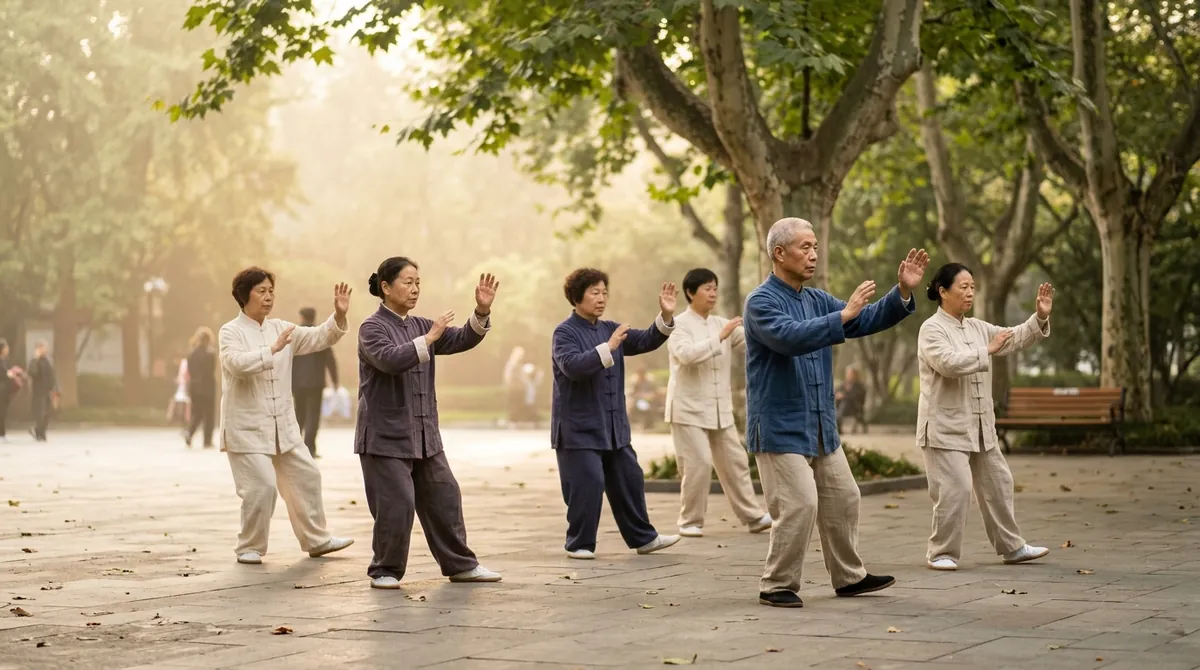
Morning exercise in China is called 晨练 (chénliàn), and its best-known forms are tai chi (太极拳, tàijíquán), the eight-movement Baduanjin (八段锦, bāduànjǐn) and radio calisthenics (广播体操, guǎngbō tǐcāo). Walk through almost any Chinese park soon after sunrise and you'll see people doing all three, along with stretching, walking and games of shuttlecock. Most of them are retired, and many come every day.
This guide explains each one, gives you the Chinese names with audio, and teaches you the count-in calls you'll hear, so you can follow a group in a park or a video at home. If you're looking for a study routine for the morning instead, see a Chinese learning morning routine; for describing your whole day, see your daily routine in Chinese.
The Words You'll Need
Tap a play button to hear each word.
| Chinese | Pinyin | Meaning |
|---|---|---|
| 晨练 | chénliàn | morning exercise |
| 锻炼身体 | duànliàn shēntǐ | to exercise, keep fit |
| 公园 | gōngyuán | park |
| 太极拳 | tàijíquán | tai chi |
| 打太极 | dǎ tàijí | to do tai chi (also slang for dodging a question) |
| 八段锦 | bāduànjǐn | Baduanjin, the "eight pieces of brocade" |
| 气功 | qìgōng | qigong: slow movement with controlled breathing |
| 广播体操 | guǎngbō tǐcāo | radio calisthenics |
| 做操 | zuò cāo | to do exercises (calisthenics) |
| 早操 | zǎocāo | morning exercises, at school or work |
| 广场舞 | guǎngchǎngwǔ | square dancing |
| 养生 | yǎngshēng | looking after your health (literally "nourishing life") |
| 散步 | sànbù | to go for a walk |
| 踢毽子 | tī jiànzi | to kick a shuttlecock |
| 抖空竹 | dǒu kōngzhú | to spin a diabolo (Chinese yo-yo) |
| 热身 | rèshēn | to warm up |
| 拉伸 | lāshēn | to stretch |
A note on 打太极 (dǎ tàijí): it's the everyday way to say "do tai chi", but it's also slang for dodging a question or passing a problem on to someone else, the way tai chi turns aside a push. 他在跟我打太极 (tā zài gēn wǒ dǎ tàijí) usually means "he's giving me the runaround", not that you're exercising together.
Tai Chi: 太极拳
Tai chi is a slow, flowing martial art done as a sequence of linked postures, called a form (套路, tàolù). The one you're most likely to see in a park is the 24-movement simplified form (二十四式简化太极拳, èrshísì shì jiǎnhuà tàijíquán), which China's national sports body put together in 1956 from the longer traditional Yang-style form so that ordinary people could learn it. It takes about five minutes to do once, and groups usually repeat it.
Tai chi groups often have a teacher at the front and music playing from a small speaker. If you want to join, stand at the back and copy; nobody minds. The polite way to ask is 我可以跟你们一起练吗? (wǒ kěyǐ gēn nǐmen yìqǐ liàn ma?, Can I practise with you?), in the useful sentences below.
Baduanjin: The Eight Pieces of Brocade
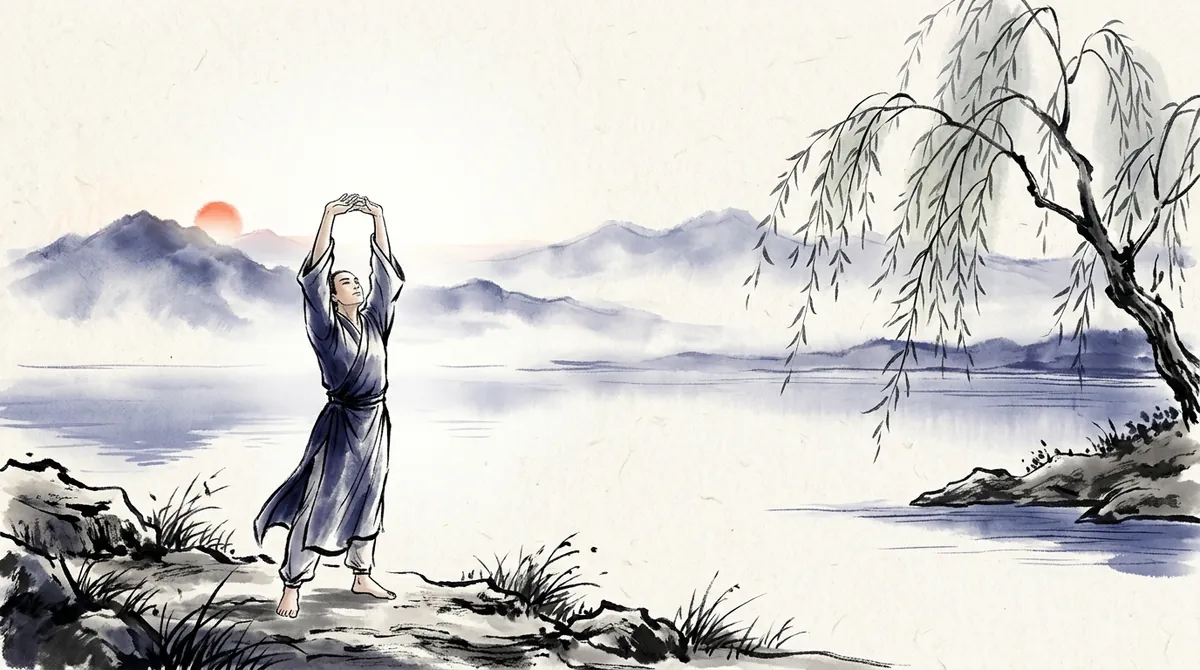
Baduanjin (八段锦, bāduànjǐn) means "eight pieces of brocade": eight gentle movements, each repeated several times, done standing. It's a form of 气功 (qìgōng), exercise that combines slow movement with steady breathing. It's shorter and simpler than tai chi, takes about ten to fifteen minutes, and has become very popular with people of all ages, including office workers who do it at their desks. There are many versions; the one most people learn is the standard "健身气功·八段锦" published by China's General Administration of Sport in 2003.
Each movement is named with a seven-character phrase that says what you do and, in the language of traditional Chinese medicine, what it's for. Those "what it's for" parts are traditional ideas, not medical findings, but the names are what you'll hear called out, so they're worth recognising.
| Movement | Pinyin | What you do |
|---|---|---|
| 两手托天理三焦 | liǎng shǒu tuō tiān lǐ sānjiāo | Interlace your fingers and push your palms up towards the sky, stretching the whole body. Literally "both hands hold up the sky to regulate the triple burner" (三焦, a traditional medicine idea). |
| 左右开弓似射雕 | zuǒyòu kāi gōng sì shè diāo | In a wide, low stance, draw an imaginary bow to the left and then the right. Literally "draw the bow left and right, as if shooting an eagle". |
| 调理脾胃须单举 | tiáolǐ píwèi xū dān jǔ | Push one palm up above your head while the other presses down, then swap. Literally "to regulate the spleen and stomach, lift one arm". |
| 五劳七伤往后瞧 | wǔ láo qī shāng wǎng hòu qiáo | Turn your head slowly to look back over one shoulder, then the other. Literally "look back to ease the five strains and seven injuries". |
| 摇头摆尾去心火 | yáo tóu bǎi wěi qù xīnhuǒ | In a low stance with hands on your thighs, lean and circle your upper body from side to side. Literally "sway the head and tail to clear the heart fire". |
| 两手攀足固肾腰 | liǎng shǒu pān zú gù shèn yāo | Bend forward and slide your hands down the backs of your legs towards your feet, then come back up. Literally "reach for the feet to strengthen the kidneys and waist". |
| 攒拳怒目增气力 | cuán quán nù mù zēng qìlì | In a low stance, punch slowly forward with each fist in turn, eyes wide open. Literally "clench the fists and glare to build strength". |
| 背后七颠百病消 | bèihòu qī diān bǎi bìng xiāo | Rise onto your toes, then drop your heels gently to the ground, seven times. Literally "seven bounces at the back, and a hundred illnesses go". |
You don't need to learn all eight names by heart. The first words of each are enough to follow along: 两手托天 (both hands hold up the sky), 左右开弓 (draw the bow), 单举 (lift one arm), 往后瞧 (look back), 摇头摆尾 (sway the head and tail), 攀足 (reach for the feet), 攒拳 (clench the fists) and 七颠 (seven bounces).
Radio Calisthenics: 广播体操
Radio calisthenics (广播体操, guǎngbō tǐcāo, often shortened to 做操, zuò cāo) are a short set of simple exercises done to music and a recorded voice calling the count. China introduced its first set on 24 November 1951, so that whole schools, offices and factories could exercise together without any equipment. New sets followed every decade or so, and the current one, the ninth set (第九套广播体操), was released on 8 August 2011. It has more squats, kicks and waist movements than earlier sets, to suit people who sit all day.
For most adults today, radio calisthenics is a school memory: pupils line up in the playground for 早操 (zǎocāo, morning exercises) or 课间操 (kèjiān cāo, exercises between lessons) every day. You'll still see it in some workplaces and parks, and older people who grew up with the early sets sometimes do them together for fun.
The Count-In Calls
Radio calisthenics, and many teachers in the park, count in eights. The trick is that the first number tells you which round of eight you're on, and the rest is always 二三四五六七八:
| Call | Pinyin | Meaning |
|---|---|---|
| 一二三四五六七八 | yī èr sān sì wǔ liù qī bā | one, two, three … eight (the first round) |
| 二二三四五六七八 | èr èr sān sì wǔ liù qī bā | the second round |
| 三二三四五六七八 | sān èr sān sì wǔ liù qī bā | the third round |
| 四二三四五六七八 | sì èr sān sì wǔ liù qī bā | the fourth round |
So the second round starts "two, two, three, four" and the fourth "four, two, three, four". Once you've noticed it, you can always tell where you are in the set. It's also good listening practice: the numbers come fast, in rhythm, and you have to recognise them without thinking.
Other Things You'll See in the Park
- 踢毽子 (tī jiànzi): kicking a weighted shuttlecock with feathers to keep it in the air, alone or passed around a circle.
- 抖空竹 (dǒu kōngzhú): spinning a Chinese yo-yo, a diabolo, on a string between two sticks. A good one hums as it spins.
- 散步 (sànbù) and 倒着走 (dàozhe zǒu): walking, sometimes backwards, which some older people believe is good for the back.
- 拉伸 (lāshēn): stretching, often with a leg up on a railing.
- 广场舞 (guǎngchǎngwǔ): group dancing to music on a public square. You'll see some in the morning, but it's mostly an evening activity.
All of this falls under 养生 (yǎngshēng), literally "nourishing life": the everyday habits people keep to stay healthy, from morning exercise to drinking warm water and going to bed early.
Useful Sentences
| Chinese | Pinyin | English |
|---|---|---|
| 你每天早上锻炼吗? | nǐ měitiān zǎoshang duànliàn ma? | Do you exercise every morning? |
| 我每天早上在公园打太极。 | wǒ měitiān zǎoshang zài gōngyuán dǎ tàijí. | I do tai chi in the park every morning. |
| 我可以跟你们一起练吗? | wǒ kěyǐ gēn nǐmen yìqǐ liàn ma? | Can I practise with you? |
| 请慢一点。 | qǐng màn yìdiǎn. | A bit slower, please. |
| 下一个动作是什么? | xià yí ge dòngzuò shì shénme? | What's the next movement? |
| 跟着我做。 | gēnzhe wǒ zuò. | Follow me (do what I do). |
| 预备,开始! | yùbèi, kāishǐ! | Ready, begin! |
Using Morning Exercise to Learn Chinese
Following a tai chi, Baduanjin or radio calisthenics video in Chinese is a surprisingly good listening exercise. The vocabulary is small, the instructions repeat, and the movements tell you what each word means. Search for 八段锦 or 太极拳 跟练 (gēnliàn, follow-along) on a video site, pick one with a calm voice, and try it with the English turned off.
When a phrase sticks, such as 两手托天 or 跟着我做, save the whole sentence and review it. That's sentence mining: in Mandarin Mosaic you can add sentences like these to a custom pack, and the app adds audio and brings them back for review. If you'd rather practise saying them, the Chunking Chinese speaking trainer gives you English prompts to answer out loud and checks your tones.
Frequently Asked Questions
What is the Chinese morning exercise called?
The general word is 晨练 (chénliàn), "morning exercise". The most common forms are tai chi (太极拳), Baduanjin (八段锦) and, in schools, radio calisthenics (广播体操).
What are the eight movements of Baduanjin?
In order: 两手托天理三焦, 左右开弓似射雕, 调理脾胃须单举, 五劳七伤往后瞧, 摇头摆尾去心火, 两手攀足固肾腰, 攒拳怒目增气力 and 背后七颠百病消. The table above gives the pinyin, what each movement involves, and audio.
Is Baduanjin the same as tai chi?
No. Tai chi is a martial art with a long sequence of moves, while Baduanjin is a form of qigong with eight separate movements, each repeated. Baduanjin is shorter and easier to learn, which is why many beginners start with it.