 Mandarin Mosaic
Free on iPhone, iPad and Android.
Download on theApp Store Get it onGoogle PlayYour first month of Premium is free.
The 12 Best Mandarin Learning Apps in 2026

Choosing a Mandarin learning app can feel overwhelming. With dozens of options available, each promising fluency, it's difficult to know which one fits your goals, learning style, and budget. This guide compares the main options honestly, including their limits.
Below are 12 leading apps, with their strengths, weaknesses and prices at the time of writing. Whether you're a complete beginner, an intermediate learner stuck on the infamous plateau, or an advanced student refining your skills, the 'best for' notes will help you decide. We look at core learning mechanics like spaced repetition systems (SRS), character writing practice, and sentence mining, and each entry links to the app's own site so you can explore further.
1. Mandarin Mosaic
Mandarin Mosaic is our own app, so weigh this entry accordingly. It takes a focused approach to vocabulary: it centres its whole method on sentence mining, presenting new words within complete, natural sentences organised into HSK-levelled lessons, plus graded Chinese articles to read. This moves learners beyond rote memorisation of isolated words, building a feel for grammar and context from day one.
Its standout feature is the "i+1" sentence calibration: each new sentence you encounter contains only one word you haven't learned yet. This reduces cognitive load, so you can work out the meaning from context and pick up grammatical patterns without feeling overwhelmed.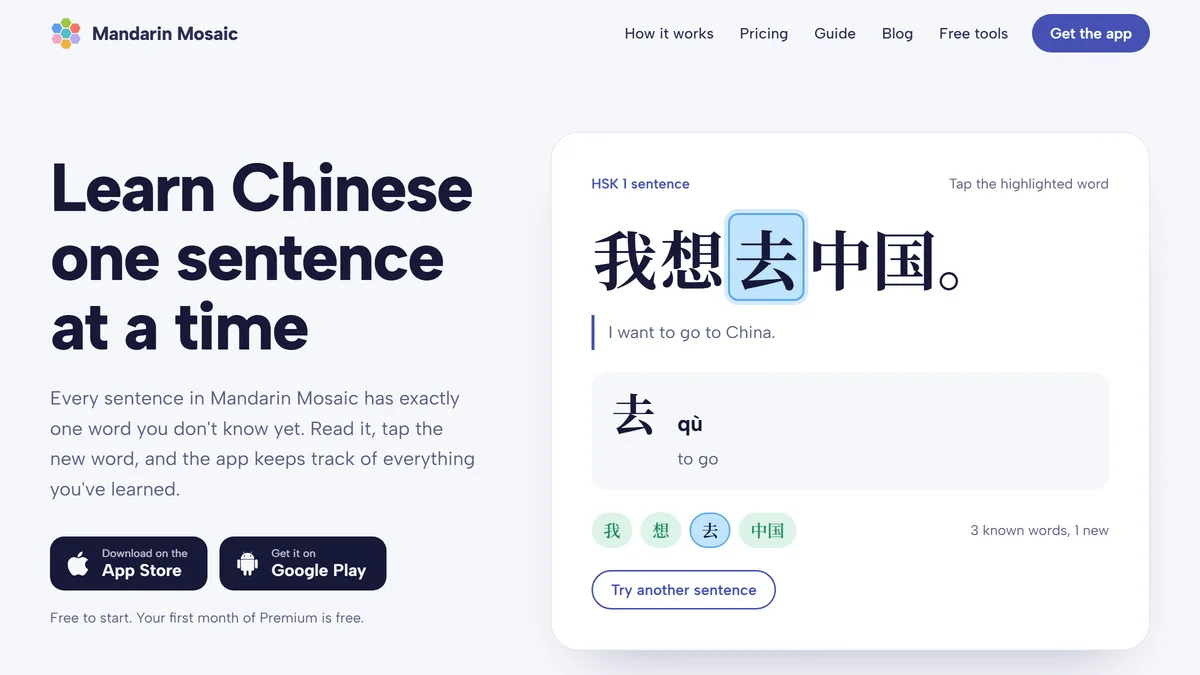
Key Features & User Experience
The user experience is clean and distraction-free. Unknown words are highlighted, and a single tap shows the meaning and plays lifelike audio, so your study flow isn't interrupted. A Spaced Repetition System (SRS) schedules reviews automatically to help long-term retention.
- Best for: Learners stuck at the intermediate plateau, Anki users wanting a simpler SRS setup, and anyone who prefers contextual learning over flashcards.
- Availability: On Google Play and the App Store. At the time of writing, new users get a 30-day free trial, then a limited free plan (1 lesson a day, 10 focus words, no sync) or paid plans from £7.92 a month billed yearly (£11.95 monthly).
- Pros: The "one new word" per sentence method is highly efficient for retention. The built-in dictionary, audio, and SRS create a seamless, all-in-one study tool.
- Cons: The app's primary focus is vocabulary and sentence structure. Learners needing extensive character writing drills or explicit, long-form grammar lessons will need to supplement their studies.
You can learn more and find download links on the official site: mandarinmosaic.com
2. Chunking Chinese (speaking fluency trainer)
Most apps on this list are built around recognising Chinese: reading it, hearing it, choosing the right answer. Chunking Chinese, our sister app, is built for the other half of the problem: actually saying things. Instead of single words, it teaches reusable chunks, short phrases like 我想问一下 (wǒ xiǎng wèn yíxià, "I'd like to ask") and 在哪里 (zài nǎli, "where is"), and then has you combine them into sentences out loud.
A short placement asks where you're comfortable between HSK 1 and HSK 5. After that, each session is a daily loop of about fifteen minutes: you get an English prompt, answer it by speaking the Chinese, and the app checks both what you said and how you said it, scoring the sound and tone of each character. You can shadow a native recording first, switch the pronunciation feedback off, or type instead of speaking when you can't talk out loud. You can also add your own sentences and chunks, and there's a built-in dictionary.
It isn't a complete course on its own: it assumes you know some pinyin and basic characters, and it doesn't teach reading or writing. It works best alongside an app that builds vocabulary and reading, such as Mandarin Mosaic. For the full picture, see our Chunking Chinese review.
Best for: Learners who understand more than they can say and want structured daily speaking practice with feedback on their tones.
- Key Features: Reusable sentence chunks recombined into new sentences, English-to-Chinese speaking prompts, per-character sound and tone scores, shadowing, HSK 1-5 content, custom sentences and chunks.
- Pros: One of the few apps that makes you produce whole sentences out loud, specific feedback on each character's tone, short daily sessions.
- Cons: Speaking-focused, so not a standalone course; not for complete beginners; places open in small groups from a waiting list.
- Pricing: 7-day free trial, then $30 a month at the time of writing.
- Website: https://www.chunkingchinese.com/app
3. Duolingo (Mandarin Chinese)
Duolingo is often the first stop for language learners, and its Mandarin Chinese course is no exception. It excels at building a consistent daily study habit through its famous gamified interface, featuring streaks, leaderboards, and experience points (XP). The platform's strength lies in its low barrier to entry; you can start learning basic vocabulary and sentence structures within minutes, making it an excellent choice for absolute beginners testing the waters of Mandarin.
The course guides users through a structured learning path, introducing characters, pinyin, and tones in bite-sized lessons. While it doesn't offer the grammatical depth of more specialised apps, it provides a solid foundation. The free version is perfectly functional, though the daily Energy system can limit practice sessions, and ads are present. Upgrading to Super Duolingo removes these limitations.
Duolingo is best used as a motivational tool and a fun introduction rather than a comprehensive curriculum. For a deeper analysis of its effectiveness for learning Chinese, you can read our full Duolingo Chinese review, and if you're ready to move on, our guide to Duolingo Chinese alternatives sorts the options by what Duolingo misses.
Best for: Absolute beginners who want a free, fun, and gamified way to start learning Mandarin.
- Key Features: Gamified lessons, streaks and leagues, progress tracking.
- Pros: Very easy to start and stay motivated, completely free core course.
- Cons: Limited grammar explanations, can feel repetitive for intermediate learners.
- Pricing: Free with ads and a daily Energy limit; paid Super Duolingo and pricier Duolingo Max tiers (prices vary by region and billing period).
- Website: https://www.duolingo.com
4. HelloChinese
HelloChinese is a powerful app designed exclusively for learning Mandarin, offering a structured and comprehensive curriculum that feels like a private tutor in your pocket. It distinguishes itself from broader language apps by focusing deeply on the unique challenges of Chinese, integrating core skills like pinyin, characters, listening, and speaking from the very first lesson. Its game-like approach keeps learners engaged while covering a curriculum aligned with HSK levels.
The platform’s real strength lies in its interactive exercises, particularly its speech recognition technology that provides instant feedback on your pronunciation and tones. You can also practise writing characters directly on your screen, receiving guidance on correct stroke order. These features make it an excellent choice for building a well-rounded foundation in the language, far beyond simple vocabulary memorisation. While the core content is accessible for free, a premium subscription unlocks all courses and advanced features.
Best for: Beginners and intermediate learners seeking a dedicated, all-in-one app for building fundamental Mandarin skills.
- Key Features: Integrated voice recognition, character handwriting practice, HSK-aligned lessons, offline mode.
- Pros: Purpose-built for Mandarin, excellent for pronunciation and writing practice, clear grammar explanations.
- Cons: Most useful features require a premium subscription, progress can feel slow for those wanting to advance quickly.
- Pricing: Free core content; Premium from around £9.99 a month (cheaper on longer plans), plus a pricier Premium+ tier, on the UK App Store at the time of writing.
- Website: https://www.hellochinese.cc
5. Pleco (Dictionary + Toolkit)
No serious Mandarin learner's phone is complete without Pleco. It is the undisputed gold-standard Chinese dictionary app, but calling it just a dictionary is an understatement. It serves as an essential companion toolkit, integrating powerful features that support your learning, regardless of which primary course or app you use. Its core function provides lightning-fast definitions with pinyin and audio, available offline, and paid add-on dictionaries give you far more example sentences.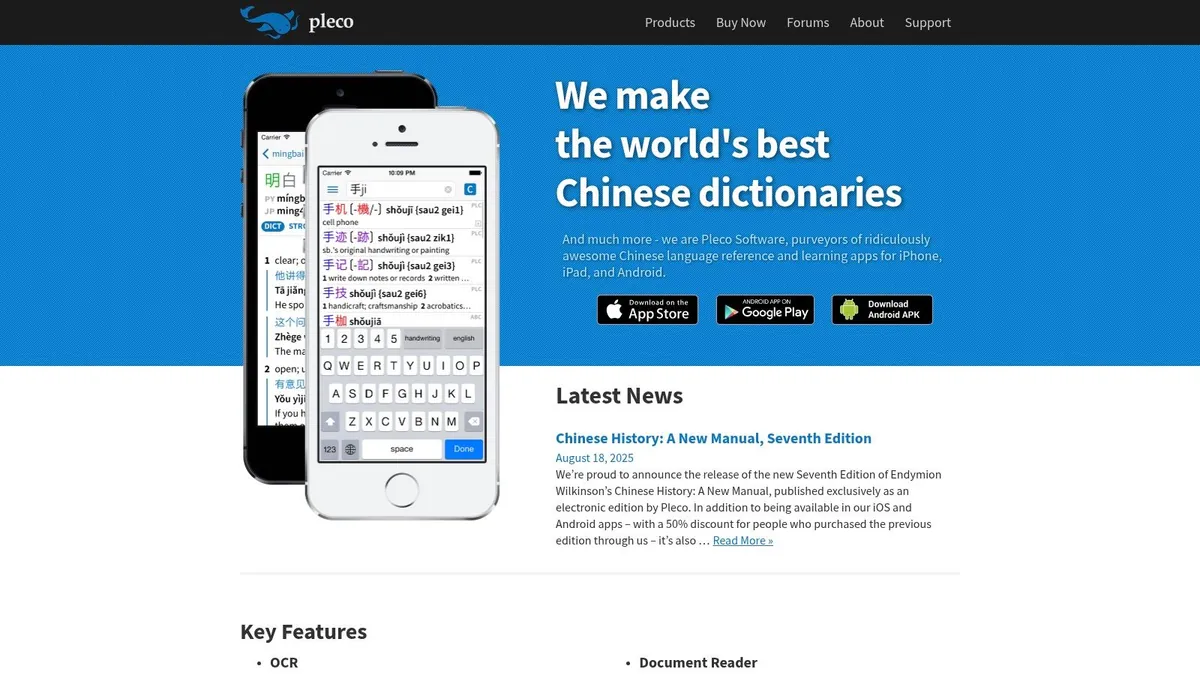
Handwriting input is included free, but much of the app's power comes from its modular, one-time purchase add-ons. These include an optical character recognition (OCR) tool that lets you look up characters with your phone's camera, a Document Reader, enhanced handwriting recognition, and an integrated flashcard system with SRS. While the sheer depth can feel advanced for absolute beginners, it quickly becomes an indispensable resource for looking up unknown words you meet in daily life or other study materials.
Best for: Serious learners at any level who need a powerful, offline reference tool and study companion.
- Key Features: High-quality dictionaries, OCR and handwriting recognition, powerful SRS flashcards.
- Pros: Exceptional reference depth and works offline, modular design means you only buy what you need.
- Cons: Feature depth can be intimidating for new learners, add-ons are separate purchases.
- Pricing: Free basic dictionary; individual add-ons from £4.99, or the Basic Bundle (£29.99) and Professional Bundle (£59.99), all one-time purchases on the UK App Store at the time of writing.
- Website: https://www.pleco.com
6. Skritter (Chinese writing)
Skritter is a specialised tool with one primary goal: to teach you how to write Chinese characters correctly. It moves beyond simple flashcards by providing an interactive canvas where you actively practise the stroke order for each Hanzi. The app uses a sophisticated spaced repetition system (SRS) to schedule reviews, ensuring that characters you find difficult appear more frequently, which is a highly effective method for long-term retention.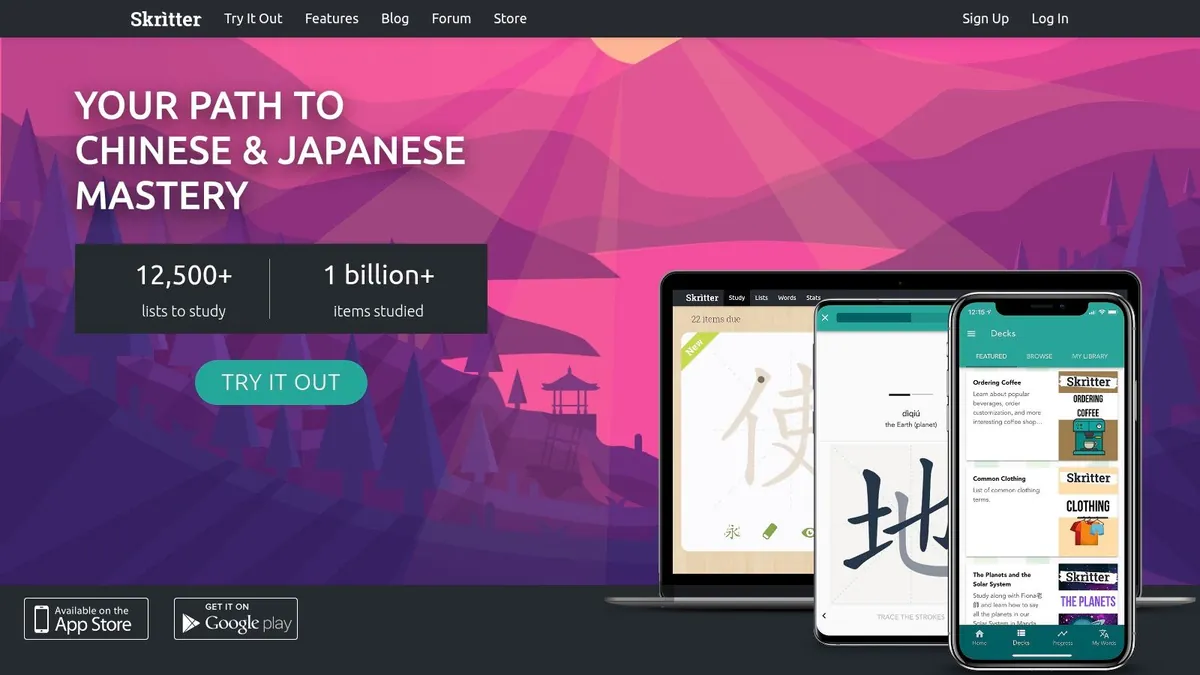
Its strength lies in its focused approach. It doesn't teach grammar or conversation, but for character writing it's hard to beat, which makes it a useful part of a well-rounded study plan. The platform offers curated vocabulary lists that align with HSK levels and popular textbooks, and also lets you create your own custom decks. For guidance on how to pace yourself, see our advice on how many Chinese characters to learn per day.
Skritter is best used as a powerful supplement to a core curriculum. It solidifies your understanding of character construction, which dramatically improves reading ability and recall.
Best for: Learners who want to master writing Chinese characters with correct stroke order and build long-term retention.
- Key Features: Interactive stroke-order animations, SRS-based reviews, large curated vocabulary lists, iOS/Android and web versions.
- Pros: Best-in-class for handwriting practice and retention, integrates well with HSK progression and custom decks.
- Cons: Subscription cost can add up, focuses solely on writing/retention and doesn't replace a full course.
- Pricing: Limited free access; subscriptions cost roughly £10-£15 a month on the UK App Store at the time of writing, less on six-month and yearly plans.
- Website: https://skritter.com
7. Busuu (Chinese)
Busuu brings a structured, community-powered approach to its Mandarin Chinese course, framing its lessons around the CEFR (Common European Framework of Reference for Languages) levels. This makes it a great choice for learners who appreciate a clear, steady progression from A1 to B2. The platform organises its content into logical, bite-sized lessons covering vocabulary, dialogues, and grammar, all presented in a clean, modern interface.
What sets Busuu apart is its integrated social feature. Learners can submit writing or speaking exercises and receive feedback and corrections from native Mandarin speakers within the community. This human interaction provides real-world context that automated systems often miss. Some lessons are free, but full access to the course needs a Premium subscription.
Busuu offers a well-rounded curriculum that feels more like a traditional course than a simple game, making it a solid next step for those who have outgrown introductory apps.
Best for: Beginners and intermediate learners who want a structured, CEFR-aligned course with human feedback.
- Key Features: CEFR-level courses, community feedback on exercises, expert-designed lessons.
- Pros: Strong community correction system, balanced and well-structured curriculum.
- Cons: Less China-specific cultural depth than specialised apps, key features require a premium subscription.
- Pricing: Free basic access; Premium and Premium Plus from roughly £6 a month on a yearly plan at the time of writing (monthly billing costs more).
- Website: https://www.busuu.com
8. Memrise (Chinese)
Memrise is a flashcard-based platform that excels at teaching vocabulary and phrases through spaced repetition and mnemonics. Its official Chinese courses stand out by using thousands of short video clips featuring native speakers, which helps you connect characters and pinyin to real-world pronunciation and intonation. This approach makes learning new words feel more dynamic and contextual compared to static audio clips.
Memrise used to be known for its user-made courses (HSK word lists, textbook vocabulary and so on), but since 2024 these have lived on a separate community-courses website rather than in the app. While its core strength is vocabulary acquisition, its official courses guide you through phrases in a structured manner. Memrise is a good tool for building your word bank, but it's not a standalone curriculum for grammar. If you're weighing up other flashcard systems, see our comparison of Quizlet vs Anki.
Best for: Beginners who want to rapidly build vocabulary with real-world video and audio context.
- Key Features: Video clips of native speakers, spaced repetition system (SRS), AI conversation practice.
- Pros: Engaging video-based learning, excellent for memorising vocabulary and phrases quickly, large library of courses.
- Cons: Limited grammar explanations, less effective for developing advanced conversational skills without other resources.
- Pricing: Free basic access; Pro subscription around £62 a year (much more if paid monthly) on the UK App Store at the time of writing, with frequent discounts.
- Website: https://www.memrise.com
9. LingoDeer (Chinese)
LingoDeer is often praised as the app many wish Duolingo was, especially for Mandarin Chinese. It provides a highly structured, curriculum-based approach that excels in teaching grammar explicitly. From the very beginning, LingoDeer integrates clear, concise grammar notes and examples into its lessons, ensuring you understand the why behind sentence construction, not just the what. This makes it an ideal choice for beginners who prefer a more academic, classroom-style learning path.
The platform organises its content into logical units that build upon each other, covering topics from basic greetings to more complex grammatical concepts. Unlike some competitors, it uses high-quality audio recordings from native speakers for all its vocabulary and sentences. While a portion of the initial content is free, most of the course requires a premium subscription. LingoDeer stands out for learners who need a solid grammatical foundation.
Best for: Beginners and intermediate learners who want a structured curriculum with clear grammar explanations.
- Key Features: Structured lessons with clear grammar explanations, Offline learning, High-quality native speaker audio.
- Pros: Strong foundation for grammar and structured practice, Useful travel phrasebook and test-out options.
- Cons: Much content sits behind the premium paywall, Lifetime deals and promotions have been inconsistent over time.
- Pricing: Limited free content; Premium from £14.99 a month or £99.99 a year on the UK App Store at the time of writing, with lifetime options.
- Website: https://www.lingodeer.com
10. FluentU (Chinese)
FluentU moves away from structured lessons and immerses you in authentic Mandarin video content. The platform's core concept is learning through real-world media, such as music videos, film trailers, news clips, and inspiring talks. This approach makes it a fantastic tool for improving listening comprehension and seeing how vocabulary is used naturally by native speakers, a crucial step for learners moving beyond basic textbook phrases.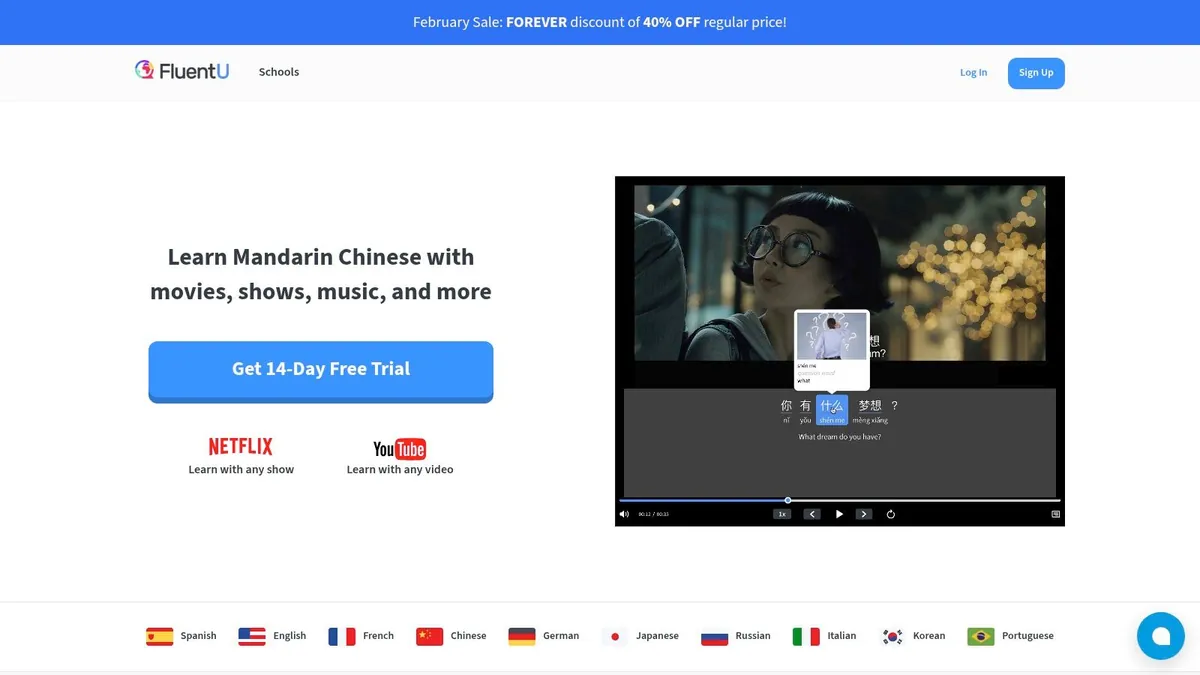
Each video comes with interactive subtitles in characters, pinyin, and English. You can tap on any word to see its definition, hear its pronunciation, and see example sentences. You can then add these words to a personalised flashcard deck powered by a Spaced Repetition System (SRS) for effective memorisation. It stands out for contextual vocabulary building.
Best for: Intermediate learners looking to improve listening skills and learn vocabulary from authentic contexts.
- Key Features: Interactive subtitles with tap-to-define functionality, themed video courses, custom SRS flashcards.
- Pros: Excellent for real-world listening practice, learn vocabulary in context, wide variety of engaging content.
- Cons: Subscription is pricier than some competitors, not a complete grammar or production course on its own.
- Pricing: 14-day free trial; plans from about US$12 a month billed yearly at the time of writing (prices vary with frequent promotions).
- Website: https://www.fluentu.com/chinese/
11. The Chairman's Bao (Graded news for Chinese learners)
The Chairman's Bao (TCB) offers a unique and powerful way to transition from textbook Mandarin to understanding real-world content. It functions as a news source specifically designed for learners, publishing new articles every day, graded from HSK1 to HSK6+. This approach allows you to build your reading and listening skills using current and engaging topics, making it an excellent resource once you have a basic vocabulary foundation.
Each article includes high-quality audio recordings, interactive vocabulary lists with one-tap dictionary lookups, and clear grammar explanations. This integrated system provides crucial context, helping you understand how words and structures are used naturally. TCB is a standout tool for bridging the gap to authentic materials, and a good fit for intermediate students who want to improve their comprehension with relevant, interesting content. For why graded reading like this works, see our guide to comprehensible input for Chinese.
Best for: Upper-beginners and intermediate learners (HSK2+) looking to improve reading and listening with real-world content.
- Key Features: Graded news articles (HSK1-6+), full audio for every article, interactive vocabulary lists, grammar points, writing and speaking exercises.
- Pros: Excellent for building contextual vocabulary, aligns directly with HSK levels, constantly updated with new content.
- Cons: Not ideal for absolute beginners, requires a subscription for full access as free content is limited.
- Pricing: Free sample lessons; paid plans from roughly £10 a month, cheaper on longer plans, at the time of writing.
- Website: https://www.thechairmansbao.com
12. SuperChinese
SuperChinese brings a modern, AI-powered approach to the structured curriculum model, making it a strong contender for motivated beginners. It offers a clear, HSK-aligned learning path that guides you from the absolute basics up to an intermediate level, claiming coverage to HSK5. Its standout feature is the AI-driven feedback on pronunciation and even sentence construction, which provides immediate, personalised corrections that are often missing in other self-study apps.
The platform is designed around short, manageable lessons that fit easily into a daily routine. This bite-sized format, combined with a sleek user interface, makes the learning process feel less daunting and more engaging. SuperChinese effectively gamifies learning without sacrificing its educational core, organising content into a logical sequence that builds upon previous knowledge, covering vocabulary, grammar, and even cultural insights. Read our full SuperChinese review for prices and common complaints.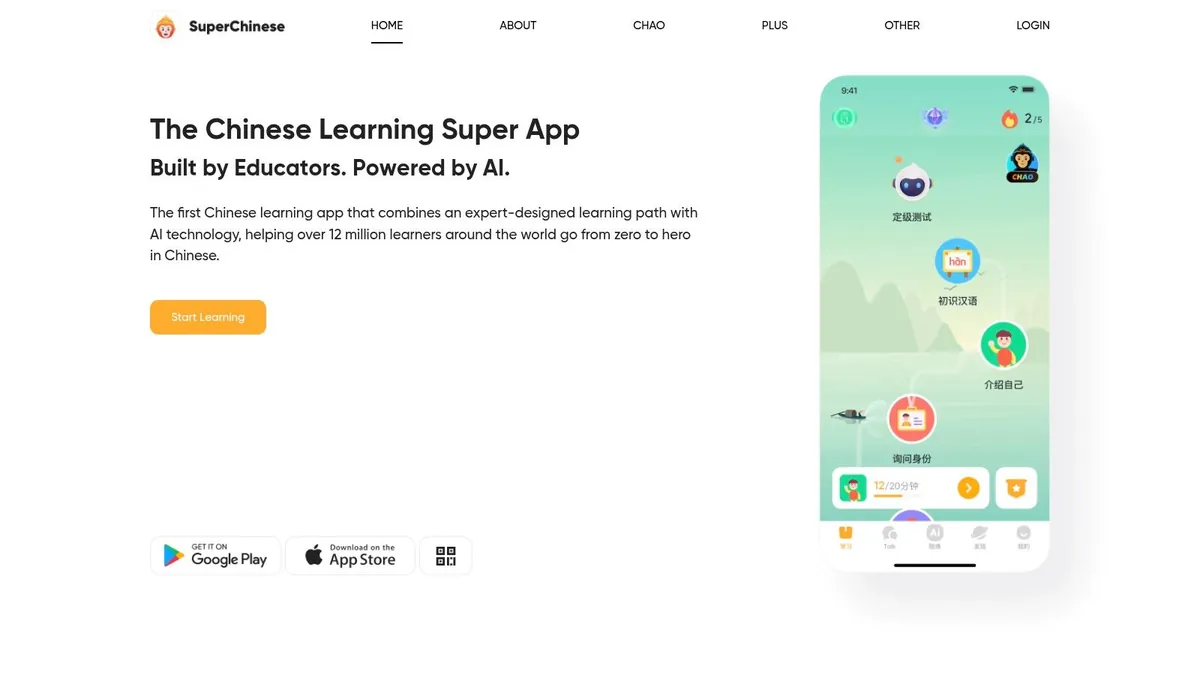
While the AI tutor is a powerful tool for practice, learners may find they still need a dedicated dictionary app for more nuanced or advanced vocabulary searches. The app’s structure is ideal for those who thrive with a clear syllabus but want the flexibility of mobile learning. It successfully bridges the gap between gamified starter apps and more intensive, academic resources. If you are deciding between an AI tutor and more structured speaking drills, our guide to AI chat apps vs chunk practice for speaking Chinese compares the two.
Best for: Beginners and lower-intermediate learners who want a structured, HSK-focused curriculum with modern AI feedback.
- Key Features: AI-powered speech recognition and feedback, HSK-aligned curriculum, bite-sized lessons, integrated cultural content.
- Pros: Highly structured learning path, modern and intuitive user interface, instant pronunciation correction.
- Cons: Premium features are necessary for full curriculum access, pricing can differ based on region and subscription plan.
- Pricing: Limited free version; PLUS from £11.99 a month on the UK App Store at the time of writing, cheaper on yearly plans, with a separate, pricier subscription for the CHAO AI tutor.
- Website: https://www.superchinese.com
Top 12 Mandarin Apps Comparison
| App | Focus / Strength | Target audience | Key features | Price / Access | Unique selling point |
|---|---|---|---|---|---|
| Mandarin Mosaic | Sentence mining + SRS | Duolingo/HelloChinese grads, Anki users, self-directed learners | Level-calibrated sentences, one new word/sentence, HSK-levelled lessons, graded articles, one‑tap dictionary, lifelike audio, spaced repetition, cloud sync (paid plans) | 30-day free trial; then limited free plan or paid from £7.92/month (yearly) | Automated, minimalist sentence‑mining that teaches words in real usage |
| Chunking Chinese | Speaking fluency | Learners who understand more than they can say (HSK 1-5) | Reusable chunks, spoken English-to-Chinese prompts, per-character tone and sound scores, shadowing | 7-day free trial; then $30/month (waiting list) | Makes you say whole sentences out loud and marks every character's tone |
| Duolingo (Mandarin) | Gamified basic course | Absolute beginners, habit builders | Bite-size lessons, streaks, XP, SRS elements | Free core; Super Duolingo subscription removes ads/limits | Very low barrier to start and strong gamification |
| HelloChinese | All‑round Mandarin skills | Beginners → lower‑intermediate | Pinyin/tones, speech recognition, handwriting, HSK paths | Freemium; premium subscription | Purpose‑built Mandarin with handwriting & voice feedback |
| Pleco | Reference toolkit & study addons | Serious learners & reference users | High‑quality dictionaries, OCR, handwriting, SRS flashcards | Free core; paid add‑ons/modules | Deep offline reference + modular professional tools |
| Skritter | Hanzi writing & retention | Learners focused on writing/characters | Stroke‑order practice, handwriting input, SRS, curated lists | Limited free access; subscription for full use | Best‑in-class stroke‑order training & retention for Hanzi |
| Busuu (Chinese) | Structured course + community | Beginners wanting corrections & routine | CEFR-style lessons, community feedback, placement tests | Freemium; premium for full access | Community corrections and balanced curriculum |
| Memrise (Chinese) | Video & phrase SRS | Beginners wanting phrases & listening | Native speaker clips, SRS reviews, AI practice | Freemium; subscription for full features | Real‑world video clips for natural phrase learning |
| LingoDeer (Chinese) | Curriculum & grammar clarity | Beginners who want explicit instruction | Clear grammar notes, structured units, offline (premium) | Freemium; premium subscription | Strong grammar explanations and structured progression |
| FluentU (Chinese) | Video‑based comprehension | Learners focused on listening & vocab in context | Interactive subtitles, tap‑to‑define, SRS flashcards | Subscription required (generally pricier) | Authentic video clips with interactive learning tools |
| The Chairman's Bao | Graded news & reading | Intermediate+ readers moving to authentic text | HSK‑mapped articles, audio, vocab lists, quizzes | Limited free; subscription for full access | Constantly updated graded news mapped to HSK levels |
| SuperChinese | AI‑assisted curriculum | Beginners → intermediate wanting AI feedback | Levelled curriculum (to about HSK 5), AI pronunciation/sentence feedback | Freemium/paid plans; pricing varies by region | Modern UI with AI tutor for instant feedback |
Final Thoughts

The "best" app is not a one-size-fits-all choice; it's the tool, or combination of tools, that fits your learning style, current level, and goals in Chinese.
The key takeaway is the importance of moving beyond gamified introductions towards methods that build deep, contextual understanding. While apps like Duolingo and HelloChinese offer excellent, structured entry points for absolute beginners, learners often hit an "intermediate plateau". This is where specialised tools become crucial for making meaningful progress. The most effective long-term strategies centre on engaging with authentic, comprehensible input.
Choosing Your Path Forward
To select your ideal toolkit, reflect on your primary bottleneck.
- For vocabulary and character acquisition: An SRS-focused app like Mandarin Mosaic or the flashcard features in Pleco and Skritter will provide the structured repetition necessary for long-term retention.
- For listening and comprehension: Immersive apps like FluentU or graded readers such as The Chairman's Bao help tune your ear to the rhythms and patterns of natural Chinese.
- For speaking and tones: HelloChinese and SuperChinese include speech recognition, but if speaking is your main goal, Chunking Chinese (number 2 above) is built specifically for it.
- For foundational grammar and structure: A curriculum-driven app like LingoDeer or SuperChinese provides the explicit instruction needed to build a solid grammatical framework.
Implementing Your Tools for Success
No single app can do all the work for you. Most successful learners combine a few resources. You might start with a foundational app, then add a dictionary like Pleco, a character-writing tool like Skritter if handwriting matters to you, and a sentence-mining app like Mandarin Mosaic. Consistency matters more than intensity: 15-20 minutes of focused practice every day beats an occasional long session.
If you're ready to move beyond isolated vocabulary drills and learn words in real, contextual sentences, try Mandarin Mosaic's sentence-mining approach to help you break through the intermediate plateau. The 30-day free trial is a good way to see whether it suits you: start at Mandarin Mosaic.