 Mandarin Mosaic
Free on iPhone, iPad and Android.
Download on theApp Store Get it onGoogle PlayYour first month of Premium is free.
10 Best Anki Alternatives for Learning Chinese in 2026

You've done everything right. You installed Anki, hunted down decks, tweaked card types, and promised yourself you'd finally stick to daily reviews. Then the friction started. Adding Chinese cards took too many taps, isolated words didn't transfer well to real sentences, and every improvement seemed to require more setup rather than more learning (here's why Anki is hard for Chinese).
That problem is especially common in Mandarin. Chinese isn't just a vocabulary problem. You need characters, tones, sentence patterns, and enough context to tell similar-looking or similar-sounding words apart. That's why so many learners discover the same thing: generic flashcards often aren't enough.
The best response isn't to abandon spaced repetition. It's to use it in a Chinese-specific workflow. If you want a broader primer on the method itself, our guide to what spaced repetition is and how it works is a good starting point. But if you're looking for an Anki alternative for Chinese, the better options aren't the ones with the most knobs and settings. They're the ones that reduce setup, add context, and keep you moving.
1. Mandarin Mosaic
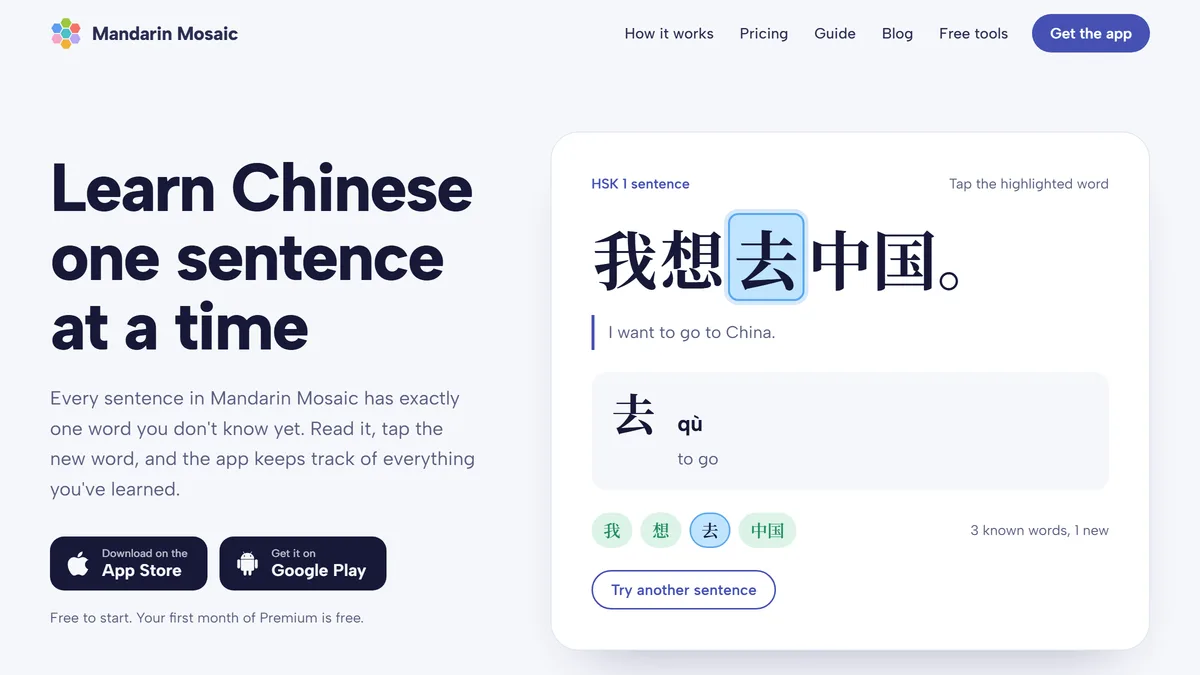
Mandarin Mosaic fixes the part of Anki that frustrates most Chinese learners. It doesn't ask you to build a system first and study second. It gives you level-calibrated sentences, shows only one new word at a time, and lets you learn vocabulary where it naturally occurs: inside usable Mandarin.
Why it works better for Chinese
Instead of reviewing disconnected cards, you see a sentence you can effectively process. Unknown words are highlighted in blue, and you can toggle them with a tap. One-tap dictionary lookup and lifelike audio mean you don't keep breaking focus to open other apps.
The most effective part is the constraint. One new word per sentence sounds simple, but it's the difference between learning and drowning. You get context without overload, and your brain gets repeated exposure to grammar patterns without having to study abstract rules first.
Practical rule: If Anki makes you spend more time formatting Chinese than reading Chinese, you've outgrown it.
A lot of learners say they want “sentence mining”, but what they really want is automated sentence selection that doesn't turn into admin. Mandarin Mosaic gets close to that ideal. Curated sentence packs guide beginners and intermediate learners, while custom packs give advanced learners room to target their own reading, work, or heritage-language goals.
Best fit and trade-offs
Mandarin Mosaic is the strongest choice if your main bottleneck is moving from isolated recognition to natural understanding. That's why it's the first app I'd point frustrated Anki users to, especially if they're stuck somewhere between basic app courses and real reading.
For a detailed side-by-side look, the Mandarin Mosaic vs Anki comparison breaks down the workflow differences clearly.
Pros and cons are straightforward:
Best for contextual acquisition: The one-new-word design reduces overwhelm and builds grammar feel through exposure.
Best for clean daily study: Dictionary lookup, audio, SRS, and cloud sync are all in one flow.
Best for sustainable sentence mining: Curated packs save time, and custom packs let you keep progressing.
Less suited to speaking-only goals: It helps vocabulary and grammar in context, but it isn't a full speaking course.
Free trial, then free or paid: New users get a 30-day free trial. After that there's a limited free plan (1 lesson a day, 10 focus words, no sync), or paid plans from £7.92 a month billed yearly (£11.95 monthly) at the time of writing.
2. Pleco
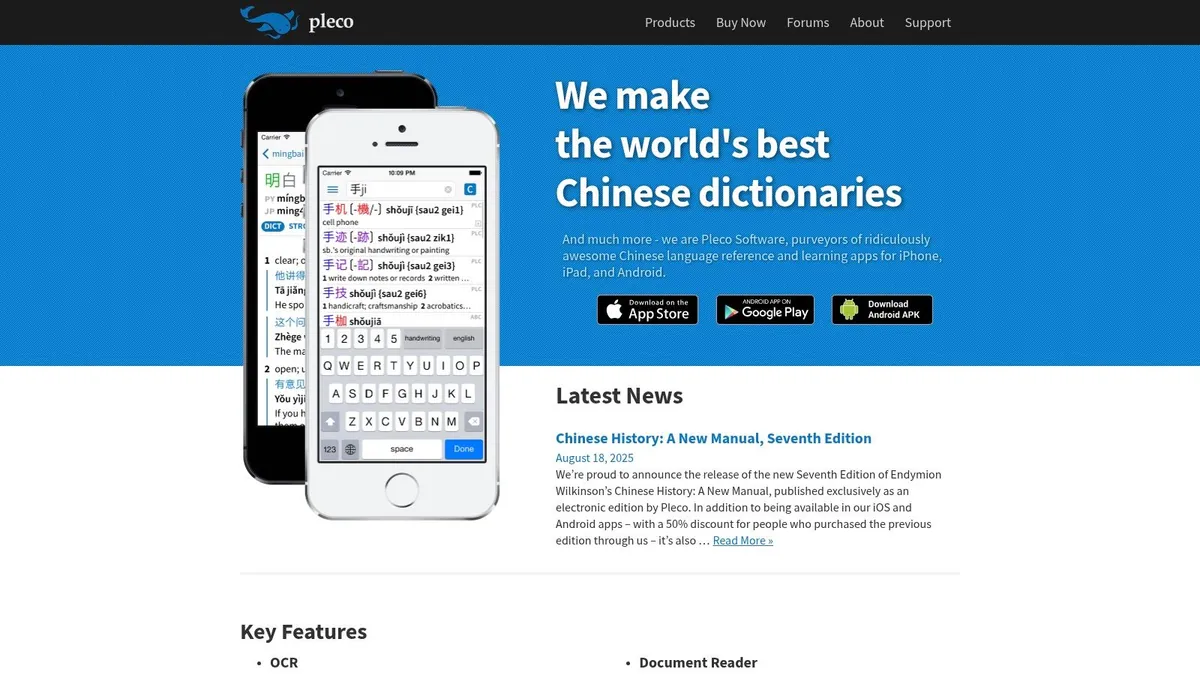
You look up one word. Then another. Then a sentence from a screenshot. Then a menu item you scanned on your phone. That is where Pleco earns its place.
Pleco is less a replacement for Anki than a Chinese study hub with flashcards built in. For Mandarin, that matters. Chinese learners run into problems Anki does not solve well on its own: messy segmentation, unreliable audio, weak dictionary context, and too much friction between lookup and review. Pleco handles those jobs in one place.
Where Pleco works best
Pleco is strongest for learners who already read a little and want to capture useful vocabulary while they work through real material. Its dictionary is the centre of the experience. You can check pronunciation, meanings, measure words, example sentences, and character details, then save what matters without jumping between apps.
That workflow is especially useful for Chinese-specific study:
- Reading and lookup stay connected: You can go from unknown word to saved card in a few taps.
- OCR and document tools save time: Screenshots, signs, PDFs, and copied text become study material quickly.
- Entry quality is usually better than random shared decks: Definitions, pinyin, and character data are more reliable from the start.
For learners who like to build their own decks from native content, Pleco can be a very good fit. If your study style is "read first, save later," it often makes more sense than forcing everything through Anki.
The trade-off
Pleco rewards learners who like control. It also asks for more setup.
The flashcard system is powerful, but it still feels like a toolkit. Categories, scoring, profiles, and add-ons give you a lot of options, and beginners can burn time configuring a system instead of learning Chinese. Pleco attracts serious learners, but serious learners also overbuild.
That is the key decision point. Choose Pleco if you want a dictionary-first workflow and do not mind shaping your own process. Choose Mandarin Mosaic if your main goal is efficient sentence mining with less admin and clearer structure around what to study next.
Our guide to the best flashcard apps is worth reading if you want to build a more reliable review habit around tools like Pleco.
3. Skritter
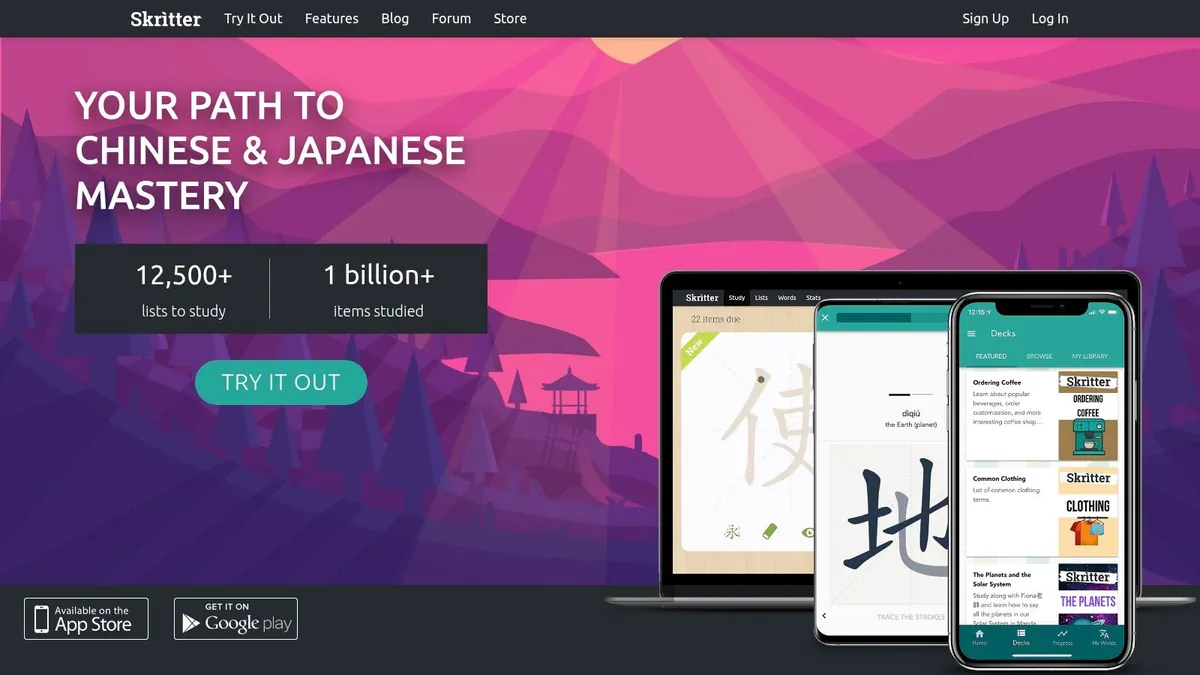
You finish a chapter, recognise every character on the page, then freeze when asked to write even half of them by hand. That is the gap Skritter is built for.
Skritter focuses on character production. You write, recall, and correct stroke order in real time, which makes it a very different tool from a standard flashcard app. If Anki left you with passive recognition but weak handwriting, Skritter addresses the problem directly.
That focus matters because handwriting is its own skill. Recognising 识 in a sentence is one thing. Writing it from memory, with the right components in the right order, is another. Skritter slows the process down enough for the character to stick.
Who should use it
Skritter makes the most sense for a specific type of learner:
- Students in formal courses: It pairs well with textbook vocabulary, class quizzes, and HSK study.
- Learners who need handwriting, not just recognition: Useful for exams, tutoring, note-taking, or personal goals around writing by hand.
- Learners who confuse similar characters: Writing exposes weak spots faster than tapping through cards.
I recommend it most when handwriting is a real requirement, not a vague “maybe I should practise writing too.” That distinction saves time.
The trade-off
Skritter is character-first. It does much less for sentence comprehension, listening flow, or learning how words behave in natural context. That makes it strong as a specialist tool, but limited as a full Mandarin system.
This is the decision point. Choose Skritter if your bottleneck is producing characters accurately. Choose Mandarin Mosaic if your bottleneck is turning words you meet in the wild into useful sentence cards with less manual work. Choose Du Chinese if you need more guided reading input.
Used well, Skritter fills a gap that many Chinese learners ignore until it becomes obvious. Just do not expect handwriting practice alone to build reading range or grammar intuition.
4. Hack Chinese
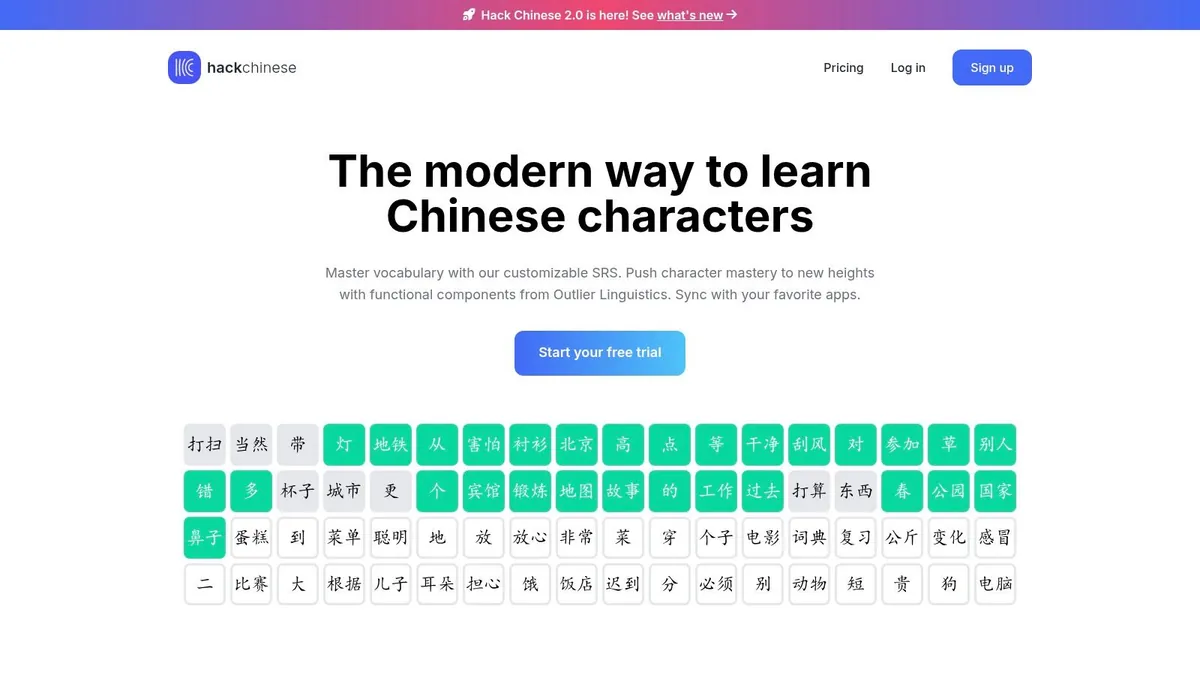
You finish a review session, clear a pile of words, and feel productive. Then you open a graded reader or podcast transcript and still cannot follow the sentence flow. That is the central trade-off with Hack Chinese.
Hack Chinese is built for efficient vocabulary review. It keeps the interface clean, the daily task obvious, and the feedback loop tight. For learners who bounced off Anki because deck maintenance kept getting in the way, that simplicity can be a real advantage.
Why people keep using it
Hack Chinese reduces friction. Open the app, review what is due, add a list if needed, and stop. There is very little fiddling, which matters more than many learners admit. A tool you use every day will beat a more flexible system that keeps collapsing under setup work.
The progress tracking is also useful in a practical way. You can spot weak words quickly, notice whether your review load is creeping up, and make adjustments before the queue gets out of hand.
I usually recommend Hack Chinese to learners who fit one of these patterns:
- They want a cleaner replacement for a messy Anki setup.
- They are working through HSK or textbook vocabulary and want stable review.
- They need a habit-friendly app that makes daily consistency easier.
Where the ceiling shows up
Hack Chinese works best when your main job is remembering words. Mandarin usually gets harder one stage later. The bottleneck becomes combining vocabulary with grammar, word order, collocations, and context.
That is why I do not treat it as the strongest long-term choice for every learner. If your study style is list-based and you want efficient review with minimal setup, Hack Chinese fits well. If your goal is to mine useful sentences from real content and remember how words behave in actual Mandarin, Mandarin Mosaic is usually the better fit.
That distinction matters. A learner who needs tighter review discipline should choose Hack Chinese. A learner who keeps thinking, “I know these words, so why can't I read or say this sentence?” will usually get more from a sentence-first workflow.
5. Ninchanese
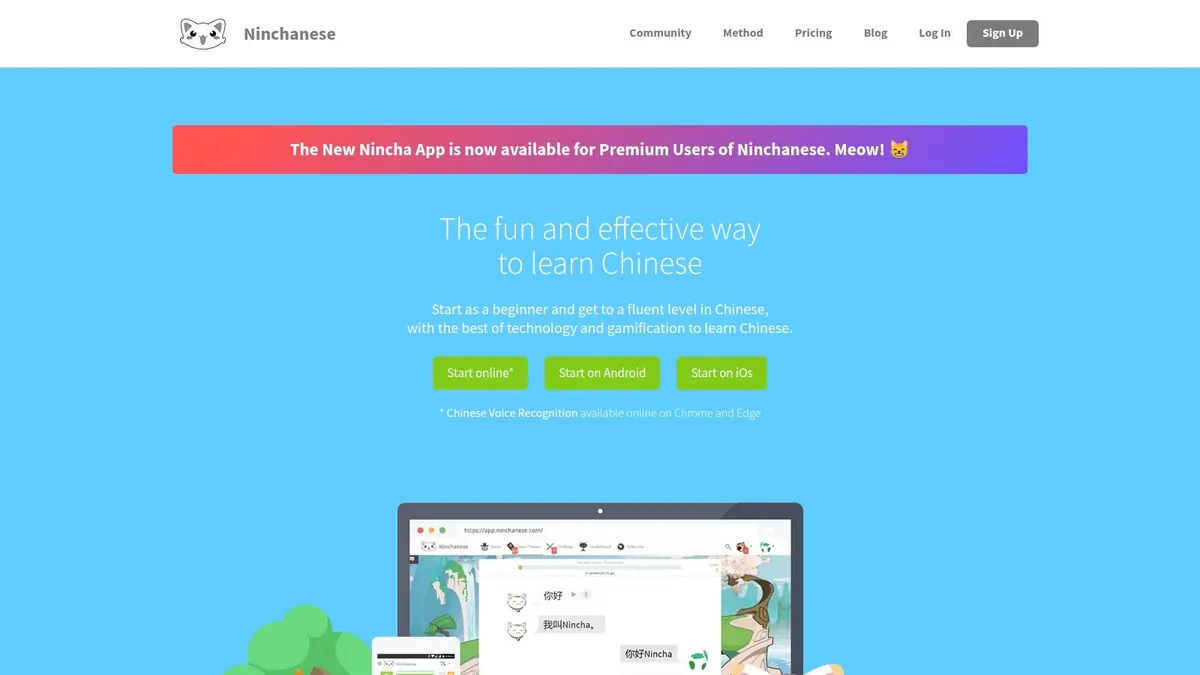
Ninchanese is for learners who don't want an SRS app in isolation. They want a guided Mandarin course with review built in. If Anki feels too mechanical and too dependent on self-management, Ninchanese offers structure, progression, and a more game-like environment.
The advantage is obvious. You don't need to decide what to study next. Lessons, grammar, sentence-building, listening, and review are already organised. For a beginner, that can be much more important than customisability.
Where it shines
Ninchanese handles the “what now?” problem well. It gives you a path, not just a review queue. That's useful for learners coming out of Duolingo or HelloChinese who want something broader than flashcards but still want repetition and level-based progression.
Its voice and tone practice also make it more rounded than a pure card app. That matters in Mandarin because pronunciation errors can fossilise early if all you do is silent review.
Where it isn't ideal
The main downside isn't quality. It's style. If you like minimalist tools, the gamified design may feel busy. If you're leaving Anki because you want cleaner sentence mining, Mandarin Mosaic feels more efficient.
Ninchanese is a better course app than a mining app. That's a strength if you need a course. It's a weakness if your real need is context-rich review with less fluff.
6. Du Chinese
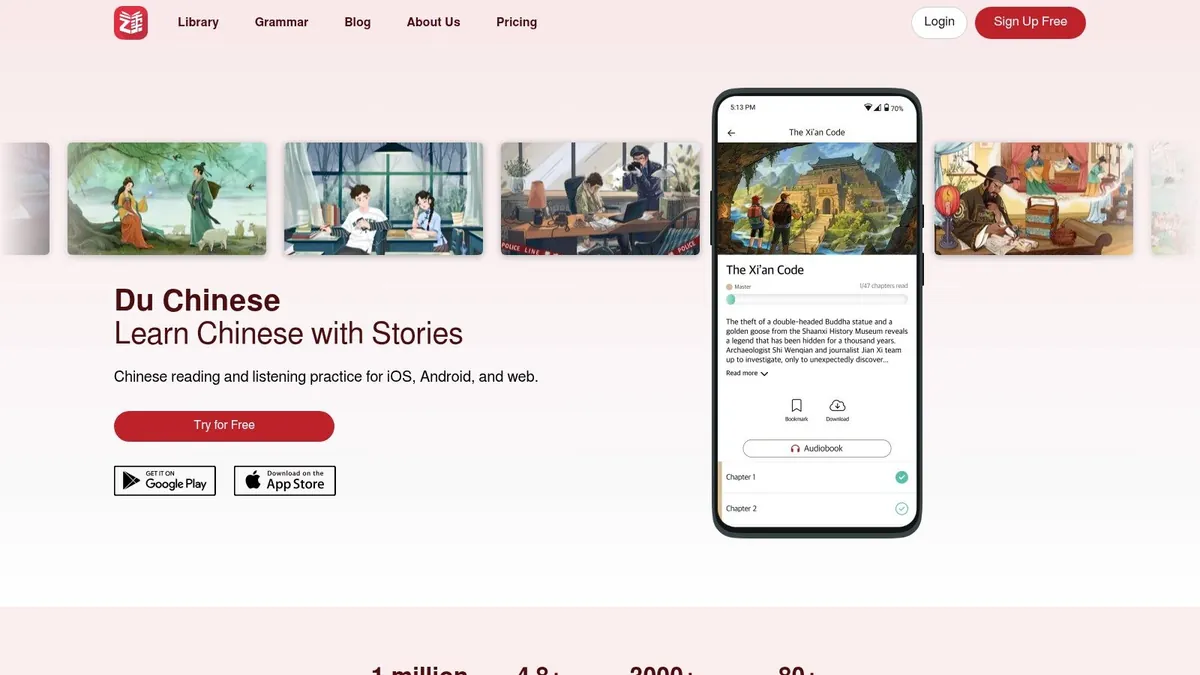
Du Chinese is the reading habit app on this list. If your current study still lives mostly inside flashcards, this is one of the fastest ways to bring actual Mandarin back into your routine.
It works because graded reading solves a problem flashcards can't. Cards help you remember. Stories help you process. Human-narrated audio, tap-to-define words, and levelled lessons make it easy to stay in the language longer.
Best use case
Use Du Chinese when your Chinese feels brittle. You know words on review screens, then miss them in actual text. That's usually a sign you need more comprehensible reading and listening, not more isolated prompts.
The app's built-in review features are helpful, but I wouldn't choose it as my sole SRS platform. I’d choose it as the tool that turns vocabulary into recognition speed and sentence familiarity.
- Best for reading fluency: Graded lessons lower the barrier to daily reading.
- Best for listening support: Natural audio helps connect characters to sound.
- Best as a complement: It pairs especially well with a sentence-mining tool.
Main limitation
Du Chinese is stronger on input than on explanation. It gives you context, but not always a strong grammar framework. If you want a primary review app that deliberately controls sentence difficulty and introduces only one new word at a time, Mandarin Mosaic is more targeted. If you want lots of levelled content to read and hear, Du Chinese is excellent.
7. Clozemaster

Clozemaster is what I’d call a volume tool. It gives you lots of sentence reps quickly, usually through cloze deletion, and it's good at creating momentum once you've moved beyond the very beginning.
That sounds close to sentence mining, but the experience is different. Clozemaster is broad and repetitive by design. Mandarin Mosaic is more curated and level-sensitive.
When Clozemaster makes sense
Clozemaster is useful when you already have a base and want lots of extra reps on common sentence patterns. It can be good for dead time: commutes, waiting rooms, ten-minute sessions when you want exposure without planning.
The Clozemaster vs Anki comparison is helpful if you're deciding between brute-force sentence drilling and a more personalised workflow.
More sentences isn't always better. Better-calibrated sentences usually are.
Why it can frustrate Chinese learners
Chinese learners often need more support than a fill-in-the-blank prompt gives them. If the sentence is just a bit too hard, the review turns into guessing. If it's too easy, you don't gain much. Clozemaster works best as a supplement, not as the centre of your Mandarin system.
For learners who want context with more careful pacing, Mandarin Mosaic usually feels more deliberate. It teaches through sentences, but doesn't ask you to brute-force your way through a giant pool of them.
8. Glossika

Glossika is the speaking-pattern machine. It gives you audio-rich sentence drills designed to build automaticity, especially for listening and repeating. If your Anki routine improved recognition but didn't make Mandarin come out of your mouth any faster, Glossika addresses that gap.
I don't recommend it for everyone. But I do recommend it for learners who already read a bit, know basic grammar, and need more spoken sentence familiarity.
What it does well
Glossika's strength is rhythm. You hear lots of natural Mandarin sentence patterns, repeat them, and gradually internalise chunks. That's valuable because Chinese fluency isn't only vocabulary recall. It's also pattern recall under time pressure.
Offline mode and mobile apps make it practical for routine use. It pairs especially well with reading-heavy tools because it adds sound, pace, and production pressure.
What to watch out for
Glossika can feel expensive relative to narrower tools, and it doesn't give much explicit explanation. If you need to understand why a structure works, another app may need to carry that load.
I see it as a specialist layer. Add it when speaking flow is the bottleneck. Don't choose it as your only Anki replacement if you're still trying to build your core vocabulary and sentence understanding.
9. Memrise

Memrise is the low-friction option for learners who want to start immediately. Official courses, your own word lists, short exercises, and native-speaker clips make it easy to fit Chinese into spare moments without much setup.
That ease is also the reason many Anki users move to it temporarily. They want less maintenance and faster onboarding. For daily vocabulary top-ups, Memrise does that well.
Where it helps
Memrise is good for:
- Quick daily reps: Open app, do a short session, move on.
- Pronunciation support: Native-speaker video clips add useful real-world sound.
- Supplementary review: It works best when another tool provides your main structure.
Where it falls short
Memrise has changed over time, and community content quality can be uneven. That's the recurring issue with easy-start platforms. Convenience comes first, consistency second.
For Chinese, that matters because sloppy example selection and inconsistent deck quality create hidden friction later. If you just want lightweight review, Memrise is fine. If you want a system that carries you through the intermediate plateau with sentence control and grammar feel, Mandarin Mosaic is much better aligned.
10. ChineseSkill
ChineseSkill is one of the better beginner-friendly replacements for Anki if flashcards aren't your primary mode. It teaches through structured lessons, game-style exercises, dialogues, and built-in review, so you can make progress without building your own deck ecosystem.
For absolute beginners, that's often the right trade. Too much flexibility too early becomes procrastination disguised as productivity.
Why beginners like it
ChineseSkill keeps the entry barrier low. It supports simplified and traditional characters, includes speech and writing practice, and gives clear progression. That makes it a sensible first app if you're still getting comfortable with pinyin, basic characters, and beginner sentence patterns.
It also works offline, which helps if your study happens in short bursts away from a desk.
Why advanced learners move on
The very thing that makes ChineseSkill approachable also limits it later. Once you want serious sentence mining, targeted vocabulary work, or more nuanced context, it starts to feel closed. You follow its path rather than shaping your own.
That's why I see it as a beginner launchpad, not a long-term replacement for a stronger Chinese-specific SRS workflow.
Anki Alternatives for Chinese, Top 10 Comparison
A good Chinese study app earns its place by fitting your actual workflow. If you spend more time organising cards than reading, listening, or reviewing useful sentences, the tool is getting in the way. The comparison below focuses on the trade-offs that matter for Mandarin, especially context, character handling, audio quality, and how much setup the app asks from you.
| Product | Core focus | Key features | Best for | UX / Ease of use | Price & access |
|---|---|---|---|---|---|
| Mandarin Mosaic | Sentence-mining SRS for contextual vocab and grammar | One new word per sentence; blue highlights; one-tap dictionary; natural-sounding audio; spaced repetition; cloud sync; curated and custom packs | Learners who want practical vocabulary in context and an efficient sentence-mining workflow | Focused, low-friction study flow built around sentence review | 30-day free trial, then limited free plan or paid plans; iOS and Android |
| Pleco (Flashcards add-on) | Dictionary-first app with integrated flashcards | Strong SRS tools; one-tap card creation; OCR and document reader; high-quality audio | Users who need accurate lookups and fast card or sentence creation | Powerful, but beginners may need time to set it up well | Free core app; many paid add-ons (one-time purchases) |
| Skritter (Chinese) | Handwriting and character mastery with SRS | Active recall handwriting tests; stroke order recognition; HSK and custom lists | Learners focused on writing characters and stroke order | Practice-heavy and dependable for writing review | Trial available; subscription required for full access |
| Hack Chinese | Retention-focused SRS for vocabulary drills | HSK word lists; progress analytics; short daily sessions; web and mobile | Learners who want efficient, low-setup vocabulary retention | Simple, web-first design that makes daily reviews easy | Subscription plans vary by billing and region |
| Ninchanese | Gamified full course with integrated SRS | HSK1-6 curriculum; adaptive SRS; voice recognition; themed worlds | Beginners who want guided, multi-skill learning in a game format | Engaging and guided, though less focused than specialist tools | Generous free tier; affordable paid plans |
| Du Chinese | Graded readers for reading and listening with SRS | Large lesson library; tap-to-define; pinyin toggle; natural audio; in-app SRS | Learners building reading and listening comprehension | Clean reading experience with little friction | Freemium; premium subscription for full library |
| Clozemaster | High-volume sentence cloze practice | Large sentence bank; cloze tests; listening and typing modes; SRS-style practice | Intermediate and advanced learners seeking heavy contextual exposure | Fast to use, though less curated for Chinese-specific problems | Free core; Pro monthly and annual plans |
| Glossika (Mandarin) | Audio-rich sentence drills for fluency | Level-based sentence sets; native audio; offline mode; progress reports | Learners improving speaking fluency, prosody, and automaticity | Repetition-heavy and audio-first | 7-day trial; paid subscriptions (often seen as pricier) |
| Memrise (Chinese) | Bite-size SRS plus native video content | Official courses and your own word lists; native-speaker clips; spaced review | Quick daily vocabulary top-ups and supplementary practice | Very easy to start and mobile-friendly | Freemium; Pro features behind paid plans (pricing varies) |
| ChineseSkill | Beginner-friendly course with SRS and practice | Structured lessons; SRS vocabulary review; grammar notes; speech and writing games; offline | Absolute beginners who want clear progression and offline use | Game-style and intuitive for new learners | Free tier; subscription or lifetime purchase options |
Your Mandarin Learning Toolkit: Making the Right Choice

The biggest mistake learners make is trying to find one perfect app to do everything. Mandarin usually doesn't reward that approach. Different bottlenecks need different tools. Handwriting, reading stamina, sentence intuition, pronunciation, and raw vocabulary retention aren't the same problem.
If handwriting matters, Skritter is the specialist pick. If you want daily graded reading, Du Chinese is the easiest habit-builder here. If you want the best reference tool on your phone, Pleco still earns its place because dictionary lookup, OCR, and flashcards are so useful in Chinese.
For most frustrated Anki users, the decision point sits elsewhere. They don't need more settings. They need a workflow that helps words stick inside real Mandarin. That's why contextual sentence study matters so much.
A simple way to choose
Ask yourself which sentence feels most true right now:
- I know words, but I don't recognise them naturally in sentences. Choose Mandarin Mosaic.
- I need to read more real Chinese every day. Choose Du Chinese.
- I need to write characters, not just recognise them. Choose Skritter.
- I need one strong Chinese reference tool for everything else. Choose Pleco.
- I want a guided beginner course, not a review engine. Choose ChineseSkill or Ninchanese.
- I understand sentences but freeze when I have to say them. Try Chunking Chinese, our sister speaking app: you get an English prompt, say the whole sentence in Mandarin, and it gives you per-character feedback on your tones and pronunciation.
If you're stuck between tools, I'd keep it simple. Start with one primary app and one support app. For many learners, the strongest pair is Mandarin Mosaic plus Pleco. Mandarin Mosaic handles contextual acquisition and efficient sentence review. Pleco handles lookups, reference, and ad hoc mining from the wild.
The best app is the one that removes friction from tomorrow's study session, not the one with the longest feature list.
For efficient, context-based vocabulary and grammar, Mandarin Mosaic is the best answer on this list. Its one-new-word-per-sentence approach is unusually well matched to how Mandarin learners progress. You don't just memorise. You learn to notice patterns, infer grammar, and build usable understanding without fighting your tool.
If Anki still works for you, keep using it. But if you're tired of spending your study time managing decks instead of learning Chinese, leaving Anki behind isn't giving up. It's upgrading to a workflow that respects your time.
If you're ready to stop building decks and start learning from real, level-appropriate Mandarin, try Mandarin Mosaic. It gives you sentence-based SRS, one-tap dictionary lookup, natural audio, and a cleaner path from beginner review to genuine comprehension.